Floating Shelves Height From the Floor: A Practical Guide
As an Amazon Associate we earn from qualifying purchases.
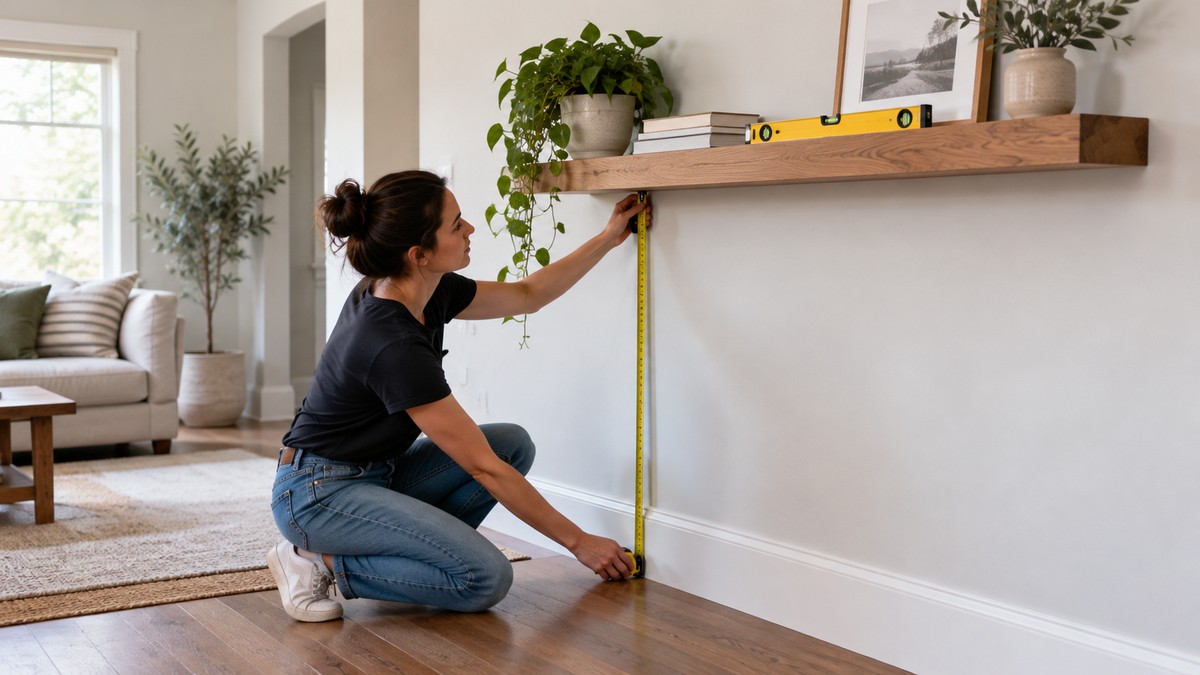
Floating shelves height from floor has no single correct value in the sources we opened, so the right number starts with who will reach the shelf and what will sit on it. Two accessibility references give the most concrete numbers: a reach band of 15 to 48 inches above the floor, and a cane-detection limit of 27 inches for objects that project into a walkway. A seating guide from IKEA gives heights for a related piece of furniture. Treat all three as reference points, not as targets for every wall.
Quick answer
- No source we opened sets a height for floating shelves in a home. Choose the height from the people who will reach the shelf and the items on it.
- The Access Board’s reach band runs from 15 inches to 48 inches above the floor, but it applies to operable parts such as controls, not to shelves.
- A projecting shelf whose leading edge is 27 inches high or lower is within cane detection. Edges between 27 inches and 80 inches are where the guide flags possible hazards in walkways.
- IKEA’s TV bench guide gives 50 cm, about 19.7 inches, for a viewer on a dining chair. That is a bench height, not a shelf height.
Who will reach the shelf
The first question is reach. The Access Board’s guide to operable parts says: “The range for unobstructed reaches (15″ to 48″) applies only to those portions of elements that are operable.” Operable parts are things a person works, such as switches, handles and controls. A floating shelf holds objects but does not work like a control, so the 15-to-48-inch band is a reference for reach, not a rule for where a shelf goes.
The same guide adds a point that matters for shelves meant for children. It says: “The standards include advisory (non-mandatory) reach ranges based on children’s dimensions that can be followed when operable parts are designed for use by children.” The advisory ranges are described for operable parts. The sources we opened do not give a child’s shelf height, so for a child’s room, measure the child’s reach and set the lowest useful shelf from that.
Calculate the reach band
The band has two edges, so its width is simple arithmetic. Use the numbers from the guide, not a guess:
| Calculation | Working | Result |
|---|---|---|
| Width of the unobstructed forward reach band | 48 − 15 | 33 inches |
| Same band in feet | 33 ÷ 12 | 2.75 feet, or 2 feet 9 inches |
| Midpoint of the band | (15 + 48) ÷ 2 | 31.5 inches above the floor |
A shelf you want a person to reach easily can sit inside this band, with the midpoint of its contents near 31.5 inches for an adult standing in front of it. That midpoint is only arithmetic from the band. It is not a stated target for shelves, and it does not account for the height of the person or the size of the objects.
Walkways and cane detection
The height that matters most in a walkway is the height of the shelf’s leading edge, the part that sticks out. The Access Board’s guide to protruding objects says: “Those with leading edges that are within cane sweep (27″ high maximum) or that provide minimum headroom clearance (80″ minimum) do not pose hazards and can protrude any amount.” The guide is written for public and commercial buildings, so it is a reference for a home, not a home code, but the logic is clear.
Run the numbers for a shelf in a hallway. Use the three bands in this table:
| Leading edge height above floor (inches, example) | Band | What the Access Board guide says |
|---|---|---|
| 24 | At or below 27 | Within cane sweep, so it does not pose a hazard by that rule, and can protrude any amount |
| 36 | Above 27, below 80 | Between the cane band and headroom, so a projecting shelf here is the case the guide flags |
| 84 | 80 or above | Provides minimum headroom clearance, so it does not pose a hazard by that rule |
The 36-inch row is the one to plan around. A floating shelf whose lower edge sits at 36 inches and projects into a hallway lies in the band the guide flags. A shelf that stays flat against the wall, or whose edge sits at 24 inches or 84 inches, avoids that band. The example heights are assumed; the bands are the guide’s numbers.
Seated viewing and shelves near a TV
Many floating shelves go near a TV or a sofa. IKEA’s guide to choosing a TV bench does not give a shelf height, but its seating figures help you think about eye level. It says the recommended height for a TV bench is “50 cm when sitting on a dining chair or similar,” and gives 40 to 50 cm for a standard sofa and “30–40 cm when sitting on the floor or a low sofa.” Converting at 2.54 cm to the inch gives these ranges:
- 50 cm ÷ 2.54 = 19.7 inches for a dining chair.
- 40 to 50 cm ÷ 2.54 = 15.7 to 19.7 inches for a standard sofa.
- 30 to 40 cm ÷ 2.54 = 11.8 to 15.7 inches for a floor seat or low sofa.
The same guide advises: “Choose a TV bench that brings the centre of the TV to just under line of sight”. Read that as a placement principle for the TV, not a rule for a shelf. The guide says nothing about a shelf above a TV, so the only height it sets for that wall is the TV’s centre.
Headroom and the ceiling
Headroom sets the top of the height range. The Access Board’s protruding-objects page says: “Headroom clearance of at least 80″ high is required along all circulation paths”. For a shelf, the practical point is that a leading edge at 80 inches or above is outside the hazard band in that guide’s terms. The figure matters most for shelves that project into a hall or over a walkway, where a person’s head passes below the edge.
Pick a height for each use
Most floating shelves serve one of three uses, and each use takes a different reading of these sources. A display shelf is for looking at, so the reach band matters less than sight line. A storage shelf is for lifting things on and off, so the reach band matters more. A shelf beside a path is for passing, so the projection rule matters most. Sort each shelf into one of these uses before you choose its height:
- Display shelves above a sofa or TV: check the seated figures and the TV centre described above before you choose the shelf height.
- Storage shelves for everyday items: keep the items you lift most inside the 15-to-48-inch band the Access Board gives for operable parts.
- Shelves beside a walkway: keep the leading edge out of the 27-to-80-inch band, or keep the shelf flush to the wall so it does not project.
A worked check for a storage shelf uses the band’s 33-inch width. Suppose the shelf’s bottom edge sits at 30 inches, an assumed value. Items 10 inches tall reach 30 + 10 = 40 inches, which is inside the band. Items 20 inches tall reach 30 + 20 = 50 inches, which is above the band’s top at 48 inches. The reach band is the guide’s number; the shelf and item heights are assumptions for this example.
A shelf placed on the same wall as a TV bench is the case where the seated figures are most useful. The bench figures are the only heights in these sources that refer to a seated viewer, and they describe the bench, not the shelf. Use them as a starting point for thinking about eye level, then check the result against the reach band if people will also lift items from the shelf.
Shelves above a toilet and other fixed spots
Shelves above a toilet or a fixture are a common case in homes, and the walkway rule applies only when the shelf projects into a path. Published guides on this site cover the options for those spots: 3-tier shelves over the toilet, freestanding bathroom shelves over a toilet, and decorating ideas for shelves over a toilet. Check each option’s depth against the walkway rule before you pick the height.
Related shelf guides on this site
For the shelves themselves, several published guides cover other rooms and types. A small bathroom wall shelf suits a tight wall beside a sink. A small wall shelf for a living room and a corner wall shelf for a living room cover the display use. For kitchens, see shelf ideas for a small kitchen. Use these to pick the type of shelf, then use this guide to check its height.
If you want a decorative look for a living room wall, see decorative floating wall shelves for a living room. Its choices still need the same height check before you mount anything.
How we chose
We searched for height references for shelves and opened three pages on 2026-10-21: the Access Board’s operable-parts guide, its protruding-objects guide, and IKEA’s TV bench article. Most search results for shelf height were blog posts that gave different numbers for the same wall, so we left them out. Each quoted phrase was matched against the text of the opened page. The IKEA article is on the Japan site in English, and its heights are in centimeters. The conversions use 2.54 cm to the inch.
Mistakes to avoid
- Treating 48 inches as a shelf ceiling. The 48-inch figure is the top of the reach band for operable parts. The guide does not set a maximum for a home shelf.
- Ignoring the 27-to-80-inch band in a walkway. A shelf edge in that band that projects into a hallway is the case the protruding-objects guide flags.
- Using a seating figure as a shelf height. The IKEA numbers are for a TV bench, and they describe where the bench should put the TV for seated viewers.
- Rounding metric heights too early. 40 to 50 cm is 15.7 to 19.7 inches, and rounding each end to whole inches changes the range.
What we could not verify
- No source we opened sets a standard height for floating shelves in a home.
- The Access Board guides are written for public and commercial buildings. We did not find a residential standard in the pages we opened.
- No source we opened gives a shelf height for children, beyond the advisory reach ranges.
- Wall height, stud position and anchor type are not covered here. The spacing guide on this site covers the vertical gap between shelves, and the wall choice still depends on your own wall.
FAQ
What is the standard height for floating shelves?
No source we opened sets a standard height for floating shelves in a home. The Access Board reach band of 15 to 48 inches applies to operable parts such as controls, so choose the height from the people who will reach the shelf and the items on it.
Is 48 inches the highest a shelf can be?
No. Forty-eight inches is only the top of the reach band for operable parts, and the sources we opened do not set a top height for shelves in a home.
Should a floating shelf sit below 27 inches?
Not by rule. A leading edge at 27 inches or lower is within cane detection, and the Access Board guide says such objects do not pose a hazard. Edges above 27 inches and below 80 inches are the ones the guide flags in walkways.
What height does IKEA suggest for a TV bench?
IKEA suggests 50 cm, about 19.7 inches, for a viewer on a dining chair, 40 to 50 cm for a standard sofa, and 30 to 40 cm for a viewer on the floor or a low sofa. These are bench heights, not shelf heights.
Do shelves for children need a different height?
The Access Board guide gives advisory reach ranges based on children’s dimensions, but they are not mandatory. The sources we opened do not give a shelf height for children, so measure the child’s reach and set the lowest useful shelf from that.
Does a shelf need 80 inches of headroom?
The Access Board guide requires at least 80 inches of headroom along public circulation paths. That is a rule for public and commercial buildings, so in a home it is a reference point for projecting shelves rather than a requirement.
Bottom line
Keep any shelf that projects into a walkway out of the 27-to-80-inch band, and set every other shelf height by the reach of the people who will use it.
Sources
- U.S. Access Board, ADA Standards guide, Chapter 3: Operable Parts: https://www.access-board.gov/ada/guides/chapter-3-operable-parts/ (opened 2026-10-21)
- U.S. Access Board, ADA Standards guide, Chapter 3: Protruding Objects: https://www.access-board.gov/ada/guides/chapter-3-protruding-objects/ (opened 2026-10-21)
- IKEA, Choosing the perfect TV bench (English page on the Japan site): https://www.ikea.com/jp/en/campaigns/tlp-tv-bench-pub82b98bc0/ (opened 2026-10-21)
As an Amazon Associate we earn from qualifying purchases.