Distance Between a TV and Floating Shelves
As an Amazon Associate we earn from qualifying purchases.
Distance between TV and floating shelves is not set by any source we opened, so the number comes from arithmetic on the TV’s size, its centre height and the height of the shelf. The sources do set three limits you can use: keep 10 cm of clear space at the wall for ventilation, keep objects off the top of the TV, and bring the TV’s centre to just under line of sight. This guide shows the calculation with a 55-inch example and assumed heights, and it marks where the sources stop.
Quick answer
- No source we opened gives a distance between a TV and a floating shelf. Calculate the gap from the TV’s top edge up to the shelf’s bottom edge.
- LG’s manual asks for 10 cm, about 3.9 inches, of space from the wall for proper ventilation. Keep shelves and items out of that space.
- The VIZIO guide says: “Do not place any objects on the top of your TV.” Plan the items on any shelf above the set with that rule in mind.
- IKEA’s TV bench guide says to bring the TV’s centre to just under line of sight. Use the centre height to find the TV’s top edge.
What the manuals and guides say
The LG owner’s manual gives the only wall figure in these sources. For a TV placed on a table, it says: “Leave a 10 cm (minimum) space from the wall for proper ventilation.” For a wall mount, it says: “For proper ventilation, allow a clearance of 10 cm on each side and from the wall.” That is a ventilation gap behind the set. It is not a spacing rule for a shelf, and it does not tell you how far a shelf should sit from the TV’s edge.
The VIZIO quick start guide for model D48NE0 gives no wall clearance figure. It gives two placement rules that matter for shelves. It says: “Do not place any objects on the top of your TV.” It also says: “Do not place your TV in a bookcase or cabinet unless proper ventilation is provided.” For wall mounting, it says to use “a UL-listed wall mount bracket rated for the weight/load of this TV” and to follow the mount’s own instructions.
IKEA’s TV bench article describes the TV’s position relative to the viewer. It says: “Choose a TV bench that brings the centre of the TV to just under line of sight”. That sets the TV’s centre height, which is the starting point for the calculation below.
Work out the TV’s top edge
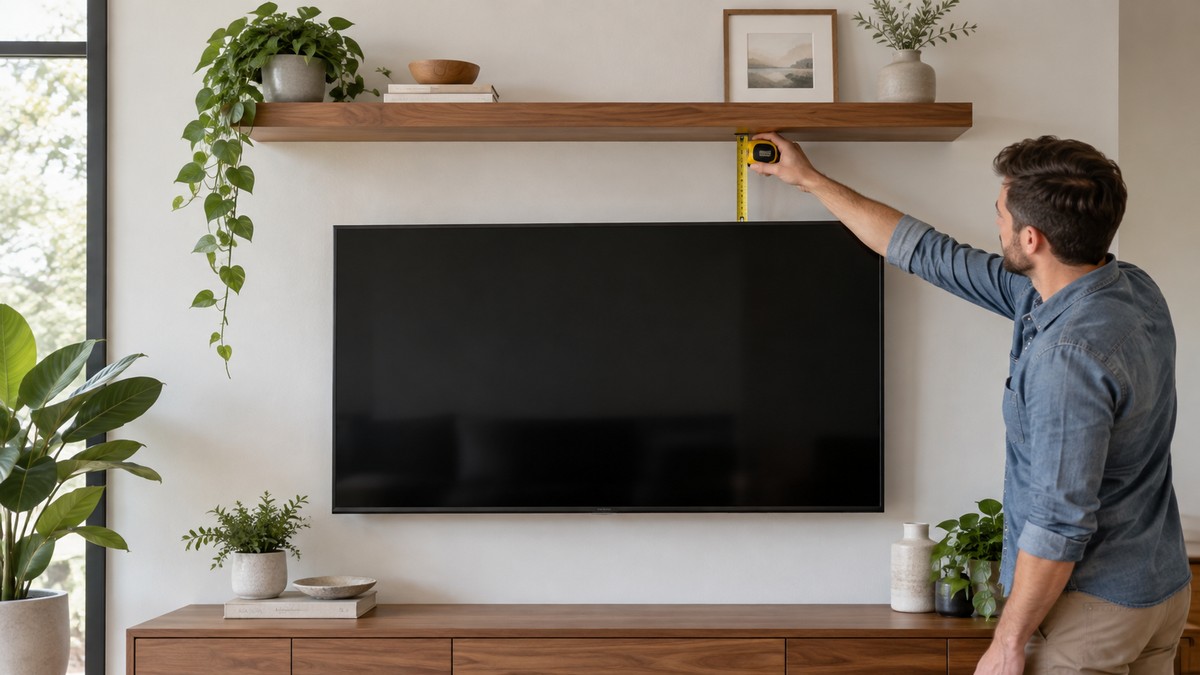
The gap you want is measured between two edges: the TV’s top edge and the shelf’s bottom edge. The TV’s top edge is its centre height plus half its height. Because a listing may give only a diagonal, the height can be worked out from the screen’s aspect ratio. For a 16:9 screen, with diagonal d, the width is d × 16 ÷ √(16² + 9²) and the height is d × 9 ÷ √(16² + 9²). The square root is 18.36.
| Step | Working for a 55-inch 16:9 TV | Result (inches) |
|---|---|---|
| Width | 55 × 16 ÷ 18.36 | 47.9 |
| Height | 55 × 9 ÷ 18.36 | 27.0 |
| Half the height | 27.0 ÷ 2 | 13.5 |
| TV centre height (assumed) | given | 48.0 |
| TV top edge | 48.0 + 13.5 | 61.5 |
The 55-inch figure is an example, and the centre height of 48 inches is an assumption. Use the TV’s listed dimensions, including its stand or mount, when you have them. The 16:9 ratio is a property of the screen format, so the height above is arithmetic, not a stated dimension from a source.
Compare the shelf height with the TV’s top edge
Once you have the top edge, subtract it from the shelf’s bottom edge. Three example shelves show the result:
| Shelf bottom edge (inches, assumed) | TV top edge (inches) | Gap: shelf bottom minus TV top (inches) |
|---|---|---|
| 66 | 61.5 | 66 − 61.5 = 4.5 |
| 72 | 61.5 | 72 − 61.5 = 10.5 |
| 78 | 61.5 | 78 − 61.5 = 16.5 |
A 4.5-inch gap leaves little room between the set and the shelf, so check that nothing on the shelf overhangs toward the TV. A 10.5-inch gap is the middle example. A 16.5-inch gap keeps the shelf well clear of the TV’s top edge. None of these gaps is a stated minimum. They are the results of the arithmetic, and the choice is yours.
Seated viewers and the centre height
The TV centre height in the table is an assumption, so IKEA’s seating figures help set it. The article gives these heights for a TV bench, and the same numbers can guide the TV centre when the viewer is seated:
| Seating (IKEA guide) | Height in centimetres | Height in inches (÷ 2.54) |
|---|---|---|
| Dining chair or similar | 50 cm | 19.7 |
| Standard sofa | 40 to 50 cm | 15.7 to 19.7 |
| Floor or low sofa | 30 to 40 cm | 11.8 to 15.7 |
The guide says the recommended height for a TV bench is “50 cm when sitting on a dining chair or similar”. Those are bench heights. If you use them for the TV centre, you are choosing a bench height and a centre height together, so the shelf calculation then needs the bench height added to the wall position. The guide does not describe a shelf above the set.
Keep the wall vent space clear
The LG figure converts to 10 ÷ 2.54 = 3.9 inches. Keep that gap behind the set clear of shelving, cable clutter and stored items. The figure is from a UK manual for an LG model. Other brands and models give different figures, so the TV’s own manual decides for your set.
Built-in shelves around the TV
Built-in shelves are the case where the ventilation warning matters most. The VIZIO guide says not to place the TV in a bookcase or cabinet unless proper ventilation is provided. A floating shelf mounted on open wall above or beside the set is a different case, because it does not enclose the set. If you plan a shelf unit that surrounds the TV, plan the air space first and then the shelves.
Plan the items above the TV
The shelf above the set is where most problems start. The VIZIO guide says: “Do not place any objects on the top of your TV.” That rule applies to any object that could rest on the top edge, including a frame, a plant or a speaker. Set the shelf’s bottom edge high enough that nothing on the shelf can sit on the set, and check the gap from the table before you choose the height.
Pick the shelf type first
Shelf type affects how much depth and height you need. For a living room, see floating corner shelves for a living room, decorative floating wall shelves for a living room and small wall shelves for a living room. For a corner beside the set, see a corner wall shelf for a living room. If the room is small, shelves for a small room and bookcase ideas for small rooms cover other options. Pick the shelf type from these guides, then run the gap calculation above with that shelf’s depth and height. Depth matters too: a deeper shelf projects toward the viewer, so compare its projection with the TV’s own depth from the wall and with the 10 cm ventilation space.
If the shelves will hold books beside the set, a standalone unit may suit better than floating shelves. See a bookshelf for an apartment living room and bookshelves for a small room, then check the bookcase against the same ventilation rule.
Check the numbers before you drill
Before any holes go in the wall, run the calculation with three numbers from your own room: the TV’s listed height, its centre height and the planned shelf height. Write each one down with its unit, convert any centimetre figure from a manual once, and keep the results in inches. A shelf that gives a gap of about 4 inches is the one to adjust first, because it leaves the least room between the set and anything on the shelf. A gap of 10 inches or more is easier to live with, but it puts the shelf higher on the wall, so check the seated figures again.
When the numbers do not fit
If a shelf sits too close to the TV, the arithmetic supports three choices: raise the shelf, lower the TV centre by moving the TV or the bench, or move the shelf to another part of the wall. The sources do not say which choice is best for your room. Each choice changes either the TV’s top edge or the shelf’s bottom edge, so run the gap again after any change before you mark the wall.
How we chose
We searched for TV placement and clearance guidance and opened three pages on 2026-10-21: an LG owner’s manual (UK PDF), a VIZIO quick start guide for model D48NE0 (PDF), and IKEA’s TV bench article (English page on the Japan site). The search results also included wall-mount manuals for other brands, which give different clearance figures for other products. We did not use them. Each quoted phrase was matched against the text of the opened page. The conversions use 2.54 cm to the inch.
Mistakes to avoid
- Using the ventilation figure as a shelf distance. The 10 cm is a gap behind the set for air flow. It is not a spacing between the TV and a shelf.
- Stacking items on top of the TV. The VIZIO guide says not to place any objects on the top of the set.
- Enclosing the TV without air space. Shelving that closes off the back and sides of the set leaves no room for air, and that is the risk the VIZIO ventilation warning addresses.
- Mixing units. 10 cm is 3.9 inches, and 50 cm is 19.7 inches. Converting once and then rounding can move the gap by an inch or more.
What we could not verify
- No source we opened gives a distance between a TV and a floating shelf.
- The LG figure comes from a UK manual for one LG model range, and the VIZIO guide we opened does not state a wall clearance. Models differ, so the manual for your set governs.
- Wall-mount depth, cable clearance and the bracket’s projection are not stated for a shelf in the pages we opened.
- The TV’s listed height, stand and mount depth are not known here. The 55-inch figure is an example.
FAQ
How far should a floating shelf be from a TV?
No source we opened gives a distance. Work it out from the TV’s top edge and the shelf’s bottom edge, using the TV’s listed height and centre height, and keep objects off the top of the TV.
How far should a TV sit from the wall?
The LG manual says to leave 10 cm, about 3.9 inches, of space from the wall for proper ventilation. Leave that gap clear of shelving and stored items.
Can I put a shelf directly above a TV?
The sources we opened do not say that a shelf is not allowed. The VIZIO guide says not to place any objects on the top of the TV, so plan the shelf’s contents and its bottom edge with that rule in mind.
What height should the TV centre be?
IKEA’s TV bench guide says to bring the centre of the TV to just under line of sight. Its bench heights are 50 cm for a dining chair, 40 to 50 cm for a standard sofa and 30 to 40 cm for a floor seat. Use them as a starting point.
Can I build shelves around the TV?
The VIZIO guide warns against putting the TV in a bookcase or cabinet without proper ventilation. Plan air space around the set before you choose the shelf positions.
How do I calculate the gap for my own TV?
Take the TV’s height from its listing, halve it, add the result to the centre height to get the top edge, then subtract that top edge from the shelf’s bottom edge. For a 55-inch 16:9 TV, the height is about 27 inches.
Bottom line
Find the TV’s top edge from its listed height and centre height, keep objects off the top of the set, and set the shelf’s bottom edge at a gap you have calculated.
Sources
- LG TV owner’s manual (UK PDF), wall clearance for ventilation and wall mounting: https://www.lg.com/content/dam/channel/wcms/uk/support/products/documents/Eng.pdf (opened 2026-10-21)
- VIZIO quick start guide, model D48NE0 (PDF), placement and ventilation warnings: https://cdn.vizio.com/documents/d48ne0/qsg-d48ne0.pdf (opened 2026-10-21)
- IKEA, Choosing the perfect TV bench (English page on the Japan site): https://www.ikea.com/jp/en/campaigns/tlp-tv-bench-pub82b98bc0/ (opened 2026-10-21)
As an Amazon Associate we earn from qualifying purchases.