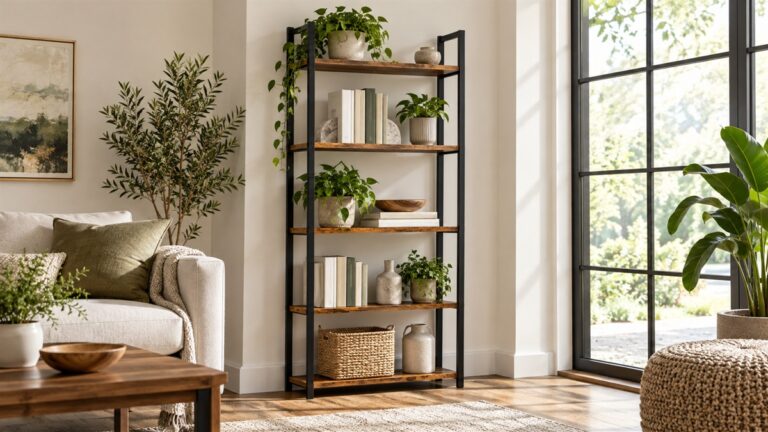
Where to Place a Bookshelf in Your Room
As an Amazon Associate we earn from qualifying purchases.
Where to place a bookshelf depends on three checks: the kind of wall behind it, the light and heat near that spot, and whether the unit can be anchored to the wall. The pages we opened address all three checks. They do not give a room size or a gap width, so the arithmetic below uses stated assumptions that you can replace with your own measurements.
Quick answer
- Choose an interior wall rather than an exterior wall, because the State Library of Queensland advises against placing bookshelves on external walls.
- Keep the shelf away from direct sunlight, windows, and sources of heat and moisture.
- Check the wall behind the shelf for condensation, since the EPA guide lists walls behind furniture as a place where condensation forms.
- Anchor the unit to the wall before you load it, and put the heaviest books on the lowest shelves.
The placement checks in one table
The table lists each placement factor, what the pages we opened say about it, and what to look for in your room. Where a page gives no figure, the cell says not stated.
| Factor | What the pages say | Check in your room |
|---|---|---|
| Exterior wall | Avoid placing bookshelves on external walls | Does the wall face outside? |
| Interior walls and airflow | If possible, use a room with solely internal walls and good ventilation | Is there a window or vent that moves air? |
| Heat and moisture | Avoid bathrooms, kitchens and laundries, with a high risk of mould growth | How far is the spot from these rooms? |
| Direct light | Store and display books away from direct light | Does sunlight fall on the spot in the afternoon? |
| Wall behind the shelf | Walls behind furniture are a place where condensation forms | Look for condensation or damp patches |
| Anchoring | Must always be mounted to a wall, to wood studs whenever possible | Locate the studs and the wall type |
| Shelf height for books you read | 15 to 48 inches for unobstructed reach | Place the books you read often inside this band |
Worked numbers
- Wall space check, using assumed figures: a 36-inch wall space less a 30-inch unit leaves 36 minus 30 equals 6 inches.
- Splitting that 6 inches evenly gives 3 inches on each side. The pages give no minimum side gap, so 3 inches is an assumption.
- Reach band for books you read: 48 minus 15 equals 33 inches of band.
- Three shelf levels 15 inches apart, starting at 18 inches, sit at 18, 33 and 48 inches. All three fall inside the band.
- A five-shelf unit, as the Container Store manual lists, puts the two lowest shelves in the zone for heavier books.
Start with the wall, not the room
The State Library of Queensland’s guide on caring for book collections gives the first rule. It says: “Avoid placing bookshelves on external walls.” The reason follows in the same guide: “External walls are subject to much greater daily fluctuations in temperature and humidity than internal walls.” If the room offers a choice, the guide also says: “If possible, use a room with solely internal walls and good ventilation.”
Many rooms do not offer a choice. The pages we opened do not say what to do when every wall in a room is an exterior wall. In that case, place the shelf where the wall is driest and keep the back of the unit visible, and check the wall for condensation as described below.
For a compact option that fits an interior wall in a small room, see our guide to bookshelves for a small room. For ideas that use a corner or an alcove, see bookcase ideas for small rooms.
Keep books away from heat, moisture and light
The same guide lists the sources to avoid: “Avoid areas where sources of heat and moisture are located (e.g. bathrooms, kitchens, and laundries) as there is a high risk of mould growth.” A bookshelf placed in one of those rooms is in the wrong spot, even when the wall is an interior one.
Light matters too. The guide advises: “Store and display books away from direct light.” It adds: “Avoid areas near windows where sunlight may fall on books”. Choose a wall that stays out of the path of afternoon sun, and remember that lamps and overhead lights also count as light sources in the guide’s list.
The guide also warns about indoor pollutants: “Avoid exposing book collections to internal sources of airborne pollutants such as photocopiers, cleaning products, and poor quality shelving.” In a home, that means keeping the shelf out of a corner where a printer or a cleaning cupboard sits. For a bookshelf in a mini room, see bookshelves for mini rooms.
A bookshelf in a corner of an apartment living room needs the same checks. For that layout, see our guide to living room bookshelves for an apartment.
Check the wall behind the shelf
The EPA’s brief guide on mold and moisture names the wall behind furniture as a common hidden spot. It says mold may hide in “the surface of walls behind furniture (where condensation forms)”. The same guide says: “If you see condensation or moisture collecting on windows, walls or pipes act quickly to dry the wet surface and reduce the moisture/water source.”
In practice, look at the wall behind the shelf once a month, and again after a cold spell or a humid week. Check for condensation or damp patches, and dry the wall if you find any. The guide does not give a schedule, so the timing is your choice. For a wall-mounted choice in a living room, see our guide to small wall shelves for a living room.
Anchor the unit before you load it
The Container Store assembly guide for a leaning bookcase is the clearest source we opened on anchoring. It says: “This product must always be mounted to a wall.” It adds: “It is essential to use wall anchors appropriate to your wall type (e.g. plaster, drywall, etc).” For the mount itself, it says: “Mount to wood studs whenever possible.”
The same guide opens with a warning: “WARNING: Severe injury may occur if furniture tips over. Never allow children to climb or play on this product.” That warning applies to the bookcase in the guide. For another unit, read its own instructions, because the wall hardware differs by product. The guide says to mount to studs whenever possible, so locate the studs before you choose hardware.
For a floating option where the wall must carry the weight, see our guide to floating shelves that can hold weight, and check the load rating there before you load it.
Set the height for the books you read
The Access Board’s guide describes an unobstructed forward reach of 15 to 48 inches above the floor. Its wording applies to operable parts such as controls, so it does not set a rule for bookshelves. It still gives a useful starting band for books you read often. Put those books inside the band, and move rarely used volumes above or below it.
A bottom shelf at floor level sits below the band, so reaching its contents means bending. The pages we opened do not address bending, so treat floor-level storage as a separate choice from the books you read daily.
The arithmetic is short. The band is 33 inches tall, from 15 to 48, so three shelf levels 15 inches apart fit inside it at 18, 33 and 48 inches. A top shelf above 48 inches is the place for books you read rarely, because reaching it may need a step. For a small bedroom, see our guide to small shelves for a bedroom.
Fit the shelf to the room
Use the wall-space check before you buy. The example uses assumed figures: a 36-inch wall space and a 30-inch unit. Subtracting gives 6 inches left over. Splitting the leftover evenly gives 3 inches on each side. These are planning numbers, not product dimensions, so repeat the check with your own wall and your own unit.
Two things the room may also limit are not in the pages we opened. The pages do not give a door swing clearance, and they do not give a walking path width. Measure the door swing and the walking path yourself, and place the shelf so neither one is blocked. For a dorm or small room where space is tight, see dorm room bookshelves, and for a narrow fit, see shelves for a small room.
How we chose
The figures in this guide come from the pages we opened with curl on 2026-10-21. They are a State Library of Queensland guide on caring for book collections, an EPA brief guide on mold and moisture, a Container Store assembly guide for a leaning bookcase, and an Access Board page on reach. Each one gives a rule or a figure that we quote. We checked each quote against the text of the page we opened.
Search results also included low-quality and garbled pages on book storage. We left those out, because they cited no standard and gave no figure that we could check against a page we opened.
What we could not verify
The pages we opened do not give a minimum gap between a bookshelf and a wall, a room size for a given shelf, or a door swing clearance. They do not give a temperature or humidity limit for a home room, apart from the State Library’s guide, which is written for collections. The Access Board figure is for accessible design, so it works here as a planning band. We did not find a National Park Service guide on bookcase placement in our search, so this guide does not rely on one.
Mistakes to avoid
- Placing the bookshelf on an exterior wall. The State Library guide advises against it because of daily swings in temperature and humidity.
- Putting the shelf in direct sun. The guide says to store and display books away from direct light.
- Using a bathroom, kitchen or laundry. The guide names those rooms as a high risk for mould growth.
- Leaving the unit unanchored. The assembly guide says the product must always be mounted to a wall.
- Loading the top shelves with the heaviest books. The same guide says to place heavier items on lower shelves.
FAQ
Can I put a bookshelf against an outside wall?
The State Library of Queensland advises against it, because external walls face much greater daily swings in temperature and humidity than internal walls. If the room has no other wall, check the wall for condensation often, as the EPA guide advises.
Can a bookshelf go next to a window?
The Queensland guide says to avoid areas near windows where sunlight may fall on books. Choose a spot that stays out of direct light, and move the shelf if the sun reaches it.
Is a bathroom, kitchen or laundry a good place for books?
No. The Queensland guide says to avoid those rooms because they are sources of heat and moisture and carry a high risk of mould growth.
Does a bookshelf need to be anchored to the wall?
The Container Store assembly guide says the product must always be mounted to a wall, with wall anchors that suit the wall type. Mount to wood studs whenever possible, and read the instructions for the unit you buy.
Which shelves should hold the heaviest books?
Place heavier items on lower shelves, as far back as possible, and never overload the unit, according to the Container Store assembly guide for its bookcase.
How high should the books I read often go?
The Access Board guide describes 15 to 48 inches above the floor as the unobstructed forward reach band. Keep the books you read often inside that band, and treat it as a planning range, not a rule for bookshelves.
Bottom line
Place the bookshelf on an interior wall away from windows, heat and moisture sources, and anchor it to the wall before you load it.
Sources
- https://www.slq.qld.gov.au/sites/default/files/Caring%20for%20your%20collections%20-%20Books%20%26%20bound%20material_2025.pdf (opened 2026-10-21)
- https://www.epa.gov/mold/brief-guide-mold-moisture-and-your-home (opened 2026-10-21)
- https://www.containerstore.com/medialibrary/Assembly/Linea/LineaLeaningBookcase2014.pdf (opened 2026-10-21)
- https://www.access-board.gov/ada/guides/chapter-3-operable-parts/ (opened 2026-10-21)
Disclosure: As an Amazon Associate we earn from qualifying purchases.