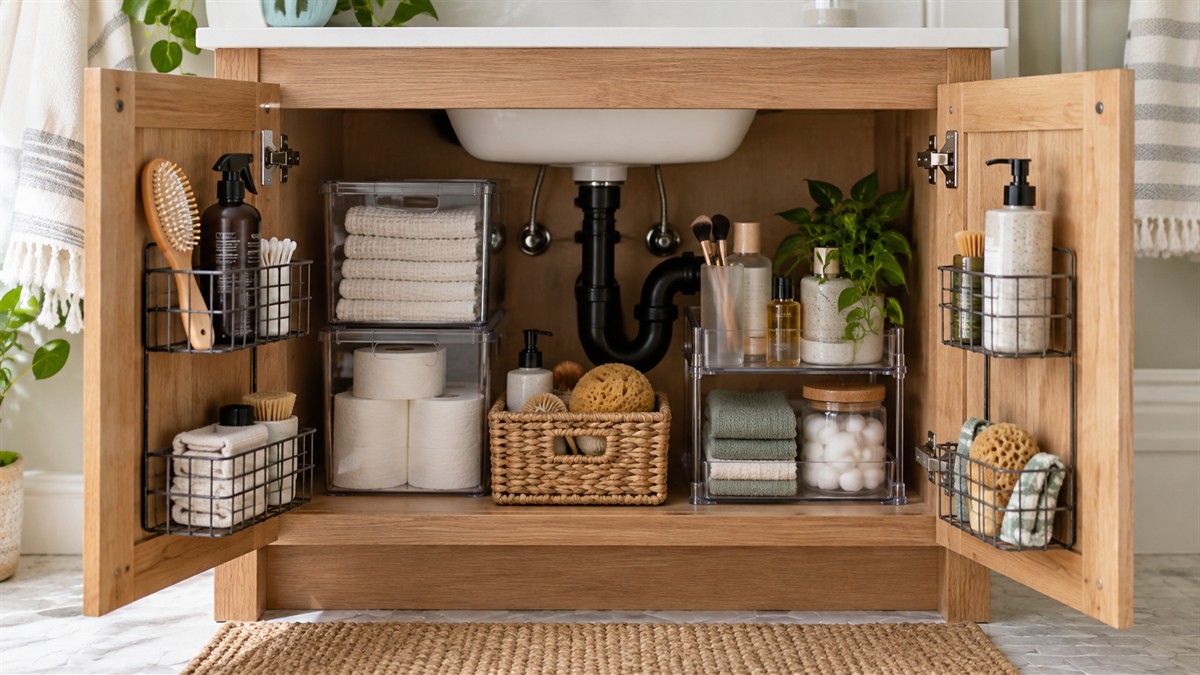
How to Organize a Small Bathroom Cabinet
As an Amazon Associate we earn from qualifying purchases.
How to organize a small bathroom cabinet starts with deciding what belongs in it at all. MedlinePlus says the heat and moisture from your shower, bath and sink may damage medicines, and the FDA says moisture, such as in a bathroom, may make it easier for bacteria and fungi to grow in cosmetics. So empty the cabinet, move medicines and household chemicals to safer storage, then place what is left by how often you reach for it. This guide gives a six-step method, a footprint calculation for shallow cabinets and a monthly check.
Quick answer
- Empty the cabinet and sort every item into a group before anything goes back in.
- Move medicines out of the bathroom if you can. MedlinePlus names a dresser drawer, a kitchen cabinet away from the stove and sink, a storage box, a shelf or a closet as better places.
- Lock household products and medicines out of a child’s reach, and store household products in a different place from food and medicine.
- Plan frequently used items between 15 and 48 inches above the finished floor, the range in the NKBA access standard.
- Measure the cabinet’s depth before you buy bins. A cabinet 5½ inches deep takes one row of small bins and no large ones.
- Date opened cosmetics, keep them closed, and throw away anything that changes color or smell.
Step 1: Empty the cabinet and sort by group
Take everything out and set it on a counter or a towel. A small cabinet hides duplicates, expired items and half-empty containers, and you cannot judge the space until it is bare. Sort what you removed into the groups in the table. The groups come from the kinds of rules the health and safety pages we opened give, and the last row covers everything those pages leave unaddressed.
| Group | What the pages we opened say | What to do in the cabinet |
|---|---|---|
| Medicines, prescription and over-the-counter | MedlinePlus: heat, air, light and moisture may damage medicines. The FDA says a damp bathroom cabinet can reduce effectiveness before the posted expiration date. | Move to a cool, dry place outside the bathroom if possible. Keep in the original container. |
| Cosmetics and eye makeup | The FDA says moisture in a bathroom may make it easier for bacteria and fungi to grow, and eye-area products tend to have shorter shelf lives. | Keep closed, mark the open date, discard on change of color or smell. |
| Toothbrushes | The ADA’s MouthHealthy page says to store a brush upright, let it air dry and keep it out of closed containers. | Keep upright and separated. Do not cap or seal. |
| Household cleaners and chemicals | Poison Control says to lock household products out of a child’s reach and store them apart from food and medicine. | Move to a locked space, away from the medicine group. |
| Aerosol and spray cans | The FDA says to use spray cans in well-ventilated areas and not near an open flame. | Store with the household products and use with the fan or window open. |
| Everything else, such as razors, hair ties and cotton swabs | The pages we opened do not address these items. | Arrange by how often you use them. |
Items in the last row have no rule behind them in the pages we opened, so the choice is yours. A simple frequency rule works: things you use every day go in front, and things you use once a month go behind them.
Step 2: Decide what leaves the bathroom
Two groups deserve a second look before you spend time arranging them: medicines and household chemicals.
MedlinePlus is direct about medicines. It acknowledges that most people probably keep their medicines in a bathroom cabinet, and then explains that the heat and moisture from your shower, bath and sink may damage them. Its list of better places is a dresser drawer, a kitchen cabinet away from the stove, sink and hot appliances, a storage box, a shelf or a closet. It adds that pills and capsules are easily damaged by heat and moisture, and that medicines can become less potent or go bad before the expiration date.
The FDA reaches the same place. Its page on expired medicines says improper storage, such as a damp bathroom cabinet, can contribute to decreased effectiveness in medicines that have not reached their posted expiration date. It also says to read the label for storage instructions, because certain medicines need the refrigerator and others cannot be exposed to high temperatures. Whatever place you pick, MedlinePlus says to keep medicines in their original container and to take the cotton ball out of the bottle, because the cotton ball pulls moisture into it.
Household chemicals are a separate decision. Poison Control’s tips for toddlers list drain cleaners and toilet bowl cleaners among the especially hazardous household products that must always be kept out of a child’s reach, and they add “Buy small quantities only.” If cleaners sit in the bathroom cabinet today, this is the moment to decide whether they stay at all. For a roundup built around that decision, see our guide to a cleaning supplies organizer for under the sink.
Step 3: Place daily items inside the reach band
With the cabinet down to what really belongs there, decide which items go where. The National Kitchen & Bath Association publishes Bathroom Planning Guideline 22 on storage. It recommends adequate, accessible storage for toiletries, bath linens, grooming items and general bathroom supplies “at point of use.” Its access standard adds a number: plan storage of frequently used items between 15 and 48 inches above the finished floor.
That range matters most for wall cabinets, because a wall cabinet hangs above a counter and often reaches past 48 inches. The ADA guide to operable parts also notes that the maximum reach of 48 inches is reduced to 44 inches when the reach goes over an obstruction deeper than 20 inches. Our reading is that a deep counter below a wall cabinet is that kind of obstruction.
The NKBA text is an access standard, so treat it as a planning aid for your own cabinet rather than a rule for a home. To see what it means in practice, the table uses a one-door wall cabinet from the IKEA GODMORGON buying guide, listed at 40 × 14 × 96 centimeters (15¾ × 5½ × 37¾ inches) as width × depth × height. The three bottom-edge heights are our own assumptions for a cabinet hung above a counter. The formula is: share inside the band = (48 − bottom edge) ÷ cabinet height, if the bottom edge is 15 inches or higher.
| Bottom edge above floor (our assumption) | Inches of cabinet inside the 15 to 48 inch band | Share of the 37.75 inch height |
|---|---|---|
| 36 inches | 48 − 36 = 12 | 12 ÷ 37.75 = 31.8 percent |
| 40 inches | 48 − 40 = 8 | 8 ÷ 37.75 = 21.2 percent |
| 44 inches | 48 − 44 = 4 | 4 ÷ 37.75 = 10.6 percent |
The pattern is clear. The higher a wall cabinet hangs, the less of it falls inside the planning band, so its lowest shelf becomes the place for daily items and its upper shelves hold things you reach for rarely. A base cabinet under the sink is different: most of its interior sits below 48 inches, and its lowest shelf may sit close to the 15 inch floor of the band. For ideas on wall-mounted options in a tight room, see our guide to small bathroom wall shelves.
Step 4: Fit bins to the cabinet’s footprint
Depth decides what fits in a small cabinet more often than width does. The IKEA buying guide shows how much depth varies between cabinet types: the one-door wall cabinet is 14 centimeters deep, and the high cabinet in the same series is listed at 40 × 32 × 192 centimeters (15¾ × 12⅝ × 75⅝ inches). A semi-custom cabinet maker’s specification guide, hosted by Lowe’s, lists a standard vanity base cabinet as 21 inches deep, and it notes that cabinet depth does not include door thickness.
To compare cabinets, count how many bins fit on one shelf with this formula: bins per shelf = whole number of (interior width ÷ bin width) × whole number of (interior depth ÷ bin depth). The listings give outside dimensions only, so the table assumes the interior is 1.5 inches narrower and 1 inch shallower than the outside, and it compares two bin sizes. Both the interior deduction and the bin sizes are our own assumptions. Replace them with measurements of your own cabinet.
| Cabinet (outside width × depth, from the listing) | Assumed interior | 4 × 4 inch bins per shelf | 6 × 6 inch bins per shelf |
|---|---|---|---|
| One-door wall cabinet, 15¾ × 5½ inches | 14.25 × 4.5 | 3 × 1 = 3 | 2 × 0 = 0 |
| High cabinet, 15¾ × 12⅝ inches | 14.25 × 11.625 | 3 × 2 = 6 | 2 × 1 = 2 |
| Vanity base, 15 × 21 inches (15 inch width is one of the listed widths) | 13.5 × 20 | 3 × 5 = 15 | 2 × 3 = 6 |
The zero in the first row is the useful result. A 6 × 6 inch bin does not fit a cabinet that is about 4.5 inches deep inside, however wide the shelf is. Measure the depth first, then pick the bin. For options that suit a base cabinet, compare under-vanity organizers and organizers for underneath a bathroom sink.
Step 5: Keep moisture and heat down
A bathroom cabinet sits in the wettest room of the house, so part of organizing is slowing the moisture that reaches it. The EPA’s guide to mold and moisture says to keep indoor humidity below 60 percent if possible, ideally between 30 and 50 percent, and to run the bathroom fan or open the window when showering. The EPA says a moisture or humidity meter can measure it, and the pages we opened do not say what humidity a closed cabinet reaches.
Cosmetics and toothbrushes need different handling. The FDA says to keep containers clean and tightly closed when not in use and to protect them from temperature extremes. The ADA’s MouthHealthy page says “Toothbrushes like to be left out in the open,” and it advises against routinely covering them or storing them in closed containers, because a moist environment favors bacteria more than open air does. A closed cabinet door is not named on that page, so our reading is that a brush stand on the counter fits the wording better than a cabinet shelf. The same page says to keep brushes separated if several share a space, and to replace a brush every three to four months.
Aerosol cans are the last item in this step. The FDA’s general tips say to use aerosol and spray cans in well-ventilated areas, and not while smoking or near an open flame. A small bathroom with the door closed is not an obviously well-ventilated place, so the fan or window matters when you spray.
Step 6: Date, check and discard
An organized cabinet stays organized only if things leave it. The FDA gives three cues you can build into a routine. It says that marking a cosmetic’s container with the date you open it may help you keep track of its age. It says to throw away cosmetics if their color or smell changes. And it says that manufacturers usually recommend discarding mascara two to four months after purchase, because every use exposes the wand to bacteria and fungi.
Medicines have a printed date. The FDA’s page says the expiration date is a critical part of deciding whether a medicine is safe to use and will work as intended, and MedlinePlus says to throw out medicines that are out of date. A cabinet clear-out is a natural time to check each label.
The pages we opened do not set a schedule, so the routine below is our own suggestion, not a source figure:
- Monthly: scan the cabinet for open containers with no date and for any item that smells or looks different.
- Every three months: check eye makeup against the two to four month guidance, and check toothbrush age against the three to four month range.
- Every time you restock medicine: read the expiration date and the storage line on the label.
If children live in or visit your home
Poison Control’s advice for toddlers is to poison-proof every home where a child spends time, and to lock household products and medicines out of a child’s reach. MedlinePlus gives a similar instruction for medicines: store them out of reach and out of sight of children, in a cabinet with a child latch or lock. The Poison Control page also says to store household products in a different place from food and medicine.
Together these rules shape the layout. Medicines and chemicals each get their own locked space, and neither shares a shelf with the other. If the bathroom cabinet is the only locked space you have, the pages we opened give no rule for choosing which group takes it, so that decision is a judgment call. For wider options in a bathroom, our guide to under-cabinet bathroom organization covers the base cabinet and its fixtures.
How we chose
This is a method, not a product list. We read the pages named in the source list on 2026-10-21 and kept only rules that one of them states in plain words: the NKBA bathroom planning guidelines for storage placement, MedlinePlus and the FDA for medicines and cosmetics, Poison Control for child access, the ADA’s MouthHealthy page for toothbrushes, the EPA for moisture, and two manufacturer documents for cabinet dimensions. We checked every quoted phrase against the text of the page it came from. Where a page gave no number, the post says so and labels any figure as our own assumption. Dimension facts from a buying guide and a specification guide are used only as dimensions, never as support for a safety claim.
What we could not verify: what the sources do not say
The pages we opened do not say how much open room a bathroom shelf should keep, and they do not give a safe way to keep medicine in a bathroom when no other place exists. MedlinePlus and the FDA both steer you away from the bathroom cabinet but offer no bathroom alternative. They do not cover razors, hair tools, nail polish, towels or cotton products. They give no humidity reading for the inside of a cabinet and no cleaning schedule. The NKBA reach range comes from an access standard, and the pages we opened do not say it applies to a private home. The interior dimensions and bin sizes in the footprint table are our assumptions, and no source describes a typical small bathroom cabinet.
Frequently asked questions
What should not be stored in a small bathroom cabinet?
Start with medicines. MedlinePlus and the FDA both point to damp bathroom storage as a risk to how well medicines work. Household chemicals are the second group to move, since Poison Control advises locking them away from children and keeping them apart from food and medicine.
How high should the things I use every day sit?
The NKBA access standard recommends planning frequently used items between 15 and 48 inches above the finished floor. In a wall cabinet, that usually means the bottom shelf, as the table in step 3 shows.
How do I know whether a bin will fit?
Measure the inside width and depth of the shelf. Divide each by the bin’s width and depth, drop the remainders, and multiply the two results. If either result is zero, the bin does not fit.
How often should I clear out the cabinet?
The pages we opened give no cleaning schedule. They do give item dates: manufacturers usually recommend discarding mascara two to four months after purchase, the ADA says to replace a toothbrush every three to four months, and every medicine carries an expiration date. A monthly scan with a deeper check each quarter covers all three.
Where should I keep a toothbrush?
The ADA’s MouthHealthy page says to rinse it, store it upright and let it air dry, and not to cover it or keep it in a closed container. A stand on the counter, away from other brushes, fits that wording.
Bottom line
Empty the cabinet, move medicines and chemicals out or under lock, keep daily items within the 15 to 48 inch band, and size every bin to the depth of the shelf it must fit.
Sources
- https://media.nkba.org/uploads/2022/05/Bath-Planning-Guidelines.pdf (opened 2026-10-21)
- https://medlineplus.gov/ency/patientinstructions/000534.htm (opened 2026-10-21)
- https://www.fda.gov/drugs/safe-disposal-medicines/dont-be-tempted-use-expired-medicines (opened 2026-10-21)
- https://www.fda.gov/cosmetics/cosmetics-labeling/shelf-life-and-expiration-dating-cosmetics (opened 2026-10-21)
- https://www.fda.gov/cosmetics/resources-consumers-cosmetics/using-cosmetics-safely (opened 2026-10-21)
- https://www.poison.org/poison-prevention-tips-by-age/toddler (opened 2026-10-21)
- https://www.mouthhealthy.org/all-topics-a-z/toothbrushes (opened 2026-10-21)
- https://www.epa.gov/mold/brief-guide-mold-moisture-and-your-home (opened 2026-10-21)
- https://www.access-board.gov/ada/guides/chapter-3-operable-parts/ (opened 2026-10-21)
- https://www.ikea.com/ca/en/files/pdf/b5/35/b5352a47/godmorgon-buying-guide-fy23-l2-en.pdf (opened 2026-10-21)
- https://pdf.lowes.com/productdocuments/a1eb9084-5b50-46c6-8c75-617601687698/48070959.pdf (opened 2026-10-21)
Disclosure: As an Amazon Associate we earn from qualifying purchases.