How to Store Winter Clothes in Closet
As an Amazon Associate we earn from qualifying purchases.
This guide explains how to store winter clothes in closet space so they come out clean and moth-free next fall. The method has five parts: clean everything, dry it completely, pack it so natural fibers can breathe, keep insects out of the containers, and put the containers where it is cool, dark and dry. It draws on extension publications from Ohio State, Kansas State and Mississippi State, a National Archives article on textiles, and a University of Florida mildew guide. Each rule below names the page that states it.
Quick answer
- Clean, repair and fully dry every item before it goes away. Ohio State University Extension says soiled sweaters in storage could attract cloth-damaging insects, and a Kansas State column says damp clothing invites mildew.
- Fold knits instead of hanging them, and give natural fibers room to breathe by not filling bins to the brim.
- Wool, silk, fur and other animal-origin fabrics are the moth targets. Mississippi State Extension advises cleaning them first and keeping them in bug-tight containers.
- Keep bins off the closet floor and away from damp, and keep them out of attics, basements and garages.
Sort first: decide what actually goes into storage
Packing clothes you will never wear again only moves clutter from one place to another. The Kansas State University fact sheet on clutter describes a simple hanger test. Turn every hanger so the hook faces you, then turn each hanger back the other way when you wear the garment. After several months, the hangers still facing you mark the clothes you do not wear. The fact sheet suggests using that result to see which items are clutter.
A Geary County column from K-State Research and Extension describes a four-pile sort done before packing: ready to wear, ready to store, ready to pass down to a younger child, and ready to send to a cousin. Your piles will differ, but the order matters. Sort first, then wash, then pack. The same column says the sorting also shows which items need repair, so mending happens before storage and not after the bins are sealed.
Once the pile for storage is clear, count the hanging pieces separately from the folded ones. You need that count for the rod-space table later in this guide, and the bin count depends on the folded pile. If the closet does not have room for the bins, the same Kansas State fact sheet lists other places in the home to hold out-of-season clothing: other closets, a utility room, or under the beds. For ideas on using the top of the closet itself, see our guide to storage ideas for the top shelf of a closet.
Clean, repair and dry every piece
The extension pages that cover seasonal storage all put cleaning ahead of packing. The Ohio State University Extension article says that when winter is over, your clothes should all be cleaned and completely dried, because soiled sweaters in storage could potentially attract cloth-damaging insects. It also tells readers to treat stains soon, particularly before storage, since stains that age can darken over time. For laundering, it points to the care label on each garment.
The Geary County column adds two laundering details. It says research shows it is best to rinse the clothes thoroughly after they are laundered and to omit any use of fabric softener before storage. It also warns: “Storing damp or wet clothing will invite mildew and mold to set in.” The drying step is therefore not optional, and it applies to heavy items such as jeans as much as to sweaters.
Mississippi State University Extension explains why cleaning matters for moths. Its 2016 newsletter says clothes moths rarely damage cotton or synthetic fabrics, while wool, silk, fur and other animal-origin fabrics are susceptible, and items soiled with sweat, dandruff and other stains are especially attractive to egg-laying moths. The specialist advises having susceptible clothing cleaned before summer storage, which also removes any moth or carpet beetle stages already on the garment. A 2005 newsletter from the same specialist makes the same point about sweat, oil and flakes of skin. It also notes that carpet beetles, not only clothes moths, may be the cause of holes in a favorite sweater.
| Cleaning option | What the page says | Limit the page states |
|---|---|---|
| Machine wash, per the care label | Ohio State advises reading the care label; Mississippi State says machine washing of items that are safe to wash helps control pests | Wool sweaters should never go in the dryer, according to Ohio State |
| Dry cleaning | Mississippi State advises cleaning susceptible clothing before summer storage; Ohio State mentions the dry cleaners for dry clean-only items that smell musty after storage | Keep the item in the wrapping the cleaner returns it in for extra protection (Mississippi State, 2016) |
| Thorough ironing | Mississippi State lists it as a way to control pests | Does not replace storage in a tight container |
| Sun and brushing | Mississippi State suggests hanging items in a bright, sunny place and brushing them inside and out for a few days when cleaning is not possible | Offered only when cleaning is not possible |
| Freezer for four to seven days | Mississippi State describes sealing the item in a plastic bag with the air forced out | It does not clean the clothing, and soiled clothing is more prone to reinfestation |
Hang or fold: match the method to the garment
The pages we opened do not give one rule for every garment, and in one case they disagree. Ohio State says clean sweaters should be folded and put in a drawer or shelf, “rather than hung in the closet,” because hanging can stretch a sweater or create bumps at the shoulder. The Kansas State fact sheet says even a sweater can be folded and hung over a padded hanger. If you follow the Ohio State rule, folding is the safer choice for knits. If you follow Kansas State, a padded hanger is acceptable. This guide folds knits by default, because the Ohio State reason (stretching and shoulder bumps) is stated and the Kansas State page gives no reason.
| Item | What the page says | Page |
|---|---|---|
| Sweaters and knits | Fold and shelve rather than hang | Ohio State Extension |
| Sweaters (alternative) | Can be folded and hung over a padded hanger | Kansas State fact sheet |
| Suits, skirts and coats that stay on hangers | Store in specially designed bags, sealed at both ends for long-term protection | Mississippi State, 2005 |
| Cotton items and similar natural fibers | Need room to breathe, so do not pack the container too full | Geary County column |
| Heavy items such as jeans | Place at the bottom of the container, with lighter items near the top | Geary County column |
| Antique or heirloom garments | Do not hang them; flat storage is best | National Archives article |
The National Archives article is written for family heirlooms such as quilts and old dresses, not for everyday coats. Treat its rule on hanging as relevant only to old or fragile garments. For everyday winter coats, the Mississippi State advice on hanger bags is the closest match in the pages we opened. If a coat closet is your main storage, our guides to under-stairs coat closet ideas and coat closet shoe storage cover the layout side.
Pack the bins
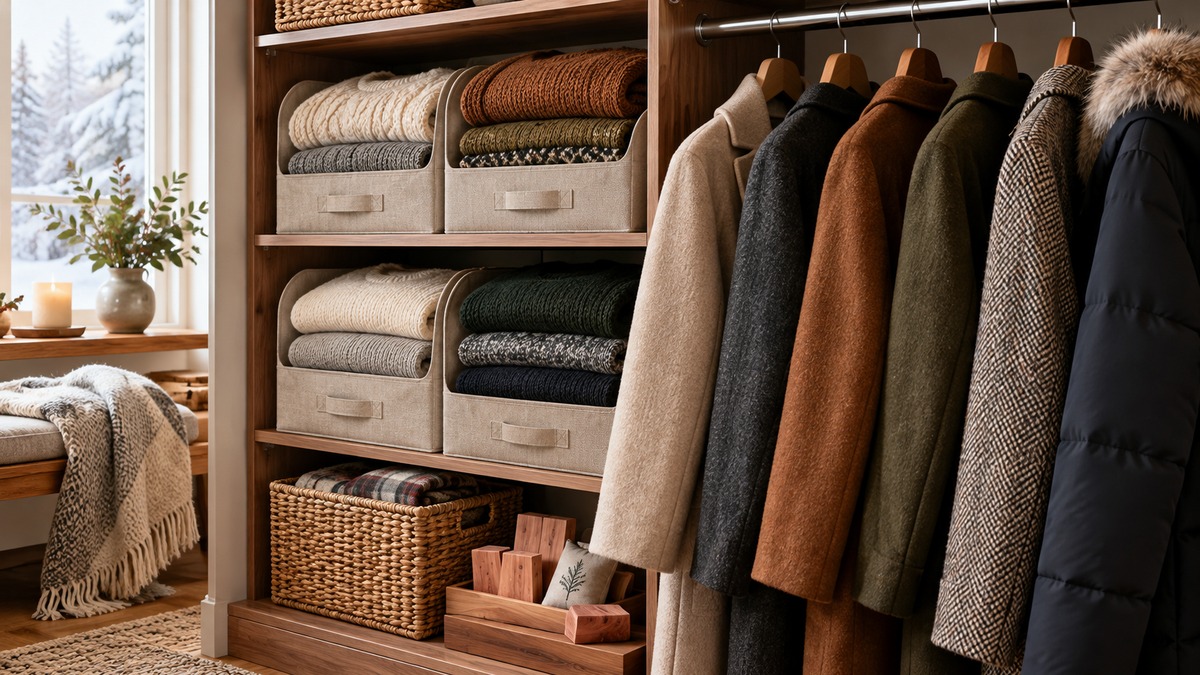
The Geary County column gives the most detailed packing routine. Most of the clothes go into large storage containers with snap-on lids, or into trunks and suitcases that are not in use. Clothes made from natural fibers such as cotton need room to breathe, so the writer does not pack a container too full. A layer of white tissue paper, a clean sheet or a pillowcase between the clothes gives them the same room. Heavier items such as jeans sit at the bottom, and light items such as tank tops sit near the top, which puts less stress on the lightweight pieces.
The column also says to fold clothes differently for storage than for a dresser drawer. Folding on the seamlines whenever possible prevents unwanted creases from setting in while the clothes sit. The last step is a label by size and season, and the column adds any special items, such as winter gloves, so you can find them during unpredictable temperature swings. The Kansas State fact sheet agrees on labels, advising that every bin and tote carry the owner’s name and, when the contents are seasonal, the season. It also says storage bags that can be vacuum sealed reduce bulk and increase capacity, but the pages we opened do not discuss how sealing affects wool or other natural fibers.
Use this small calculation to plan how many bins to buy or free up. The formula is bins = items to store ÷ items per bin, rounded up. The 10 and 8 items per bin are our own assumptions. Replace them with a count from your own container, since the pages we opened give no capacity figure.
| Folded items to store | Bins at 10 items each | Bins at 8 items each (more breathing room, our assumption) |
|---|---|---|
| 24 | 24 ÷ 10 = 2.4, so 3 | 24 ÷ 8 = 3.0, so 3 |
| 35 | 35 ÷ 10 = 3.5, so 4 | 35 ÷ 8 = 4.4, so 5 |
| 50 | 50 ÷ 10 = 5.0, so 5 | 50 ÷ 8 = 6.25, so 7 |
The gap between the two columns shows what the breathing-room rule costs: at 50 items, the roomier packing needs two more bins. If you share the closet with other seasonal items, our guide to storing blankets in a closet covers a related stacking problem.
Keep moths out of the containers
The 2005 Mississippi State newsletter lists the steps in order: clean the clothing, store it in bug-tight containers, and check it periodically. Moths and adult carpet beetles cannot lay eggs in clothing they cannot reach, so sweaters can go in plastic boxes with tight-fitting lids, and suits, skirts and coats can hang in storage bags sealed at both ends. The specialist adds a warning that matters for the whole plan: clothing is not immune just because it is stored this way, and if moths or beetles do get into boxes or bags they thrive. Items kept in one place without being used for long periods are prime candidates for damage.
The same newsletter answers the questions people ask about cedar and chemical products. It says cedar does not really repel clothes moths, although high concentrations of cedar oil can kill small caterpillars, and that cedar-lined closets do not usually provide a seal tight enough for that effect. It describes moth balls and pest strips as extra protection and not a substitute for good housekeeping, says to read and follow the label, and warns that moth ball chemicals can react with plastic, so they should not directly contact the stored items or the container. It states plainly: “Insecticides should never be sprayed directly on clothing.” The Mississippi State pages are from 2005 and 2016, so check the label on any current product, because the pages we opened cannot speak to products sold today.
One page pushes the other way on sealed bags. Kansas State’s publication on controlling mold growth says plastic bags may be fine for protecting textiles for short periods but should not be used for long-term storage, because condensation may occur in the bag. It suggests cloth bags, or fabric such as sheets draped over stored textiles, which allow ventilation, provide protection from light and soil, and prevent condensation. It also says silica gel desiccants can be used in clothes storage areas and adds: “Desiccants are more effective in small confined storage compartments such as drawers and boxes.” That fits the University of Florida point, covered below, that desiccants do little in a whole closet. Mississippi State’s advice targets moths and Kansas State’s targets mildew, and neither page reconciles the two. Our reading is that a sealed container is only as safe as what goes into it, so dry the clothes completely before you close the lid.
The Kansas State fact sheet makes a related point about crowding: “Tightly packed clothing can be a buffet line to clothes moths” and other fiber-eating insects. It says most clothing needs 2 to 3 inches of space for hanging, which allows air flow that helps prevent mold and mildew. That is why the hanging-space table below matters even if all your winter clothes stay in a closet and none go into bins.
Choose the spot in the closet
Three pages describe the ideal storage environment in similar terms. Ohio State says to store sweaters and winter wear in a cool, dark and dry area of the home. The Geary County column says to avoid areas that are damp or exposed to excessive heat, and that the area should be free of fumes. The National Archives article says an environment comfortable for people is suitable for textiles, and that textiles last longest in the dark.
A closet can fail the dry test even in a comfortable house. The University of Florida mildew guide names closets as one of three mildew hot spots, along with bathrooms and bedrooms. It says: “Moisture migrates into closets much more easily than it can come out naturally.” It adds that anything damp put into a closet, even a little moisture in shoes or other clothing, can add to the problem. Its closet checklist includes keeping items off the floor because moisture can be trapped under them, and keeping solid closet doors open when the closet smells musty. It also says desiccants are of little use in a closet because the space to be dried is large compared with what such materials can absorb. The guide was written for Florida homes, so its humidity concerns are strongest in humid climates. Kansas State’s mold publication gives matching advice for closets: “If mold is growing in closets, keep closet doors open to promote air flow.” It also says closets should not be overfilled, since that reduces air circulation, which adds a second reason to leave the hanging space described below.
The EPA gives a number to check against. Its mold guide says to keep indoor humidity below 60 percent, ideally between 30 and 50 percent, and notes that a small humidity meter can measure it. Measuring the room beside the closet tells you whether the closet is a reasonable home for bins.
| Spot | What the pages say | Our reading |
|---|---|---|
| Closet shelf | Cool, dark, dry areas suit winter wear (Ohio State) | Good if the room stays under the EPA humidity ceiling |
| Closet floor | Keep items off the floor because moisture can be trapped under them (University of Florida) | Use a shelf or a low platform instead |
| Another closet, utility room or under a bed | Listed as places for out-of-season clothing (Kansas State) | Fine if dry and free of fumes |
| Attic, basement or garage | Avoid them (Kansas State); avoid hot attics and damp basements or garages (National Archives) | Rule out |
Check how much hanging space your winter coats need
Some winter clothes will stay on hangers, and bulky pieces can crowd a rod fast. Use the Kansas State figure of 2 to 3 inches of hanging space per garment, which the fact sheet says varies with the length and width of the garment. A North Carolina State Extension circular reprinted in 1965 adds one recommendation, that bedroom closets have at least 48 inches of rod space. Bulky coats are more likely to need the 3-inch end of the range or more, but that is our reading, because no page we opened gives a figure for coats. The formula is garments = rod length ÷ inches per garment, rounded down.
| Rod length (inches) | Garments at 3 inches each | Garments at 2 inches each |
|---|---|---|
| 36 | 36 ÷ 3 = 12 | 36 ÷ 2 = 18 |
| 48 | 48 ÷ 3 = 16 | 48 ÷ 2 = 24 |
| 60 | 60 ÷ 3 = 20 | 60 ÷ 2 = 30 |
| 72 | 72 ÷ 3 = 24 | 72 ÷ 2 = 36 |
For example, if 10 winter coats stay on the rod, they need 10 × 2 = 20 inches at the low end and 10 × 3 = 30 inches at the high end. That leaves most of a 48-inch rod free for the clothes you wear now. If the rod is already full, the closet is the wrong place for the coats, and the bins or a second closet are the better answer. Our guides to closet organizing for small spaces and boot storage in a closet cover the next question, which is where winter boots go.
How we chose
This is a method guide and not a product list. We opened ten pages on 2026-10-21 and kept only rules that a page states in plain words: two Mississippi State University Extension newsletters, an Ohio State University Extension article, a K-State Research and Extension county column, a Kansas State University fact sheet, a second Kansas State publication on mold, a National Archives article, a University of Florida mildew guide, an EPA guide and a North Carolina State Extension circular. We checked every quoted sentence against the text of its page. Where two pages disagree, as Ohio State and Kansas State do on hanging sweaters, we show both. Numbers in the tables are either taken from a named page or marked as our own assumption.
Mistakes to avoid
- Storing soiled clothes. Ohio State says soiled sweaters could attract cloth-damaging insects.
- Packing damp items. The Geary County column says damp clothing invites mildew and mold.
- Using fabric softener before storage. The same column says to omit it.
- Trusting cedar alone. Mississippi State says cedar does not really repel clothes moths.
- Overfilling the bin. The column says natural fibers need room to breathe.
- Parking bins on the closet floor. The University of Florida guide says moisture can be trapped under items.
- Skipping the periodic check. Mississippi State says moths that reach a closed container thrive there.
What we could not verify
The pages we opened do not give a bin size, a number of items per bin, a width for bulky coats, or an interval for checking stored clothes beyond the word periodically. They do not compare plastic bins with fabric garment bags for wool, and they do not say how vacuum sealing affects wool or down. The Mississippi State and Kansas State pages disagree about sealed plastic containers, and neither page settles it. The Mississippi State newsletters are from 2005 and 2016, the North Carolina State circular is a 1965 reprint, and the University of Florida guide is an archival copy written for Florida homes. The National Archives article covers heirloom textiles, so its hanging rule is a loose fit for everyday coats. Nothing here is a product claim, and no bin, bag or hanger is rated or recommended.
Frequently asked questions
Should I hang or fold winter sweaters for storage?
Fold them. Ohio State University Extension says clean sweaters belong in a drawer or on a shelf, and that hanging can stretch them or create bumps at the shoulder. The Kansas State fact sheet says a folded sweater can also hang over a padded hanger, so the pages differ.
Do I have to dry clean winter clothes before storing them?
Follow the care label. Ohio State says to read the label for laundering and mentions the dry cleaners for dry clean-only items. Mississippi State advises having susceptible clothing, meaning wool, silk, fur and similar fabrics, cleaned before summer storage.
Is a cedar closet enough to protect wool from moths?
The Mississippi State newsletter says no. It says cedar does not really repel clothes moths and that cedar-lined closets do not usually seal tightly enough for cedar oil to build up. Tight containers and clean clothes do more.
Where should the bins go inside the closet?
Put them on a shelf instead of the floor, in a cool, dark, dry spot. The University of Florida guide says moisture can be trapped under items on a closet floor, and Ohio State recommends cool, dark and dry conditions.
How often should I check stored clothes?
The Mississippi State newsletter says to check stored items periodically and deal with any infestation promptly, but it gives no interval. Look for holes, small light-colored moths, small beetles and shed larval skins at the bottom of the container.
Can I use vacuum storage bags for winter clothes?
The Kansas State fact sheet says vacuum-sealed storage bags reduce bulk and increase storage capacity. The pages we opened do not say how sealing affects wool, down or other natural fibers, so check the care label and the bag maker’s instructions.
Bottom line
Clean it, dry it, fold the knits, close the container, and put it somewhere dry that you will remember to check.
Sources
- https://u.osu.edu/livehealthyosu/2024/09/26/sweater-weather/ (opened 2026-10-21)
- https://www.geary.k-state.edu/health-home-family/living-resourcefully/2013/Seasonal-Clothing-Storage.pdf (opened 2026-10-21)
- https://extension.msstate.edu/newsletters/bugs-eye-view/2016/webbing-clothes-moth-vol-2-no-3 (opened 2026-10-21)
- https://extension.msstate.edu/sites/default/files/newsletter/bw0105.pdf (opened 2026-10-21)
- https://www.archives.gov/publications/prologue/2016/summer/preserve-textiles.html (opened 2026-10-21)
- https://bookstore.ksre.k-state.edu/pubs/cut-the-clutter-and-get-organized-fact-sheet_MF2879.pdf (opened 2026-10-21)
- https://www.shawnee.k-state.edu/homeandfamily/pdfs/Controling%20mold.pdf (opened 2026-10-21)
- https://journals.flvc.org/edis/article/download/108194/103485/149853 (opened 2026-10-21)
- https://www.epa.gov/mold/brief-guide-mold-moisture-and-your-home (opened 2026-10-21)
- https://ocr.lib.ncsu.edu/ocr/ua/ua102_200-001-bx0004-004-005/ua102_200-001-bx0004-004-005.pdf (opened 2026-10-21)
As an Amazon Associate we earn from qualifying purchases.