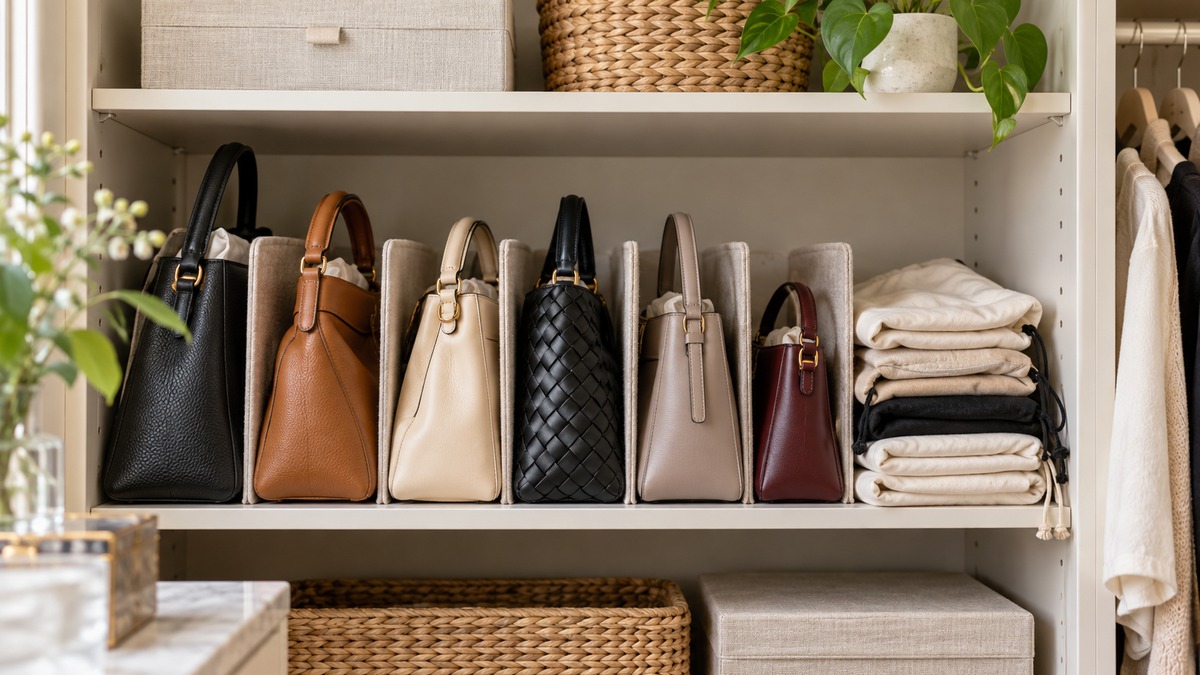
How to Store Handbags Properly
As an Amazon Associate we earn from qualifying purchases.
How to store handbags properly comes down to six habits: keep them cool, dry and out of light, support the shape with the right stuffing, cover them with something that breathes, keep straps and hardware from rubbing, skip routine conditioners unless the maker calls for them, and check the bags on a schedule. The Canadian Conservation Institute, the National Park Service and Iowa State Extension cover leather care, and four bag makers add their own advice. This guide ties those rules to closet shelf planning.
Quick answer
- Store bags in a cool, dry, dark place. The Canadian Conservation Institute recommends a stable 45% to 55% relative humidity and 18 to 20 degrees Celsius for leather, which is about 64 to 68 degrees Fahrenheit.
- Stuff and cover the bag. Cuyana says to store a bag stuffed and upright in a dust bag, and the Canadian note advises unbuffered, acid-free tissue.
- Keep plastic bags off leather. Iowa State Extension warns against them, though the Canadian note lists polyethylene dust sheets, so the sources differ.
- Plan the shelf around the bag. A 12-inch shelf takes a bag up to 12 inches wide turned sideways, and a 16-inch shelf takes a larger tote.
Why storage matters more than polish
The Canadian Conservation Institute’s note on caring for alum, vegetable and mineral-tanned leather names bags among the items it covers, along with boots and horse collars. Its advice is blunt: current museum practice is to minimize dressings, lubricants and cleaners because of their negative long-term effects, and proper storage environments and supports are the most important thing for leather. Chrome tanning counts as mineral tanning in the same note, so the advice reaches modern leather too.
The note was written for museum objects in 1992, not for a closet, so it is a close fit and not an exact one. It is the most detailed public source on leather storage that we opened, so the targets in this guide start there. The bag makers’ pages, which we cite by name, add what a home owner can do with a dust bag and a shelf.
The storage environment
The Canadian note sets the targets. Leather should be protected from extremes and swings of relative humidity. Very dry conditions below 30% cause loss of moisture and embrittlement, and humidity over 65% encourages mold growth and breakdown of the fibers. A stable 45% to 55% and a temperature of 18 to 20 degrees Celsius are the recommended conditions. It also says locally raised temperatures, such as near a radiator, can speed up deterioration.
| Source | Temperature | Humidity | Other |
|---|---|---|---|
| Canadian Conservation Institute | 18 to 20 °C = 64.4 to 68.0 °F | Stable 45% to 55%; under 30% dries, over 65% invites mold | Not over radiators, in damp basements or near sweating pipes |
| Longchamp | Preferably 19 to 25 °C = 66.2 to 77.0 °F | Without excessive humidity | Away from prolonged light and heat |
| Iowa State Extension | Cool | Ventilated area | Dry heat dries leather and hot, humid storage invites mildew |
The Fahrenheit values are our conversion, with degrees Celsius multiplied by 1.8 and 32 added. The two ranges overlap only between 19 and 20 degrees Celsius. The Canadian figure is the narrower, museum-grade target and Longchamp’s is a brand preference for its own bags, so a closet that stays inside both is the safest reading. The sources do not say how to measure humidity at home.
On light, the Canadian note says leather objects should, if possible, be stored in the dark, and that painted or dyed leather can be extremely light-sensitive. Dagne Dover says to keep a bag away from direct sunlight. For the room, the Canadian note says leather should not be stored over radiators or furnace pipes, in damp basements, or near sweating pipes.
Cover: dust bag, cotton or plastic
Most sources want a cover. Tory Burch says to always store its handbag in the proper dust bag, and Longchamp says to store your bags in their original cover when not in use. Dagne Dover says to store a bag in a dust bag away from sun and heat. The Canadian note protects leather from dust with polyethylene or cotton dust sheets, closed cabinets or acid-free boxes, because dust attracts water vapor and can carry pollutants.
| Source | On plastic or a cover |
|---|---|
| Canadian Conservation Institute | Polyethylene or cotton dust sheets are listed for dust protection; wrapping in acid-free tissue or cotton helps with humidity swings |
| Iowa State Extension | Do not store leather in a plastic bag (written for leather garments) |
| Tory Burch | The proper dust bag, with filler to keep the shape |
| Longchamp | Original cover |
| Cuyana | Dust bag, stuffed and upright |
| Dagne Dover | Dust bag, away from sunlight or heat |
The sources may not be in direct conflict, since a dust sheet laid over an object is not the same as sealing it inside a plastic bag, and the Iowa State line is about a bag, not a sheet. None of the pages makes that distinction. A breathable cotton dust bag, the choice every maker lists, avoids the question, and we give the sources’ wording and not a ruling.
Stuffing and support
A soft bag that slumps in storage can crease and stay that way. The Canadian note says leather objects should be fully supported while in storage and on display, and it warns that artifacts which have sagged and stiffened are difficult or impossible to reshape. Sharp folds or creases should be padded with unbuffered, acid-free tissue, and pouches should be filled with polyester batting or rolls of acid-free paper. Cuyana puts the same advice in one line: “Store it stuffed and upright, in a dust bag to keep its shape.”
The tissue matters. The Canadian note says paper or cardboard used as padding should be acid-free but unbuffered, since buffered materials are alkaline and potentially harmful to leather. The National Park Service leaflet on buffered and unbuffered storage materials agrees in its own words: for ethnographic objects, which include leather, it says “If in doubt, use unbuffered neutral pH materials.” For fabric bags, the same leaflet says the Park Service recommends that all textiles be wrapped in soft, unbuffered, neutral pH tissue.
| Material | What the sources say |
|---|---|
| Unbuffered acid-free tissue | Canadian note: for padding folds and wrapping; National Park Service: preferred when in doubt |
| Polyester batting or rolls of acid-free paper | Canadian note: to fill pouches |
| Unnamed filler | Tory Burch: add filler to help preserve the shape, without naming a material |
| Newsprint and ink | Canadian note: protect leather from pencils, ink and newsprint |
The sources do not say how full to stuff a bag, and Tory Burch does not name a filler. A bag stuffed so tightly that it bulges is a risk the pages never address.
Straps, hardware and linings
Hardware and straps are where bags wear in storage. Longchamp says to leave the shoulder strap either inside the bag or outside the storage bag so that it does not rub or distort the bag. It also says to avoid contact with materials that could migrate onto a bag, particularly a clear or varnished one, and to keep small personal items in a pocket to protect the lining from pen, oil, perfume, cream or lipstick stains.
The Canadian note covers metal. Copper and copper alloys such as brass and bronze react with the oils in leather and form waxy green corrosion products at the contact point, and iron, iron alloys and tinplate corrode in contact with acidic leather and weaken the leather around them. Whenever possible, it says, keep leather and metal apart with a sheet of Mylar or polyethylene as an interleaf. It also says heavy attached elements need separate supports to reduce strain on the leather where they join.
None of the pages we opened says whether to hang a handbag by its straps. The Canadian note’s advice that heavy attached parts need their own support is the closest guidance, and it supports laying a heavy bag on a shelf over hanging it. That reading is ours.
Conditioners and cleaning
The sources split on conditioners. The Canadian note says dressings and saddle soap are now not generally recommended, and the National Park Service leaflet on leather dressing recommends that park staff “not apply leather dressings to their historical collections on a routine basis.” The bag makers differ among themselves. Tory Burch’s care guide for its pebbled leather McGraw handbags says leather requires no creams, polishes or conditioning products. Longchamp tells owners to use its colorless nourishing cream on leather, except nubuck, suede and patent leather. Cuyana lists a leather conditioner for its bags.
Iowa State Extension takes the cautious line for leather garments: if staining occurs, take the garment to a professional suede and leather cleaner and do not try to remove spots at home. It adds that the care label matters for imitation leather or suede, because some of those fabrics are fragile. The practical reading is to follow the care label or the maker’s page for your bag, and to leave conditioning out of long-term storage unless the maker asks for it.
Plan the shelf for the bags
Once the care rules are set, the shelf is arithmetic. ClosetMaid lists wire shelving in 12 and 16 inch depths and in 4, 6, 8 and 12 foot lengths. A North Carolina State extension circular says a 12-inch shelf will hold hats, folded garments, shoes and clothing accessories. A 1967 Oregon State circular goes further for purses: a rubber-covered plate rack, available at hardware stores, can be used to store purses in a vertical position on closet shelves, and shelves at the sides of a coat closet can hold purses, gloves and hats.
The bag sizes below are our own assumptions for three common shapes, in inches, so measure your bags before you rely on them. We assume a gap of 1 inch between bags and 2 inches of clearance above each bag, and the shelf is the 48-inch stock length. The front-facing count divides the shelf length by the bag width plus the gap. The sideways count turns the bag so its depth runs along the shelf, which only works when the bag width is no more than the shelf depth.
| Bag (our assumed size, W × H × D) | Shelf gap needed (H + 2) | Front-facing on a 48-inch shelf: 48 ÷ (W + 1) | Fits sideways on a 12-inch shelf? | Sideways on a 48-inch shelf: 48 ÷ (D + 1) |
|---|---|---|---|---|
| Clutch, 10 × 6 × 2 | 8 | 48 ÷ 11 = 4.4, so 4 | Yes, 10 is under 12 | 48 ÷ 3 = 16 |
| Satchel, 11 × 9 × 4 | 11 | 48 ÷ 12 = 4.0, so 4 | Yes, 11 is under 12 | 48 ÷ 5 = 9.6, so 9 |
| Large tote, 16 × 12 × 6 | 14 | 48 ÷ 17 = 2.8, so 2 | No, 16 is over 12; yes on a 16-inch shelf | 48 ÷ 7 = 6.9, so 6 |
The table shows two things. A deeper shelf changes what you can store, since the large tote needs the 16-inch depth to go sideways, and the closet depth limits that choice, as we cover in our guide to reach-in closet depth. And a bag lying on its side takes far less shelf length than a bag facing out, which is why the counts jump from 4 to 16 for the clutch. The cost is that you see the side of the bag, not the front. The sources do not say whether a bag should lie flat, stand or sit sideways, and Longchamp only says to store its canvas-and-leather Le Pliage flat and unfolded.
For vertical spacing, use the gap column. The ADA reach range of 15 to 48 inches is 33 inches tall, so it holds 33 ÷ 8 = 4 clutch shelves, 33 ÷ 11 = 3 satchel shelves or 33 ÷ 14 = 2 tote shelves. The ADA standard applies to accessible spaces, and nothing we opened says it governs a private closet, but it is a handy yardstick for the zone you reach daily. For ideas on what else belongs on those shelves, see items to store on closet shelves and top-shelf closet storage ideas.
Check on a schedule
The Canadian note says collections should be inspected every three months for signs of mold or insect infestation. Mold appears as a thin gray, green or white powdery deposit or as small black dots, and the note says mold needs relative humidity above 65% to grow, so adequate humidity control and air circulation prevent it. If you see mold, it says to lower the humidity of the surroundings, isolate the affected objects and dry them slowly with a fan or in a drier, well-ventilated room. It names hide and carpet beetles as insects that eat leather and says good housekeeping and protection from dust prevent infestations.
Turn that into a calendar habit: look at every stored bag at each change of season, which is roughly every three months. Look for powder, spots, small holes, green marks near metal and any stiffening where a bag has bent. Our guide to organizing a woman’s closet shows where a seasonal check fits in a wider closet routine.
How we chose
We relied on pages that give storage rules for leather or bags and that we could open: the Canadian Conservation Institute note, two National Park Service leaflets, an Iowa State Extension article, four bag makers’ care pages, an Oregon State circular, a North Carolina State circular, the ADA standard for the reach range and ClosetMaid’s how-to guide for shelf sizes. Each quoted sentence was checked against the page text on 2026-10-21. We included the brand pages only for the brand that wrote them. We left out pages that returned an access error or that we could not read. The bag sizes, the gaps and every division in the table are our assumptions and arithmetic.
Mistakes to avoid
- Storing in a hot or damp spot. The Canadian note names radiators, furnace pipes, damp basements and sweating pipes.
- Using acidic padding. The note wants acid-free but unbuffered paper, and warns that newsprint and ink can mark leather.
- Letting a bag slump. The note says sagging leather can be difficult or impossible to reshape.
- Sealing leather in a plastic bag. Iowa State Extension advises against it.
- Letting metal touch leather. The note recommends an interleaf of Mylar or polyethylene sheet.
- Conditioning without checking the maker. The makers disagree, so read your bag’s own care page.
What we could not verify
The Canadian and National Park Service pages are written for museum collections, and the Iowa State article is about leather garments, so none of them speaks to handbags in a closet. None gives guidance on faux leather, exotic skins, nylon or suede bags beyond the Iowa State care-label line, and none says how tightly to stuff a bag or whether a closet shelf marks leather. The brand pages cover only their own bags. We found no source that says whether to hang or lay a bag, and no source on how to measure humidity in a closet. The Oregon State and North Carolina circulars are from the 1960s. The bag sizes in the shelf table are our assumptions.
Frequently asked questions
Should I store a handbag in a plastic bag?
Iowa State Extension says not to store leather in a plastic bag. The Canadian Conservation Institute lists polyethylene dust sheets for dust, so a breathable cotton dust bag is the common choice.
What should I stuff a handbag with?
The Canadian note recommends unbuffered, acid-free tissue for padding folds and polyester batting or rolls of acid-free paper for pouches. It also says to protect leather from pencils, ink and newsprint.
How humid should handbag storage be?
The Canadian note recommends a stable 45% to 55% relative humidity, warns that under 30% dries leather and that over 65% encourages mold, and suggests 18 to 20 degrees Celsius. Longchamp prefers 19 to 25 degrees Celsius without excessive humidity.
Can I hang a handbag by its straps?
The pages we opened do not address it. The Canadian note says heavy attached elements need separate support and that leather should be fully supported, which points to a shelf.
How often should I check stored bags?
The Canadian note says to inspect collections every three months for mold or insects. At a seasonal check, look for powder, spots, holes, green marks near metal and stiffening.
Bottom line
Keep each bag cool, dry, dark, stuffed with unbuffered acid-free tissue and covered with a breathable bag, then set the shelf depth and spacing from the bag’s own size.
Sources
- https://www.canada.ca/en/conservation-institute/services/conservation-preservation-publications/canadian-conservation-institute-notes/care-alum-vegetable-mineral-leather.html (opened 2026-10-21)
- https://www.nps.gov/subjects/museums/upload/09-01_508.pdf (opened 2026-10-21)
- https://www.nps.gov/subjects/museums/upload/04-09_508.pdf (opened 2026-10-21)
- https://blogs.extension.iastate.edu/answerline/2015/03/23/leather-care-tips/ (opened 2026-10-21)
- https://blog.toryburch.com/2018/11/care-guide-the-mcgraw/ (opened 2026-10-21)
- https://www.longchamp.com/gb/en/maison-longchamp/savoir-faire/article-ensure-bag-longevity.html (opened 2026-10-21)
- https://cuyana.com/pages/leather (opened 2026-10-21)
- https://www.dagnedover.com/pages/care (opened 2026-10-21)
- https://ir.library.oregonstate.edu/xmlui/bitstream/1957/24327/1/ECNO691.pdf (opened 2026-10-21)
- https://homedepot.closetmaid.com/en-US/Installation/Pages/how-to-guides.aspx (opened 2026-10-21)
- https://ocr.lib.ncsu.edu/ocr/ua/ua102_200-001-bx0004-004-005/ua102_200-001-bx0004-004-005.pdf (opened 2026-10-21)
- https://www.access-board.gov/ada/ (opened 2026-10-21)
As an Amazon Associate we earn from qualifying purchases.