How Deep Should Closet Shelves Be
As an Amazon Associate we earn from qualifying purchases.
How deep should closet shelves be? The sources we opened point to 12 inches for most folded clothes, shoes and accessories, 16 inches for linens, boxes and shoe shelving, and 22 to 24 inches of closet depth for hanging space. A shelf deeper than the opening allows will crowd the doors. This guide lays the depth figures side by side, converts the metric ones to inches, and shows how to check a shelf depth against your own closet.
Quick answer
- Start with 12 inches for folded clothes, hats, shoes and accessories. A North Carolina State extension circular says a 12-inch shelf will hold most of them.
- Move to 16 inches for linens, boxes and shoe shelving. ClosetMaid calls 16-inch shelving especially good for those uses.
- Keep hanging space at 22 to 24 inches deep or more. HUD’s manufactured-home rule sets 22 inches, and its design manual calls 24 inches usual.
- Match the bracket to the shelf. ClosetMaid says to use 12-inch brackets with Shelf and Rod shelving, even when the shelf is 16 inches deep.
The depth figures in the sources
Depth figures appear in two kinds of source. Shelf makers state shelf depths, and housing documents state the depth of the closet itself. The first table lists shelf depths. Metric values are converted by us, with centimeters divided by 2.54.
| Source | What the depth describes | Stated depth | Inches |
|---|---|---|---|
| Elfa Sparring planning guide | Smaller sideboard and decoration shelf | 25 cm | 9.8 |
| Elfa Sparring planning guide | Bookcase for large and small books | 30 cm | 11.8 |
| North Carolina State circular | Shelf for hats, folded garments, shoes, accessories | 12 inches | 12.0 |
| ClosetMaid how-to guide | SuperSlide and Shelf and Rod shelving | 12 and 16 inches | 12.0 and 16.0 |
| Elfa Sparring planning guide | Storage shelf | 40 cm | 15.7 |
| ClosetMaid how-to guide | Close Mesh shelving | 16 and 20 inches | 16.0 and 20.0 |
| Elfa Sparring planning guide | Desk shelf | 50 cm | 19.7 |
The Elfa figures are for its Sparring open shelving system, not for closets, so they work as a cross-check rather than a closet rule. Still, the match is close. Elfa’s storage shelf is 15.7 inches and ClosetMaid’s 16-inch shelf is meant for linens and boxes. Elfa’s bookcase shelf is 11.8 inches and the 12-inch shelf holds folded garments and shoes. Two makers working in different units land on the same pair of depths.
The second table lists the depth of the closet or frame that holds the shelves.
| Source | What the depth describes | Stated depth | Inches |
|---|---|---|---|
| HUD manufactured-home rule | Minimum inside depth of hanging space in a sleeping room | 22 inches | 22.0 |
| HUD Fair Housing Act Design Manual | Usual depth of a closet for hanging clothes | 24 inches | 24.0 |
| North Carolina State circular | Minimum depth where clothes will hang | 24 inches | 24.0 |
| Oregon State circular | Storage wall built as a closet | 24 to 30 inches | 24.0 to 30.0 |
| IKEA PAX frames | Two frame depths | 35 and 58 cm | 13.8 and 22.8 |
| Elfa ready solutions, wardrobe page | Hallway shoe-display solution | 370 mm | 14.6 |
| Elfa ready solutions, wardrobe page | Closet solution with four drawers | 450 mm | 17.7 |
| Elfa ready solutions, wardrobe and walk-in pages | Closet and hallway solutions | 575 mm | 22.6 |
When 12 inches is enough
The North Carolina circular is the plainest statement of the 12-inch case: “A 12-inch shelf will hold most hats, folded garments, shoes, and clothing accessories.” The same sentence adds that the best widths for closets and shelves depend on individual needs, so the circular treats 12 inches as a common answer and not a rule. It was published in 1964 and reprinted in 1965, so check it against what you own.
ClosetMaid’s page agrees from the product side. It says Shelf and Rod shelving, which it also calls wardrobe shelving, is used where both storage and hanging space are required, such as in a closet or laundry room, and that it is widely available in 12 and 16 inch depths. The brackets for that shelving are always 12 inches. For rods and the shelf that sits above them, see our guide to wire closet shelving with a clothes rod.
When to go to 16 inches
ClosetMaid’s installation sheet for fixed-mount shelving explains the case for the deeper shelf. It says 16-inch shelving provides additional storage capacity and is “especially good for storage of linens or boxes and as shoe shelving.” The sheet also says hanger bars can be installed using 16-inch shelving. When you hang clothes from it, it says to use 12-inch support brackets so the shelf is supported properly and “hangers can slide unobstructed.”
The shoe case fits the North Carolina circular’s shoe spaces. The circular lists two shoe shelf sizes, with depths of 10 and 13 inches. A 12-inch shelf is shallower than the larger of the two, while a 16-inch shelf clears it by 16 − 13 = 3 inches. The scan does not make clear which depth goes with which size, so use the larger figure for planning. For shoe layouts, see our guide to shoe storage for a small closet.
Deeper than 16 inches
ClosetMaid lists Close Mesh shelving in 16 and 20 inch depths and calls it perfect for pantry storage or anywhere small items are stored. The page does not recommend it for clothes. A deeper shelf also means a longer reach to the back. The HUD Fair Housing Act Design Manual speaks to this in its section on accessible closets: its drawing of a small shallow storage closet marks 18 inches as the recommended maximum depth, with shelves at all reach heights. The drawing belongs to the manual’s guidance on side reach for wheelchair users, and the same page says its italic notes are recommendations only and not required.
The ADA standard puts numbers on reaching over something. Where a high forward reach goes over an obstruction with a reach depth of 20 inches or less, the high reach can be 48 inches. Where the reach depth is more than 20 inches and up to 25, the high reach drops to 44 inches. A closet shelf is not covered by that rule, so treat it as a way to see the trade-off: the deeper the thing you reach over, the lower the comfortable height.
Match the bracket to the shelf
A shelf is only as deep as its support allows, so ClosetMaid’s bracket rules matter. The table collects the ones we found.
| Shelf | Bracket to use (ClosetMaid) |
|---|---|
| Shelf and Rod (wardrobe) shelving, 12 or 16 inches | 12-inch brackets, always |
| 16-inch SuperSlide with a closet rod and support | 12-inch brackets |
| Shelving used for storage only | Bracket size to match the shelving depth |
The ShelfTrack instructions say to always match the bracket size to the shelving depth except for Shelf and Rod shelving. The page does not give a bracket rule for the 20-inch Close Mesh shelf, so follow the sheet for the hardware you buy. IKEA’s version of the same idea is a system-wide match. Its PAX page says to pick interiors in the correct depth for your frames, and its buying guide lists KOMPLEMENT interiors as fitting either 35 cm or 58 cm deep frames. Our guide to ClosetMaid wire shelf weight limits shows what listings state about capacity at each depth.
How much depth the closet leaves
A reach-in closet limits the shelf, and ClosetMaid says depth in a reach-in closet affects the depth of shelving you can use. The simplest check is subtraction. Measure the closet depth from the back wall to the inside edge of the door frame, then subtract the shelf depth. The result is the space between the front edge of the shelf and the opening. The pages we opened give no minimum, so the door type and your own clearance decide.
| Closet depth (inches) | 12-inch shelf leaves | 16-inch shelf leaves | 20-inch shelf leaves |
|---|---|---|---|
| 22 (HUD manufactured-home minimum) | 22 − 12 = 10 | 22 − 16 = 6 | 22 − 20 = 2 |
| 24 (HUD manual and North Carolina figure) | 24 − 12 = 12 | 24 − 16 = 8 | 24 − 20 = 4 |
| 30 (top of the Oregon State range) | 30 − 12 = 18 | 30 − 16 = 14 | 30 − 20 = 10 |
The table shows why a 20-inch shelf suits a deep closet and not a 22-inch one. It also shows the benefit of 12 inches: it leaves at least 10 inches in front in every row. The Oregon State circular takes the opposite approach for shallow closets. It says a closet less than 24 inches deep can use extension rods that pull garments out for easy selection, and that a closet of 30 inches or more can use an over-the-door rack.
Walk-in closets: depth becomes aisle
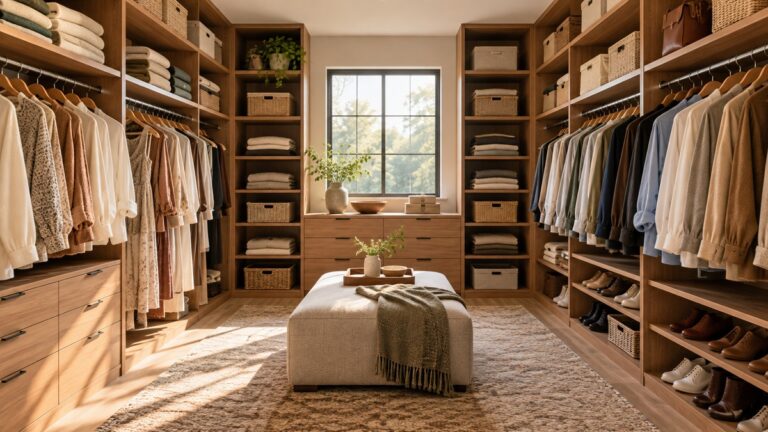
In a walk-in closet, shelves can run along both side walls, and the depth you choose comes out of the width. ClosetMaid says the width of a walk-in affects the depth of shelving you can use. The aisle left is the closet width minus the two shelf depths.
| Walk-in width (our example) | Aisle with two 12-inch shelves | Aisle with two 16-inch shelves |
|---|---|---|
| 60 inches | 60 − 24 = 36 | 60 − 32 = 28 |
| 72 inches | 72 − 24 = 48 | 72 − 32 = 40 |
| 84 inches | 84 − 24 = 60 | 84 − 32 = 52 |
As a reference point only, the ADA standard sets the clear width of walking surfaces on accessible routes at 36 inches minimum, and it sets clear floor space for a wheelchair at 30 by 48 inches. Those are accessibility figures, and nothing we opened says they govern a private walk-in. Even so, a 28-inch aisle between two 16-inch shelves is 8 inches under the first figure. Elfa’s six ready solutions on its walk-in closet page are all 575 mm deep, or 22.6 inches, so that maker plans its hanging systems around about the same depth as a reach-in closet. For layouts in narrow walk-ins, see our guide to narrow walk-in closet organization ideas.
Choose a depth in four steps
- Measure the closet depth from the back wall to the inside edge of the frame, and use the smallest reading.
- List what the shelf will hold and measure the deepest item, such as the larger shoe or a lidded box.
- Pick the nearest stock depth. The stock depths in the sources are 12, 16 and 20 inches.
- Subtract from the closet depth and check that the door still has room to close, allowing for any drawers.
A worked example shows the steps. Suppose the closet is 24 inches deep, the deepest shoe is 13 inches, and the shelf is for shoes and folded sweaters. A 12-inch shelf is too shallow for the 13-inch shoe, so a 16-inch shelf is the next stock depth. It leaves 24 − 16 = 8 inches in front. The sweaters fit either depth, since the 12-inch shelf is described as holding folded garments. The numbers in this example are ours, apart from the stock depths and the 13-inch shoe depth from the North Carolina circular.
How we chose
We chose pages that state a depth in inches or a unit we could convert: the ClosetMaid how-to guide and two ClosetMaid installation sheets, the Elfa Sparring planning guide and two Elfa closet pages, the IKEA PAX page and buying guide, the HUD Fair Housing Act Design Manual, HUD’s room requirements for manufactured homes, two state extension circulars and the ADA standard. Each quoted sentence was checked against the page text on 2026-10-21. The subtraction tables and the walk-in widths are our arithmetic.
Mistakes to avoid
- Choosing 16 inches by default. The North Carolina circular says a 12-inch shelf holds most folded garments, shoes and accessories.
- Using a 16-inch shelf with 16-inch brackets for hanging. ClosetMaid says to use 12-inch brackets so the hangers can slide.
- Forgetting the larger shoe. The circular lists a 13-inch shoe depth, which is deeper than a 12-inch shelf.
- Subtracting from the wrong depth. Use the smallest reading from the back wall to the frame.
- Ignoring the aisle in a walk-in. Two 16-inch shelves take 32 inches of the width.
- Treating a recommendation as a requirement. The HUD manual marks its 18-inch figure as a recommendation only.
What we could not verify
The pages we opened do not give one correct depth for a home closet shelf, and the best depth depends on what you store. The North Carolina circular says a 12-inch shelf holds shoes yet lists a 13-inch shoe depth, and it does not explain how the two fit together. They do not say how much space to leave between the front of a shelf and the door, how thick a shelf is, or what aisle a walk-in needs. The Elfa depths describe open shelving. The HUD and ADA figures come from accessibility and housing rules and may not apply to a private closet. The North Carolina and Oregon State circulars are from the 1960s. The ClosetMaid pages do not state a bracket rule for 20-inch shelving. We make no weight claim.
Frequently asked questions
What is the standard depth for closet shelves?
ClosetMaid sells wire shelving in 12 and 16 inch depths for clothes and storage, and in 16 and 20 inch depths for Close Mesh. A North Carolina State circular says a 12-inch shelf will hold most folded garments, shoes and accessories.
Is a 12-inch or 16-inch closet shelf better?
It depends on the load. ClosetMaid says 16-inch shelving is especially good for linens, boxes and shoe shelving, while the North Carolina circular describes a 12-inch shelf as enough for most hats, folded garments, shoes and accessories.
How deep should a closet be for hanging clothes?
HUD’s manufactured-home rule requires hanging space with a minimum inside depth of 22 inches in a sleeping room. The HUD design manual says closets for hanging clothes are usually 24 inches deep, and the North Carolina circular names 24 inches as its minimum.
Can I use a 16-inch shelf over a clothes rod?
ClosetMaid says hanger bars can be installed with 16-inch shelving, and it says to use 12-inch support brackets so the hangers can slide unobstructed.
How deep should walk-in closet shelves be?
The sources do not set a walk-in depth. ClosetMaid says the width of a walk-in affects the depth of shelving you can use, so subtract two shelf depths from the width to see the aisle you will have left.
Bottom line
Use 12 inches as the default, move to 16 inches for linens, boxes and shoes, and subtract the shelf from the closet depth before you buy.
Sources
- https://homedepot.closetmaid.com/en-US/Installation/Pages/how-to-guides.aspx (opened 2026-10-21)
- https://cdn.rona.ca/documents/74635076-HowToManual.pdf (opened 2026-10-21)
- https://pdf.lowes.com/productdocuments/d1af380f-0c6e-4e7d-92b6-c4cde568f53d/50039299.pdf (opened 2026-10-21)
- https://ocr.lib.ncsu.edu/ocr/ua/ua102_200-001-bx0004-004-005/ua102_200-001-bx0004-004-005.pdf (opened 2026-10-21)
- https://ir.library.oregonstate.edu/xmlui/bitstream/1957/24327/1/ECNO691.pdf (opened 2026-10-21)
- https://www.huduser.gov/portal/sites/default/files/publications/pdf/fairhousing/fairfull.pdf (opened 2026-10-21)
- https://www.ecfr.gov/api/renderer/v1/content/enhanced/current/title-24?part=3280§ion=3280.109 (opened 2026-10-21)
- https://www.ikea.com/sg/en/rooms/bedroom/how-to-plan-pax-pub72099180 (opened 2026-10-21)
- https://www.ikea.com/ie/en/files/pdf/69/0a/690a180e/pax__komplement.pdf (opened 2026-10-21)
- https://elfa.com/en/measure-and-plan/planning-guide-sparring (opened 2026-10-21)
- https://elfa.com/en/inspire-me/room/walk-in-closet (opened 2026-10-21)
- https://elfa.com/en/inspire-me/wardrobe (opened 2026-10-21)
- https://www.access-board.gov/ada/ (opened 2026-10-21)
As an Amazon Associate we earn from qualifying purchases.