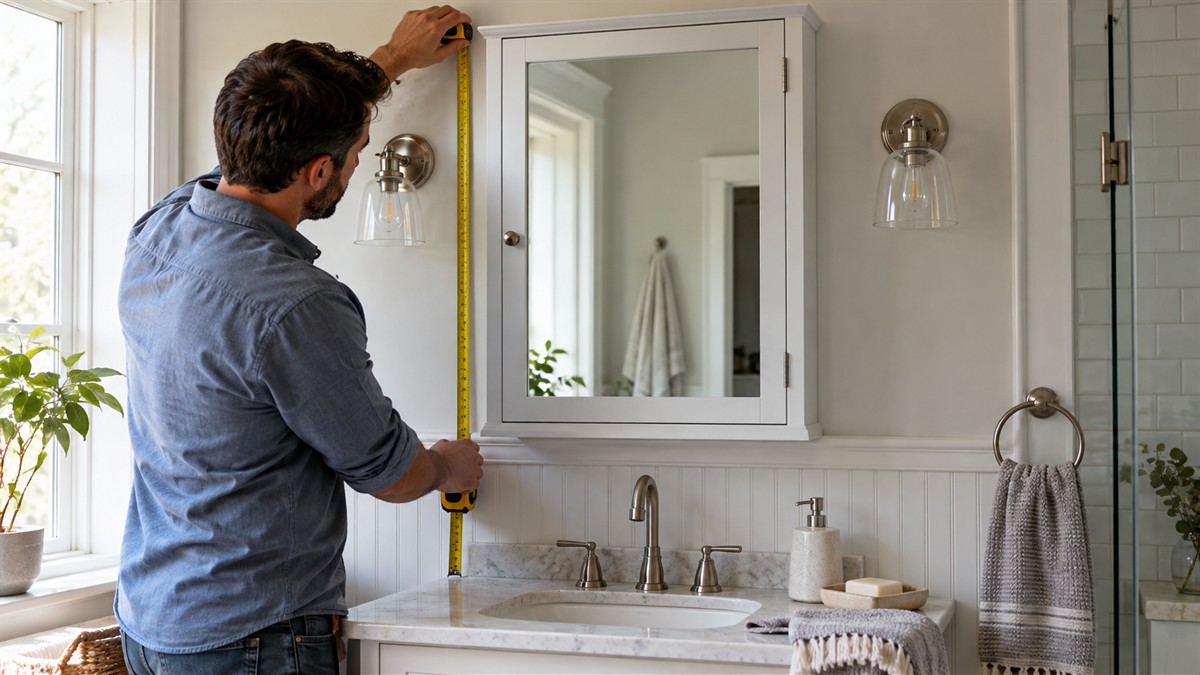
How High Should a Medicine Cabinet Be
As an Amazon Associate we earn from qualifying purchases.
How high should a medicine cabinet be? The pages we opened give three different reference points. Installation sheets hosted by Lowe’s say the recommended height to the center of a recessed cabinet is generally 64 inches from the floor. Kohler’s guide for surface-mounted cabinets puts a mounting bar at 73 or 83 inches, depending on cabinet height. The accessibility standard, by contrast, caps the bottom edge of a mirror above a lavatory at 40 inches. This guide works the three out in inches and shows what none of them settles.
Quick answer
- For a recessed cabinet, the installation sheets we opened say the recommended height to the center is generally 64 inches from the floor.
- For a surface-mounted Kohler cabinet, the guide gives the mounting bar height: 73 inches for a 30 inch tall cabinet and 83 inches for a 40 inch tall one.
- For an accessible bathroom, the ADA text sets the bottom edge of the reflecting surface above a lavatory at 40 inches maximum.
- Leave at least the clearance your model’s spec sheet gives between the cabinet and the faucet, which is 2 or 3 inches on the Kohler sheets we opened.
- Height is not a substitute for a latch. MedlinePlus says to store medicines out of reach and sight of children and in a cabinet with a child latch or lock.
The figures side by side
The table lists every height the pages we opened give for a medicine cabinet or the mirror that is part of it. The reference point is different in each row, which is why the numbers cannot simply be compared.
| Source | Reference point | Figure |
|---|---|---|
| Recess-mount installation sheets hosted by Lowe’s | Center of the cabinet | Generally 64 inches from the floor |
| Kohler installation guide, surface mount, 30 inch tall cabinet | Mounting bar, as recommended | 73 inches from the floor |
| Kohler installation guide, surface mount, 40 inch tall cabinet | Mounting bar, as recommended | 83 inches from the floor |
| Kohler spec sheets | Clearance above an obstruction such as a faucet | 3 inches minimum on one sheet, 2 inches minimum on another |
| ADA Standards 603.3 | Bottom edge of a mirror above a lavatory or countertop | 40 inches maximum |
| ADA Standards 603.3 | Bottom edge of a mirror elsewhere | 35 inches maximum |
| NKBA Guideline 23 | Mirror above or near the lavatory | At a height that takes the user’s eye height into consideration |
| NKBA Guideline 22, access standard | Frequently used storage | 15 to 48 inches above the finished floor |
The 64 inch center, worked out
The installation sheets list the outside size of each cabinet as width × height × depth. Because they fix the center rather than the bottom, the position of the bottom edge changes with the cabinet’s height. The formulas are: bottom edge = 64 − height ÷ 2, and top edge = 64 + height ÷ 2. The last column shows the center height that would put the bottom edge at exactly 40 inches, which is 40 + height ÷ 2.
| Cabinet, outside size from the sheet | Bottom edge at a 64 inch center | Top edge at a 64 inch center | Bottom edge above the 40 inch cap | Center that gives a 40 inch bottom edge |
|---|---|---|---|---|
| 20 × 26 × 5 inches | 64 − 13 = 51 | 64 + 13 = 77 | 51 − 40 = 11 | 40 + 13 = 53 |
| 20 × 28 × 5 inches | 64 − 14 = 50 | 64 + 14 = 78 | 50 − 40 = 10 | 40 + 14 = 54 |
| 16 × 28 × 5 inches | 64 − 14 = 50 | 64 + 14 = 78 | 50 − 40 = 10 | 40 + 14 = 54 |
| 24 × 30 × 5 inches | 64 − 15 = 49 | 64 + 15 = 79 | 49 − 40 = 9 | 40 + 15 = 55 |
At the 64 inch center, the bottom edge of these cabinets sits 9 to 11 inches above the ADA cap for a mirror over a lavatory, and 1 to 3 inches above the 48 inch top of the NKBA reach band. The 64 inch figure is a general recommendation in a maker’s sheet, so it is a default for an ordinary household and not a rule. If you want the bottom edge at 40 inches, the table shows the center must drop by 9 to 11 inches.
Kohler’s bar heights, worked out
Kohler’s guide for a surface-mounted cabinet fixes the height of a mounting bar and does not state the height of the cabinet’s bottom edge. We can still bound it. The bar must sit at or below the top of the cabinet, because the cabinet hangs from it. So the top edge is at least as high as the bar, and the bottom edge is at least the bar height minus the cabinet height.
| Kohler cabinet | Mounting bar height | Bottom edge at least |
|---|---|---|
| 30 inches tall | 73 inches | 73 − 30 = 43 inches |
| 40 inches tall | 83 inches | 83 − 40 = 43 inches |
Both lines give the same floor for the bottom edge, 43 inches, because the bar height rises by exactly the 10 inches by which the cabinet is taller. That floor is already 3 inches above the 40 inch cap. The guide does not say how far below the cabinet’s top the bar sits, so the real bottom edge may be higher, and we do not equate the surface-mount figure with the 64 inch center of the recessed sheets. They use different reference points and different mounting types.
The 40 inch cap for mirrors
The ADA text says that mirrors above lavatories or countertops are installed with the bottom edge of the reflecting surface 40 inches maximum above the finish floor, and 35 inches maximum for mirrors elsewhere. The NKBA lists the same 40 inch figure in the ICC A117.1 reference under its mirror guideline. The NKBA’s own recommendation is softer: place a mirror above or near the lavatory at a height that takes the user’s eye height into consideration. The ADA advisory adds that a single full-length mirror serves more people, including children, and that the top edge of a mirror should be at least 74 inches from the floor to work for both ambulatory people and wheelchair users.
The pages we opened do not say whether the mirrored door of a medicine cabinet counts as a mirror under section 603.3, so the 40 inch cap is a reference and not a ruling about cabinets. If you want to apply it, the faucet is the first obstacle. The Kohler sheets give a minimum clearance of 2 or 3 inches above an obstruction such as a faucet, so the lowest the bottom edge can go is the counter height plus the faucet height plus that clearance. The pages do not give a faucet height. The table therefore uses faucet heights we assumed, and the 34 inch rim height is the ADA’s maximum for a lavatory, used here as an example.
| Assumed faucet height above the rim | Lowest bottom edge with a 3 inch clearance | Lowest bottom edge with a 2 inch clearance | Meets the 40 inch cap? |
|---|---|---|---|
| 4 inches | 34 + 4 + 3 = 41 | 34 + 4 + 2 = 40 | Only with the 2 inch clearance |
| 6 inches | 34 + 6 + 3 = 43 | 34 + 6 + 2 = 42 | No |
| 8 inches | 34 + 8 + 3 = 45 | 34 + 8 + 2 = 44 | No |
The table shows why the 40 inch cap and a faucet clearance can collide. With a rim at 34 inches, a faucet that rises more than 3 inches (with a 3 inch clearance) or more than 4 inches (with a 2 inch clearance) leaves no room for both. A lower rim helps, and so does a lower faucet. The NKBA gives lavatory heights from 32 to 43 inches, so the numbers move with the vanity. For the vanity side of the question, see our guide to a pedestal sink storage cabinet.
Reach: how much of the cabinet you can use
A medicine cabinet is also storage, and the NKBA access standard plans frequently used items between 15 and 48 inches above the finished floor. The ADA text sets the same unobstructed forward reach. Over a counter deeper than 20 inches the high reach drops to 44 inches. A cabinet maker’s specification guide lists standard vanity bases 21 inches deep, so a vanity counter can fall on the 44 inch side, and the table shows both limits. The formula is: reachable height = the lower of the cabinet’s top and the reach limit, minus the cabinet’s bottom edge, if the result is above zero.
| Scenario (heights from the pages above) | Cabinet height | Reachable at 48 inches | Reachable at 44 inches |
|---|---|---|---|
| Bottom edge at 49 inches (64 inch center, 30 inch cabinet) | 30 | 0 inches | 0 inches |
| Bottom edge at 43 inches (Kohler floor, 30 inch cabinet) | 30 | 48 − 43 = 5 inches, up to 16.7 percent | 44 − 43 = 1 inch, up to 3.3 percent |
| Bottom edge at 40 inches (ADA cap, 28 inch cabinet) | 28 | 48 − 40 = 8 inches, 28.6 percent | 44 − 40 = 4 inches, 14.3 percent |
The pattern matters more than any single line. The higher a cabinet hangs, the less of it lies inside the reach band, and a cabinet at the 64 inch center holds none of it inside the band. That is fine if the cabinet stores only occasional items. It is a problem if the cabinet is your daily storage, in which case the NKBA reach band is the better guide. For storage that stays within reach, see our guide to a small bathroom wall shelf.
Children and what height cannot do
The ADA advisory table gives high reach limits of 36 inches for ages 3 and 4, 40 inches for ages 5 through 8, and 44 inches for ages 9 through 12. A bottom edge at 49 inches is above all three. The table is guidance about comfortable reach for building elements designed for children, and the pages we opened give no height at which a medicine cabinet is out of a child’s reach.
The medical sources point to a different safeguard. MedlinePlus says to store medicines out of reach and out of sight of children and to keep them in a cabinet with a child latch or lock. Poison Control says to lock household products and medicines out of a child’s reach. Neither page offers a height as the answer. Choose the cabinet height for the adults who use the mirror, and add the lock for the children.
Should medicines be in a medicine cabinet at all?
This is a fair question to ask before you pick a height. MedlinePlus says that the heat and moisture from your shower, bath and sink may damage medicines, and it names a dresser drawer, a kitchen cabinet away from the stove and sink, a storage box, a shelf or a closet as better places. If you move medicines out, the cabinet in the bathroom holds toiletries and grooming items, and the height question becomes about the mirror and about daily reach. If medicines stay, MedlinePlus says to keep them in their original container.
How to choose your height
- Decide whether the cabinet is mainly a mirror or mainly storage. A mirror goes by the user’s eye height. Storage goes by reach.
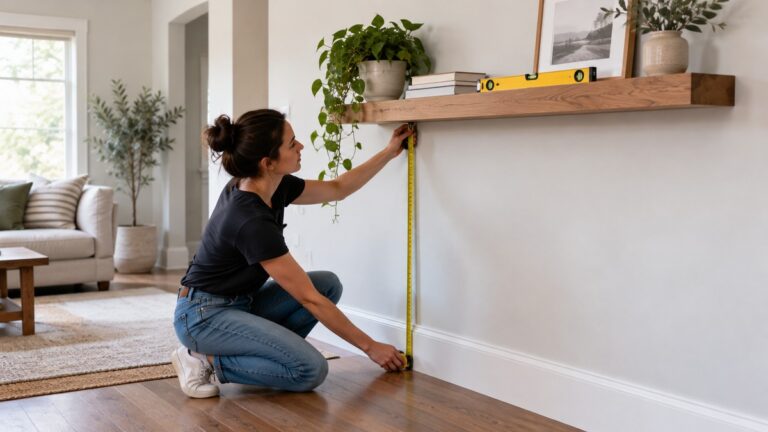
- Measure the eye height of the tallest and the shortest regular user, and note the vanity rim and faucet heights.
- For an accessible bathroom, start from the 40 inch cap for the mirror’s bottom edge and check the faucet clearance with the table above.
- For an ordinary household, use the maker’s recommended height as a default, then adjust it to the eye heights you measured.
- Mark the position with tape on the wall and stand in front of it to check the view. This step is our suggestion.
- Add the latch or lock whatever the height.
If wall space above the vanity is tight, a cabinet over the toilet is another option, and our guide to an over-the-toilet cabinet with glass doors covers it.
How we chose
We opened the ADA Standards chapter on toilet and bathing rooms, the Access Board’s full ADA text, the NKBA bathroom planning guidelines, a Kohler installation guide, two Kohler specification sheets, four recess-mount installation sheets hosted by Lowe’s, MedlinePlus and Poison Control on 2026-10-21. We kept only the heights and clearances that those pages state in plain words. Where a page gave a reference point and not a bottom edge, we worked out the bottom edge with a stated formula, and we labelled the assumed inputs. This guide makes no claims about how to mount a cabinet, because that was outside the question and outside the pages we opened.
What we could not verify: what the sources do not say
The pages we opened do not give one recommended height that fits every household. They do not say how far below the top of a Kohler cabinet its mounting bar sits. They do not say whether a mirrored door counts as a mirror under the ADA text. They give no faucet height and no height at which a cabinet is out of a child’s reach. The ADA and NKBA reach ranges come from accessible-design documents, and the pages do not say they apply to a private home. The 64 inch figure comes from installation sheets for specific recess-mount cabinets and the sheets use the word generally. The faucet heights and the 34 inch rim in the clearance table are our assumptions.
Frequently asked questions
How high should a medicine cabinet be above the sink?
The Kohler sheets we opened give a minimum clearance of 2 or 3 inches between the cabinet and a faucet or similar obstruction, depending on the model. The pages give no total height, so the faucet height and the user’s eye level decide it.
What height is the center of a medicine cabinet usually set at?
The recess-mount installation sheets we opened say the recommended height to the center is generally 64 inches from the floor. That is a maker’s recommendation for those cabinets, not a code figure.
Does the ADA set a height for a medicine cabinet?
The ADA text we opened sets a height for mirrors and does not name medicine cabinets: 40 inches maximum for the bottom edge of a mirror above a lavatory or countertop, and 35 inches maximum elsewhere. The pages we opened do not say how this applies to a mirrored cabinet door.
How can I keep medicines away from children?
MedlinePlus says to store medicines out of reach and sight of children, in a cabinet with a child latch or lock. Poison Control says to lock medicines out of a child’s reach. A latch or lock matters more than height alone.
Is a bathroom medicine cabinet a good place for medicine?
MedlinePlus says the heat and moisture from a shower, bath and sink may damage medicines, and lists a dresser drawer, a kitchen cabinet away from the stove, a storage box, a shelf or a closet as better places.
Bottom line
Use the maker’s 64 inch center as a starting point, drop the cabinet toward the 40 inch bottom edge if the room must be accessible, clear the faucet by the amount your spec sheet states, and lock the medicines.
Sources
- https://www.access-board.gov/ada/chapter/ch06/ (opened 2026-10-21)
- https://www.access-board.gov/ada/ (opened 2026-10-21)
- https://media.nkba.org/uploads/2022/05/Bath-Planning-Guidelines.pdf (opened 2026-10-21)
- https://techcomm.kohler.com/techcomm/pdf/1516730-2.pdf (opened 2026-10-21)
- https://techcomm.kohler.com/techcomm/pdf/K-99008_spec_US-CA_Kohler_en.pdf (opened 2026-10-21)
- https://pdf.lowes.com/productdocuments/1ca140b8-992e-40f9-8fa8-d81aa58de2ab/63052840.pdf (opened 2026-10-21)
- https://pdf.lowes.com/productdocuments/3b1faaf4-2edc-4072-81f2-1016796c865b/70187546.pdf (opened 2026-10-21)
- https://pdf.lowes.com/productdocuments/94ecf319-612a-4bc6-b8b2-998048d51d23/67000056.pdf (opened 2026-10-21)
- https://pdf.lowes.com/productdocuments/8b856e71-ced1-45c4-89b4-753403a1fb72/67569499.pdf (opened 2026-10-21)
- https://pdf.lowes.com/productdocuments/932903a8-c542-4d4e-88eb-e9c331ef4761/66790707.pdf (opened 2026-10-21)
- https://medlineplus.gov/ency/patientinstructions/000534.htm (opened 2026-10-21)
- https://www.poison.org/poison-prevention-tips-by-age/toddler (opened 2026-10-21)
- https://pdf.lowes.com/productdocuments/a1eb9084-5b50-46c6-8c75-617601687698/48070959.pdf (opened 2026-10-21)
Disclosure: As an Amazon Associate we earn from qualifying purchases.