How to Assemble Garage Shelves Safely
Affiliate disclosure: As an Amazon Associate we earn from qualifying purchases.
How to assemble garage shelves safely comes down to a few habits: check every part before you start, build on a level and firm floor, work with at least one helper, and tighten the bolts only after the frame is complete. This guide follows the printed assembly sheets for three shelving units and one storage center. It lists the load and height figures those sheets state, and it marks where a sheet says nothing. Your own unit’s sheet controls the exact order and numbers, so read it before you lift the first post.
Quick answer
- Check every part against the sheet before you lift anything. The SafeRacks sheet says its 8 foot garage unit arrives in three separate boxes.
- Assemble with at least two people. The UK garage guide says assembly should be undertaken by at least two competent persons.
- Finger-tighten the bolts while you build, then tighten all of them at the end. The SafeRacks sheet gives that order.
- Keep each shelf within its stated load. The limits printed are 500 pounds per shelf for the SafeRacks unit and 175 kg per shelf for the UK unit.
What the sheets state, and what they leave out
Table 1 lists only the figures the opened sheets print. Where a sheet is silent, the table says so. Do not fill a blank with a figure from a different brand, because a shelf’s limit belongs to the unit it was printed for.
| Unit (sheet) | Size stated | Load stated | Floor fixing stated |
|---|---|---|---|
| SafeRacks 8 ft garage shelving | 2 ft deep, 8 ft wide, 7 ft high | 500 lb per shelf maximum | Not stated |
| UK garage shelving unit | Maximum upright height 1780 mm | 175 kg per shelf in the full-height bay | Recommended; tall narrow bays may need it |
| Wire shelving (Argo instructions) | Not stated | No figure; the sheet asks you to check each shelf and the whole unit | Not stated |
Convert the figures before you compare them
Most US shelving is listed in feet and pounds, while the UK sheet uses millimeters and kilograms. Table 2 puts each stated figure on one scale. The arithmetic uses 2.20462 pounds per kilogram and 25.4 millimeters per inch.
| Calculation | Input from the sheet | Result |
|---|---|---|
| UK per-shelf limit in pounds | 175 kg × 2.20462 | 385.8 lb per shelf |
| SafeRacks per-shelf limit in kilograms | 500 lb × 0.4536 | 226.8 kg per shelf |
| UK chart total against per-shelf limit | 875 kg ÷ 175 kg | 5, so the chart total equals five shelves at the per-shelf figure |
| UK maximum upright height in inches | 1780 mm ÷ 25.4 | 70.1 inches |
| SafeRacks width in inches | 8 ft × 12 | 96 inches |
| SafeRacks height in inches | 7 ft × 12 | 84 inches |
Read the converted figures as limits for one product only. A 500 pound shelf and a 175 kilogram shelf come from different sheets, and neither applies to a shelf you buy elsewhere.
Before you open the box
Clear a space large enough to lay out the posts, beams and shelves. The UK guide asks for a suitable level floor that can carry the load and leaves room to work. Count the parts against the sheet’s parts list before you discard any carton, and if a part is missing, contact the maker’s support line printed on the sheet rather than substituting a bolt or shelf from another kit. Check the unit type too. A wire shelf, a solid board shelf and a welded post frame do not share the same parts. If you are still choosing a type, read our utility shelves comparison first, or the Sakugi and DUMOS comparison for a second set of models.
Plan the shelf levels before you bolt anything
The SafeRacks sheet places the 2-foot beams at the shelf levels you have chosen, so decide the levels first. The table divides the stated 84-inch height evenly. It is a planning aid, not a figure from the sheet.
| Number of spaces | Calculation | Spacing between levels |
|---|---|---|
| 3 | 84 in ÷ 3 | 28 inches |
| 4 | 84 in ÷ 4 | 21 inches |
| 5 | 84 in ÷ 5 | 16.8 inches |
Mark the chosen levels on the posts with a pencil, so both side sections are marked the same way. The UK load chart is written for similar distances between levels, so an even split matches the layout that chart describes.
Build the frame in the order the sheets use
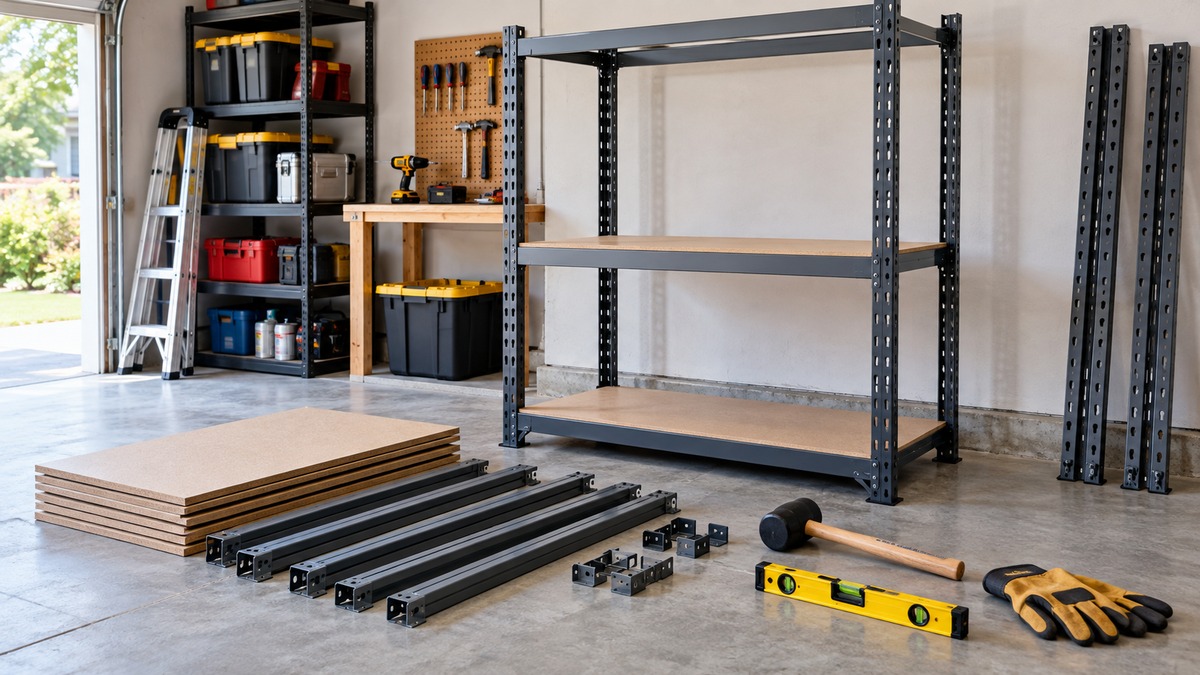
The SafeRacks sheet builds two matching side sections first. Stand two vertical posts against a wall or lay them on the floor with the keyholes facing down, then add the 2-foot beams at your chosen levels. Repeat so you have two identical sections. Next add the 8-foot beams at the same levels, fit the center supports between them, and lay the wire decks with the side that has more front-to-back wires facing up. The sheet ends with brackets where two decks meet, and a final pass of tightening.
The Argo wire shelving sheet works differently. It has you push the leveling feet into the post bottoms, slide the posts through the collars in the bottom shelf, set the frame upright, and seat each shelf with a mallet and a towel. Follow the order your own sheet gives, because each step assumes the one before it is finished. For a wider choice of metal frames, compare 5-tier metal shelving options and 5-shelf metal storage racks before you commit to a layout.
Use two people, and keep ladders off the shelving
The UK guide asks for at least two competent persons and suggests that another person hold the frames in place while you secure them. Two people are most useful when you join the side frames and tighten the beams. The same guide says never to climb the structure and not to lean ladders, steps or other objects against the shelving. Use a stepladder or safety steps placed away from the frame to reach upper levels, and take care when you lift heavy parts.
Load limits and where to place weight
The SafeRacks sheet sets a maximum of 500 pounds per shelf and says to load the unit evenly, with heavy objects nearest the vertical posts and light objects nearest the center. The UK guide lists 175 kg per shelf for its full-height bay and says the product is designed for hand loading only. The Argo sheet gives no figure. It asks you to check the weight capacity of each shelf and of the entire unit, and to spread items evenly.
The UK chart applies only to its stated conditions: a maximum upright height of 1780 mm, single bays, similar distances between levels, and bays on a level floor. Any other use needs the supplier’s loading figures. For more models to compare on stated capacity, see this storage rack comparison, or read the closetmaid wire shelf weight limit post for wire shelves in particular.
Tall and narrow units: floor fixing
The UK guide recommends fixing the product to the floor and says tall narrow bays may need floor fixing to ensure stability. Its maximum upright height is 1780 mm, or about 70.1 inches. The guide lists wall fixings as an accessory, but the pages we opened do not describe how to fix the unit to a floor or a wall. Follow your manufacturer’s anchoring instructions, and do not improvise with brackets or fasteners the sheet does not name. If overhead storage is the alternative you are weighing, compare ceiling mounted storage racks and check the printed mounting method before you drill.
Level the frame and the shelves
The Argo sheet has you stand a stationary unit upright and then screw the foot levelers in or out to level the whole frame. The Southwest Solutions pullout shelving sheet gives a similar order: seat the tapered foot bushings with a rubber mallet, screw in the adjustable levelers, then stand the unit upright and adjust them as required. Both sheets put leveling after the unit is standing, not before.
Final checks before you load the shelves
Walk around the finished unit before anything goes on it. Every shoulder bolt on the beams should be tight with the wrench, not only finger tight. Each shelf should sit fully over its supports, the unit should stand upright, and the leveling feet should be set so each post sits on the floor. Lock the casters on a mobile unit when it is stationary, as the Argo sheet asks. Keep the sheet with the unit so you can check the stated limits later.
Mistakes to avoid
- Tightening bolts before the frame is complete. The SafeRacks sheet asks for finger tightening first and the wrench at the end.
- Assembling alone. The UK guide asks for at least two competent persons.
- Building on an uneven or soft surface. The UK guide asks for a suitable level floor that can carry the load.
- Leaning a ladder or steps on the shelving. The UK guide says not to.
- Loading beyond the printed figure. The SafeRacks limit is 500 pounds per shelf, and the UK guide lists 175 kg per shelf.
- Skipping the parts count. The SafeRacks unit arrives in three boxes, so a missing part only shows up if you check each box.
- Installing self-leveling feet on a unit that uses casters. The Uline sheet says not to install self-leveling feet when casters are fitted.
How we chose
We chose five printed assembly sheets that describe a garage or wire shelving unit, give a clear order of steps, and state at least one figure we could compare. We opened each file on 2026-10-21 and read the sections on assembly, people, floors, loads, leveling and fixing. We did not rank products, and we did not compare offers or ratings. We left out retail product pages and used the printed sheets instead. Two safety-agency pages could not be opened, so this article has no government source on fixing or stability. Each figure is attributed to the sheet it came from.
What we could not verify
- How any garage shelf is anchored to a wall or a floor. The pages we opened do not describe an anchoring method, so this article does not give one.
- Load limits for models other than the ones named here. The sheet for your own model controls.
- Whether each sheet still matches current production. The Argo sheet is dated 8/2024, and the SafeRacks sheet carries a copyright line from 2015 to 2018.
- How far each leveling foot can adjust. The sheets we opened do not print that range.
Before you order a standing shelf unit, compare the standing shelf units from Plano and VEVOR, then check the leveling step on the sheet that ships with the one you pick. The sheets we opened do not share one leveling order.
FAQ
Do I need two people to assemble garage shelves?
The UK garage guide says at least two competent persons should do the assembly. A second person can hold frames in place while you secure them.
Should garage shelves be fixed to the floor?
The UK guide recommends fixing the product to the floor and says tall narrow bays may need it for stability. Follow your manufacturer’s fixing instructions, because the pages we opened do not describe a method.
How much weight can one garage shelf hold?
It depends on the model. The SafeRacks sheet states 500 pounds per shelf as a maximum, and the UK guide lists 175 kg per shelf. Use the figure printed for your own unit.
Which bolts should I tighten first?
The SafeRacks sheet says to finger-tighten the shoulder bolts while you build, then tighten all of them with the wrench after the shelves are in place.
Can I lean a ladder against the shelves to reach the top?
No. The UK guide says never to climb the structure and not to lean ladders or steps against the shelving. Use a stepladder placed away from the frame.
Should I build on a level floor?
Yes. Choose a floor that is level, firm enough for the load, and roomy enough to work around the frame.
Bottom line
Build the frame with two people on a level floor, tighten every bolt only after the frame is complete, and never load a shelf above the figure printed for your own unit.
Sources
- https://www.costco.com/wcsstore/CostcoUSBCCatalogAssetStore/Attachment/SafeRacks+Freestanding-Shelving_Instructions.pdf (opened 2026-10-21)
- https://manuals.bigdug.co.uk/1588602832175RBQ_Garage_Shelving_Unit_Assembly_2020_web.pdf (opened 2026-10-21)
- https://argo.webstaurantstore.com/documents/pdf/wire_shelving_installation_guide.pdf (opened 2026-10-21)
- https://img.uline.com/is/content/uline/IH-2449pdf (opened 2026-10-21)
- https://www.southwestsolutions.com/sms-external-images/installation-brochures/Pullout_Shelving_Assembly_NEX.pdf (opened 2026-10-21)
Affiliate disclosure again: As an Amazon Associate we earn from qualifying purchases.