How to Level Garage Shelves on Uneven Floors
Affiliate disclosure: As an Amazon Associate we earn from qualifying purchases.
How to level garage shelves on uneven floors starts before anything is loaded. Find the highest point of the floor, set the first unit there, and then bring the other corners to the same height with the adjustable feet. The assembly sheets we opened describe this order in different ways, and none of them prints how far a foot can travel. This guide sets out what each sheet says, shows the checks a long run of shelving needs, and marks what the sheets leave unanswered. The steps assume adjustable or self-leveling feet, so confirm that your unit has one of them first.
Quick answer
- Level the unit after it stands, not while it lies on its side. The Argo and Southwest sheets both adjust the feet once the frame is upright.
- On a sloped floor, start at the high point. The StoreMore guide sets its first base there, with the adjustable feet screwed almost all the way in.
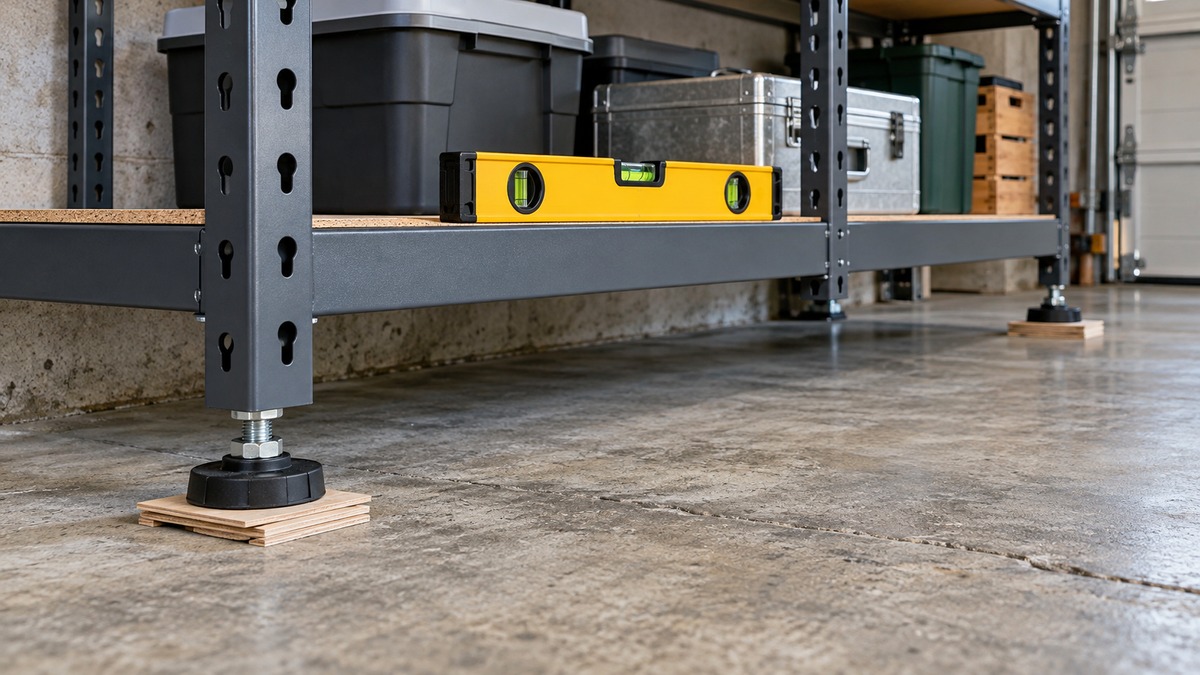
- Check front to back and side to side, then rock the frame on all four corners so every foot carries weight.
- Expect a limit. None of the sheets we opened prints how far a foot can travel, so check your own unit before you rely on the adjustment.
What each sheet says about leveling
Table 1 compares the leveling step in each sheet. A blank cell means the sheet does not say.
| Sheet | Starting point | Tool named | Final adjustment |
|---|---|---|---|
| StoreMore retractable shelving guide | Highest point of the floor | Two or four foot level; torpedo level | Feet left down about 25 percent so neighboring bases match |
| Southwest Solutions pullout shelving | Tapered bushings seated in post bottoms | Rubber mallet for the bushings | Stand the unit upright, then adjust the levelers as required |
| Argo wire shelving | Leveling feet pushed into post bottoms | Not named | Stationary unit: screw the feet in or out after standing |
| Uline IH-3818 wire shelving | Self-leveling feet tapped into posts | Rubber mallet or hammer | Not stated |
| UK garage shelving guide | Suitable level floor before assembly | Not named | Not stated |
Leveling order at a glance
The sheets differ in detail, but they share a sequence. Use this order for a stationary unit with adjustable or self-leveling feet, and check each step name against your own sheet.
- Seat the leveling feet or self-leveling feet into the post bottoms before the shelves go on, as the Argo and Uline sheets do.
- Assemble the frame and stand it upright, as the Argo and Southwest sheets do.
- On a sloped floor, find the highest point with a level, as the StoreMore guide does for a row of bases.
- Level the unit front to back with a two or four foot level, then left to right with a torpedo level.
- Rock the frame on its corners so all four feet touch the floor, then lower the middle feet.
- For a row, bring each remaining unit to the same elevation as the first unit.
Steps 1 and 2 happen during assembly. Steps 3 to 5 are the leveling itself. Step 6 applies only to a row, so a single stationary unit stops after step 5 and then goes to the checks in Table 2.
Find the high point before you set a foot
The StoreMore guide is written for a row of bases, but its first step applies to any run of shelving that has to sit at one height. Use a level to find the highest point of the floor where the units will stand. The base on that spot gets its adjustable feet screwed almost all the way in when it is leveled. Bases placed on lower floor have their feet screwed out by varying amounts, so every base lies in the same horizontal plane. A single unit has no neighbor to match, so the step matters most when you line up several units.
Keep the first base off the wall. The StoreMore procedure sets it at least 1 inch off the back wall before it is leveled. If your garage shelf is also fixed to a wall, follow the manufacturer’s fixing sheet, because a gap from the wall is not a fixing method. For stand-alone units to compare, see standing shelf units from Plano and VEVOR or the SINGAYE and VEVOR standing units.
Level front to back, then side to side
StoreMore’s procedure for the first base turns two of the feet down slightly and makes sure the third is fully in. A two or four foot level rests on the top frame sides to level the carriage front to back, and the front feet are adjusted until it reads level. A torpedo level on the top of the shelf frame then checks left to right. Rock the carriage on its corners so all four feet touch the floor, and lower the middle feet to the floor once the frame is level. The guide calls the first unit the benchmark for the rest of the system.
Use the same tools on each shelf you level, and check both directions on every level. If a shelf rocks when you press a corner, adjust the foot nearest the rock and check again before you move on.
Match a row to the benchmark unit
Once the first unit is level, bring each remaining unit to the same elevation with a torpedo level and a two or four foot level, leveling each one against the benchmark. The StoreMore guide says its bases are designed to butt against each other, so the units must line up in front before the row is finished. Continue until every base is level with its neighbors. That guide starts its anchoring only after this step, and its anchoring uses its own brackets. For your unit, follow the manufacturer’s anchoring instructions rather than copying that layout.
If you are lining up several metal frames, compare 5-tier metal shelving and 5-shelf metal storage racks before you buy, because each sheet has its own leveling step and its own order.
Self-leveling feet on wire shelving
The Uline wire shelving handout (IH-3818) uses self-leveling feet. You insert each foot into the open end of a post and tap it in with a rubber mallet or hammer until it slides into the post. The sheet also says that self-leveling feet should not be installed when casters are used. Uline’s garment storage center handout (IH-2449) describes the same self-leveling foot and the same tap-in step. Neither sheet gives a separate adjustment step or a range, so do not assume the feet will correct a slope until your own sheet says how much they adjust.
Adjust the feet after the unit stands
The Argo instruction sheet for wire shelving puts leveling last. For a stationary unit, you stand the frame upright and then screw the foot levelers in or out to level the whole unit. The Southwest pullout shelving sheet gives a similar order: after assembly, stand the unit upright and adjust the foot levelers as required. Both sheets treat the feet as the final adjustment, so plan to level after the frame stands rather than while the parts are still laid out on the floor. The Argo sheet also notes that pushing the foot leveler inserts into the posts may take a bit of force, so seat them before the shelves go on. Once the unit is level, the closetmaid wire shelf weight limit post is the next read for how much it can carry.
How many checks a long run needs
A beam is longer than a level, so one reading does not cover it. The SafeRacks garage unit is 8 feet wide and 2 feet deep, which gives the spans in Table 2. The arithmetic uses a 2-foot level, one of the lengths the StoreMore procedure names.
| Check | Calculation | Result |
|---|---|---|
| Readings along the 8-foot beam | 96 in ÷ 24 in | 4 spans |
| Readings front to back on the 2-foot depth | 24 in ÷ 24 in | 1 span |
Read each span and adjust the nearest foot before you move to the next one. Check every beam at each level, since a shelf can read level front to back and still sit out of level side to side.
Uneven floors and tall units
The UK garage guide says to build on a suitable level floor that is strong enough to carry the load and allows room to work. It recommends fixing the product to the floor and says tall narrow bays may need floor fixing to ensure stability. Its maximum upright height is 1780 mm, or about 70.1 inches. The same guide makes its load chart valid only for bays on a level floor, so an uneven floor puts the unit outside the chart. The pages we opened do not describe a fixing method for uneven floors, so this article does not give one. Follow your manufacturer’s anchoring instructions, and do not use shims or packers unless the sheet names them. For a taller unit that you are considering as an alternative to a floor frame, see ceiling mounted storage racks and check the printed mounting method first.
Mistakes to avoid
- Leveling before the unit stands. The Argo and Southwest sheets both adjust the feet after the frame is upright.
- Starting a run from a low corner. The StoreMore guide starts at the highest point of the floor.
- Leveling by eye. The StoreMore procedure uses a two or four foot level and a torpedo level, and checks both directions.
- Assuming the feet adjust without limit. Check the travel range on your own sheet.
- Setting the first base against the wall. The StoreMore procedure keeps it at least 1 inch off the back wall.
- Installing self-leveling feet on a unit that uses casters. The Uline sheet says not to do that.
- Leveling a shelf on an uneven floor and still expecting the load chart to apply. The UK guide’s chart is valid only for bays on a level floor.
If you are still choosing a model, compare the OUTNILI and Sttoraboks storage racks or the Sakugi and JOJUOU utility shelves, and then check the leveling step on the sheet that ships with the one you buy.
How we chose
We chose six printed instruction documents that describe a leveling step: a retractable shelving guide, three wire or pullout sheets, one UK garage guide and one garage unit sheet. We opened each file on 2026-10-21 and read the sections on leveling, floors, fixing and loading. We did not rank products, and we did not compare offers or ratings. Two safety-agency pages could not be opened, so this article has no government source on floors or stability. Where two sheets describe the same tool or order, we say so, and where a sheet is silent, the table shows a blank cell.
What we could not verify
- How far each leveling foot can travel. None of the sheets we opened prints that range.
- Whether shims or packers are safe for a given unit. The sheets we opened do not mention shimming for garage shelves.
- How leveling differs between units with casters and units with fixed feet, beyond the Uline note on casters.
- A fixing method for an uneven floor. The pages we opened do not describe one.
- Whether each sheet still matches current production. The Argo sheet is dated 8/2024, and the other sheets carry no date we could confirm.
FAQ
Can I level garage shelves with the feet alone?
Often, if the unit has adjustable feet. The Argo and Southwest sheets adjust the feet after the frame stands. The sheets we opened do not print how far a foot travels, so check the range on your own unit.
Where do I start on a sloped floor?
Start at the highest point of the floor, as the StoreMore guide does for a row of bases. Set that unit first, then match the rest of the run to it.
How do I check that a shelf is level?
Use a two or four foot level on the frame, then a torpedo level across the shelf. Rock the frame on all four corners so every foot touches the floor.
Should I shim the feet on an uneven floor?
Not unless your manufacturer’s sheet names shims or packers. The pages we opened do not describe shimming for garage shelves.
Do self-leveling feet correct a sloped floor?
The Uline sheets describe self-leveling feet that are tapped into the posts, but they do not state a correction range. Check your sheet before you rely on them.
Does an uneven floor affect the load limit?
It can. The UK guide says its load chart applies to bays on a level floor, and any other use needs the supplier’s loading figures.
Bottom line
Level every garage shelf after it stands, start from the high point of the floor, and check all four corners in both directions before you load it.
Sources
- https://products.storemorestore.com/hubfs/StoreMoreStore/Shelving-and-Racks/Retractable-Shelving-Systems/Assembly-Guide.pdf (opened 2026-10-21)
- https://argo.webstaurantstore.com/documents/pdf/wire_shelving_installation_guide.pdf (opened 2026-10-21)
- https://www.southwestsolutions.com/sms-external-images/installation-brochures/Pullout_Shelving_Assembly_NEX.pdf (opened 2026-10-21)
- https://img.uline.com/is/content/uline/IH-3818pdf (opened 2026-10-21)
- https://manuals.bigdug.co.uk/1588602832175RBQ_Garage_Shelving_Unit_Assembly_2020_web.pdf (opened 2026-10-21)
- https://www.costco.com/wcsstore/CostcoUSBCCatalogAssetStore/Attachment/SafeRacks+Freestanding-Shelving_Instructions.pdf (opened 2026-10-21)
Affiliate disclosure again: As an Amazon Associate we earn from qualifying purchases.