How to Plan a Closet Organization System
Affiliate disclosure: As an Amazon Associate we earn from qualifying purchases.
How to plan a closet organization system starts with a count of what you store and how much hanging space it needs, not with the shelves. The extension publications we opened set out the same basic order: decide whether the closet needs more space or a better layout, write down what you own, and give each kind of clothing a rod or shelf at the height it needs. Two of those publications date from 1964 and 1967, so this guide uses them for method and arithmetic. They do not give current product sizes, and we say so where it matters.
Quick answer
- Decide first whether you need more closet or a better one. The 1967 Oregon State circular says improving the present closet may be the better answer.
- Count what you own and what you need, on paper or in a spreadsheet. The Nebraska circular EC476 describes a plan and a spreadsheet for exactly this.
- Allow about 4 feet of hanging rod per person. The Oregon State circular gives that figure as a minimum for hanging clothes.
- Put long garments on the higher rod and short garments on a lower one, then use the space between for shelves.
Start with the question: more closet or better closet?
The Oregon State circular asks you to weigh whether the items you store justify the cost of an additional closet. It warns that a new closet without a storage plan may do little to relieve a crowded one. Its advice is to add accessories that suit the type of article stored, because the improvement can be inexpensive compared with building. For many homes, the first planning step is therefore a look at the closet you already have, not a shopping list.
If the look at the closet shows that the items cannot fit, then a second closet or an added storage area becomes the question. The circular gives examples of space that some homes use for this, including the area under a stairway and a portable closet that can serve as a room divider. Those options need the same count of items and rod length as a built-in closet.
Write down what you own and what you need
The Nebraska circular EC476, Planning the Family Wardrobe, suggests a written plan and a spreadsheet that record what the household has and what it needs. The same archive lists EC64-434, Ready to Wear through Care, which covers the proper organization of clothing so that storage space goes further. Together they support a simple method. List the clothes by owner, then mark each item as hung, folded, or stored out of season, and compare the list against the space you have.
A list is useful only if it stays current. Update it when the seasons change, and note which items you wear each week. That record tells you which rod or shelf needs to be closest to the door, and it shows when a plan needs more space rather than more hangers.
Calculate the rod length from the number of people
The Oregon State circular states that hanging clothes need at least four feet of rod space per person. Table 1 applies that figure to a closet shared by one to four people. It is arithmetic from the 1967 rule, so it gives a starting length, not a guarantee for modern garments.
| People sharing the closet | Calculation | Rod length needed (inches) | Rod length needed (feet) |
|---|---|---|---|
| 1 | 1 × 48 in | 48 | 4 |
| 2 | 2 × 48 in | 96 | 8 |
| 3 | 3 × 48 in | 144 | 12 |
| 4 | 4 × 48 in | 192 | 16 |
Check the result against the closet width. A rod can run along the back wall, but it also needs clearance at each end. If the closet is too narrow for the total, the circular suggests either a second rod at a different height or a different hanging method, which the next section covers.
Plan two hanging heights
The Oregon State circular gives average hanging heights for different kinds of clothing. The figures in Table 2 come from that table, and they are labeled as the 1967 averages.
| Clothing (1967 average) | Hanging height | Calculation against a 63-inch rod |
|---|---|---|
| Street dresses and coats | 63 inches | Reference rod |
| Trousers, suits, blouses and skirts | 39 to 45 inches | 63 − 45 = 18 and 63 − 39 = 24 inches |
| Clothes for 3- to 5-year-olds | 30 inches | 63 − 30 = 33 inches |
| Clothes for 5- to 12-year-olds | 45 inches | 63 − 45 = 18 inches |
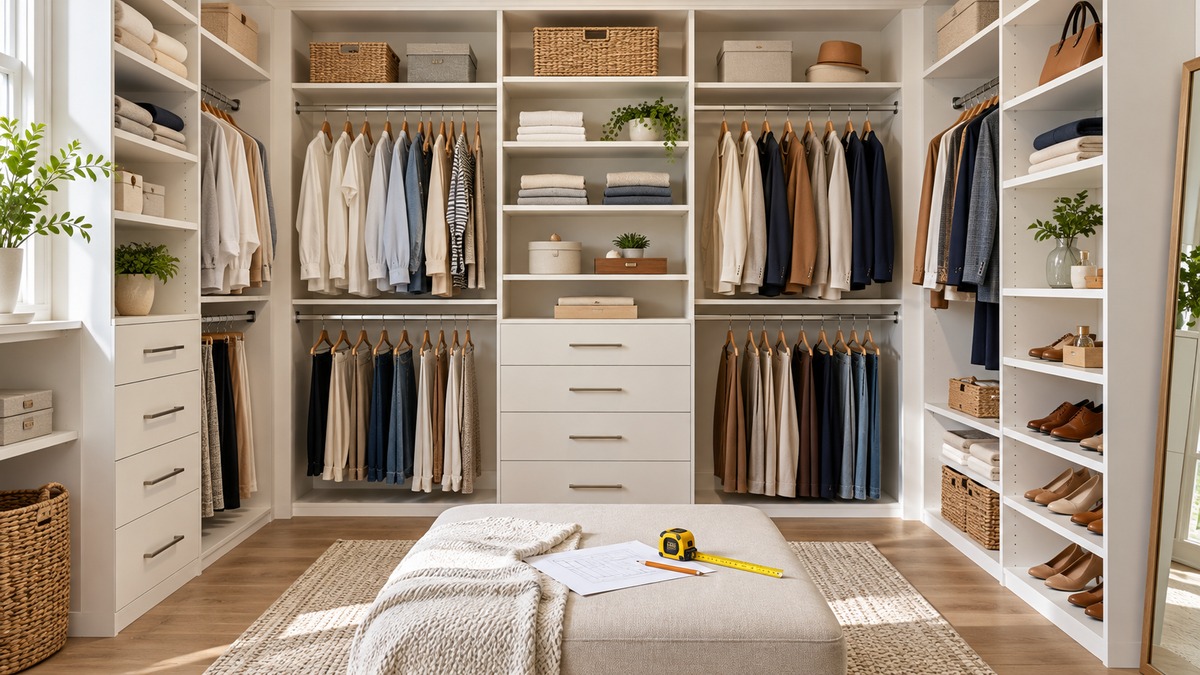
The circular suggests that some clothes rod space be higher than the rest. Short items hang on the lower rod and leave shelf space above them. The gap between a 63-inch rod and a 39- to 45-inch rod is 18 to 24 inches, which is the room that a shelf above the lower rod would use. Measure the actual gap in your closet before you buy shelving, because the 1967 heights describe the garments of that period.
Use the shelf, door and floor space
The circular lists several ways to add storage without a new closet. Boxes stacked at one side provide shelf areas at several heights for caps, hats, shoes and out-of-season items. A portable step shelf can sit above or below clothes on hangers, and it can be shorter than the closet with the tall items placed at the end. A special hanger holds three pairs of trousers or three skirts, and a blouse rack holds five blouses in the space one blouse would take.
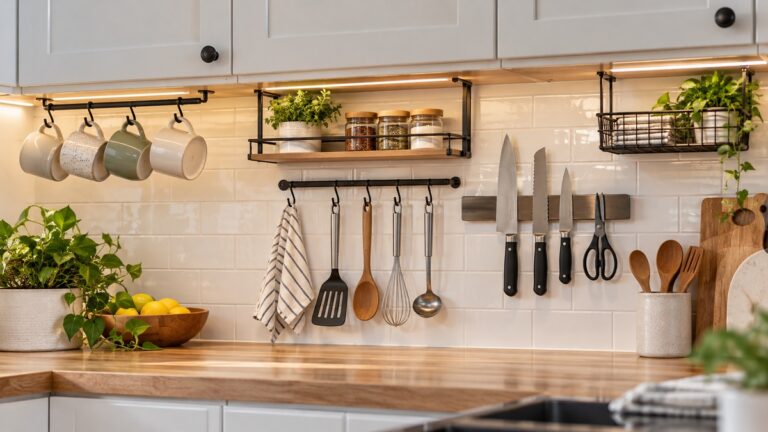
Closet doors can add storage too. The circular notes that a hinged door can carry racks or bins for scarves, gloves and caps, and that the door can be lined with pegboard. A rubber covered plate rack can hold purses in a vertical position on a shelf. Each of these uses space that a rod does not, so count them in the plan rather than as extras.
For the small items that tend to pile up on the floor, a rack or basket is usually the better choice than a loose box. The circular describes a shoe rack built from the ends of a fruit box, but the same planning rule applies to any rack: give it a fixed place in the plan before you buy it. If the closet also holds shoes, the shoe organizer for the top of a closet shows one way to use high space, and towels can share the plan if you read the best way to store towels in a closet.
Measure the depth before you order anything
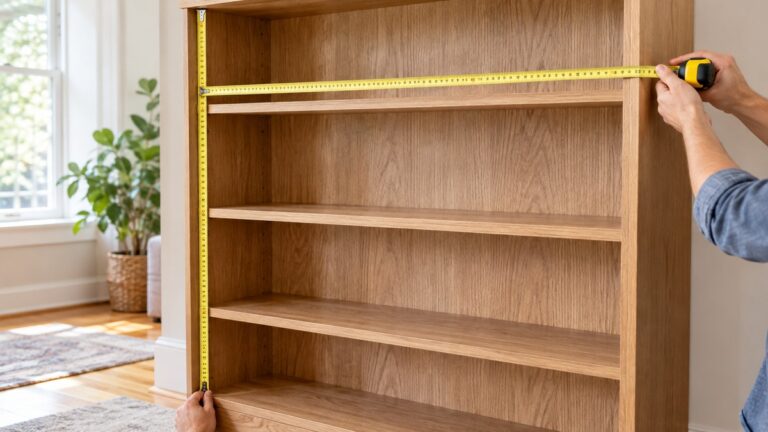
Depth decides which hanging method works. The Oregon State circular says a shallow closet, less than 24 inches deep, can take one or more extension rods, depending on the width available. A closet 30 inches or more deep can take an over-the-door rack, which holds several hangers. Measure the depth at the top, the middle and the bottom of the closet, because a wall that is not square can change the answer. Then choose the method that matches the depth you found.
If your closet is deeper, you have more options for a shelf above the rod. The plan should note where the shelf ends, where the door opens, and where the rod ends on each side. Once those three points are written down, the layout almost draws itself.
Build the plan on paper
Put the plan on one sheet with four columns: the item, the count, the space it needs, and the place it goes. Start with rod length from Table 1, then hanging heights from Table 2, then shelves and bins, then door and floor items. Add the totals and compare them with the closet. If the totals do not fit, cut the list or improve the present closet before you add another one, because the circular puts improving the existing closet ahead of building more space. Use the spreadsheet method from the Nebraska circular if you want a running record. If a dresser or chest is part of the plan, the chest of drawers for clothes storage is the next read, because a chest takes floor space that the rod does not.
For a closet that is also a wall of shelves, the shelf depth in the plan matters as much as the rod length. Read our guide to standard reach-in closet depth before you fix the shelf depth, and check the depth you found against the plan.
Mistakes to avoid
- Buying organizers before counting. The Oregon State circular warns that another closet without a storage plan may do little.
- Giving everything one rod. The circular recommends a higher rod for long garments and a lower one for short items.
- Counting only the household. The 4-foot rule applies to each person who hangs clothes in the closet, so count everyone who uses it.
- Assuming an over-the-door rack works in a shallow closet. The circular ties that method to a depth of 30 inches or more.
- Using the 1967 heights for modern garments without measuring the gap in your own closet.
- Skipping the written count. The Nebraska circular treats a plan and a spreadsheet as the way to see what the household has and needs.
If you are comparing organizers for the closet you plan, look at the closet organizing ideas for small spaces before you order. For a top shelf, compare the storage ideas for the top shelf of a closet.
How we chose
We chose three extension publications that address closet and clothing storage directly. The Oregon State circular is a 1967 reprint of Extension Circular 691. The Nebraska pages are archive entries for EC476 and EC64-434, and we read their abstracts rather than full texts. We opened each file on 2026-10-21 and read the sections on planning, rod length, hanging heights, doors and depth. We did not rank products or compare offers. We also did not consider modern closet systems, because none of the three publications covers them.
What we could not verify
- Current garment lengths and hanger shapes. The hanging heights come from a 1967 table, and the sources we opened do not update them.
- Rod diameters, rod supports and clearances for current closet hardware. The pages we opened do not give those figures.
- The full text of the Nebraska EC476 and EC64-434 publications. We read the abstracts only.
- Whether a 4-foot-per-person rule suits a closet shared by children and adults in the same household.
- Any current closet kit size or depth. Check the kit’s own sheet before you draw the plan.
For the rod and shelf question on its own, see the post on the rod to hang clothes in a closet, and read the way to organize a woman’s closet for a layout built around everyday clothing.
FAQ
Do I need a plan before buying closet organizers?
Yes. The Oregon State circular warns that adding storage without a plan may do little to relieve a crowded closet. Count what you own and what you need first.
How much rod space does each person need?
The Oregon State circular gives at least four feet of rod space per person for hanging clothes. For two people, that is 96 inches, or 8 feet.
How high should the lower rod be?
The circular lists average hanging heights of 39 to 45 inches for trousers, suits, blouses and skirts. Measure the gap between the upper and lower rods in your own closet before you fix either one.
What do I do if my closet is shallow?
The Oregon State circular says a closet less than 24 inches deep can take one or more extension rods, depending on the width available. Measure the depth at several points before you order.
Can a closet door add storage?
Yes, for hinged doors. The circular describes racks and bins for scarves, gloves and caps, and says a door can be lined with pegboard for hanging items.
What should the written plan contain?
List the items, the count, the space each item needs, and the place it goes. The Nebraska EC476 describes a written plan and a spreadsheet for this purpose.
Bottom line
Count what you own and what you need before you buy anything, then allow at least four feet of hanging rod per person and plan the shelf above the lower rod from the measured gap.
Sources
- https://ir.library.oregonstate.edu/xmlui/bitstream/1957/24327/1/ECNO691.pdf (opened 2026-10-21)
- https://digitalcommons.unl.edu/extensionhist/2228/ (opened 2026-10-21)
- https://digitalcommons.unl.edu/extensionhist/3655 (opened 2026-10-21)
Affiliate disclosure again: As an Amazon Associate we earn from qualifying purchases.