How to Clean Open Kitchen Shelves
As an Amazon Associate we earn from qualifying purchases.
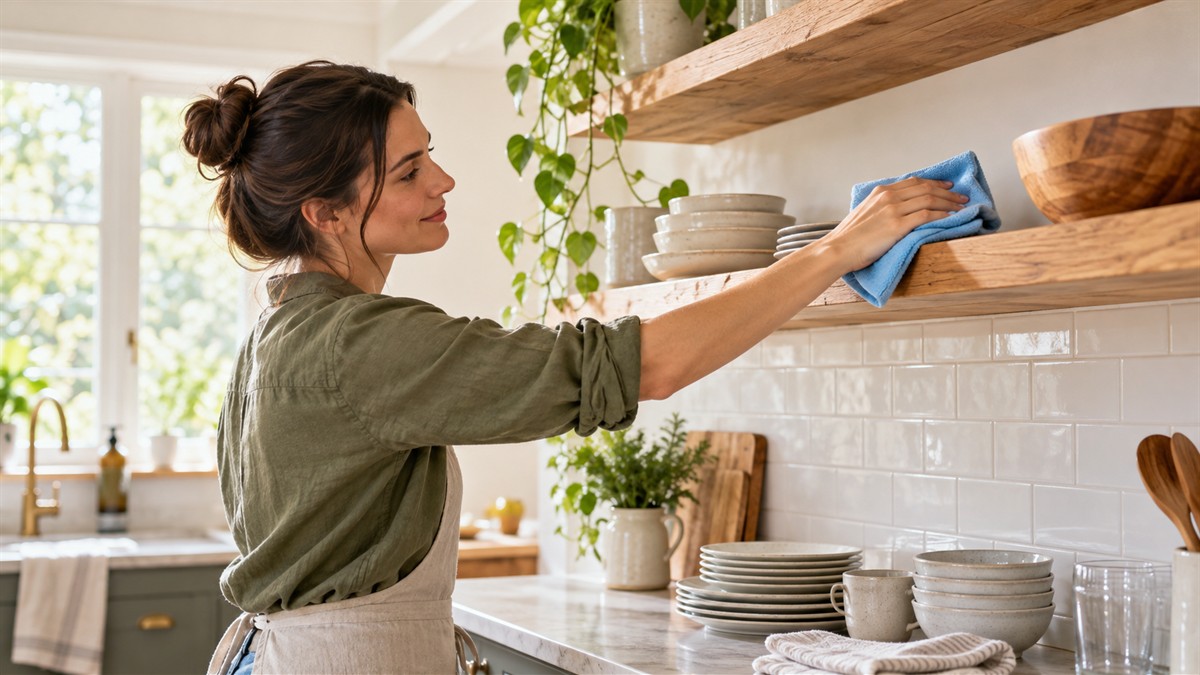
How to clean open kitchen shelves comes down to three rules: match the cleaner to the shelf material, remove grease while it is fresh, and dry every surface afterward. The kitchen-furniture and shelf care sheets we opened ask for a soft cloth and a mild soap or water-soluble household cleaner, and they rule out abrasive pads, solvents and steam. They disagree on whether wood shelves can take soap at all. This guide lines up what each page says so you can choose for your own shelf.
Quick answer
- Dust first with a soft, lint-free cloth, then wash with a soft cloth and a mild soap or household cleaner. A German kitchen maker says to use only mild, water-soluble cleaners approved for kitchen furniture.
- Remove grease early. The same maker says to remove soiling as quickly as possible, and a Home Depot care sheet says to clean spills immediately.
- Skip abrasives, steel wool, solvents and steam cleaners. The pages name all four as damaging.
- Dry the shelf with a soft cloth after cleaning, and use the exhaust fan when you cook, because heat and steam can swell wood.
Why open shelves need their own routine
An open shelf has no door, so cooking steam and grease reach it directly. The pages that discuss kitchens point to the same two causes. The German kitchen maker Bauformat says that when you cook you should provide adequate ventilation and always switch on the extractor fan, because over time rising heat and steam will cause swelling and damage the wooden elements of a kitchen. The U.S. Department of Energy says that most kitchen moisture and pollution come from the range, and that range hoods exhausting to the outside are preferable to kitchen vent fans.
The Department of Energy adds a limit that matters for shelves near the stove: recirculating range hoods do not remove cooking-generated moisture from the living space. If your hood only recirculates, the moisture stays in the room, which makes drying the shelf after each wash more important. The Home Depot care sheet we opened names grease buildup on shelves directly and describes a cleaning step for it. That step comes below.
Step 1: Clear the shelf and dust it
Take everything off the shelf. The pages we opened say nothing about dishware, so wash dishes and glasses as you normally would before they go back. Then dust. The Home Depot sheet says to dust shelves frequently with a soft lint-free cloth and says you can dampen the cloth slightly with water or a spray-type dust remover. Bauformat also asks for a soft, lint-free cloth or a chamois leather, and for glossy surfaces it warns that minute particles of dirt in cloths will leave scratches. Shake out the cloth, or use a fresh one, before you start the wet cleaning.
Step 2: Identify the material
Which cleaner is right depends on what the shelf is made of, and the care pages split by material. Laminate, melamine and finished wood each have their own instructions in the pages we opened. None of the pages covers plastic-coated wire shelving, glass shelves or metal shelves, so for those, use the maker’s instructions. If you do not know the material, check the label, the manual or the underside of the shelf, and start with the gentlest method in the table.
| Shelf material | What the page says to use | What it says to avoid | Page |
|---|---|---|---|
| Laminate (high-pressure laminate) | A damp cloth or sponge and a mild soap or detergent | Acidic or abrasive cleaners; steel wool and abrasive pads; prolonged bleach exposure | Wilsonart care guide |
| Laminate-faced kitchen fronts | Standard household cleaners diluted with water, applied with a clean cloth | Abrasive products; nitro-cellulose or artificial resin thinners; excessive rubbing of matt surfaces, which produces shiny patches | Bauformat care advice |
| Melamine-faced panel | Detergent applied to a soft damp cloth, then rinsed | Spraying directly on the surface; abrasive products, bleach, highly chlorinated products and acids | Cleaf cleaning instructions |
| Lacquered solid wood or wood veneer | A moist chamois leather, wiped along the grain | Cleaning products | Bauformat care advice |
| Wood shelves (Home Depot use-and-care sheet) | A clean cloth and mild soap if necessary, then wiped dry | Detergents, soap pads and steel wool | Home Depot use-and-care sheet |
| Stained and lacquered solid pine (one IKEA bookcase) | A cloth dampened in a mild cleaner, then wiped dry with a clean cloth | Not stated | IKEA HEMNES product page |
The Bauformat and Home Depot rows pull in opposite directions on wood, which is the next question.
Soap on wood shelves: where the pages disagree
Five pages tell you something about washing finished wood, and they do not agree on how much cleaner to use. Bauformat is the strictest, saying of solid wood and veneer: “Never use cleaning products for cleaning.” The Home Depot sheet allows mild soap, but it says to never use detergents, soap pads or steel wool on the shelf, because these harsh abrasives will mar the wood finish. IKEA says to wipe a bookcase clean with a cloth dampened in a mild cleaner. A University of Wisconsin–Madison apartment cleaning guide says to clean wood cabinets with mild dish soap or soap made for use on wood. An old Oregon State extension circular says to wash wood furniture with a soft cloth wrung dry from warm, mild soap suds, to work rapidly, and never to wash a shellac or cheap varnish finish because water may turn it white.
| Source | Cleaning agent on wood | Water |
|---|---|---|
| Bauformat (lacquered solid wood and veneer fronts) | None; “Never use cleaning products for cleaning.” | Moist chamois leather along the grain |
| Home Depot use-and-care sheet | Mild soap if necessary; no detergents | Clean cloth, then dry |
| IKEA HEMNES product page | A mild cleaner | Cloth dampened, then wipe dry |
| University of Wisconsin–Madison apartment guide | Mild dish soap or a soap made for wood | Not stated |
| Oregon State extension circular (old) | Warm mild soap suds | Cloth wrung dry; work rapidly; never wash shellac or cheap varnish |
The practical reading is a ladder. The least aggressive method is a barely damp cloth with nothing added, which Bauformat prescribes for lacquered wood; the Oregon State circular warns that even water can turn a shellac or cheap varnish finish white, so try a hidden spot first. If that leaves the surface greasy, a mild soap on a barely damp cloth is what the other four pages allow, and you then dry the shelf at once. The pages do not say which of these your shelf’s finish is. The Home Depot wording is also internally awkward, since it forbids detergents yet allows mild soap, and the sheet does not define the difference. That ladder is our reading of the table, not an instruction from any single page.
Step 3: Remove grease
Grease is where the pages agree on timing and disagree on product. Bauformat says to remove all soiling as quickly as possible, and that stains are usually removed much more easily, and completely, while still fresh. For matte single-color surfaces it adds that you should not allow dirt to dry under any circumstances, and that for stubborn stains and grease deposits that have already dried you should use hand-warm water with a soap solution. Home Depot’s sheet says to clean spills immediately and describes a grease step: apply a named cleaner and remove it quickly, wash with a mild soap, dry thoroughly and apply a silicone-free polish.
For melamine, the Cleaf table lists cold water with household detergent for fats and sauces. The U.S. Wilsonart laminate sheet lists named household cleaners as recommended, repeats that acidic and abrasive cleaners should be avoided, and calls for a thorough rinse after its stronger stain treatments. A second Wilsonart sheet, hosted by an Australian building supplier, says to always rinse laminate after cleaning, and that failure to rinse can cause damage even if a small amount of cleaning solution remains. Rinsing therefore belongs in the routine for laminate, even where the other pages do not mention it.
If you prefer to start without chemistry, a few facts from the pages help. Water temperature appears in two of them: Bauformat says hand-warm water, and the Oregon State circular says warm suds. Every care page warns against abrasives or scouring, though Wilsonart allows a soft-bristled brush and a baking-soda paste on stubborn stains, with light scrubbing only. So a soft cloth and warm, mildly soapy water is a reasonable starting point on most of the materials the pages cover, and the escalation is to a household cleaner from the maker’s own list.
Step 4: Rinse and dry completely
The care pages end the same way. Bauformat says that after cleaning all parts must be thoroughly dried with a soft cloth. The Home Depot sheet says to wipe dry with a clean soft cloth and, after a grease wash, to dry thoroughly. IKEA says to wipe dry with a clean cloth. Cleaf says to rinse after the detergent. The Oregon State circular says to dry immediately with a soft cloth and warns that moisture can raise the grain or soften the glue in wood furniture.
The reason is moisture. The Environmental Protection Agency says that if you have a mold problem you should scrub mold off hard surfaces with detergent and water and dry completely, and that you should fix water problems as soon as possible. It also says porous materials may have to be thrown away if they become moldy. A shelf that stays damp from the wash is a water problem you created, so give the cloth a final pass and let air reach the surfaces before you reload the shelf.
What not to use on kitchen shelves
The pages produce a short list of things to leave out. The table shows which page names each one.
| Avoid | Page that says so | What it says |
|---|---|---|
| Steam cleaners | Bauformat | “Please never use steam cleaners!” |
| Disinfectants | Bauformat | Disinfectants are not suitable for use on kitchen furniture and surfaces |
| Scouring powder, steel wool, pan scourers | Bauformat; Wilsonart; Home Depot | These damage the surface; Bauformat says the damage cannot be restored |
| Solvent-based products and thinners | Bauformat | Never use aggressive chemicals, abrasive products or solvent-based products |
| Bleach and chlorinated products | Cleaf; Wilsonart | Cleaf says to avoid; Wilsonart says prolonged exposure causes discoloration |
| Acids | Cleaf; Wilsonart | Acidic cleaners can damage the surface |
| Detergents and soap pads on wood shelves | Home Depot | Harsh abrasives mar the wood finish |
One of these deserves a note. Illinois Extension recommends sanitizing with a diluted bleach solution after washing surfaces that food touches, and it warns never to mix bleach with ammonia. That advice is written for countertops, work surfaces and appliances, not for display shelves, and it sits against Bauformat’s statement that disinfectants are not suitable for kitchen furniture. For shelves that do not touch food, the pages we opened point you to wash and dry, not to sanitize.
How often to clean open shelves
The pages give two intervals, and both are loose. The Home Depot sheet says to dust shelves frequently and to wash and polish them once or twice each year. Bauformat says to remove soiling as quickly as possible. Neither page names an interval for a shelf in a busy kitchen.
A routine built from those two statements has three parts. Dust when you can see it. Wipe spills and splashes at once. Do a full empty-and-wash when a shelf feels greasy or after a season of heavy cooking. The once-or-twice-a-year figure is for washing and polishing a wood shelf, so a greasy kitchen shelf may need washing more often, and the page does not say. That routine is our reading, not a rule in the pages. For shelf ideas in a small kitchen, see our guide to open shelves in a small kitchen and our guide to shelf ideas for a small kitchen.
If you find mold on a shelf
The EPA says that if the moldy area is less than about 10 square feet, in most cases you can handle the job yourself. For a shelf, scrub the mold off with detergent and water, and dry completely. The EPA also says that mold may cause staining and cosmetic damage, and it may not be possible to restore the original appearance. It says not to paint or caulk moldy surfaces. The agency adds that if you have health concerns you should consult a health professional before starting cleanup.
For a shelf above a sink or dishwasher, check where the water comes from. The EPA’s list begins with fixing plumbing leaks and other water problems as soon as possible, and drying all items completely. The pages do not give an exact timing for drying a wooden shelf, so judge by feel and keep the fan on.
A sample cleaning plan and its assumptions
Here is how the pages translate into one session for a three-shelf open unit. The time per step is our assumption; the sources give no times.
| Step | What to do | Source behind the step | Time (our assumption) |
|---|---|---|---|
| 1 | Clear the shelf and dust with a dry or slightly damp lint-free cloth | Home Depot sheet; Bauformat | 5 minutes |
| 2 | Wash with warm water and mild soap on a barely damp soft cloth | Bauformat; Home Depot; IKEA; Wisconsin–Madison guide | 10 minutes |
| 3 | Rinse with a cloth wrung out in clean water | Cleaf; Wilsonart (Australia) | 5 minutes |
| 4 | Dry thoroughly with a soft cloth and leave the shelf to air | Bauformat; Home Depot; IKEA | 5 minutes |
| 5 | Reload the shelf | None | 5 minutes |
The assumed times add up to 5 + 10 + 5 + 5 + 5 = 30 minutes. A greasier shelf, or a longer unit, will take longer. Change the numbers to fit your shelf, and treat them as a planning guess only.
How we chose
This guide uses pages that we opened on 2026-10-21 and that said what we cite. We looked first for kitchen-furniture and shelf care sheets from makers, then for university and agency pages on cleaning, moisture and mold. We kept a page only when its text, with the HTML tags removed, contained the quoted sentence or a close paraphrase. Pages from the USDA, CDC and a state extension site refused our download and are not used. We considered the Home Depot sheet carefully because it does not name its product in the text we read, and the guide relies on it only for the statements it makes about shelves.
We did not rank the pages. Where they disagree, the tables show both positions. The sample plan and its times are ours.
Mistakes to avoid
- Using a steam cleaner. Bauformat says never to use one on kitchen furniture.
- Scrubbing with steel wool or a scouring pad. Bauformat, Wilsonart and Home Depot all warn against it.
- Letting grease dry. Bauformat says soiling is removed more easily while it is fresh.
- Spraying cleaner directly on melamine. The Cleaf sheet says to apply it to a soft damp cloth.
- Leaving the shelf wet. Bauformat says all parts must be thoroughly dried with a soft cloth.
- Cooking without the exhaust fan. Bauformat ties steam to swelling of wooden elements.
What we could not verify (what the sources do not say)
The pages we opened do not say how often open kitchen shelves need washing, how to clean plastic-coated wire, glass or metal shelves, or how to care for any one shelf you own. Bauformat writes about its own kitchen fronts, Wilsonart and Cleaf write about their own laminates, IKEA writes about one bookcase, and the Home Depot sheet does not name its product, so each is a close fit rather than an exact one. The Oregon State circular is old, and the Wisconsin–Madison guide is written for apartment move-outs. The pages disagree on whether wood takes soap. None of them gives a drying time, and none explains why the Home Depot sheet forbids detergent but allows soap.
Frequently asked questions
What is the best way to clean greasy open shelves?
Remove the grease while it is fresh. For matte surfaces Bauformat says to use hand-warm water with a soap solution on grease deposits, and the Home Depot sheet describes a cleaner removed quickly, then a wash with mild soap and a thorough dry. Check your shelf’s own care sheet first.
Can I use soap on wood shelves?
The pages split. Bauformat says never to use cleaning products on lacquered solid wood, while the Home Depot sheet, IKEA and a University of Wisconsin–Madison guide allow a mild soap or cleaner. If you do not know the finish, start with a barely damp cloth and dry at once.
Can I use bleach or disinfectant on kitchen shelves?
The pages point away from it. Bauformat says disinfectants are not suitable for kitchen furniture, Cleaf says to avoid bleach on melamine, and Wilsonart says prolonged bleach exposure discolors laminate.
How do I keep steam and moisture off open shelves?
Use the exhaust fan when you cook. Bauformat links steam to swelling of wood, and the Department of Energy says recirculating range hoods do not remove cooking moisture while hoods exhausting to the outside are preferable.
What do I do if there is mold on a shelf?
The EPA says to scrub mold off hard surfaces with detergent and water and dry completely. It says porous materials may have to be thrown away, and it says to fix water problems quickly.
How often should I clean open kitchen shelves?
The Home Depot sheet says to dust frequently and to wash and polish once or twice each year, and Bauformat says to remove soiling as quickly as possible. The pages give no other interval.
Bottom line
Dust, wash with a soft cloth and mild soap on a barely damp cloth, skip abrasives and steam, and dry the shelf at once.
Sources
- https://www.bauformat.de/en/service/the-right-care (opened 2026-10-21)
- https://images.homedepot-static.com/catalog/pdfImages/de/de166886-19ca-47d9-88bc-6ae4fc67aea5.pdf (opened 2026-10-21)
- https://www.ikea.com/lt/en/p/hemnes-bookcase-spr-79231154/ (opened 2026-10-21)
- https://pdf.lowes.com/useandcareguides/688598215633_use.pdf (opened 2026-10-21)
- https://hvgbuilding.com.au/wp-content/uploads/2025/09/2025-HPL-Laminate-Care_-Maintenance.pdf (opened 2026-10-21)
- https://cleaf.it/docs/299/6896/Cleaf-ENG—Melamine-cleaning-instructions.pdf (opened 2026-10-21)
- https://www.housing.wisc.edu/wp-content/uploads/sites/168/2022/11/2018-move-out-cleaning-guide-FINAL-3.pdf (opened 2026-10-21)
- https://ir.library.oregonstate.edu/downloads/mg74qm295 (opened 2026-10-21)
- https://extension.illinois.edu/food-safety/cleaning-and-sanitizing (opened 2026-10-21)
- https://www.epa.gov/mold/mold-cleanup-your-home (opened 2026-10-21)
- https://www1.eere.energy.gov/buildings/publications/pdfs/building_america/26466.pdf (opened 2026-10-21)
Disclosure: As an Amazon Associate we earn from qualifying purchases.