How to Store Luggage on a Shelf
As an Amazon Associate we earn from qualifying purchases.
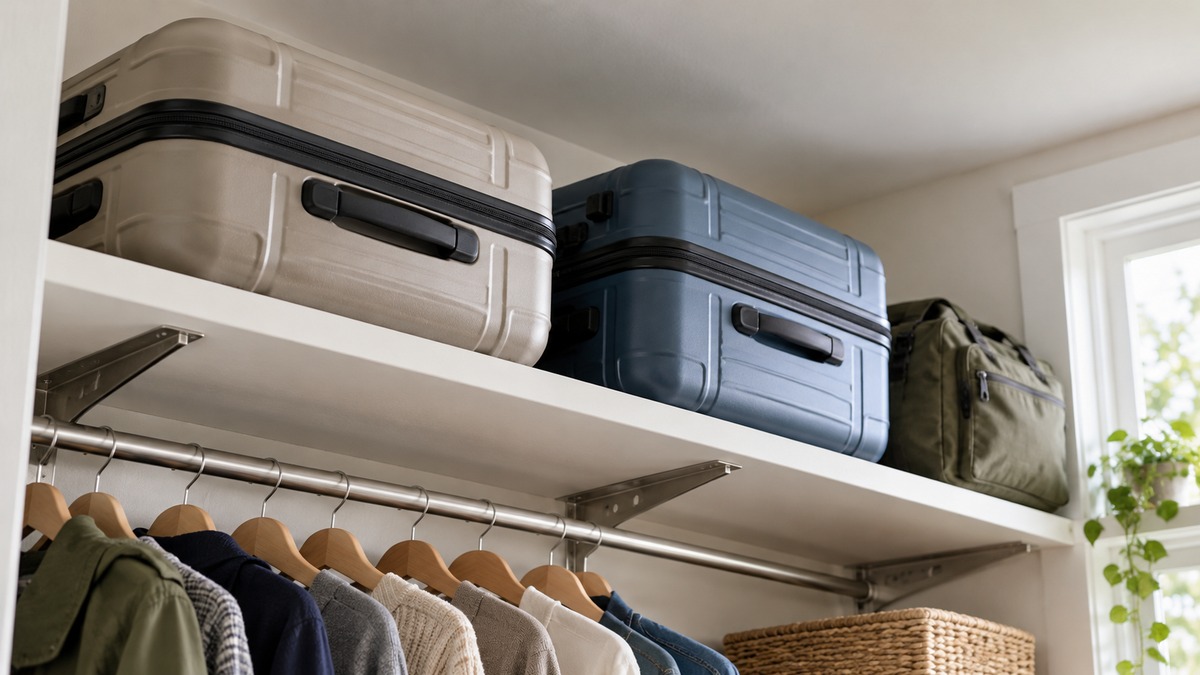
How to store luggage on a shelf comes down to four checks: whether the case is clean and dry, whether it is supported so it keeps its shape, whether the spot stays out of damp and temperature swings, and whether the shelf height suits the weight you have to lift. The pages we opened do not cover suitcases as a topic. They cover pests that travel in luggage, mold, leather and textile storage, lifting and shelf sizes, and this guide combines them into one routine.
Quick answer
- Empty the case, inspect it, and make sure it is completely dry before it goes up. The EPA says the key to mold control is moisture control.
- Pick a stable, dry spot. Textile and leather guides warn against attics, damp basements and spots near radiators, while a pest guide suggests keeping luggage away from the bedroom.
- Keep the case supported and covered with a breathable cloth, not a sealed plastic bag.
- Put only lighter items above shoulder level, and use a step stool rather than reaching overhead.
What these sources cover and what they leave out
Two pest pages, from the University of California Statewide IPM Program and the Centers for Disease Control and Prevention (CDC), name luggage directly. The Environmental Protection Agency (EPA) mold guide includes a photograph of a suitcase that grew mold in a humid basement. For materials, we used a Canadian Conservation Institute (CCI) note on leather such as bags and boots, a University of Nebraska-Lincoln Extension fact sheet on textile storage, a Washington State University Extension bulletin on leather garments, and a National Park Service leaflet on mold prevention, a National Park Service leaflet on safe plastics and fabrics, and a University of California page on clothes moths. For shelves and lifting, we used a University of British Columbia guide, a University of Oregon sheet and a ClosetMaid planning page. Delta Air Lines supplies the one luggage size we use.
Most of these were written for museum objects, quilts, garments or workplaces, so each is a close fit for a suitcase rather than an exact one. None gives guidance for hard-shell cases, wheels, handles or zippers, and none gives a luggage weight.
Empty it, inspect it and clean it first
The University of California IPM page says people can bring bed bugs home in luggage or on clothes after visiting an infested hotel or dwelling. For frequent travelers it advises inspecting luggage before leaving and, on arrival at home, washing and drying all clothes at the hottest settings the fabric will permit. It adds that frequent travelers may want to “store luggage away from the bedroom” in a place such as the garage or a hall closet. The CDC page agrees that bed bugs spread by getting into the seams and folds of luggage and overnight bags, and lists signs to look for: shed exoskeletons, rusty-colored blood spots on mattresses or nearby furniture, and a sweet musty odor. It also says bed bugs tend to live within 8 feet of where people sleep.
That advice leads to a practical rule for a shelf in a bedroom closet: a case that has been on a trip should be inspected along its seams and folds before it is stored, and a hall closet or another room is a sounder place for it than the bedroom. Neither page gives a method for treating a suitcase specifically, so the sources stop at inspection and prevention.
Moisture is the second check. The EPA guide says the key to mold control is moisture control, and that dry items within 24 to 48 hours of a leak or spill usually do not grow mold. Its cleanup advice for mold on hard surfaces is to scrub with detergent and water and then dry completely, and it warns that porous materials may have to be thrown away if they become moldy, because the mold can fill their crevices. The guide mentions a suitcase only in a photograph caption, so it gives no luggage-specific cleaning steps.
For leather, the Washington State University bulletin says to store clean garments only. The CCI note explains why dirt matters: dust attracts water vapor and can carry pollutants that contribute to degradation. It advises sweeping dust off with a soft brush toward a vacuum nozzle covered with gauze, and says current practice is to minimize dressings, lubricants and cleaners because of their negative long-term effects. The CCI note says saddle soap and leather dressings are now generally not recommended. That is a museum view, and the Washington State bulletin on garments takes a gentler line, allowing wiping smooth leather with mild soap and lukewarm water, so the pages differ on how much cleaning is right.
Choose the spot: what each location risks
| Spot | What the sources say | Source |
|---|---|---|
| Attic, basement, kitchen, unheated room | Avoid storing textiles in attics, basements, kitchens and unheated areas, because temperature and humidity vary too much there | Nebraska Extension (quilts) |
| Damp basement | No leather objects should be stored in damp basements, over radiators or furnace pipes, or near sweating pipes; the EPA shows a suitcase with mold from a humid basement | CCI; EPA |
| Next to an outside wall | Try to store quilts away from outside walls and from areas with wood smoke or tobacco smoke | Nebraska Extension (quilts) |
| Bedroom | Bed bugs tend to live within 8 feet of where people sleep; store frequently used luggage away from the bedroom | CDC; University of California IPM |
| Garage or hall closet | Named by the University of California IPM page as places to store luggage; the page does not address garage temperature or humidity | University of California IPM |
| Dark spot | Leather should be stored in the dark if possible; sunlight and light cause fading and stiffening | CCI; Washington State |
The table shows a real tension. The pest page points toward the garage or a hall closet, while the textile and leather pages warn against locations with swinging temperature and humidity. A garage can be one of those locations, though none of the pages we opened says so. The textile and leather advice is for quilts and leather, not for a polyester or polycarbonate case, so the pest advice may carry more weight for a modern suitcase and the humidity advice more for a leather one.
Humidity figures differ between the pages, and the table below puts them side by side. The CCI leather note puts the recommended range for leather at 45 to 55 percent relative humidity and 18 to 20 degrees Celsius, and says mold needs humidity above 65 percent, while dry air below 30 percent causes embrittlement. The National Park Service mold leaflet says spore germination is less likely when humidity is held between 45 and 55 percent and that humidity should always stay below 65 percent. The EPA home guide says to keep indoor humidity below 60 percent if possible, ideally between 30 and 50 percent.
| Source | Humidity figure | Context |
|---|---|---|
| EPA | Below 60 percent, ideally 30 to 50 percent | Homes |
| National Park Service | 45 to 55 percent; always below 65 percent | Museum collections |
| CCI | 45 to 55 percent for leather; mold above 65 percent; embrittlement below 30 percent | Leather in museums |
The overlap among the three is 45 to 50 percent, which sits inside every range. That overlap is our arithmetic, not a figure any page gives for luggage. The EPA page names a humidity meter as the tool for measuring humidity at home.
Support the shape and pad the folds
The CCI note says leather objects should be fully supported while in storage and on display, because it is difficult and often impossible to reshape leather that has sagged and stiffened out of shape. It says sharp folds or creases should be padded to avoid cracking, that folds and rounded objects should be padded with unbuffered acid-free tissue, and that pouches should be filled with polyester batting or rolls of acid-free paper. It also says to keep metal parts such as buckles, clasps and rivets from touching the leather by inserting a sheet of polyester film or polyethylene as an interleaf, because some metals corrode against leather or stain it.
The Nebraska fact sheet uses a similar idea for textiles: tissue crumpled into sausages to cushion folds. It says to protect textiles from direct contact with wood, including cedar chests, and with regular cardboard and paper, which give off acid byproducts as they age. It suggests lining shelves or boxes with acid-free tissue or washed unbleached cotton muslin. It also says to avoid stacking heavy items on top of textiles, because the weight can crease them and crush the batting. The fact sheet is about quilts, and no page we opened says how many suitcases may be nested or stacked on each other, so treat that as an open question.
The CCI note’s advice about pouches is the closest match to a soft bag: fill it with polyester batting or rolls of acid-free paper. For a leather case with a heavy handle or other attached part, the note says to provide a separate support for heavy attached elements. No page we opened describes suitcase-specific supports, so this is an application of the leather guidance.
Cover it, but let it breathe
The Washington State bulletin says leather needs to breathe, so garments should be stored in a cloth bag. It says in plain words: “Do not store in a plastic bag.” The Nebraska fact sheet gives the same warning for quilts: plastic bags may not allow air circulation, may give off harmful byproducts as they age and decompose, trap moisture that can cause mildew, and attract dust through static electricity.
The CCI note takes a more mixed position. It recommends protecting stored leather from dust with polyethylene or cotton dust sheets, corrugated plastic or unbuffered acid-free cardboard boxes, or closed cabinets. It also says wrapping leather in hygroscopic materials such as acid-free tissue or cotton fabric, and storing it in acid-free boxes, helps reduce the effects of humidity changes. The National Park Service mold leaflet says to use dust covers over objects in storage that are not in cabinets or drawers.
The pages do not actually disagree about sealed bags, since none recommends one. They differ on whether a loose polyethylene sheet is acceptable. A washed cotton sheet or unbleached muslin draped over the case follows all of them. The National Park Service leaflet on safe plastics asks whether a breathable textile would be better than plastic when humidity is high or fluctuates, and it notes that some people recommend keeping polyethylene bags open because condensation can form when humidity changes.
Fit the shelf, and lift safely
The ClosetMaid planning page lists its shelf depths and lengths: SuperSlide and wardrobe shelving come in 12-inch and 16-inch depths, and close mesh shelving comes in 16-inch and 20-inch depths. Lengths run from 4 feet to 12 feet, and the 20-inch depth appears only with the 6-foot and 12-foot lengths. Delta Air Lines publishes a carry-on limit of 22 by 14 by 9 inches, including handles and wheels, with the three added together not exceeding 45 linear inches. The three numbers do sum to 45 (22 + 14 + 9 = 45). We use that carry-on size as the sample case. The 4-foot and 6-foot shelf lengths are two lengths from the ClosetMaid range, and the table assumes no gap between cases, so it gives an upper bound.
| How the case sits | Width along shelf × depth needed (inches) | Depth spare on a 12-inch / 16-inch / 20-inch shelf | Cases across 4 feet (48 inches) | Cases across 6 feet (72 inches) |
|---|---|---|---|---|
| Flat, long side along the shelf | 22 × 14 | -2 / +2 / +6 | 48 ÷ 22 = 2.18, so 2 | 72 ÷ 22 = 3.27, so 3 |
| Flat, short end toward the front | 14 × 22 | -10 / -6 / -2 | 48 ÷ 14 = 3.43, so 3 | 72 ÷ 14 = 5.14, so 5 |
| On end, wide face toward the front | 14 × 9 | +3 / +7 / +11 | 48 ÷ 14 = 3.43, so 3 | 72 ÷ 14 = 5.14, so 5 |
| On end, narrow side toward the front | 9 × 14 | -2 / +2 / +6 | 48 ÷ 9 = 5.33, so 5 | 72 ÷ 9 = 8.00, so 8 |
A negative number means the case would hang past the front of the shelf. The University of Oregon sheet says to make sure nothing hangs over the edge. A case standing on end needs about 22 inches of clear height in this example. The sources give no extra headroom for lifting, so allow your own. For closet depth, see our guide to standard reach-in closet depth, and for the upper shelf, see our guide to top-of-closet shelf storage.
The lifting rules come from two workplace pages. The University of British Columbia guide says to store heavier items in your strongest lifting zone, between mid-thigh and waist height, and to store only lighter items above shoulder level and below knee level. The University of Oregon sheet says to put lighter items overhead, to store heavier and frequently used items between knee and shoulder, and to use a step stool instead of reaching overhead. It says never to climb on shelves. An empty case is the lighter item the upper shelf is for, though neither page gives a weight for one. The UBC guide also lists 50 pounds as its recommended maximum weight under ideal conditions, which include no twisting or bending. Whether a packed case belongs on a high shelf is a judgment the pages leave to you.
Shelf strength is a separate question that these sources do not answer. For that side, see our guide to the ClosetMaid wire shelf weight limit.
Check the stored case on a schedule
The CCI note advises inspecting stored leather every three months for signs of mold or insects. Mold shows as a thin grey, green or white powder or small black dots, and the note warns that fatty blooms and salts can look like mold. It says dermestids such as hide and carpet beetles eat leather, and that signs of infestation include small fresh holes and larval casings in dark, protected places. If mold appears, it says to lower the humidity, isolate the object, and dry it slowly with air movement. The University of California IPM page on clothes moths adds that they feed on wool, furs and stored woolen items, and that susceptible items put into storage should be clean and pest free and placed in an airtight container. That advice is about the clothes, not the case, but it matters if the case doubles as a seasonal wool store.
How we chose
This is a storage routine, not a product list, so there are no products to rank. We read thirteen pages on 2026-10-21 and kept a rule only when a page states it in plain words and the rule can be applied to a case on a shelf. We checked each quoted sentence against the text of its page. Where pages disagree, as on plastic covers, humidity ranges and cleaning, we show both sides. We left out how to remove bed bugs, which the pest pages treat separately, and how to remove mold from a heavily infested case. The figures in the tables are our own arithmetic with each input named, apart from the shelf depths and the carry-on size, which come from the ClosetMaid and Delta pages.
Mistakes to avoid
- Storing the case damp. Moisture is what lets mold start, in the EPA’s account, so dry every surface first.
- Putting luggage in a damp basement. The CCI note and the EPA photograph both point to the same risk.
- Sealing a leather case in a plastic bag. The Washington State bulletin says not to.
- Letting a leather case slump. The CCI note says supports matter because sagged leather is hard to reshape.
- Leaving a travel-worn case by the bed. The CDC says bed bugs tend to live near where people sleep.
- Hanging a case over the shelf edge. The Oregon sheet says nothing should hang over the edge.
- Reaching overhead for a heavy case. The Oregon sheet says to use a step stool, and the UBC guide keeps only lighter items above the shoulder.
What we could not verify
The pages we opened do not cover hard-shell cases, wheels, handles or zippers, and they give no luggage weights or shelf load limits for a packed case. They do not say how many cases may be stacked or nested, how much headroom a case needs, or whether a garage is a suitable place for luggage. The University of California page does not say how to treat a case that has bugs. The humidity ranges come from museum, workplace and home pages that do not agree exactly. The CCI, Nebraska and Washington State pages are about leather and textiles, so they are a close fit for a suitcase rather than an exact one. We have no source for any product, and nothing in this guide is a product claim.
Frequently asked questions
Where is the best place to keep luggage in a house?
The pest page from the University of California suggests the garage or a hall closet, away from the bedroom. The textile and leather pages favor a dark, dry spot without large swings in temperature or humidity, so the closet is the safer reading when a garage is damp or hot.
Can I store luggage in a plastic bag?
Washington State Extension says not to for leather, and Nebraska Extension warns that plastic bags can trap moisture and cause mildew. The CCI note allows polyethylene dust sheets, which are loose coverings, so a draped cloth is the safest common ground.
Should the suitcase be empty when it goes on a shelf?
The CCI note suggests padding folds and filling pouches with batting or acid-free paper rolls to hold shape, so the case should hold only light filler. An empty or lightly filled case also suits the lifting rules, which keep lighter items overhead.
How high can I put a suitcase?
The University of British Columbia guide says only lighter items go above shoulder level, and the University of Oregon sheet says to use a step stool instead of reaching overhead. Neither names a luggage weight, so weigh the case yourself.
How often should I check stored luggage?
The CCI note advises every three months for mold and insects, which is guidance for leather collections. A quick look at seams, folds and zippers on that schedule is a sensible reading for a household case.
Bottom line
Store the case clean, dry and lightly padded, under a cloth cover, in a stable spot away from damp, with only light cases above your shoulders.
Sources
- https://ipm.ucanr.edu/home-and-landscape/bed-bugs/ (opened 2026-10-21)
- https://www.cdc.gov/bed-bugs/about/index.html (opened 2026-10-21)
- https://www.epa.gov/mold/brief-guide-mold-moisture-and-your-home (opened 2026-10-21)
- https://www.canada.ca/en/conservation-institute/services/conservation-preservation-publications/canadian-conservation-institute-notes/care-alum-vegetable-mineral-leather.html (opened 2026-10-21)
- https://extensionpubs.unl.edu/publication/g1820/2007/pdf/view/g1820-2007.pdf (opened 2026-10-21)
- https://content.libraries.wsu.edu/digital/api/collection/ext/id/55869/download (opened 2026-10-21)
- https://www.nps.gov/subjects/museums/upload/03-04_508.pdf (opened 2026-10-21)
- https://www.nps.gov/subjects/museums/upload/18-02_508.pdf (opened 2026-10-21)
- https://ipm.ucanr.edu/home-and-landscape/clothes-moths/ (opened 2026-10-21)
- https://hr.ubc.ca/sites/default/files/2020-09/Lifting%20Guidelines.pdf (opened 2026-10-21)
- https://safety.uoregon.edu/sites/default/files/safety_sheet_-_shelving_safety_final.pdf (opened 2026-10-21)
- https://homedepot.closetmaid.com/en-US/Installation/Pages/how-to-guides.aspx (opened 2026-10-21)
- https://www.delta.com/us/en/baggage/carry-on-baggage (opened 2026-10-21)
As an Amazon Associate we earn from qualifying purchases.