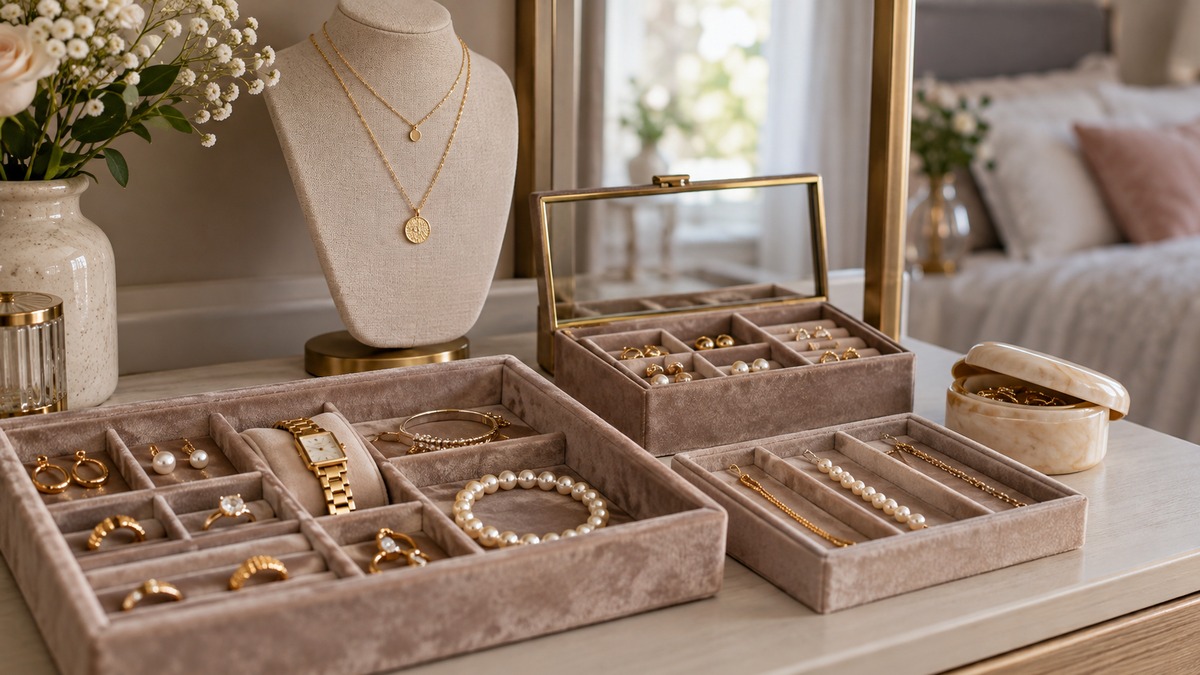
How to Store Jewelry on a Shelf
As an Amazon Associate we earn from qualifying purchases.
How to store jewelry on a shelf depends mostly on what each piece is made of. Silver reacts with sulfur gases, copper alloys react with acids and ammonia, pearls scratch easily, and opals can crack when they get hot. The Canadian Conservation Institute, the National Park Service and the Gemological Institute of America each publish care guidance that bears on a shelf, though none was written for a bedroom. This guide turns that guidance into a plan for the shelf and the containers on it.
Quick answer
- Never rest metal jewelry directly on a shelf. Line the shelf with closed-cell polyethylene foam and keep pieces apart with padding.
- Wrap silver in unbuffered tissue and seal it in a polyethylene bag, adding a tarnish-inhibiting cloth for more protection. Keep rubber, felt, wool and raw wood away from it.
- Keep pearls in a soft pouch or case, away from sharp or rough objects and out of hot, dry spots.
- Anchor the shelving unit, do not overload it, and keep it away from cold exterior walls, sun and heat.
What these sources cover and what they leave out
Three Canadian Conservation Institute (CCI) pages carry most of the metal advice: Note 9/2 on the storage of metals, Note 9/7 on silver care and tarnish removal, and a longer guide to caring for metal objects. Note 9/2 was first published in 1988 and revised in 1994, 1995 and 2007. The National Park Service (NPS) contributes a leaflet on a dry microclimate box for metals and a leaflet on museum storage shelves. The Gemological Institute of America (GIA) pages cover pearls and opals. A University of Oregon safety sheet covers shelf loading and anchoring.
All of these were written for collections, gem labs or workplaces, not for a dresser-top shelf. Where they give a figure, we pass it on with the source named. They do not cover jewelry stands, hooks or hanging necklaces, chain tangling, or ring storage, so those topics are outside this guide. They also name no product to buy, and nothing here is a product claim.
Know the material before you pick the container
The same shelf treats different pieces differently. The table collects what each source says about the materials most common in a jewelry box and what that means for a shelf.
| Material | What the sources say | What it means on a shelf |
|---|---|---|
| Silver | Tarnish is mainly black silver sulfide, caused by sulfur-containing compounds such as hydrogen sulfide in the air (CCI Note 9/7). Sulfur can also come from natural or synthetic rubber, certain paints, and some textiles such as wool or felt (CCI Note 9/2). | Seal each piece in a polyethylene bag, wrapped first in unbuffered tissue, and keep rubber and felt away. |
| Gold | Pure gold does not corrode, but gold alloys can: the silver and copper in them darken in sulfur-containing gases (CCI metals guide). | Treat gold alloys like silver if they have darkened before. |
| Brass, bronze and other copper alloys | Copper alloys are susceptible to ammonia, acids, strong alkalis, chlorides and sulfide gases (CCI Note 9/2). | Small pieces go in clear plastic boxes padded with acid-free unbuffered paper, or in boxes of acid-free board. |
| Plated pieces | A continuous plating protects the metal underneath; a defective, scratched or dented plating lets the base metal corrode in air and moisture (CCI metals guide). | Padding between pieces matters more, since scratches open the plating. |
| Pearls | Very soft and easily scratched or abraded; damaged by hair spray, perfume, cosmetics and perspiration; high heat can cause splitting or cracking (GIA). | Soft pouch or case, apart from sharp or rough objects, away from heat. |
| Opals | Heat from intense light can cause fine fractures called crazing, and high heat or sudden temperature changes can crack the stone (GIA). | Keep out of sunny or lamp-lit shelf spots. |
The table shows why one tray for everything is a poor plan. A silver chain sealed in a tight bag is protected from sulfur gases, but the GIA page asks for a soft pouch or case for pearls and warns against hot, dry places. The sources do not say whether a sealed bag suits pearls, so pearls and silver should not share one container. The same split applies to a piece with mixed materials: the CCI guide says composite objects need a moderate humidity range so that organic parts do not dry out.
Check the shelf itself
The CCI guide lists wood and wood-based products, unless sealed, among the materials that give off formic acid, acetic acid, aldehydes and peroxides, which are harmful to metals. Note 9/2 says to avoid wood and wood-pulp products near metals because they release sulfur compounds and organic acid vapors. The NPS shelving leaflet says museum shelves should never include wooden or particle board components, calling those materials acidic and likely to off-gas. Three pages from two institutions therefore agree that raw wood is a poor neighbor for stored metal. All of them write for museums, and none says how much wood is too much in a bedroom.
The CCI guide gives two practical ways around wood. One is to avoid using it over large surface areas. The other is to separate the metal from the wood with an interleaf such as clear polyester film. It adds that paints, varnishes and other coatings are generally not effective barriers against wood emissions. It also says to avoid using the original storage case of a metal object if it is made of wood, cardboard, foam or leather, unless it has been checked to confirm that it is not acidic and does not give off volatiles. A wooden jewelry box is close to that description, and none of the sources say how to check one at home.
Fresh paint is a second source of fumes. Note 9/2 says rooms freshly painted with oil or alkyd paints should be aired for at least four months before metals are stored in them. The CCI guide is gentler about latex paints, saying an open, well-ventilated room needs at least four days of airing and an enclosed space at least four weeks. The two pages cover different paints and different spaces, so both figures stay in this guide.
Shelf location also matters. The CCI guide advises keeping objects away from colder areas in a room, such as exterior walls with windows, because they create localized damp pockets of air and raise the corrosion risk. It also recommends air circulation to prevent local concentrations of high humidity.
The NPS shelving leaflet adds points that suit jewelry. It says liners are particularly important on wire shelving, where they stop small objects from falling through the wire, and that liners should be cut to the exact interior size of the shelf so they do not overhang. It also says shelves without added protection may let objects fall during an earthquake or be bumped, and it recommends securing units with wall or floor anchors as necessary and fitting restraining bars or cords. The University of Oregon sheet says to anchor shelves to the floor or wall, not to overload them, and to make sure nothing hangs over the edge. If you are still choosing a shelf for a bedroom, our guides to small bedroom shelves and small bedroom shelving ideas cover the shelf side.
Line the shelf and keep pieces apart
Note 9/2 states the rule plainly: “Never place metal objects directly on a storage shelf or drawer.” It says to line shelves and drawers with closed-cell polyethylene foam, and it names Ethafoam, PolyPlank, Volara, Plastazote and Nalgene as examples. It adds that the foam also protects objects from shock and abrasion, and that urethane foams should be avoided because they degrade easily. The same note says to arrange each piece so its weight is evenly supported and it can be retrieved without damaging its neighbors.
The CCI guide explains the physical risk. Soft metals, including gold and silver, are especially vulnerable to dents, scratches and abrasion. Its advice is to separate objects that share a box, tray or drawer with padding so they cannot touch or scratch when moved, or to carve custom nests. Note 9/2 suggests wads of acid-free unbuffered paper or strips of polyethylene foam between objects. A second reason to separate comes from Note 9/2: when objects of different metals touch in high humidity, galvanic corrosion can result.
The GIA pearl pages give the same instruction from the gem side. They say pearls should be kept away from sharp or rough objects to avoid scratching and stored in a soft pouch or case. They say nothing about stacking pearls with other jewelry, but the scratching warning argues against sharing a compartment with a pin or a clasp.
The table turns the spacing idea into numbers for the containers on the shelf. The 30-inch shelf and the one-inch and two-inch gaps are our own assumptions, and the sources set no gap. The number of trays that fit is the shelf width minus one gap, divided by the tray width plus one gap, rounded down. The width used is the tray count times the tray width, plus one more gap than there are trays.
| Tray width (inches) | Gap (inches) | Calculation | Trays that fit | Width used (inches) |
|---|---|---|---|---|
| 6 | 1 | (30 − 1) ÷ (6 + 1) = 4.14, so 4 | 4 | (4 × 6) + (5 × 1) = 29 |
| 6 | 2 | (30 − 2) ÷ (6 + 2) = 3.50, so 3 | 3 | (3 × 6) + (4 × 2) = 26 |
| 8 | 1 | (30 − 1) ÷ (8 + 1) = 3.22, so 3 | 3 | (3 × 8) + (4 × 1) = 28 |
| 8 | 2 | (30 − 2) ÷ (8 + 2) = 2.80, so 2 | 2 | (2 × 8) + (3 × 2) = 22 |
| 10 | 1 | (30 − 1) ÷ (10 + 1) = 2.64, so 2 | 2 | (2 × 10) + (3 × 1) = 23 |
| 10 | 2 | (30 − 2) ÷ (10 + 2) = 2.33, so 2 | 2 | (2 × 10) + (3 × 2) = 26 |
Two comparisons stand out. A 6-inch tray with a one-inch gap uses 29 of the 30 inches, and doubling the gap costs a whole tray. Moving from 8-inch to 10-inch trays costs nothing at a two-inch gap, since both fit two, but costs one tray at a one-inch gap. Measure your own shelf before relying on any row, and leave room to lift a tray out without touching its neighbor.
Wrap and enclose the pieces that tarnish
Note 9/7 says tarnish can be minimized in storage by placing individual silver objects in polyethylene bags and sealing them with tape, heat or a self-sealing bag. It calls it good practice to wrap each piece in acid-free tissue paper that is unbuffered, which it describes as sulfur-free and of archival quality, to buffer humidity changes and to stop harmful materials from the storage area reaching the silver. For more protection it suggests small containers of dried silica gel and activated charcoal inside the bag, or wrapping the silver in a tarnish-inhibiting cloth before it goes into the bag. Cloths embedded with tiny silver particles are described as particularly effective, because tarnishing gases react with the silver in the cloth before they reach the object. The note says cloths containing metal salts are less effective. The CCI guide shows the same sequence in a photograph: tissue paper, then tarnish-preventing fabric, then a zip-lock bag. A caption on another photograph says to squeeze the excess air out when sealing.
There is a small disagreement over sealing. Note 9/7 recommends sealed bags. Note 9/2 says boxes and bags may need to be perforated to stop condensation if the storage area is not well controlled for humidity swings. The sources do not settle this for a bedroom. The CCI guide does say that sealed polyethylene bags can soften short-term damp and sudden humidity swings only to a limited degree, and that they are not efficient at holding a low humidity with a desiccant.
Note 9/2 also lists other boxes it considers safe: clear food-grade polystyrene boxes, polyolefin freezer containers and polyethylene bags. It warns against one brand of plastic food wrap, because the poly(vinylidene chloride) in it slowly degrades into hydrogen chloride gas, which can damage metals.
For an open shelf, Note 9/2 says objects must be protected from dust and pollutants by wrapping them in unbuffered paper or placing them in acid-free boxes or polyethylene bags. It adds that polyethylene or washed cotton dust covers can be draped over shelving units, and notes that dust that settles on metal retains moisture and, in urban areas, may carry sulfur compounds that tarnish silver. The best option it describes is a closed system, such as a cabinet with well-sealed doors or a drawer, which protects metals from dust, pollutants and, to a degree, humidity changes. It warns that volatile materials can slowly build up in closed storage, so the cabinet should be made of inert materials such as metal.
Humidity, desiccants and what the numbers mean
Humidity matters because the sulfur and acid gases do their damage faster in moist air. The CCI guide says that at a given pollutant level, silver’s tarnish rate falls by a factor of three when relative humidity drops from 75 percent to 15 percent. The table collects the figures the pages give for metals.
| Relative humidity | What the source says | Source |
|---|---|---|
| Above 65 percent | All metal corrosion significantly speeds up | CCI metals guide |
| 40 to 55 percent | Most metals show no immediate problems; also the range recommended for composite objects | CCI metals guide |
| 35 to 55 percent | Range generally recommended for stable metals in mixed collections; above 55 percent, consider drier storage | CCI Note 9/2 |
| 30 percent or lower | Ideal for metals, but low humidity can dry out organic parts of composite pieces | CCI metals guide |
| Below 35 percent | Storage level for actively corroding metal (CCI); the NPS leaflet houses metal objects below this level | CCI Note 9/2; NPS leaflet 4/16 |
These numbers describe museum storage, and the pages do not say how to reach them in a bedroom. The CCI guide does name indicator strips as one way to monitor humidity. Note 9/2 adds that a domestic dehumidifier cannot reduce humidity below 40 percent, though it calls one better than none for a collection of unstable metals.
The NPS leaflet describes a dry microclimate box for metals: a polypropylene or polyethylene container with a silicone gasket, desiccant conditioned to a low humidity, and a humidity indicator card. It asks for monitoring every three months and says the desiccant may need reconditioning or replacement every year. Two cautions apply to jewelry. The leaflet says not to let silica gel touch the objects. It also says a dry microclimate box should not be used for objects made of other materials such as wood, glass and leather, or for composite objects that include metal. A glass bead necklace or a locket on a leather cord would fall outside the box, and the leaflet does not mention pearls.
Pearls and soft stones
The GIA FAQ on pearl care says pearls are more durable than most people think. It still advises wiping them clean after wear, storing them in a soft pouch or case, and avoiding dry, hot environments. It also says pearl necklaces may need restringing from time to time, because the silk string can darken, stretch or wear thin. The pearl care guide adds that pearls can be damaged by hair spray, perfume, cosmetics and perspiration, that they should never be cleaned in an ultrasonic or steam cleaner, and that heat from intense light can dehydrate pearl and crack the nacre. For a shelf, that argues for a spot beyond the reach of a bright lamp or a window.
For opal, the GIA care guide gives hardness of 5 to 6.5 on the Mohs scale and describes its toughness as very poor to fair. It says heat from intense light can cause crazing, and that high heat or sudden temperature changes can cause fractures. It says the only safe way to clean opal is warm, soapy water. The page does not say how to store opal, so the shelf advice comes from its stability notes: no sunny shelf, and no spot near a heat source.
Handling, cleaning and polishing before you store
The three CCI pages differ on gloves. Note 9/7 says to wear clean cotton gloves when handling silver, since salts and oils from skin can mark it. Note 9/2 allows well-fitting plastic or clean cotton gloves and says to avoid latex rubber gloves with silver because their sulfur compounds can tarnish it over the long term. The newer guide says disposable nitrile gloves made without chemical accelerators are the safest kind for polished metals. Clean cotton gloves can also be used, it says, though chloride salts have been found to pass through cotton gloves after a single use, and new cotton gloves contain residual chloride, so they should be washed first. These pages are about handling collections, and they do not say whether to wear gloves when putting on a piece.
The same pages advise restraint with polish. Note 9/7 says tarnish need not be removed before storage, and that each polishing takes away a little underlying silver. It says not to use general, multi-purpose metal polishes on silver, because they are more abrasive. It warns that many commercial silver polishes contain ammonia, which dissolves copper from sterling silver and can leave green residue in crevices if it is not rinsed out. It also advises checking every new container of polish on a piece of unscratched Plexiglas before it touches the silver. For plated pieces, it warns that any tarnish-removal method may be very damaging. None of the pages covers cleaning jewelry set with stones or pearls beyond the GIA notes above.
One security point comes from the CCI guide: precious metals and valuable items, including jewellery, are at risk of theft and so need enhanced measures. The guide gives no measure for a home, so an open shelf in view of a window or doorway is a decision to weigh against the display benefit.
How we chose
This is a storage method rather than a product list, so there are no products to rank. We read nine pages on 2026-10-21: three from the Canadian Conservation Institute, two from the National Park Service, three from the Gemological Institute of America and one from the University of Oregon. We kept a rule only when a page states it in plain words and it can be applied to a household shelf, and we checked each quoted sentence against the page text. We left out treatment methods for corroded museum objects, which suit a conservator more than a bedroom. The figures in the layout table are our own arithmetic with each input named, and the 30-inch shelf and the gaps are assumptions.
Mistakes to avoid
- Setting metal straight onto a raw shelf. Note 9/2 says never to place metal objects directly on a storage shelf.
- Letting pieces tangle or touch. The CCI guide says soft metals scratch and dent easily and asks for padding between objects.
- Pairing silver with felt, wool or rubber. Note 9/2 lists them as possible sulfur sources.
- Trusting a wooden jewelry box. The CCI guide warns against wooden original cases unless they have been checked.
- Using a general metal polish on silver. Note 9/7 says these are more abrasive than silver polishes.
- Putting pearls in a hot, dry, bright spot. GIA warns against dry, hot storage and says heat from intense light can crack the nacre.
- Placing silica gel against the pieces. The NPS leaflet says not to let it touch the objects.
- Skipping the anchor. The NPS leaflet and the Oregon sheet both call for anchoring shelving.
What we could not verify
The pages we opened do not give a gap between containers, a shelf depth, a foam thickness, or a safe way to store stands, hooks or hanging necklaces. They do not say how to check a wooden box for acid, or how to measure humidity on a bedroom shelf beyond naming indicator strips. They do not say whether a sealed bag suits pearls, and the GIA pages we opened do not cover storing opals. The CCI and NPS pages are written for museum collections, so they are a close fit for a household shelf rather than an exact one. The CCI pages disagree on sealing bags and on gloves, and we have shown both sides. We have no source for any product, and nothing in this guide is a product claim.
Frequently asked questions
Can I keep jewelry in a wooden box on a shelf?
The CCI metals guide lists wood and wood-based products among the materials that give off acid vapors harmful to metals. It says original storage cases of wood, cardboard, foam or leather should be avoided unless checked. The guide suggests a clear polyester film interleaf to keep metal from direct contact with wood.
How do I keep silver jewelry from tarnishing on a shelf?
Wrap each piece in unbuffered tissue and seal it in a polyethylene bag, as Note 9/7 describes, and consider adding a tarnish-inhibiting cloth. Keep rubber, felt and wool away from the bag, since Note 9/2 names them as sulfur sources. The note also says tarnish need not be removed before storage.
Where should I keep pearls?
GIA advises a soft pouch or case, away from sharp or rough objects. It says to avoid dry, hot environments and to wipe pearls clean after wear. Do not put them in a dry silica gel box, since the NPS leaflet says not to use its microclimate box for objects of other materials.
Is an open shelf a bad place for jewelry?
Note 9/2 prefers a closed cabinet or drawer, which shields metal from dust, pollutants and some humidity change. If you use an open shelf, it says to wrap pieces or box them and to drape a dust cover over the unit. The CCI guide also lists jewelry among items at risk of theft.
Should I put silica gel in with my jewelry?
Note 9/7 allows small containers of dried silica gel and activated charcoal inside a silver bag. The NPS leaflet says not to let silica gel touch the objects, and not to use a dry box for composite pieces or for glass, wood or leather. Note 9/7 gives no amount for a jewelry drawer.
Bottom line
Seal silver in tissue and polyethylene, give pearls a soft pouch of their own, line the shelf with foam, and anchor the unit.
Sources
- https://www.canada.ca/en/conservation-institute/services/conservation-preservation-publications/canadian-conservation-institute-notes/storage-metals.html (opened 2026-10-21)
- https://www.canada.ca/en/conservation-institute/services/conservation-preservation-publications/canadian-conservation-institute-notes/care-silver.html (opened 2026-10-21)
- https://www.canada.ca/en/conservation-institute/services/preventive-conservation/guidelines-collections/metal-objects.html (opened 2026-10-21)
- https://www.nps.gov/subjects/museums/upload/04-16_508.pdf (opened 2026-10-21)
- https://www.nps.gov/subjects/museums/conserve-o-gram-4-1b-museum-storage-shelves.htm (opened 2026-10-21)
- https://www.gia.edu/pearl-care-cleaning (opened 2026-10-21)
- https://www.gia.edu/FAQ/gia-faq-about-gemstones-how-to-care-for-pearls (opened 2026-10-21)
- https://www.gia.edu/opal-care-cleaning (opened 2026-10-21)
- https://safety.uoregon.edu/sites/default/files/safety_sheet_-_shelving_safety_final.pdf (opened 2026-10-21)
As an Amazon Associate we earn from qualifying purchases.