How to Store Cereal Boxes on Pantry Shelves
As an Amazon Associate we earn from qualifying purchases.
How to store cereal boxes on pantry shelves comes down to where the shelf is, what the cereal sits in once it is opened, how long each box has been there, and how often the shelf is cleaned. Extension services at Virginia Tech, New Mexico State, Texas A&M, Illinois and Mississippi State, the University of California and Clemson, plus the Food and Drug Administration, all publish advice on these four points. This guide pulls it together and adds shelf arithmetic you can adapt to your own pantry.
Quick answer
- Choose a dry, cool, dark shelf away from the stove, oven, dishwasher and hot pipes, and keep boxes off the floor.
- Once a box is open, move the cereal to a tightly closed container. Extension sources agree on tight closure but differ on whether a zip-top bag is enough.
- Put the oldest boxes at the front and the newest at the back, and check the dates about once a month.
- Clean the shelf and inspect packages regularly for webbing, tiny holes and moths.
What these sources cover and what they leave out
Eight of the nine pages we opened are from universities, extension services or the FDA. Virginia Tech Cooperative Extension publication 348-960, revised in October 2025, covers storing foods in general. New Mexico State University guide E-118 and a Texas A&M AgriLife Extension publication each combine location advice with a food storage timetable. Illinois Extension has a short page on room temperature storage. A Mississippi State University Extension release from 2015 describes how to keep pests out of the pantry. The University of California and Clemson both publish pantry pest pages, and the FDA has a consumer update on storing food safely. The ninth page, from ClosetMaid, supplies shelf depths and lengths.
None of these pages gives a cereal box size, a recommended number of boxes per shelf, or a verdict on brands. The layout figures below therefore use a sample box of our own, and we label it as an assumption.
Choose the shelf: cool, dry, dark and off the floor
The Texas A&M publication says pantry storage conditions should be “dry, cool, and dark,” ideally 50 to 70 degrees Fahrenheit, because higher temperatures speed up deterioration. It says to use the coolest cabinets, away from the range, oven, water heater, dishwasher or any hot pipes, and to keep foods off the floor and away from walls so air can circulate. The New Mexico State guide adds a figure of its own: keep storage at about 50 degrees Fahrenheit for quality, though 60 to 70 degrees is acceptable. It says to avoid areas with fluctuating temperatures, giving a garage as an example, and to keep food away from heat sources and from the refrigerator exhaust.
The same New Mexico guide covers the other conditions. It says dark areas maintain food quality longer, because light can degrade a food’s nutritional content and appearance, and it asks for dry areas with little or no humidity if possible. Illinois Extension also says to keep the storage area dry and the food off the ground. The FDA gives one more location rule: “Don’t store non-perishable foods near household cleaning products and chemicals.” Illinois Extension repeats the point in a different form, advising against keeping food and cleaning supplies in the same area.
| Condition | What the sources say | Source |
|---|---|---|
| Temperature | 50 to 70 degrees Fahrenheit ideal; about 50 for quality, 60 to 70 acceptable | Texas A&M; New Mexico State |
| Heat sources | Avoid the range, oven, water heater, dishwasher, hot pipes, refrigerator exhaust | Texas A&M; New Mexico State |
| Temperature swings | Avoid fluctuating areas such as a garage | New Mexico State |
| Moisture | Dry storage area; little or no humidity if possible | Illinois; New Mexico State |
| Light | Dark areas keep quality longer | New Mexico State; Texas A&M |
| Floor and walls | Off the floor and away from walls; New Mexico State says shelving 6 inches from the floor and 18 inches from outer building walls | Texas A&M; New Mexico State |
| Chemicals | Keep apart from household cleaning products | FDA; Illinois |
The 6-inch and 18-inch figures appear in the New Mexico guide’s description of food storage areas in general, and the guide does not say they apply to a kitchen cabinet. If you are planning pantry shelving, see our guides to small kitchen pantry shelving and to free-standing wire shelves for the kitchen.
Box, bag or container: what happens after you open it
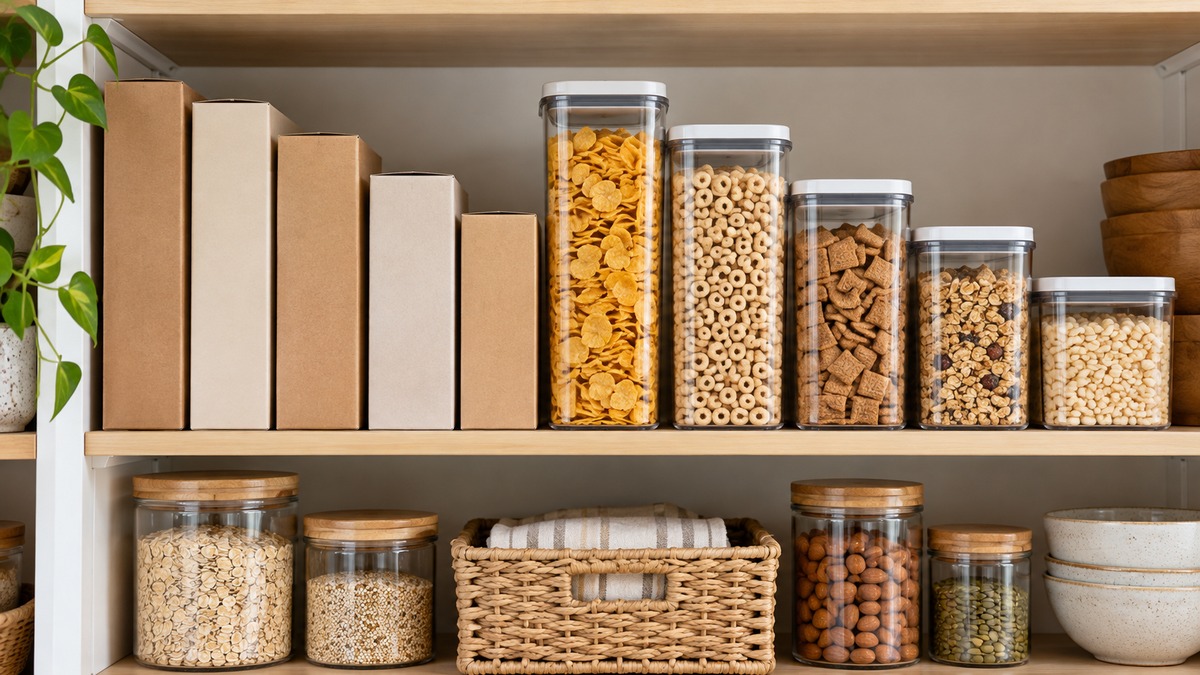
For cereal, the Virginia Tech and New Mexico State pages use almost the same sentence: cereals should be stored at room temperature in “tightly closed containers to keep out moisture and insects.” The Mississippi State release says cereal and crackers should be sealed once opened. Beyond that the sources split on how tight is tight enough.
| Source | What it says about closing opened food |
|---|---|
| Virginia Tech | Cereals stored in tightly closed containers |
| New Mexico State | Metal, glass and plastic containers, or storage bags with tight-fitting zippers or lids |
| Texas A&M | Metal, glass or plastic containers, kept clean and free of dust |
| Illinois Extension | A storage bag or a storage container with a lid to keep pests out |
| Mississippi State Extension | Airtight glass or plastic containers; “Zip-top bags are usually sufficient” |
| University of California IPM | Containers with tight-fitting lids; “plastic bags aren’t adequate” |
| Clemson | Airtight, insect-proof containers |
The split is real. Three of the sources allow a bag (New Mexico State with tight-fitting zippers, Illinois a storage bag, Mississippi State a zip-top bag), while the University of California says plastic bags are not adequate. The pages do not reconcile the point, so a rigid container with a lid is the choice that all of them accept.
Sealed packages are not a complete barrier either. The University of California page says insects are less likely to invade packages that have their original seal and more commonly infest packages that have been opened or have sat on the shelf a long time. Clemson adds that infestation can occur when a factory seal on a box or bag is not adequate and insects find their way into unopened packages. A Mississippi State entomologist, quoted in the release, says manufacturers have increased their use of insect-proof packaging but pests can be present in food before it is packaged. That is a reason to inspect new boxes as well as old ones.
For containers, the University of California page says to wash old containers before filling them with new food, because they may be contaminated and cause a new infestation. Texas A&M says to keep containers clean and free of dust, which can drop in when they are opened.
How long a box keeps on the shelf
Shelf life is quality guidance rather than a safety deadline. The FDA explains that a “use by” date means the manufacturer recommends using the product by that date for the best flavor or quality, and that the date is not a food safety date. Virginia Tech says cereals marked “best if used by,” “best before” or “use by” are not at their best quality after the date but can still be safely consumed, and the New Mexico guide describes its storage times as guidelines, not hard and fast rules.
| Source | Ready-to-eat cereal, unopened | Ready-to-eat cereal, opened |
|---|---|---|
| Virginia Tech (pantry) | 6 to 12 months | No opened figure given in the pantry column |
| New Mexico State (pantry) | 6 to 12 months | 2 to 3 months in the cereal rows; 1 month for dry cereal (opened) in the snacks and miscellaneous list |
| Texas A&M (pantry) | 6 to 12 months | 1 to 3 months |
The three pages agree on the unopened range and disagree on the opened one, with figures from one to three months. New Mexico State gives two different numbers in its own table. For a household, the practical reading is to treat the shortest figure as a prompt to check opened boxes sooner, and to look and smell before using. New Mexico State’s discard list for packaged foods includes a foul odor or change of color, broken or missing safety seals, loose or missing lids, and a cracked container. The FDA adds that mold is a sign of spoilage and that the safest practice is to discard moldy food.
Rotate: oldest in front, newest in back
Texas A&M calls “first in, first out” a good policy: rotate items so older ones are used first, and buy foods in reasonable amounts so you can use them while they are still of good quality. The New Mexico guide gives the method: write the contents and the date stored on the package, and once a month sort stored foods so that “the oldest dates are at the front” and the freshest at the back. New items go to the back so that the oldest dates are used first.
That method suggests a layout in which boxes stand in rows from front to back, so a new box slides in behind the old ones. The table below counts the boxes on a shelf with that layout. The sample box is our own assumption: 12 inches tall, 7.5 inches wide and 2.5 inches deep, with the wide face to the front. Real boxes differ and the sources give no size. The shelf depths (12 and 16 inches) and lengths (4 and 6 feet) come from the ClosetMaid planning page, which lists 12-inch and 16-inch depths and 4-, 6-, 8- and 12-foot lengths. The number of boxes across is the shelf length divided by 7.5, rounded down. The number of rows deep is the shelf depth divided by 2.5, rounded down. The boxes on the shelf are the two numbers multiplied.
| Shelf (length × depth) | Boxes across | Rows deep | Boxes on the shelf |
|---|---|---|---|
| 48 × 12 inches | 48 ÷ 7.5 = 6.4, so 6 | 12 ÷ 2.5 = 4.8, so 4 | 6 × 4 = 24 |
| 48 × 16 inches | 48 ÷ 7.5 = 6.4, so 6 | 16 ÷ 2.5 = 6.4, so 6 | 6 × 6 = 36 |
| 72 × 12 inches | 72 ÷ 7.5 = 9.6, so 9 | 12 ÷ 2.5 = 4.8, so 4 | 9 × 4 = 36 |
| 72 × 16 inches | 72 ÷ 7.5 = 9.6, so 9 | 16 ÷ 2.5 = 6.4, so 6 | 9 × 6 = 54 |
The shelf has to be at least 12 inches clear above the shelf below to take a standing box, and you will want a little more to lift one out. The sources give no clearance, so that figure is yours to set. A deep shelf stores more boxes, and a row four or six deep puts the oldest box at the front and the newest at the back, which makes the monthly check of dates easy. It also puts boxes out of sight at the back, and the Mississippi State release specifically says to check items that have been pushed to the back.
Shelf space and shelf life also work against each other. The table turns the unopened range into a ceiling: at the low end, 6 months is 26 weeks (52 weeks divided by 2, our conversion). It then divides each shelf total by the boxes your household opens per week to get weeks of supply. We assume one, two or three boxes a week, which are examples rather than figures from any source.
| Boxes on the shelf | At 1 box a week | At 2 boxes a week | At 3 boxes a week |
|---|---|---|---|
| 24 | 24 weeks | 12 weeks | 8 weeks |
| 36 | 36 weeks | 18 weeks | 12 weeks |
| 54 | 54 weeks | 27 weeks | 18 weeks |
Compare each figure with 26 weeks. Three cells run past it: 36 boxes and 54 boxes at one box a week, and 54 boxes at two boxes a week (27 weeks). A full 54-box shelf at one box a week holds more than a year of cereal, which is more than the 6-to-12-month unopened range supports. Every other cell finishes inside the low end of that range. Texas A&M makes a related point: buy only what you expect to use within the recommended storage times.
Clean the shelf and look for pests
The University of California page says pantry pests are insects such as certain moths or beetles that can attack almost any stored food, cereal included, and usually enter the home in an infested package. It lists signs to look for: webbing in tight places of a package and tiny holes in a food container. It says to inspect all packages, especially opened ones, because by the time you spot a pest it has usually spread to other packages. The Indian meal moth is named as the most common meal moth in home pantries, with larvae that attack cereal and cereal products. The Mississippi State release says red or confused flour beetles, often called weevils, are especially common in cereal and flour products, and that if small moths are flying around the house you should check cereal boxes, cake mixes and bags of birdseed.
The cleanup steps are consistent. Throw away food with evidence of infestation. Wash shelves with soap and water, scrubbing corners and crevices or vacuuming them with a crevice attachment, before you replace packages that are not infested. Mississippi State advises sealing affected items in a tight bag and putting them in an outdoor trash bin, then emptying the area, vacuuming and cleaning with hot, soapy water, with special attention to the undersides of shelves and the places where shelves meet the wall or cabinet. Clemson adds that cracks and crevices where food can collect should be filled with caulk, damaged shelves repaired and shelving paper laid flat.
The release also says it is a good idea for cooks to “empty the pantry at least once a year” and check items that have been pushed to the back. Combined with the New Mexico monthly date check, that gives a simple schedule: look at dates and package condition each month, and do a full empty-and-clean once a year. The sources do not give a cleaning frequency for the shelf surface beyond saying to clean it regularly.
If an infestation has been cleared, the University of California page advises storing susceptible food in airtight containers, the refrigerator or the freezer for at least several months. It says to keep infrequently used foods such as flour, spices and grains in a freezer if possible. The page lists those foods, and cereal is not among them. For a different pantry layout, see our guide to pantry under stairs storage solutions.
How we chose
This is a storage routine rather than a product list, so there are no products to rank. We read nine pages on 2026-10-21 and kept a rule only when a page states it in plain words and it applies to a box of dry cereal on a shelf. We checked each quoted sentence against the text of its page. Where pages disagree, as on opened shelf life and on zip-top bags, we show each source. We left out refrigerator and freezer storage for other foods, canning and bulk food storage for emergencies, and pest treatment with insecticides, which the pages treat separately. The layout and supply figures are our own arithmetic with each input named, and the sample box size is an assumption.
Mistakes to avoid
- Keeping open cereal in a folded box top. The extension pages call for tightly closed containers once opened.
- Using the shelf over the stove. Texas A&M names the range and oven as places to avoid.
- Letting boxes sit on the floor. New Mexico State says keeping food off the floor prevents contact with moisture.
- Storing cereal next to cleaning supplies. The FDA and Illinois both advise keeping them apart.
- Adding new boxes in front of old ones. The New Mexico guide puts the oldest dates at the front.
- Skipping the shelf wipe-down. The University of California page says to wash shelves and vacuum crevices, since eggs and pupae can remain.
- Treating a date as a safety deadline. The FDA says a use-by date is not a food safety date, so check smell, color and packaging as well.
What we could not verify
The pages we opened do not give a cereal box size, a cereal-specific moisture limit, a clearance above the box, or a count of boxes per shelf. They disagree on how long opened cereal lasts and on whether a zip-top bag is enough, and the University of California and Mississippi State pages do not say which kinds of packaging resist insects. We could not open the USDA FoodSafety.gov or FSIS shelf-stable pages, so nothing here relies on them. The 6-inch and 18-inch shelving figures come from a general food storage section, not a cereal-specific one. We have no source for any product, and nothing in this guide is a product claim.
Frequently asked questions
Should I keep cereal in the original box on the shelf?
Unopened, the original package is how the extension timetables describe cereal storage, with 6 to 12 months in the pantry. Once opened, Virginia Tech and New Mexico State both say to use tightly closed containers, and the University of California warns that insects more often infest opened packages.
Is a zip-top bag enough for opened cereal?
The sources disagree. Mississippi State Extension says zip-top bags are usually sufficient, New Mexico State accepts bags with tight zippers, and the University of California says plastic bags are not adequate. A container with a tight lid satisfies all of them.
How long does opened cereal last?
Texas A&M gives 1 to 3 months for opened ready-to-eat cereal, and New Mexico State gives 2 to 3 months in one row and 1 month in another. These are quality guidelines, so check the cereal for odor, color change and pests as well as the calendar.
Where in the kitchen should cereal be stored?
Choose the coolest, driest, darkest cabinet, away from the range, oven, dishwasher, water heater and hot pipes, as Texas A&M advises. New Mexico State warns against areas with fluctuating temperatures, such as a garage.
What are the first signs of pantry pests in cereal?
The University of California page lists webbing in tight places of a package and tiny holes in the container. Mississippi State adds small moths flying around the house as a cue to check cereal boxes. Throw out any food showing signs of infestation and clean the shelves.
Bottom line
Keep cereal in a cool, dry, dark spot off the floor, move opened cereal into a lidded container, rotate oldest to the front, and clean the shelf regularly.
Sources
- https://ext.vt.edu/content/pubs_ext_vt_edu/en/348/348-960/348-960.html (opened 2026-10-21)
- https://pubs.nmsu.edu/_e/E118/ (opened 2026-10-21)
- https://agrilifeextension.tamu.edu/wp-content/uploads/2025/04/safe-home-food-storages.pdf (opened 2026-10-21)
- https://extension.illinois.edu/food-safety/room-temperature-storage (opened 2026-10-21)
- https://www.newswise.com/articles/spring-cleaning-can-keep-stored-food-pests-at-bay (opened 2026-10-21)
- https://ipm.ucanr.edu/home-and-landscape/pantry-pests/ (opened 2026-10-21)
- https://hgic.clemson.edu/factsheet/pantry-pests/ (opened 2026-10-21)
- https://www.fda.gov/consumers/consumer-updates/are-you-storing-food-safely (opened 2026-10-21)
- https://homedepot.closetmaid.com/en-US/Installation/Pages/how-to-guides.aspx (opened 2026-10-21)
As an Amazon Associate we earn from qualifying purchases.