How to Store Books by Size
As an Amazon Associate we earn from qualifying purchases.
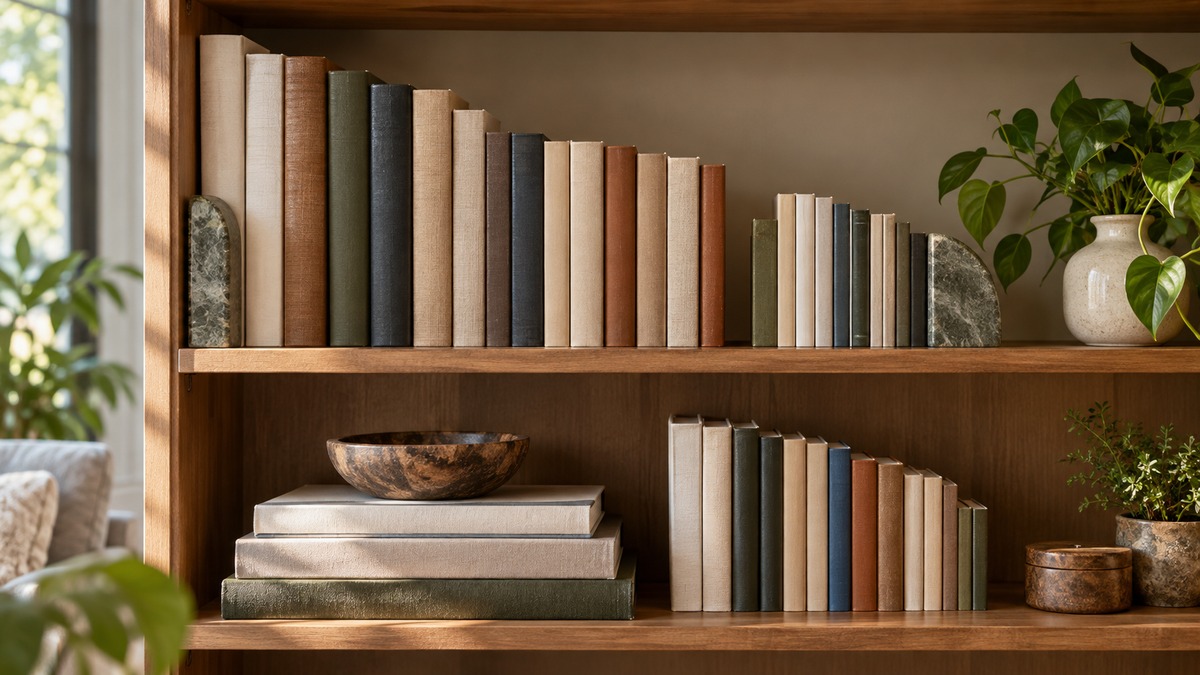
How to store books by size starts with a simple rule that three separate library and park-service guides repeat: put books of similar height next to each other, so every cover has a neighbor to lean on. The same guides add a second rule for the biggest books, which belong flat instead of standing. This guide turns both rules into a sorting plan with real arithmetic, so you can decide how many shelves you need and how tall each opening should be.
Quick answer
- Shelve books of similar size together, so neighbors support each other’s covers.
- Lay volumes over 18 inches high, or with a spine wider than 3 inches, flat, and stack no more than three.
- Use bookends tall enough that no book can lean over them.
- Keep every shelf flat and solid, and match the load on each shelf to what it can carry.
Why size is the first sort
Most of us sort books by author, subject or color. The preservation guides sort them by size first, because a book stands only as well as its neighbors let it. The Library of Congress research guide on storing books puts it as an instruction: “Shelve books of similar size together,” so that the covers are supported by the neighbors on each side.
The National Park Service care sheet for rare books gives the failure that the instruction prevents. It notes that books are usually arranged by classification number, but tall volumes shelved next to short ones “have a tendency to warp and deform over time.” It therefore says books should be grouped on shelves according to size, if that will not disrupt intellectual access to the collection. The State Library of Queensland guide says the same in other words: similarly sized volumes should be shelved together to ensure uniform support, “thereby discouraging warping of the boards or other physical distortion.”
The size rule appears in a general care guide for the public from the Library of Congress, a general care guide from the State Library of Queensland and a rare-book sheet from the National Park Service. The only numeric thresholds come from the rare-book sheet. A home shelf is not a rare-book vault, so read the numbers below as institutional limits that you are applying to a house, not as home-specific standards.
Measure before you sort
You need two measurements per book: the height of the spine and the width of the spine. Height decides which group the book joins. Spine width decides how much shelf length the book uses, and whether it passes the 3-inch test described below. A tape measure and a notepad are enough; sorting by eye works for a first pass, but the 18-inch and 3-inch thresholds need a number.
The sources do not give a standard height for any book type. They do not define small, medium and large in inches, apart from the two thresholds for flat storage. That means the groups below are yours to define. A workable method is to sort the books into rows by height, look for natural breaks, and draw group lines at the breaks. The group lines are a judgment call that the sources leave to you.
The size rules in one table
| Book type | Rule | Source |
|---|---|---|
| Small and medium volumes in good condition | May be stored upright on shelves, or within folders or boxes | State Library of Queensland |
| Books of similar height | Shelve together so neighbors support the covers | Library of Congress, State Library of Queensland, National Park Service |
| Books too large to stand upright | Store flat and horizontal, fully supported by the shelf underneath | Library of Congress |
| Volumes over 18 inches high or with a spine wider than 3 inches | Lie flat; stack no more than three | National Park Service (rare books) |
| A book that must stand though large | Place it spine down; never spine up | Library of Congress |
| Books on a shelf in general | Upright, no leaning or slanting; support with bookends if needed | Library of Congress, State Library of Queensland |
Standing books: keep them upright and supported
The Library of Congress says to keep shelved books upright and not let them lean, and to support them with bookends if necessary to keep them from leaning or slumping. The National Park Service sheet adds a plain line: “Books should not slouch on the shelves.” It also says bookends or other supports should be “tall enough to prevent a book from leaning over the support.”
That last point has a size consequence that is easy to miss. Read literally, a bookend shorter than the book it holds fails that test, because the book can lean over its top. If the shelf holds two height groups, the shorter group needs a taller support, or a neighbor, or a shelf of its own. The State Library of Queensland adds a smaller point on the hardware: bookends should not have sharp edges.
The other side of leaning is cramming. The park-service sheet says books should be close enough to provide support to the other books but loose enough to be removed without abrading the bindings. The Queensland guide says to hold books vertically “without jamming them in tightly,” and explains that tight packing puts them under continual lateral stress and prevents air circulation. So the buffer that the sorting table below leaves at the end of each row is not wasted space.
Lay the large books flat
For the biggest books, the Library of Congress guide says books too large to stand upright can be stored flat and horizontal, fully supported by the shelf underneath. The National Park Service sheet is the only page we opened that gives numbers: volumes over 18 inches high, or with a spine wider than 3 inches, should lie flat. Its reason is that the binding may not be able to support the book, so the cover can warp, the pages can separate and the spine can weaken.
When large volumes are laid flat, the sheet says to “stack no more than three volumes” and to lift off the top two volumes before removing the one at the bottom. The Library of Congress guide adds a case for books that must stand anyway: put the spine downward, and never store a book spine up, because gravity will loosen or detach the text block over time.
The same Library of Congress page sets a rule for the shelf that carries a flat book: all shelves should be completely flat, with no protrusions such as splinters or nails, and a solid surface, not latticed or slatted. By that rule, a slatted or latticed shelf is a poor match for flat storage. Check the shelf surface before you move large volumes onto a shelf you have not used for flat storage.
The park-service sheet is written for rare books, and the sources do not say whether the same 18-inch and 3-inch cut-offs apply to a modern paperback or a coffee-table book. Treat the cut-offs as a cautious limit, and use the Library of Congress rule that a book too large to stand goes flat as the broader test.
A worked example: sorting 134 books into size groups
The table below shows the method with numbers. Every number in it is our own assumption, because the sources do not give typical book sizes. Replace them with your own measurements. The method: multiply the number of books by the average spine width to get the shelf length each group needs; divide by the shelf width to get shelves, and round up so the last shelf keeps some room; and use the tallest book in the group as the minimum shelf opening, since a standing book needs an opening at least as tall as itself.
| Group | Books (assumed) | Average spine (assumed, inches) | Length needed (inches) | Shelves at 30 inches | Tallest book (assumed, inches) |
|---|---|---|---|---|---|
| A: shortest | 40 | 1.00 | 40 × 1.00 = 40.0 | 40.0 ÷ 30 = 1.33, so 2 | 8.0 |
| B: medium | 60 | 1.25 | 60 × 1.25 = 75.0 | 75.0 ÷ 30 = 2.50, so 3 | 9.5 |
| C: tall | 28 | 1.25 | 28 × 1.25 = 35.0 | 35.0 ÷ 30 = 1.17, so 2 | 12.0 |
| D: oversize, flat | 6 (two stacks of three) | 2.00 | 3 × 2.00 = 6.00 per stack | 1 shelf (assumes both stacks fit side by side) | over 18 (by the 18-inch rule) |
That plan adds up to 2 + 3 + 2 + 1 = 8 shelves. Now compare two ways of building the unit. If every shelf has an opening for the tallest standing book in the plan, 12.0 inches, then the openings add up to 7 × 12.0 = 84.0 inches for the seven standing shelves, plus 6.0 inches for the flat shelf, which is the height of one stack of three books at 2.00 inches each. If each group gets its own opening, the standing shelves need (2 × 8.0) + (3 × 9.5) + (2 × 12.0) = 16.0 + 28.5 + 24.0 = 68.5 inches, plus the same 6.0 inches for the flat shelf.
| Build | Standing shelf openings (inches) | Flat shelf opening (inches) | Total openings (inches) |
|---|---|---|---|
| Every shelf set to the tallest standing book | 7 × 12.0 = 84.0 | 6.0 | 84.0 + 6.0 = 90.0 |
| Each group gets its own opening | 16.0 + 28.5 + 24.0 = 68.5 | 6.0 | 68.5 + 6.0 = 74.5 |
The difference is 90.0 − 74.5 = 15.5 inches of height, before counting the thickness of the shelf boards. That is the case for adjustable shelves when your books fall into size groups: the shelves can follow the groups instead of the tallest book. The flat opening is the stack height alone. The sources do not state how much extra room is needed to lift off the top two volumes, so add room for your hand. For adjustable-shelf options, see adjustable height shelves.
What to do when size and subject clash
The park-service sheet says books should be grouped by size only if that will not disrupt intellectual access to the collection. At home, that condition is a choice about how you find books. The sources do not tell you how to blend the two orders, so the options below are our own suggestions, not rules from a page.
- Size zones first, subject second. Give each size group its own shelf or bay, and sort by subject or author inside the bay.
- Split a subject across two bays. A set of cookbooks, for example, can sit in the tall bay if they are tall, with a label on the shelf front.
- Keep sets and series together when their heights are close, since near-equal heights give the neighbor support the sources ask for.
The park-service sheet also mentions a book block, a sturdy form made from archival materials, to hold the place of an over- or undersized rare book, with a label noting where the book is stored. That is an institutional method, and the sources do not describe a home version. For books that suit a display, see book display shelves. For tall and large formats, see big book shelves.
Check the shelf before you load it
The Queensland guide says it is important to choose shelving carefully, because some materials can damage a collection. It names powder-coated steel and anodized aluminum as the best choice of bookshelf, because neither produces harmful by-products, and it says that with any shelving it is important to ensure correct weight loading on each shelf so it does not collapse or topple. The Library of Congress FAQ says metal shelves are preferable to wood because the acids present in wood can migrate into paper and books.
The sources give no weight figure for a home bookcase. The only sourced load instruction is the general one above, so check the stated capacity of your shelf before you load it, and check it again before you stack large volumes. For more on arranging books in tight rooms, see ways to store books in a small room.
Handle books from the middle of the spine
Handling matters once the books are sorted. The Queensland guide says damage is caused by pulling books off the shelf by the top of the spine. Its instruction is to push the books on either side back and remove the volume from the middle of the spine. If you keep the buffer in the plan above, the neighbors have room to move back.
How we chose
We read each page on 2026-10-21 and kept only the rules a page states in its own words. The core set is a Library of Congress research guide on storing books, a Library of Congress FAQ on books, a National Park Service care sheet for rare books and a State Library of Queensland guide to caring for books. Where the sources give a number, we quote it. Where they do not, the table says it is our assumption. We did not use retailer or manufacturer pages for any storage claim, and we left out pages that did not load. The tables are our own arithmetic, and every input is named.
Mistakes to avoid
- Mixing tall and short books on one run. The park-service sheet says tall volumes shelved next to short ones tend to warp and deform.
- Standing books over 18 inches high. The park-service sheet says they should lie flat.
- Stacking flat volumes more than three high. The same sheet sets the limit at three.
- Shelving a large book spine up. The Library of Congress says books should never be stored spine up.
- Using a bookend shorter than the book. The park-service sheet asks for supports tall enough to stop a book leaning over them.
- Pulling a book by the top of the spine. The Queensland guide says this damages the book.
What we could not verify
The sources we opened do not give typical heights for paperbacks, hardcovers or art books, and they do not define small, medium or large except for the two flat-storage thresholds. The 18-inch and 3-inch figures come from a rare-book care sheet, and the pages do not say whether they apply to ordinary books at home. None of them gives a clearance between a book and the shelf above, a bookend height in inches, or a weight limit for a home bookcase. Most of the guidance is written for libraries, archives and museums, so applying it to a home shelf is an adaptation and not a direct rule. Nothing in this guide is a product claim, and the example numbers in the sorting tables are assumptions.
Frequently asked questions
Should I shelve books by size or by subject?
The National Park Service sheet recommends grouping by size when that will not disrupt access, and the Library of Congress and Queensland guides say to shelve similar sizes together. A practical compromise is size zones with subject order inside each zone.
When should a book lie flat instead of standing?
The Library of Congress says books too large to stand upright can be stored flat, fully supported by the shelf underneath. The National Park Service gives numbers: volumes over 18 inches high, or with a spine wider than 3 inches, should lie flat.
How many books can I stack flat?
No more than three, according to the National Park Service sheet. It also says to lift off the top two volumes before removing the one on the bottom.
Should a large book stand with the spine up or down?
Down. The Library of Congress guide says to place the spine downward if a large book must be shelved vertically, and never to store a book spine up, because gravity will loosen the text block over time.
How tall should bookends be?
The sources give no height in inches. The National Park Service sheet says supports should be tall enough to prevent a book from leaning over them, so compare the bookend with the shortest book it holds.
Is a metal shelf better than a wood shelf for books?
The Library of Congress FAQ says metal shelves are preferable because acids in wood can migrate into paper and books. The Queensland guide recommends powder-coated steel or anodized aluminum shelving.
Bottom line
Group your books by height, stand them upright with supports tall enough to stop leaning, and lay anything over 18 inches high flat in stacks of three or fewer.
Sources
- https://guides.loc.gov/preserving-your-books/storing (opened 2026-10-21)
- https://www.nps.gov/subjects/museums/upload/19-02_508.pdf (opened 2026-10-21)
- https://www.slq.qld.gov.au/sites/default/files/Caring%20for%20your%20collections%20-%20Books%20%26%20bound%20material_2025.pdf (opened 2026-10-21)
- https://www.loc.gov/preservation/about/faqs/books.html (opened 2026-10-21)