How to Store Scarves on Shelves
As an Amazon Associate we earn from qualifying purchases.
How to store scarves on shelves comes down to folds, contact and climate. Textile care guides from Oklahoma State University, the University of Nebraska-Lincoln, the National Park Service, the Western Australian Museum and Winterthur say, taken together, that a textile should be folded as little as possible, padded where it does fold, kept away from bare wood and plastic bags, and held in a dark, steady place. None of them is about scarves in particular, so this guide applies their textile rules to a closet shelf and says where it is stretching them.
Quick answer
- Store scarves unfolded if you can, and if you must fold them, use as few folds as possible and pad each fold.
- Refold into new fold lines every six to twelve months so no crease sets.
- Keep scarves off bare wood, and use acid-free tissue or washed, unbleached muslin between the scarf and the shelf.
- Choose a dark, interior, steady spot, and skip plastic dry-cleaning bags.
What the sources cover, and what they leave out
Every source we opened is written for textiles in general. The Oklahoma State University Extension fact sheet covers heirloom textiles in the home. The University of Nebraska-Lincoln Extension publication covers quilts. The National Park Service sheet covers mold and mildew on textiles in museum collections. The Western Australian Museum page is a conservation manual entry on textile storage, and Winterthur’s page is a set of home tips from a museum’s conservators.
That matters because a scarf is not a quilt or a costume. It is long, narrow and light, and it may be silk, wool, cotton or a blend. The sources give rules by fiber type and construction, such as how silk, linen and knits behave, and by shape, such as long and narrow items. We apply those rules where a scarf fits the description and flag the places where the fit is our reading. The guidance is also written for heirlooms, so applying it to everyday scarves is an adaptation, and you can relax it for scarves that are cheap to replace.
Pick the method: flat, folded, rolled or hung
The Oklahoma State fact sheet names three ways to store textiles: flat, rolled and hanging. It says the type of textile, the condition of the fabric and the space available decide which to use. It also gives a short list of what flat storage suits, and the first two items are flat textiles and garments too fragile to hang. Knit fabrics are also on the list, which matters for wool and cashmere scarves.
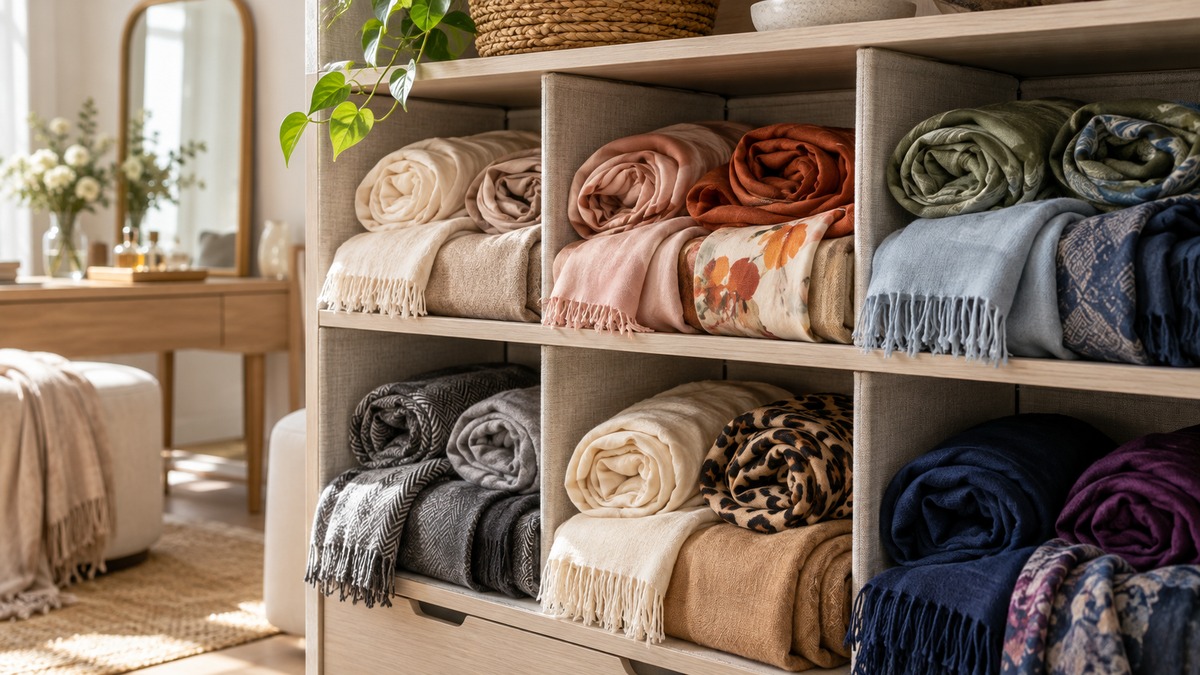
The same sheet makes the rule for folding plain: “If possible, store all textiles unfolded.” If folding is necessary, it says to pad crease points with sausages made from washed muslin tubes filled with polyester batting, and to refold the textile into new fold lines every six to twelve months so that the folds will not break or crack. It adds that linen and silk “have a tendency to crack when left folded for long periods of time.” Silk scarves are the clearest match.
| Scarf type | Method the sources point to | Source |
|---|---|---|
| Knit or stretchy scarf | Flat storage, because the sheet lists knit fabrics for flat storage | Oklahoma State University Extension |
| Silk scarf | Unfolded if possible; if folded, padded and refolded on schedule, since silk tends to crack at long-held folds | Oklahoma State University Extension |
| Long, narrow scarf | Rolling is suited to long and narrow items such as lace; scarves are long and narrow, but the page does not mention them | Winterthur (our reading) |
| Scarf with beads, sequins or metallic yarn | Separate the metallic or beaded areas from the rest with acid-free tissue or washed muslin | Oklahoma State University Extension |
| Sturdy everyday scarf | Fold with as few folds as possible and pad the folds | Western Australian Museum, Winterthur |
The Western Australian Museum explains why padding matters: textiles will eventually split along folds or creases. Winterthur says folded textiles may eventually suffer fiber breaks along the fold line and recommends padding the folds with unbuffered acid-free tissue, or with a rolled undyed cotton textile such as a pillowcase, terry cloth towel or bed sheet. The Oklahoma State sheet and the Nebraska publication both describe crumpled or tubed padding for the folds.
Fold math: how many folds does your shelf force?
The sources ask for as few folds as possible, and the shelf decides how many you get. Each fold in half halves the length of the scarf. The table below shows the folded length after zero to four folds for three example scarf lengths. The lengths are our own assumptions, because the sources do not give typical scarf sizes. Replace them with a tape-measure reading of your own scarves.
| Folds in half | 60-inch scarf (assumed) | 70-inch scarf (assumed) | 72-inch scarf (assumed) |
|---|---|---|---|
| 0 | 60.0 | 70.0 | 72.0 |
| 1 | 60 ÷ 2 = 30.0 | 70 ÷ 2 = 35.0 | 72 ÷ 2 = 36.0 |
| 2 | 30 ÷ 2 = 15.0 | 35 ÷ 2 = 17.5 | 36 ÷ 2 = 18.0 |
| 3 | 15 ÷ 2 = 7.5 | 17.5 ÷ 2 = 8.75 | 18 ÷ 2 = 9.0 |
| 4 | 7.5 ÷ 2 = 3.75 | 8.75 ÷ 2 = 4.375 | 9 ÷ 2 = 4.5 |
Now compare the folded length with the shelf depth. The folds you need are the smallest number that brings the folded length at or under the depth. With an assumed 12-inch deep shelf, all three scarves need three folds, since two folds leave 15.0, 17.5 and 18.0 inches. With an assumed 16-inch deep shelf, the 60-inch scarf needs two folds (15.0 is under 16), while the 70- and 72-inch scarves still need three. With an 18-inch deep shelf, all three need two folds (15.0, 17.5 and 18.0 are all at or under 18).
| Assumed shelf depth (inches) | Folds for 60-inch scarf | Folds for 70-inch scarf | Folds for 72-inch scarf |
|---|---|---|---|
| 12 | 3 | 3 | 3 |
| 16 | 2 | 3 | 3 |
| 18 | 2 | 2 | 2 |
The pattern is the useful part. A shelf six inches deeper can remove a fold from every scarf, and each fold removed is a crease line the sources would rather you avoid. The sources do not give a shelf depth for scarves, and the table assumes simple halving, so a different fold pattern changes the numbers. If your shelf is shallow and your scarves are long, the sources’ other options are rolling or a box.
Refold on a schedule
The Oklahoma State fact sheet gives the timing: every six to twelve months, refold the textile into new fold lines. For one shelf of scarves that means a calendar job, not a decision each time. If you pick six months, each scarf is refolded twice a year, which is 2 × 5 = 10 times in five years. If you pick twelve months, it is 1 × 5 = 5 times. The sources do not say which interval suits which fiber, so the tighter interval is the cautious pick for silk, which the sheet singles out.
The Nebraska publication adds a point about weight. It says to avoid stacking heavy items on top of quilts, so the textiles are not creased and the batting is not crushed. That sentence is written for quilts. The Oklahoma State sheet gives the stacking rule for any textile: if you must stack textiles on each other, never put a larger or heavier one on top of one that is smaller or more fragile. Put the lightest, most fragile scarf on top of any stack, not at the bottom.
Line the shelf and separate the layers
Wood is the shelf problem in these sources. The Oklahoma State sheet says: “Don’t allow your textiles to come in direct contact with wood or wood products.” Its reason is that the acid in these items causes a chemical breakdown of the fibers. For a wooden shelf it says to seal the wood with several coats of polyurethane varnish, and it adds to line drawers with washed unbleached muslin or acid-free paper.
The Nebraska publication describes the liner approach for shelves. It says to protect textiles from direct contact with wood, including cedar chests, regular cardboard and paper, because they give off acid by-products as they age. Layers of acid-free tissue or washed unbleached cotton muslin can line shelves, boxes or cedar chests. It gives upkeep numbers: remove and wash the muslin yearly, ideally, and replace the acid-free tissue about every five years, since it also becomes acidic with age. It says to avoid colored tissue papers, because most are not colorfast and can stain textiles if moistened.
The Western Australian Museum adds a rule for layers: interleave textiles with acid-free tissue if several are stored one on top of another. Oklahoma State says to separate each item with acid-free tissue or washed muslin. Together the sources give a shelf recipe: a liner on the shelf, tissue or muslin between scarves, and tissue padding in each fold. For a look at wood choices in closet shelving, see the type of wood for closet shelves.
Plastic: bags versus bins
The sources disagree on plastic, or seem to, so the table separates the cases.
| Source | Plastic item | What it says |
|---|---|---|
| Oklahoma State University Extension | Plastic bags, including dry-cleaning bags | Do not store textiles in plastic bags; they hold moisture, create static and may cause yellowing |
| University of Nebraska-Lincoln Extension | Plastic bags | Do not store quilts in plastic bags; they may not allow air circulation, and sealed moisture can lead to mildew |
| Winterthur | Polyethylene plastic bins | A cost-effective alternative to archival boxes, because the plastic is more stable and does not emit volatile gases; line the bin with cotton muslin |
The cases differ: bags that touch and seal in the fabric versus a lined bin. The Winterthur page says to line any box with cotton muslin or an undyed bed sheet, so the lining acts as a sling for lifting items out. The Oklahoma State sheet also lists styrofoam and non-acid-free products such as regular cardboard or tissue paper as things to avoid. A clear plastic bin without a lining is outside what any of the pages recommends.
Choose the spot: light, climate and location
Light comes first. The Oklahoma State sheet says to protect textiles from light, because ultraviolet rays in sunlight and fluorescent bulbs fade colors and weaken fibers. Winterthur says both ultraviolet and visible light can harm textiles, with UV particularly damaging. The Nebraska publication asks for an area that is dark most of the time, which a closed closet shelf supplies.
Location is the other half. Nebraska says to avoid attics, basements, kitchens and unheated areas, because temperature and humidity vary too much there, and to store textiles away from outside walls. Oklahoma State says not to keep textiles in an attic or basement. Winterthur recommends keeping valuable textiles where you live, and calls a bedroom a good option. The three agree on the rooms to skip. The table shows where the numbers fall.
| Source | Temperature | Relative humidity |
|---|---|---|
| Oklahoma State University Extension | A moderate 65 °F | About 50 percent |
| National Park Service, textile mold sheet | 18 to 20 °C (64 to 68 °F), upper limit 24 °C (75 °F) | Below 65 percent; 50 to 55 percent recommended if possible |
| University of Nebraska-Lincoln Extension | 50 to 60 °F, for ideal quilt storage | About 50 percent |
Two readings follow. Humidity agrees: all three sources center on about 50 percent. Temperature does not: the Oklahoma State figure of 65 °F sits inside the National Park Service range of 64 to 68 °F, and the Nebraska ideal of 50 to 60 °F sits below both. The National Park Service sheet explains the risk at the other end. It says temperatures above 24 °C (75 °F) with relative humidity above 65 percent give optimum conditions for fungal growth, that growth is noted when humidity is above 50 percent, and that fluctuations are harmful because fibers dry out and then swell and crack with each swing. The sheet’s own summary is that “Cool, dry conditions, adequate ventilation, and general good housekeeping practices” are critical. The sources do not say which target suits a home closet, so a room hygrometer is the way to see where your shelf falls.
Check the shelf now and then
The Oklahoma State sheet says to clean and repair a textile before storing it, and to check storage areas periodically for fabric discoloration, insect or rodent damage and general dust accumulation. The Western Australian Museum says textiles should be cleaned by brush vacuuming and thoroughly inspected for insects before storage. The sheets do not say how to clean a particular scarf, and care labels differ by fiber, so use the label.
Mold is the serious case. The National Park Service sheet says a musty odor is often the first sign, with irregular stains that range from gray to black, though yellow, orange and red are possible. It warns that some microorganisms are pathogenic in high concentrations and can irritate the lungs. For a badly infested textile it says to isolate the item by sealing it in polyethylene and to seek a textile conservator’s advice immediately. If a scarf smells musty or shows stains, handle it as little as possible, keep it away from the others and follow that advice. For ideas on using the top shelf of a closet, see top-shelf storage ideas, and for what else belongs on closet shelves, see items to store on closet shelves.
A shelf plan, step by step
- Step 1: clean and sort. Clean the scarves, check them for insects, and sort by fabric: knit, silk, beaded, sturdy.
- Step 2: measure. Measure scarf lengths and shelf depth, and use the fold table to count the folds your shelf forces.
- Step 3: prepare the shelf. Seal or line a wood shelf, using washed unbleached muslin or acid-free tissue.
- Step 4: pad and separate. Pad each fold with tissue and place tissue or muslin between scarves.
- Step 5: stack with care. Put lighter, more fragile scarves on top, and avoid heavy loads.
- Step 6: set a refold date. Pick six or twelve months and note it on a calendar.
- Step 7: check the climate. Keep the shelf dark and away from attics, basements, kitchens and outside walls.
Our closet shelving roundups can help once the method is settled. Compare closet organization shelves or hanging and closet shelving systems, and judge each one on shelf depth and material.
How we chose
We read each page on 2026-10-21 and kept only the rules a page states in its own words. The core set is an Oklahoma State University Extension fact sheet on heirloom textiles, a University of Nebraska-Lincoln Extension publication on quilts, a National Park Service sheet on textile mold, a Western Australian Museum entry on textile storage and a Winterthur page of home textile tips. Where a source describes a different object, such as a quilt or a costume, we say so. We did not use retailer or manufacturer pages for any care claim, and we left out pages that did not load. The tables are our own arithmetic and summaries, and each assumption is named.
Mistakes to avoid
- Leaving silk folded for years. The Oklahoma State sheet says silk and linen tend to crack at folds held for long periods.
- Setting scarves on bare wood. The Oklahoma State and Nebraska pages both warn about acid from wood.
- Using a dry-cleaning bag. The Oklahoma State sheet says such bags hold moisture and create static.
- Stacking a heavy scarf on a delicate one. The Oklahoma State sheet says never to place a heavier textile on a more fragile one.
- Using colored tissue. The Nebraska publication says most colored tissue is not colorfast.
- Storing scarves in the attic or basement. Oklahoma State, Nebraska and Winterthur all advise against it.
What we could not verify
None of the sources we opened is about scarves, so every rule is a textile rule applied to a scarf. They do not give typical scarf lengths, a shelf depth for scarves, or a stack height. They do not say whether a given fiber needs the six-month or the twelve-month refold. They do not say which target temperature to choose for a home closet, and their figures differ. The Nebraska publication is about quilts and the National Park Service sheet is about museum collections. The fold table uses assumed scarf lengths and shelf depths. None of the pages names a liner, bin or shelf product as the right one, and nothing in this guide is a product claim.
Frequently asked questions
Should I fold or roll scarves?
Oklahoma State says to store textiles unfolded if possible, and Winterthur says long, narrow items such as lace suit rolling. The sources do not mention scarves, so rolling a long scarf is our reading. If you fold, use as few folds as possible and pad them.
How often should I refold stored scarves?
Every six to twelve months, according to the Oklahoma State fact sheet, into new fold lines so that creases do not set. The sheet singles out linen and silk as likely to crack when left folded.
Can I store scarves on a wood shelf?
The Oklahoma State sheet says to seal wood with several coats of polyurethane varnish and to line the surface with washed unbleached muslin or acid-free paper. The Nebraska publication says to line shelves with acid-free tissue or washed unbleached cotton muslin.
Is plastic safe for scarves?
Oklahoma State and Nebraska advise against plastic bags. Winterthur says polyethylene bins are a cost-effective alternative to archival boxes when lined with muslin or an undyed sheet.
What humidity should the closet have?
The three sources center on about 50 percent. The National Park Service sheet says to keep humidity below 65 percent and recommends 50 to 55 percent if possible, and it warns that fluctuations harm fibers.
Where should the shelf be?
In a dark, interior spot. Nebraska advises against attics, basements, kitchens, unheated areas and outside walls, and Winterthur calls a bedroom a good option.
Bottom line
Give scarves a lined shelf, as few padded folds as the shelf depth allows, and a calendar date to refold them in a dark, steady closet.
Sources
- https://4h.okstate.edu/projects/design-and-construction/site-files/files/curriculum-and-patterns/textiles/textiles-storage-and-display-of-textiles.pdf (opened 2026-10-21)
- https://extensionpubs.unl.edu/publication/g1820/2007/pdf/view/g1820-2007.pdf (opened 2026-10-21)
- https://www.nps.gov/subjects/museums/upload/16-01_508.pdf (opened 2026-10-21)
- https://manual.museum.wa.gov.au/textile-storage/ (opened 2026-10-21)
- https://www.winterthur.org/caring-for-your-collections-textile-conservation-tips/ (opened 2026-10-21)