How to Store Extra Blankets on Shelves
As an Amazon Associate we earn from qualifying purchases.
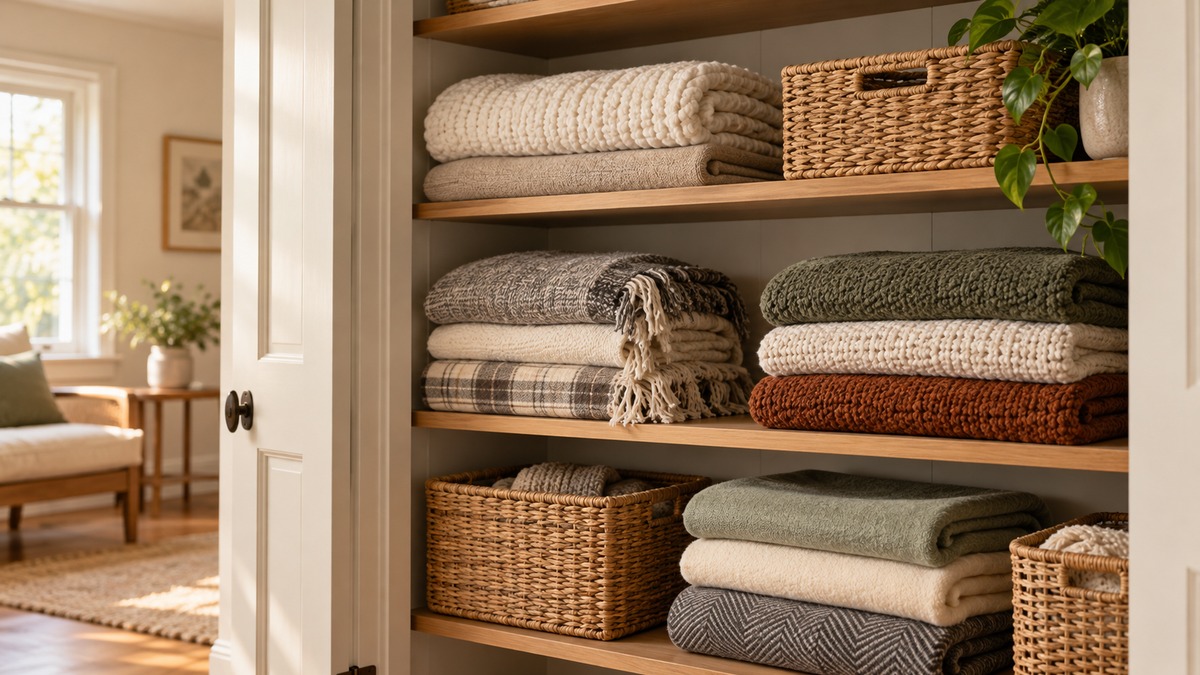
How to store extra blankets on shelves comes down to four things: what touches the shelf, how the blanket is folded, how tall the stack gets, and what the air around it is like. University extension services and museums publish storage rules for quilts and other textiles, and those rules carry over to spare blankets. Line bare wood, fold as little as you can, keep stacks light, skip plastic bags and avoid damp rooms. None of those pages was written for a fleece throw, so this guide shows where each rule comes from and where it stops.
Quick answer
- Line wood and cardboard with washed unbleached muslin or acid-free tissue. Extension guidance says both materials give off acids that harm textiles over time.
- Fold each blanket as few times as you can, and refold it now and then so the creases move.
- Keep stacks short and light. University of Nebraska Extension says to avoid stacking heavy items on top of stored quilts.
- Do not seal blankets in plastic bags. Cover them with a cotton sheet or a cloth bag instead.
- Put the shelf in a dry, dark, stable part of the living space, not an attic, basement or garage.
What these rules were written for
Most of the pages we opened are about quilts and heirloom textiles. The Nebraska Extension sheet is titled “Care of Quilts: Storage and Display,” and the Missouri sheet is aimed at family quilts and keepsakes. A fleece throw bought last winter is not an heirloom, and you may be happy to trade some long-term protection for convenience. The rules below therefore run from strict to relaxed, and each one names the page it comes from so you can decide how far to follow it.
The Nebraska sheet itself admits that ideal storage is rare. It says the ideal is a quilt kept flat and completely unfolded in total darkness, and that most private collectors and even some museums cannot do that. A shelf is a compromise, and the aim is to make that compromise as gentle as possible.
Line the shelf before the first blanket goes on
The most consistent rule across the pages is about contact. The Nebraska Extension sheet says to “line the shelves or sides with acid-free tissue or unbleached cotton muslin” when quilts sit in regular cardboard or wooden boxes or on wooden shelves. It adds that wood, regular cardboard and paper give off acid byproducts as they age, and that cedar chests are included in that warning.
The Missouri sheet, written by the same two authors for a different audience, gives the reason in plain words. Ordinary cardboard and wood “emit volatile acids that deteriorate and yellow textiles over time.” It lists closet shelves by name, so a shelf in a hallway or bedroom closet is covered by the advice.
Keep the liner fresh
A liner is not a one-time job. Nebraska Extension says the cotton muslin should be removed and washed periodically, with yearly being ideal. The acid-free tissue should be replaced periodically, ideally every five years, because tissue also becomes acidic with age. The sheet also says to avoid colored tissue papers, since most are not colorfast and can stain textiles if moistened. Plain white tissue and plain unbleached muslin are the safe choices.
If you are still deciding what the shelf itself should be made of, our guide to the type of wood for closet shelves covers that side of the question. For the blankets, the practical point is that a liner makes the choice less important.
Fold less, and move the folds
Every fold puts strain on the fibers along one line. The Nebraska sheet says to store quilts flat if possible and, if they must be folded, to fold them as few times as possible. It says to refold them periodically to redistribute the strain along the fold lines, and it warns that a quilt left folded for a long time may develop permanent creases and eventually break fibers along them.
The Missouri sheet gives the same advice in its short summary and adds an example of flat storage: a spare bed that is rarely used. The Quilt Museum and Gallery in the United Kingdom goes further and calls a bed the best way to store a quilt, covered by a larger cotton sheet to protect it from light and dust. For most households a bed is not available, which is why a shelf plan is still useful.
Folding pattern
The Quilt Museum leaflet gives the most specific folding method of the pages we opened. It says to fold the quilt into thirds, never in half and quarters, with every fold supported by rolls of acid-free tissue. Nebraska Extension offers a similar cushion: acid-free tissue crumpled into sausages along the folds. The leaflet also says to place the folded quilt in an acid-free box or wrap it in a white cotton sheet.
We read the leaflet as thirds in one direction and then thirds in the other. Under that reading, the folded footprint is the width divided by three by the length divided by three. The blanket sizes in the table are our own assumptions, so replace them with measurements of your own blankets.
| Blanket (assumed size, inches) | Width ÷ 3 | Length ÷ 3 | Folded footprint (inches) |
|---|---|---|---|
| Throw, 50 × 60 | 50 ÷ 3 = 16.7 | 60 ÷ 3 = 20.0 | 16.7 × 20.0 |
| Twin, 66 × 90 | 66 ÷ 3 = 22.0 | 90 ÷ 3 = 30.0 | 22.0 × 30.0 |
| Large bed blanket, 90 × 90 | 90 ÷ 3 = 30.0 | 90 ÷ 3 = 30.0 | 30.0 × 30.0 |
The table shows why a large bed blanket is a poor fit for a shelf that is only a foot deep. The sources we opened give no shelf depth for textiles, so compare the footprint above with the depth you actually have. If the footprint is larger than the shelf, either fold the blanket more times, which the Nebraska sheet advises against, or give it a deeper home.
Keep stacks short and light
The Nebraska sheet says to avoid stacking heavy quilts or other items on top, to prevent creasing the quilts and crushing the batting. It gives no height or weight limit, so any number you pick is a judgment call. The tables below show how the arithmetic works, using a folded thickness of 3 inches per blanket, which is our own assumption.
The formula is simple. Stack height is the number of blankets times the folded thickness. The number of blankets that fits in one stack is the clear shelf height, minus a gap for reaching in, divided by the thickness and rounded down. The 2-inch gap is also our assumption.
| Clear shelf height (inches) | Minus 2-inch gap | Blankets per stack at 3 inches each |
|---|---|---|
| 12 | 12 − 2 = 10 | 10 ÷ 3 = 3.3, so 3 |
| 15 | 15 − 2 = 13 | 13 ÷ 3 = 4.3, so 4 |
| 18 | 18 − 2 = 16 | 16 ÷ 3 = 5.3, so 5 |
Those numbers are the most the space allows, not what the sources recommend. A stack of five folded blankets is the tallest the 18-inch shelf can hold under these assumptions, and the weight on the bottom blanket grows with every layer. A lower cap is the safer reading of the Nebraska advice. A cap of three per stack is our own pick, and it leaves room for the muslin liner and a loose cotton cover on top.
Width works the same way. The next table assumes a folded blanket 18 inches wide with a 2-inch gap between stacks. Stacks per shelf equal the shelf width plus one gap, divided by the folded width plus one gap, rounded down.
| Shelf width (inches) | Width plus 2 | Stacks (÷ 20) | Blankets at a cap of 3 per stack |
|---|---|---|---|
| 24 | 26 | 26 ÷ 20 = 1.3, so 1 | 1 × 3 = 3 |
| 36 | 38 | 38 ÷ 20 = 1.9, so 1 | 1 × 3 = 3 |
| 48 | 50 | 50 ÷ 20 = 2.5, so 2 | 2 × 3 = 6 |
| 60 | 62 | 62 ÷ 20 = 3.1, so 3 | 3 × 3 = 9 |
The 36-inch row is worth a second look. It holds the same number of blankets as the 24-inch shelf, because the second stack needs a full 20 inches and the shelf has only 18 left over. Moving to 48 inches doubles the count. If your shelf sits just under a size breakpoint, folding the blankets slightly narrower can add a stack, but check the fold rule first.
The same logic applies on a high shelf. Our guide to storage ideas for the top shelf of a closet covers what suits that space, and lighter blankets in short stacks are an easy match for it.
Rolled instead of folded
If folds are the worry, the sources describe rolling. Nebraska Extension says quilts may be rolled onto large cardboard tubes that are longer than the quilt is wide and at least 4 inches in diameter. The tube is padded with cotton batting or resin-free polyester batting, then covered with acid-free tissue or washed cotton muslin, and the quilt is rolled loosely. It warns never to roll a quilt that was already folded, because that causes severe stress along the fold line.
The National Archives article by its conservation lab chief gives a similar instruction: roll large flat textiles such as quilts around the outside of large-diameter acid-free cardboard tubes, then put the rolls in boxes or cover them with muslin. The Quilt Museum leaflet has its own layering, with tin foil over the tube as a buffer under the wadding. The pages agree on the idea and differ on the layers, so pick one set and keep it consistent.
The shelf implication is a matter of length. If the tube must be longer than the blanket is wide, a 90-inch-wide blanket (our assumed size) needs a tube a little over 90 inches long. That span does not fit a 36-inch or 48-inch shelf lying side to side. A narrower throw on a shorter tube is much easier to place.
The National Park Service has one note on rolled textiles on open shelves. Its guidance on flags says to raise each end of the roll slightly on foam blocks, so the bottom of the roll is not crushed by its own weight. That page covers flags in fair to good condition and does not mention blankets, so treat it as a related example rather than a rule for your shelf.
Skip the plastic bag
Plastic is the place where the pages are strictest, and where they differ in tone. Nebraska Extension says quilts should not be stored in plastic bags, for three reasons: the bags may not allow air circulation, they may give off harmful byproducts as they age, and moisture trapped in a sealed bag can cause mildew. It adds that plastics attract dust through static electricity.
The Missouri sheet allows one exception. Containers made from new high-density polyethylene or polypropylene may hold textiles if they are lined with archival tissue or washed cotton muslin, because direct contact with plastic can expose a quilt to higher concentrations of gas and to condensation. The Kansas State extension mold publication takes a middle position: plastic bags may protect textiles for short periods, but should not be used for long-term storage because condensation may occur in the bag.
That same Kansas State publication names an alternative. Cloth bags, or fabric such as sheets draped over stored textiles, allow ventilation, protect from light and soil, and prevent condensation. For an open shelf, a cotton sheet or pillowcase is the easiest cover to apply. None of the three pages mentions vacuum-compression bags.
Pick the spot: dry, stable and dark
The shelf matters less than the room it stands in. The Missouri sheet says to avoid attics, basements, kitchens, laundry rooms and unheated spaces, and to choose areas where the family lives. Nebraska Extension adds that quilts should be kept away from outside walls and from areas with smoke, in an area that is dark most of the time. The Quilt Museum names garages, attics and airing cupboards as unsuitable. A kitchen or laundry room on that list is a useful warning for anyone tempted to use a shelf above the washer.
The National Archives gives a short rule of thumb: an environment comfortable for people is suitable for textiles. The same article says textiles last longest when stored in the dark, and that damp conditions can encourage mold and attract insects. The pages give numbers too, and the numbers differ.
| Page | Temperature | Relative humidity | What the page is about |
|---|---|---|---|
| Nebraska Extension (2007) | 50°F to 60°F | about 50 percent | Ideal indefinite storage of quilts |
| Missouri / quilt center sheet | 62°F to 72°F | 45 to 55 percent | Recommended home storage of quilts |
| EPA mold guide | not stated | below 60 percent, ideally 30 to 50 percent | Mold control in homes |
The two quilt pages disagree on temperature by 12 degrees at the low end (62 minus 50), and the EPA humidity range reaches lower than either quilt page. The most useful reading is that the pages agree on the direction: cool, dry and steady. The Missouri range overlaps most rooms people live in, which fits the National Archives rule of thumb. The Nebraska range is labeled as the ideal, and the sheet says most collectors cannot meet it.
Air movement matters too. The Kansas State mold publication says closets should not be overfilled because that reduces air circulation, and that louvered closet doors aid ventilation. A closet crammed with blanket stacks, boxes and bags works against the dry, steady conditions the other pages describe. Leave visible space around each stack. If you are planning the whole closet, our guide to closet organizing ideas for small spaces covers layouts, and the post on items to store on closet shelves helps with what shares the shelf.
Wool, moths and clean blankets
Fiber matters here. The Mississippi State Extension note says clothes moths rarely damage cotton or synthetic fabrics, but items of wool, silk, fur or other animal-origin fabric are susceptible, and items soiled with sweat or other stains are especially attractive to egg-laying moths. The Missouri sheet names webbing clothes moths and carpet beetles as the major insects and says they are especially attracted to wool, silk, hair and feathers. The Quilt Museum says the larvae of those two insects eat protein fibers, so silk and wool are at risk.
That gives a simple sort. Cotton and synthetic blankets are low risk for moth damage according to the Mississippi State note. A wool blanket, or one trimmed with wool, is the kind to look after. The Missouri sheet says to deter pests by keeping storage areas clean with frequent vacuuming, making sure items are clean when stored, and inspecting the storage area regularly. The Mississippi State note adds that susceptible items can be cleaned before storage and kept in the cleaner’s wrapping for extra protection.
Cedar and mothballs
Two common habits get little support. The Missouri sheet says cedar chests and closets may have almost no value as moth or carpet beetle repellents, and that the value of a cedar chest is that it is tightly closed. It also says wood of any type can yellow and weaken textiles in direct contact. On mothballs the pages disagree. Missouri says the active ingredient is harmful to humans and should be avoided, while Mississippi State says mothballs can be added to air-tight containers if desired, with the label read carefully. This guide does not recommend mothballs, because the more cautious page gives a health reason and the other is optional.
Washing before storage
Cleanliness matters, but the pages split on washing. The Missouri sheet says that for heirloom quilts the answer to washing is generally no, because colors can bleed and agitation can damage fragile textiles. The National Archives says to weigh the value and condition of a textile before washing, and that antique or valuable items should not be cleaned. Everyday blankets are neither, so the care label is the practical guide. The Kansas State mold publication says to follow care label recommendations and to dry damp or wet textiles quickly and thoroughly before storing them.
A Kansas State Research and Extension column on seasonal clothing adds a point written for clothing but easy to apply: storing damp or wet clothing will invite mildew and mold to set in. The same column says natural fibers need room to breathe, and suggests layering tissue paper or a clean sheet between items. A blanket that is still damp from washing should dry fully before it goes on the shelf. The pages give no drying time, so judge it by touch and by the care label.
For the closet side of this question, see our post on the best way to store blankets in a closet, and our guide to the best way to store towels in a closet for a neighboring linen question.
A schedule you can keep
The pages give few intervals, so most of this table is blank on purpose. Where a page does name a time, the table says so. The last column shows our own starting point, which you can change.
| Task | Interval in the pages | Our starting point |
|---|---|---|
| Refold to move the creases | “Periodically” (Nebraska, Missouri) | Each season change, 4 times a year |
| Wash the muslin liner | Yearly is ideal (Nebraska) | Once a year |
| Replace the acid-free tissue | Ideally every five years (Nebraska) | Every 5 years |
| Look for pests and damp | “Regularly” (Missouri, Quilt Museum) | At each season change |
| Clean the storage area | Regularly (Nebraska) | At each season change |
The arithmetic over ten years is easy to check. A yearly muslin wash happens 10 times (10 ÷ 1). Tissue replaced every five years is changed twice (10 ÷ 5). Four refolds a year add up to 40 in the same span (10 × 4), and that is the line where a written reminder on the shelf edge helps most.
How we chose
This is a method guide, not a product list, so there are no picks to rank. We opened nine pages on 2026-10-21: a University of Nebraska Extension sheet on quilt storage, a Missouri sheet from the International Quilt Study Center, a Quilt Museum and Gallery leaflet on storage at home, a National Archives article on textiles, a Mississippi State Extension note on clothes moths, a Kansas State extension publication on mold, a Kansas State column on seasonal clothing storage, an EPA guide to moisture, and a National Park Service flag-storage sheet. We kept only advice that a page states in words, and we checked every quoted phrase against the page text. Where two pages differ, the table or the paragraph shows both. The numbers in the arithmetic tables are our own assumptions, each named where it is used.
Mistakes to avoid
- Setting blankets straight on bare wood. The Missouri sheet says wood and cardboard emit acids that yellow textiles.
- Folding the same way every time. Nebraska Extension says to refold periodically so the strain does not stay on one line.
- Folding in half and in half again. The Quilt Museum leaflet says thirds, never half and quarters.
- Piling heavy items on top. The Nebraska sheet warns that weight on top can crush the batting.
- Sealing a blanket in a bag. Trapped moisture can lead to mildew, as the same sheet explains.
- Using a shelf in an attic, garage or above the washer. Several pages name those spaces as unsuitable.
- Overfilling the closet. Kansas State says that reduces air circulation.
- Trusting cedar to keep moths away. The Missouri sheet says cedar has almost no repellent value.
What we could not verify
The pages we opened do not cover fleece, microfiber or other everyday synthetic blankets, so every rule above is borrowed from quilt and textile guidance. They give no maximum stack height, no weight limit for a stack, and no shelf depth for folded textiles. They do not say whether wire, laminate or painted shelves need a liner. They name no schedule for refolding beyond “periodically,” and they do not compare sealed vacuum bags with cloth covers. The Nebraska and Missouri sheets are written for quilts that someone wants to keep for generations, so a blanket you use daily may not need the strictest version. The National Park Service flag sheet is a related example, not a blanket guide.
Frequently asked questions
Do I have to line a wood shelf?
The extension sheets say yes for textiles you want to protect. Nebraska Extension and the Missouri sheet both advise a barrier of acid-free tissue or washed unbleached muslin, because bare wood and cardboard release acids. For a blanket you use every week, a liner is a low-cost safeguard rather than a requirement.
How should I fold a blanket for a shelf?
Fold it as few times as you can. The Quilt Museum leaflet recommends thirds, with tissue rolls in the folds, and Nebraska Extension says to refold now and then. The table of folded footprints above helps you check whether the result fits the shelf depth.
Is a plastic tub better than a bag?
The Missouri sheet accepts new high-density polyethylene or polypropylene containers if they are lined with tissue or muslin. Nebraska Extension rejects plastic bags. The Missouri sheet limits this to new, not recycled, clear or milky white containers and says to check the symbols on the bottom.
Will cedar keep moths out of wool blankets?
Not by itself. The Missouri sheet says cedar closets and chests may have almost no value as repellents, and that a chest helps mainly by being tightly closed. Clean wool and regular inspection are the steps the pages recommend.
How many blankets can I stack on one shelf?
The pages give no number. They only say to avoid stacking heavy quilts or items on top. The stack tables above show what the space allows under stated assumptions, and a cap of three per stack is our own choice.
Bottom line
Line the shelf, fold the blanket as little as you can, keep stacks short, cover them with cotton rather than plastic, and park the shelf in a dry, dark room where people live.
Sources
- https://extensionpubs.unl.edu/publication/g1820/na/pdf/view (opened 2026-10-21)
- https://mhctc.missouri.edu/wp-content/uploads/2021/06/ToProtectandPreserve.pdf (opened 2026-10-21)
- https://www.quiltmuseum.org.uk/uploads/attachment/200/quilt-care-leaflet-2-storage-in-the-home.pdf (opened 2026-10-21)
- https://www.archives.gov/publications/prologue/2016/summer/preserve-textiles.html (opened 2026-10-21)
- https://extension.msstate.edu/newsletters/bugs-eye-view/2016/webbing-clothes-moth-vol-2-no-3 (opened 2026-10-21)
- https://www.shawnee.k-state.edu/homeandfamily/pdfs/Controling%20mold.pdf (opened 2026-10-21)
- https://www.epa.gov/mold/brief-guide-mold-moisture-and-your-home (opened 2026-10-21)
- https://nps.gov/subjects/museums/upload/16-05_508.pdf (opened 2026-10-21)
- https://www.geary.k-state.edu/health-home-family/living-resourcefully/2013/Seasonal-Clothing-Storage.pdf (opened 2026-10-21)
As an Amazon Associate we earn from qualifying purchases.