How to Store Shoes on Wire Shelves
As an Amazon Associate we earn from qualifying purchases.
How to store shoes on wire shelves comes down to three habits: dry the shoes before they go on, keep the shelf open enough for air to move, and give each pair a shape and a place. Wire shelving is open, which helps air circulation, but extension and university pages warn that closets collect moisture, and shoe makers ask for dry, cool storage. This guide combines those pages with ClosetMaid and Rubbermaid shoe-shelf instructions, then works out how many pairs fit on common shelf lengths.
Quick answer
- Let worn shoes dry first. Palm Beach County Extension says to let sweaty shoes dry before putting them away in your closet.
- Use the open wire for airflow, and do not fill the closet to the walls. K-State says closets should not be overfilled.
- Hold the shape of each pair. Clarks suggests a shoe tree for leather, and the Alabama extension service suggests stuffing shoes with paper.
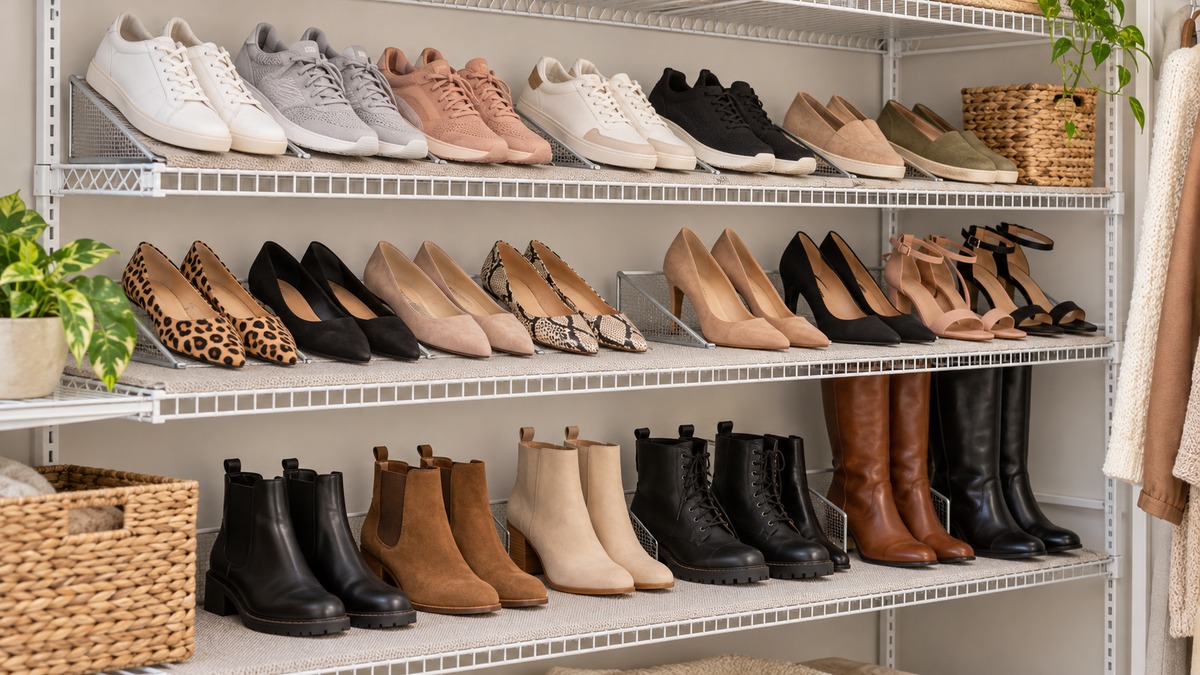
- If you add a shoe shelf support or a shoe rack, follow the shelf maker’s sheet for where it goes.
Dry the shoes before they go on the shelf
Moisture is the first thing the pages warn about. The Palm Beach County Cooperative Extension page says that worn shoes are “conditioned” to grow mildew, and that perspiration plus the composition of leather makes a welcome home for it. Its advice is short: let sweaty shoes dry before putting them away in your closet. Texas Tech University Student Housing gives a similar rule in its mold-prevention guide. It says not to leave wet or damp clothes, towels or shoes in closets, and to set them on drying racks until they are completely dry.
The University of Florida IFAS Extension publication on mildew hot spots explains why a closet matters. It says moisture migrates into closets much more easily than it comes out, and that anything damp put into a closet adds to the moisture problem, even a little moisture in shoes or other clothing. The document is an archival copy from 2002 written for Florida homes, so treat it as a description of how moisture behaves in a closed closet, not as a rule for every climate.
How you dry matters too. The Clarks Australia care guide says to leave leather shoes to dry naturally with newspaper inside to soak up moisture. It says not to use any artificial heat source, because heat may ruin the leather, and gives the same warning for trainers. The Alabama Cooperative Extension System page, used by permission of Mississippi State University Extension, says to stuff leather and suede shoes with paper so they hold their shape and to dry them away from sun and heat. That page is written for flood recovery, so it is a close fit rather than an exact one.
What the open wire does for shoes
The UF/IFAS publication lists a point that bears on wire shelving: open shelving of plastic-coated wire allows air circulation. It also says to keep items off the floor, because moisture can be trapped under them. A wire shelf lets air move above and below a pair, which a solid shelf does not. The page does not mention shoes in that line, so the link to shoes is our reading.
The same caution applies to the closet around the shelf. The NDSU Extension publication on molds in the home says closets often have mold growth, especially if clothing is stored damp or dirty or there is a cool outside wall in the closet. It also says molds grow on organic materials such as paper, leather, dirt and soap scum, and that they need moisture. The Kansas State University extension PDF says that if mold is growing in a closet you should keep the closet doors open to promote air flow, and that closets should not be over-filled because that reduces air circulation. The EPA’s brief guide on mold, moisture and your home says to keep indoor humidity below 60 percent, ideally between 30 and 50 percent, and says humidity can be measured with a meter. It adds: “The key to mold control is moisture control.”
The open wire has one trade-off against the shoe maker’s advice. Clarks says leather shoes belong in a dark, dry place within the original box, and suede should stay out of direct sunlight. A wire shelf in a lit closet or a room with a window does not give darkness. If you keep leather or suede shoes on open wire, put them where light does not fall on them, or keep them in their boxes. That conclusion is our reading of the Clarks guide.
Match the storage to the shoe
| Shoe | What the page says | Page |
|---|---|---|
| Leather | Dry naturally with newspaper inside, no artificial heat. Store in a dark, dry place within the original box, with a shoe tree to keep shape and size. | Clarks Australia |
| Trainers and sneakers | No artificial heat. Keep out of direct sunlight, in a cool, dry place. | Clarks Australia |
| Suede and nubuck | Keep out of direct sunlight to prevent the colour from fading. Store in a cool, dry place, because suede can become mouldy in humidity. | Clarks Australia |
| Walking shoes | Rotate them to give them time to return to their original shape between walks. | Mississippi State University Extension |
| Summer footwear | Let shoes air out after wear and alternate pairs every other day so they dry. | Penn State Health |
| Wet or damaged leather and suede | Stuff with paper to hold shape and dry away from sun and heat. | Alabama Cooperative Extension System |
Two pages give a rotation interval. Harvard Health says that when possible you should rotate your footwear so shoes have at least 24 hours to breathe, longer if they are wet. The Penn State page suggests alternating every other day to make sure shoes have dried. The two figures differ, and both come from pages that are mainly about foot health, so they support only the narrow point that a pair benefits from a rest between wears.
Pick a way to hold the shoes on the wire
Shelf makers sell fittings made for shoes, and the table lists the ones we found with their own instructions.
| Option | What the maker’s page says | Page |
|---|---|---|
| Shoe shelf with shoe supports | The ClosetMaid how-to guide says to create shoe shelves using inverted SuperSlide shelving supported by Shoe Shelf Supports. | ClosetMaid |
| Shoe racks of other kinds | Shoe racks can be used on the floor, over a door, or hung from a shelf. | ClosetMaid |
| 16 inch shelving | Described as especially good for storage of linens or boxes and as shoe shelving. | ClosetMaid |
| Sliding-rod shoe kit | Heel of the shoe over the back sliding rod, front of the shoe on the front sliding rod. Three back holes adjust for shoe size. | ClosetMaid |
| Shoe shelf brackets | Rubbermaid’s 6-10 ft adjustable closet system says to use the included shoe shelf brackets to create additional storage space. | Rubbermaid |
| 9-pair wire shoe rack | Crossbars push into slots in each support frame, all in the same direction. | ClosetMaid |
For a wider look at closet shoe storage, see our page on shoe storage for a small closet, and for a shelf-based unit see a shelving unit for shoes.
Step by step: set up a wire shelf for shoes
- Dry each pair first. Follow the Palm Beach County and Texas Tech advice, and keep heat away from leather, as Clarks asks.
- Shape the shoes. Use a shoe tree in leather pairs, as Clarks advises. The Alabama extension page suggests paper if you have no tree.
- Choose the fitting. If you plan to use a shoe shelf support, check the maker’s sheet. The Lowe’s-hosted sheet titled Shoe Shelf Support says to determine the shoe shelf location and install the wall clips according to the package instructions first.
- Place the supports. The same sheet says to use one shoe support 2 to 4 inches from each end of the shelf and every 48 inches in between. It says to place each support between the wires and rotate it 90 degrees, and to wedge it firmly between the wires.
- Hook and seat the shelf. It then says to adjust the support to hook onto the back wire of the shelf, snap the back wire into the wall clips, and lower the front of the shelf until the support leans on the back wall.
- Set the pairs. Place each pair with its sole on the wire and a gap at the sides. K-State’s advice that closets should not be overfilled argues for leaving some open space.
- Rotate the pairs. Put recently worn pairs on a drying rack first, then return them to the shelf.
- Check the closet. Use a humidity meter if you can, and compare the reading with the EPA range of 30 to 50 percent.
Fit the pairs: depth and length arithmetic
Two measurements decide how many pairs fit: the depth of the shelf against the length of the shoe, and the length of the shelf against the width of the pairs. ClosetMaid’s guide says its SuperSlide shelving comes in 12 inch and 16 inch depths and in 4, 6, 8 and 12 foot lengths. The sheets do not give shoe dimensions, so shoe lengths and widths below are our assumptions. Measure your own shoes.
The first table compares depth with shoe length. Spare depth equals shelf depth minus shoe length. A negative number is an overhang.
| Shelf depth (inches) | Shoe 10 inches long (assumed) | Shoe 12 inches long (assumed) | Shoe 14 inches long (assumed) |
|---|---|---|---|
| 12 | 12 − 10 = 2 spare | 12 − 12 = 0 spare | 12 − 14 = −2, an overhang of 2 |
| 16 | 16 − 10 = 6 spare | 16 − 12 = 4 spare | 16 − 14 = 2 spare |
The second table counts pairs along one shelf. Pairs per row equal shelf length divided by the width a pair takes, rounded down. We assume a pair takes 8 inches or 10 inches of width, and we also show a version that leaves 20 percent of the length open for air, which is our own figure and not a number from any page. The K-State and UF/IFAS pages ask for air circulation but give no percentage.
| Shelf length (inches) | Pairs at 8 inches each | Pairs at 10 inches each | 8 inches, with 20 percent left open | 10 inches, with 20 percent left open |
|---|---|---|---|---|
| 48 (4 ft) | 48 ÷ 8 = 6 | 48 ÷ 10 = 4.8, so 4 | 38.4 ÷ 8 = 4.8, so 4 | 38.4 ÷ 10 = 3.84, so 3 |
| 72 (6 ft) | 72 ÷ 8 = 9 | 72 ÷ 10 = 7.2, so 7 | 57.6 ÷ 8 = 7.2, so 7 | 57.6 ÷ 10 = 5.76, so 5 |
| 96 (8 ft) | 96 ÷ 8 = 12 | 96 ÷ 10 = 9.6, so 9 | 76.8 ÷ 8 = 9.6, so 9 | 76.8 ÷ 10 = 7.68, so 7 |
| 144 (12 ft) | 144 ÷ 8 = 18 | 144 ÷ 10 = 14.4, so 14 | 115.2 ÷ 8 = 14.4, so 14 | 115.2 ÷ 10 = 11.52, so 11 |
A third count covers the shoe shelf supports. The sheet calls for one support 2 to 4 inches from each end and one “every 48 in. in between”. We read that as a maximum gap of 48 inches, and assume a 3 inch end offset. Supports then equal 2 plus the intermediate count, where the intermediate count is the shelf length minus 6, divided by 48, rounded up, minus 1.
| Shelf length (inches) | Length between end supports | Intermediate supports | Total supports |
|---|---|---|---|
| 48 | 48 − 6 = 42 | 42 ÷ 48 = 0.88, so 1, minus 1 = 0 | 2 |
| 72 | 72 − 6 = 66 | 66 ÷ 48 = 1.38, so 2, minus 1 = 1 | 3 |
| 96 | 96 − 6 = 90 | 90 ÷ 48 = 1.88, so 2, minus 1 = 1 | 3 |
| 144 | 144 − 6 = 138 | 138 ÷ 48 = 2.88, so 3, minus 1 = 2 | 4 |
Check your own sheet before you buy, because the support count follows the sheet and our reading may not match it. If you want to see how shelf brackets and wire shelves combine in a closet, our page on wire closet shelving with a clothes rod covers one set of listings.
How we chose
This is a method guide, not a product list. We opened seventeen pages on 2026-10-21: one shoe-maker care guide, five university or extension moisture pages including one UF/IFAS archive, two further extension shoe pages, one Harvard Health page, one Penn State page, one EPA page, and six shelf-maker instruction or how-to pages. We kept the statements that those pages make in plain words and checked each quoted phrase against the extracted text. The wire-and-shoe link comes from combining the pages, and the tables use our own arithmetic with each assumption named.
Mistakes to avoid
- Shelving damp shoes. Texas Tech says not to leave wet or damp shoes in closets.
- Drying leather with heat. Clarks says not to use any artificial heat source, because it may ruin leather.
- Filling the closet to the walls. K-State says an overfilled closet reduces air circulation.
- Putting suede in a humid closet. Clarks says suede can become mouldy in humidity.
- Leaving items on the closet floor. UF/IFAS says to keep items off the floor because moisture can be trapped under them.
- Skipping the maker’s sheet for the shoe shelf support. The support sheet gives positions and a wedging step that this guide only summarizes.
What we could not verify
None of the pages we opened says how the gaps in a wire grid affect heels, soles or sandal straps, or whether wire leaves marks on shoes. They do not give a safe weight for shoes on a wire shelf, and this guide makes no load claim. No page gives a typical shoe length or width, which is why the tables use assumptions. The UF/IFAS publication is an archival Florida document, and the Lowe’s-hosted Shoe Shelf Support sheet does not name its brand in the text we extracted. The Clarks guide is from the Australian site. No page we opened tests wire against solid shelving for mold or shape, so the comparison of wire and solid shelving rests on the UF/IFAS airflow line.
Frequently asked questions
Are wire shelves good for shoes?
The open grid supports airflow. The UF/IFAS publication says open plastic-coated wire shelving allows air circulation. The pages do not test wire against solid shelving for shoes, so the benefit is an inference rather than a finding.
Should I store shoes in their boxes on a wire shelf?
For leather, Clarks says to keep shoes in a dark, dry place within the original box. A box on a wire shelf would help with the dark-place part of that advice. The pages do not address airflow inside a closed box.
How long should I rest a pair between wears?
Harvard Health says at least 24 hours when possible, and longer if the shoes are wet. Penn State describes alternating pairs every other day.
How do I keep shoes from sliding through a wire shelf?
The pages we opened do not say that shoes slide through the grid. ClosetMaid does describe a sliding-rod shoe kit and shoe shelves built from inverted shelving with shoe shelf supports, and each comes with its own sheet.
Can I put damp shoes in a closet to finish drying?
Texas Tech says not to. It advises setting damp shoes on drying racks until completely dry, and Palm Beach County Extension says to let sweaty shoes dry before closet storage.
Bottom line
Dry each pair, keep the closet from filling to the walls, hold the shape of the shoes, and follow the shelf maker’s sheet for any fitting you add.
Sources
- https://clarks.com.au/pages/shoe-care-guide (opened 2026-10-21)
- https://discover.pbc.gov/coextension/FACS/Housing/Avoid-Mildew.aspx (opened 2026-10-21)
- https://www.depts.ttu.edu/housing/safety/moldprevention.php (opened 2026-10-21)
- https://www.ndsu.edu/agriculture/extension/publications/molds-your-home (opened 2026-10-21)
- https://www.shawnee.k-state.edu/homeandfamily/pdfs/Controling%20mold.pdf (opened 2026-10-21)
- https://journals.flvc.org/edis/article/download/108194/103485/149853 (opened 2026-10-21)
- https://www.epa.gov/mold/brief-guide-mold-moisture-and-your-home (opened 2026-10-21)
- https://extension.msstate.edu/publications/purchasing-pointers-for-walking-shoes (opened 2026-10-21)
- https://www.health.harvard.edu/immune-and-infectious-diseases/athletes-foot-fungus-in-shoes (opened 2026-10-21)
- https://www.psu.edu/news/hershey/story/medical-minute-summer-foot-fashion-doesnt-always-lead-foot-health (opened 2026-10-21)
- https://www.aces.edu/blog/topics/emergency-handbook-home-family/salvaging-clothing/ (opened 2026-10-21)
- https://homedepot.closetmaid.com/en-US/Installation/Pages/how-to-guides.aspx (opened 2026-10-21)
- https://pdf.lowes.com/productdocuments/d1af380f-0c6e-4e7d-92b6-c4cde568f53d/50039299.pdf (opened 2026-10-21)
- https://pdf.lowes.com/productdocuments/328d2dda-4735-4eea-b6ab-2cbb1c72b1c1/09356055.pdf (opened 2026-10-21)
- https://images.homedepot-static.com/catalog/pdfImages/11/11b1b644-9d60-4372-a9f7-ae2ccd3fd0b5.pdf (opened 2026-10-21)
- https://images.thdstatic.com/catalog/pdfImages/85/85174c90-dc48-4e15-a3dc-bf0849d9eb3e.pdf (opened 2026-10-21)
- https://images.homedepot-static.com/catalog/pdfImages/93/93ae2a16-06b4-4245-b208-4556e79af830.pdf (opened 2026-10-21)
As an Amazon Associate we earn from qualifying purchases.