How to Organize a Craft Supply Shelf
As an Amazon Associate we earn from qualifying purchases.
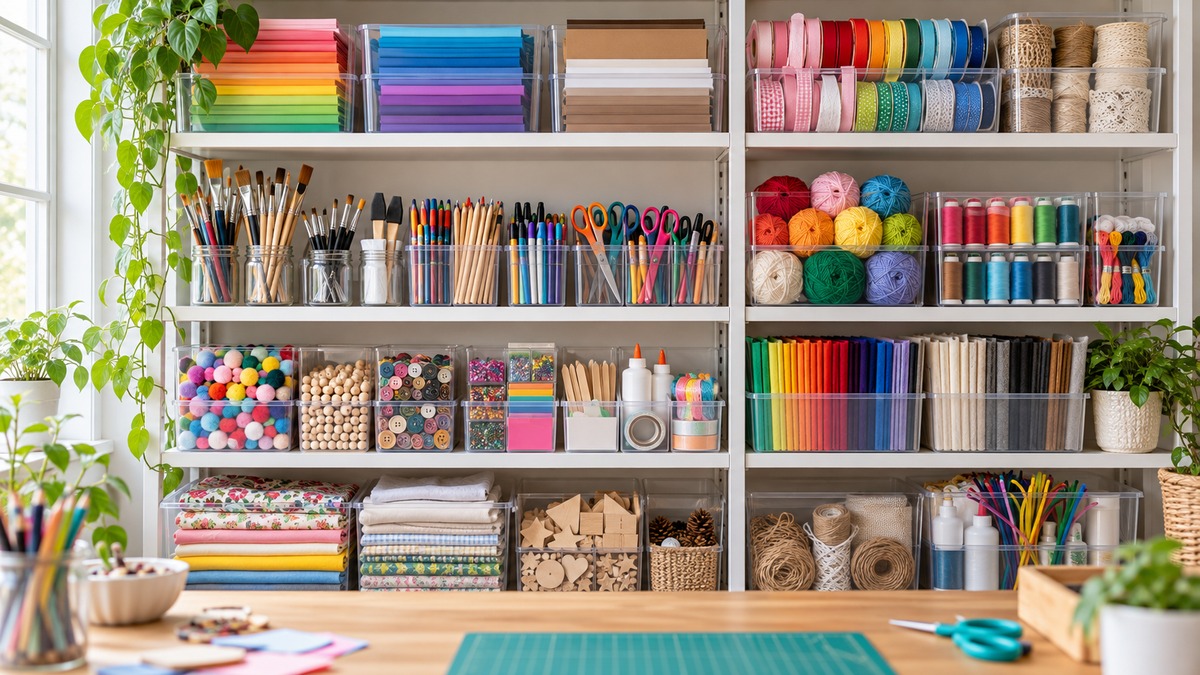
How to organize a craft supply shelf starts with sorting, not with buying bins. Pull everything off, group like items, set aside the chemical-based supplies, and give each group a shelf height that matches how often you reach for it and how much it weighs. University, county and library guidance backs a few firm rules: keep heavy and frequently used items between knee and shoulder, keep chemicals in closed original containers away from heat, and do not overload a shelf. This guide turns those rules into a plan with the arithmetic shown.
Quick answer
- Sort first. Kansas State University extension advises sorting like items together and creating “centers” for activities such as hobbies.
- Treat adhesives, fixatives, solvents and similar products as their own group, in closed original containers, away from heat and out of children’s reach.
- Put heavy and frequently used supplies between knee and shoulder height, and lighter items overhead, as a University of Oregon safety sheet advises.
- Choose bins after you know the shelf size. Bin depth must fit inside shelf depth, because the same sheet says items should not hang over the edge.
Sort before you shelve
A craft shelf collects clutter because craft supplies come in many small, odd-shaped groups. The Kansas State fact sheet on clutter lists hobby materials among the common sources, and its method is plain. Sort items into boxes labeled Keep, Store, Give Away or Sell, and Throw Away. The fact sheet calls this the method professional organizers use.
For the Keep box, the same fact sheet gives three steps that suit a craft shelf. Return items to their proper places, sort like items together, and create centers for work, with hobbies and games on its list of examples. A center is simply a spot where the supplies for one activity live together, so you do not walk around the house to finish a project. The Storage box gets bins and totes labeled with what is inside. The sheet also suggests touching items only one time, so a pile does not build up while you decide where things go.
A worked inventory
Counting before buying turns the sort into numbers. The counts and items-per-bin figures below are our own assumptions for an example crafter, and every figure should be replaced with your own count. The formula is bins equal items divided by items per bin, rounded up.
| Group | Items (assumed) | Items per bin (assumed) | Bins |
|---|---|---|---|
| Paper and card stock | 120 sheets | 40 | 120 ÷ 40 = 3.0, so 3 |
| Paints and brushes | 24 | 12 | 24 ÷ 12 = 2.0, so 2 |
| Markers and pens | 60 | 20 | 60 ÷ 20 = 3.0, so 3 |
| Beads and small parts | 100 | 30 | 100 ÷ 30 = 3.3, so 4 |
| Cutting and hand tools | 15 | 15 | 15 ÷ 15 = 1.0, so 1 |
| Adhesives, fixatives, solvents | 10 | 10 | 10 ÷ 10 = 1.0, so 1 |
| Total | 3 + 2 + 3 + 4 + 1 + 1 = 14 |
The total of 14 bins is the number the rest of this guide uses. The last row is a group that needs special handling, and the next section explains why.
Set the chemical group apart
Not every craft supply is harmless to store on an open shelf. A fact sheet from the City of Lawrence, Kansas, lists permanent felt-tip markers, rubber cement, spray fixatives, powdered clay and instant papier-mâché as standard craft supplies found in many homes. It says all of these contain chemicals that are “hazardous if inhaled, absorbed, or swallowed.” It also notes that children are prone to chewing, sucking and swallowing art materials.
Tarrant County, Texas, publishes household hazardous product guidance that applies to this group. Its storage tips are to use locked cabinets, keep stored products “away from heat, sparks, or flames,” make sure lids and caps are tightly sealed and childproof, and keep containers dry. It adds two rules that a craft shelf often breaks: never store hazardous products in food containers, and keep each product in its original container without removing the label. It also warns that leftovers should never be mixed with other products, because incompatible chemicals may react, ignite or explode.
Reading the label
The Lawrence sheet explains the signal words printed on labels. DANGER marks extremely flammable, corrosive or highly toxic products, POISON marks highly toxic ones, and WARNING or CAUTION marks less toxic ones. The sheet says these words cover short-term hazards only, not long-term effects. It also says older products, such as an old bottle of rubber cement, or professional products may not carry a warning label, and it advises keeping children away from unlabeled products.
On a shelf, those rules become a short list. Keep the adhesives, fixatives and solvents in one lidded box in their original containers. Place that box away from heat sources such as radiators and heat vents, which is the Tarrant County rule applied to a room. Where children live or visit, use a locked cabinet instead of a shelf. The sources we opened give no shelf height for chemicals, so a locked cabinet is the reading closest to what they say.
Ventilation matters during use as well as in storage. The Lawrence sheet says that opening a window or door does not provide adequate ventilation except when working with very small amounts of solvents. It suggests opening windows and turning on a fan, or working outdoors when the weather allows.
Match shelf height to weight and use
The next decision is which group goes on which shelf. A University of Oregon safety sheet on shelving gives the clearest rules of the pages we opened. It says to store heavier and frequently used items in the knee-to-shoulder range, to place lighter items overhead, and to put seldom-used items on low shelves. It also says to install shelving so common items can be reached between average waist and shoulder height.
The same sheet adds three safety points. Elbows should be no more than 6 inches from the body when placing items on a shelf or removing them, and it says to avoid reaching overhead, using a step stool or ladder instead. It says shelves should be anchored to the floor or wall to prevent the unit from falling over in an earthquake. It also says “Do not overload shelves and make sure items aren’t hanging over the edge.” For the load a particular shelf can carry, see our post on the ClosetMaid wire shelf weight limit, since the Oregon sheet gives no figure.
A reach band in inches
The Oregon sheet does not translate knee and shoulder height into inches. The federal Access Board publishes reach ranges in its ADA standards, and its section on unobstructed forward reach sets a high reach of 48 inches maximum and a low reach of 15 inches minimum above the floor. That standard is written for accessible design, so it serves here only as a yardstick for a home shelf. The band is 33 inches (48 − 15). The number of shelf surfaces inside it depends on the spacing between shelves, using the formula below, where the surface at 15 inches is the lowest.
| Shelf spacing (inches) | Band ÷ spacing | Shelf surfaces inside 15 to 48 inches |
|---|---|---|
| 8 | 33 ÷ 8 = 4.1, so 4, plus 1 | 5 |
| 10 | 33 ÷ 10 = 3.3, so 3, plus 1 | 4 |
| 12 | 33 ÷ 12 = 2.75, so 2, plus 1 | 3 |
| 16 | 33 ÷ 16 = 2.06, so 2, plus 1 | 3 |
The table ignores bin height, so on the top shelf in the band, subtract the height of the bin from 48 to see whether you can still reach the top of it. It also shows that a 16-inch spacing buys no extra reachable shelf over 12 inches, which is useful if you can set shelf pegs or brackets at either height.
Assigning the groups
Suppose a five-shelf unit with shelf surfaces at 6, 18, 30, 42 and 54 inches. That spacing and the starting height are our own assumptions. Three of the five surfaces (18, 30 and 42) fall inside the 15 to 48 inch band. The plan below puts each of the other groups from the inventory where the Oregon rules point. The chemical group is left off the grid because it belongs in a closed container or a locked cabinet.
| Shelf surface (inches) | What goes there | Reason |
|---|---|---|
| 54 | Light, rarely used items such as empty spare bins | Lighter items overhead |
| 42 | Paper and card stock, markers and pens | Light items you reach for often, inside the reach band |
| 30 | Paints and brushes, cutting and hand tools | Heavier and frequently used, inside the band |
| 18 | Beads and small parts | Used often enough to stay inside the band |
| 6 | Bulk or backup supplies | Seldom-used items on low shelves |
This is one way to read the rules, not the only one. If you paint every day and craft with beads once a month, swap those rows. The point of the table is the method: weight and frequency decide the shelf, not the order in which you bought things.
Size the bins to the shelf
Bins should be chosen last, because the shelf sets the limits. The width of the shelf decides how many bins fit side by side, the depth decides how many fit front to back, and the Oregon rule about overhang means a bin deeper than the shelf is not an option. The formulas are the number across, which is shelf width divided by bin length rounded down, times the number deep, which is shelf depth divided by bin depth rounded down.
The table assumes a shelf 36 inches wide and 12 inches deep, with 12 inches between shelf surfaces and a 2-inch gap above the bins for reaching in, leaving 10 inches of usable height. The three bin sizes are also assumptions, not any product’s dimensions.
| Bin size, length × depth × height (inches) | Across | Deep | Per layer | Layers in 10 inches | If stacked |
|---|---|---|---|---|---|
| Small, 10 × 6 × 4 | 36 ÷ 10 = 3.6, so 3 | 12 ÷ 6 = 2 | 3 × 2 = 6 | 10 ÷ 4 = 2.5, so 2 | 6 × 2 = 12 |
| Medium, 12 × 9 × 5 | 36 ÷ 12 = 3 | 12 ÷ 9 = 1.3, so 1 | 3 × 1 = 3 | 10 ÷ 5 = 2 | 3 × 2 = 6 |
| Large, 14 × 11 × 6 | 36 ÷ 14 = 2.6, so 2 | 12 ÷ 11 = 1.1, so 1 | 2 × 1 = 2 | 10 ÷ 6 = 1.7, so 1 | 2 × 1 = 2 |
For the 14 bins in the inventory, the shelf count follows by division. With medium bins in a single layer, 14 ÷ 3 = 4.7, so 5 shelves. With small bins in a single layer, 14 ÷ 6 = 2.3, so 3 shelves. With large bins, 14 ÷ 2 = 7 shelves. Stacking cuts the count, but the pages we opened do not say how high to stack, and a stacked bin hides what is under it. A good compromise is stacking only the bins you open rarely.
If the shelf is the open question, our posts on the best storage shelf and on cube shelves cover units that suit bins in this size range.
Paper, finished work and what pests like
Paper stock and finished projects need a different kind of care than bottles and tools. The State Library of Queensland guide on children’s artworks is written for finished pieces, so we apply it to paper stock only by analogy. It says to store works flat, because collage material or glitter can fall off, and to avoid folding. It says chalk, pastel and charcoal smudge easily, so handle and store them with care.
The same guide describes where to put paper. It says to locate storage away from outside walls and to select a well-insulated room away from moisture, heat and direct light, avoiding kitchens, bathrooms and areas near heating systems and water pipes. It notes that felt tip pens, fluorescent pens, watercolors and some inks are highly sensitive to light. A craft shelf in a sunny window may fade the very work stored on it.
Housekeeping
The library guide also covers pests. It says pests are attracted to collage materials, adhesives and dry food, and it advises against eating and drinking in areas where collections are stored. Its housekeeping line applies directly: “Floors, shelves, boxes, and cabinets should be kept clean, uncluttered, and dust free.” The guide also says to avoid paper clips, rubber bands, adhesive tape and sticky notes on artworks, since metal clips can leave rust marks and tape can leave residue.
None of that is a rule for a plain stack of printer paper. It is a useful standard for the shelf where finished pieces and good paper live, and a lower bar is reasonable for scrap stock.
Label, then keep it up
Kansas State extension says to label all bins and totes, and its example label gives the owner’s name and whether the contents are seasonal. For a craft shelf, a label naming the contents does the same job. Put the label on the end of the bin that faces you, so a stacked bin can be read without moving the one above it.
The fact sheet is realistic about upkeep. It says everyone should do a little bit every day, and that new routines take at least 2 to 4 weeks to become habits. For a craft shelf, that suggests a short reset at the end of each session. The sheet gives no schedule for a hobby shelf, so the interval is yours to choose.
For a wider look at what else belongs on a closet shelf in the same room, see our guide to the items to store on closet shelves.
How we chose
This is a method guide, so there are no product picks to rank. We opened six pages on 2026-10-21: a Kansas State University extension fact sheet on clutter, a University of Oregon safety sheet on shelving, a Tarrant County guide to household hazardous chemicals, a City of Lawrence fact sheet on art and hobby supplies, a State Library of Queensland guide to children’s artwork, and the federal Access Board’s ADA standards page. We kept only advice a page states in words and checked each quoted phrase against its text. The bin sizes, item counts and shelf heights in the tables are our own assumptions, and each is labeled where it appears.
Mistakes to avoid
- Putting chemicals in unlabeled or food containers. Tarrant County says to keep original containers and labels and never to use food containers.
- Storing adhesives next to heat. The same county guidance says to keep products away from heat, sparks or flames.
- Loading the heaviest bins on the top shelf. The Oregon sheet places lighter items overhead.
- Letting bins hang over the edge. The Oregon sheet warns against it.
- Reaching overhead without a step. The sheet says to use a step stool or ladder instead.
- Leaving the unit unanchored. The sheet says to anchor shelves to the floor or wall.
- Eating at the shelf. The Queensland guide says pests like adhesives and dry food.
What we could not verify
The pages we opened do not give a maximum stack height for bins, a weight limit for a home shelf, or a standard bin size. They do not cover dust control for open shelves, and none lists shelf heights in inches for knee or shoulder, which is why the ADA reach range stands in as a yardstick. The Queensland guide is written for finished artworks, not supplies, and the ADA standards are written for accessible design, not home storage. Fabric, yarn and textile supplies need their own rules that these pages do not cover.
Frequently asked questions
Where should adhesives and spray fixatives go?
In a closed container in their original packaging, away from heat, sparks or flames, and out of children’s reach. Tarrant County suggests locked cabinets, and the Lawrence sheet says to keep children away from unlabeled products.
Should heavy supplies go high or low?
The University of Oregon sheet says heavier and frequently used items belong in the knee-to-shoulder range. Lighter items go overhead, and seldom-used items go on low shelves.
How do I decide how many bins I need?
Count the items in each group, divide by how many fit in one bin, and round up, as in the inventory table. Then divide the bin total by the number of bins one shelf holds.
Is it safe to stack bins?
The pages give no stacking limit. The Oregon sheet says not to overload shelves, so check the load rating of your shelf and keep the heaviest bins in a single layer.
Does light matter for a craft shelf?
For paper and finished work, yes. The Queensland guide says some pens, watercolors and inks fade quickly in light, and recommends storage away from direct light.
Bottom line
Sort first, isolate the chemicals, put heavy and frequently used supplies between knee and shoulder, and buy bins only after you have measured the shelf.
Sources
- https://bookstore.ksre.k-state.edu/pubs/cut-the-clutter-and-get-organized-fact-sheet_MF2879.pdf (opened 2026-10-21)
- https://safety.uoregon.edu/sites/default/files/safety_sheet_-_shelving_safety_final.pdf (opened 2026-10-21)
- https://www.tarrantcountytx.gov/en/engineering-services/environmental/environmental-collection-ctr/safely-managing-household-hazardous-chemicals-waste.html (opened 2026-10-21)
- https://assets.lawrenceks.org/swm/recycling/pdf/facts-keepingkidssafe.pdf (opened 2026-10-21)
- https://content.slq.qld.gov.au/sites/default/files/Caring%20for%20your%20collections%20-%20Children%27s%20artwork%20collections_2025.pdf (opened 2026-10-21)
- https://www.access-board.gov/ada/ (opened 2026-10-21)
As an Amazon Associate we earn from qualifying purchases.