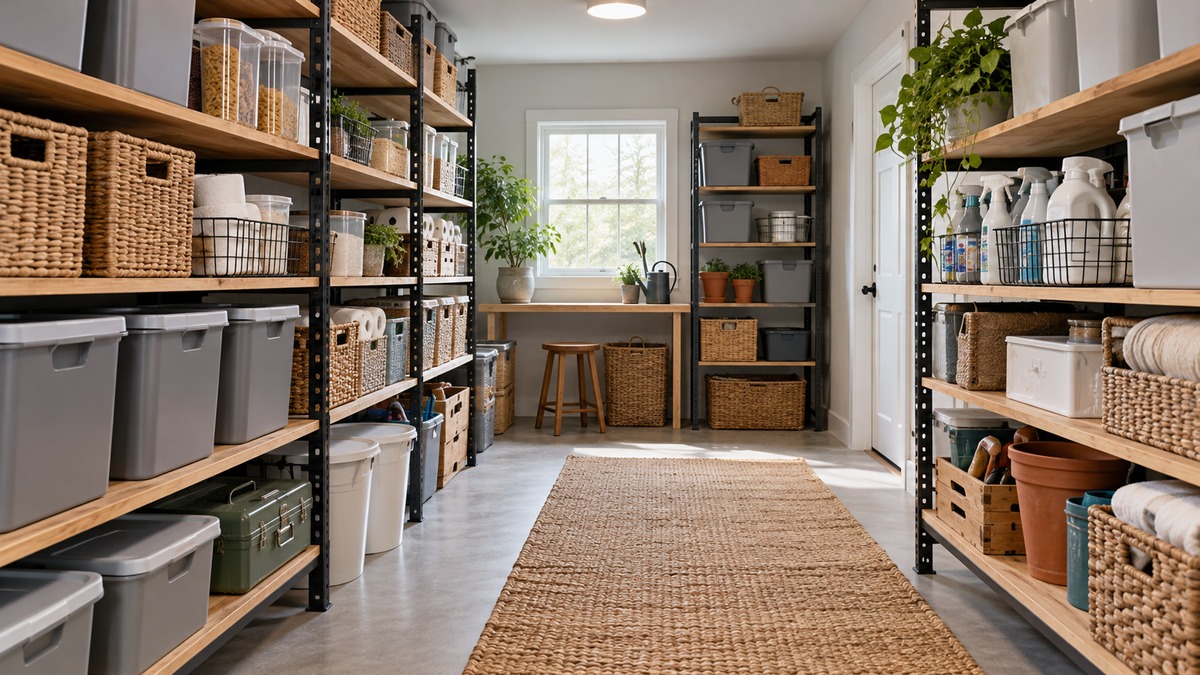
How to Organize a Storage Room at Home
As an Amazon Associate we earn from qualifying purchases.
How to organize a storage room at home starts with what the room may hold and how you plan to walk through it, not with shelves. The U.S. Fire Administration and Utah State Extension say what should stay out, university extension pages give a sort-and-assign order, and shelving safety sheets say where heavy things go. This guide puts those rules in sequence, adds a layout calculation for aisle width and shelf frontage with every assumption stated, and marks what the sources leave out.
Quick answer
- Decide what the room may hold first. The U.S. Fire Administration says to keep anything that can burn at least 3 feet from furnaces and water heaters, and Utah State Extension says gasoline, paint, pesticides and similar products should not be stored in the home.
- Empty and sort before you shop. Utah State Extension puts containerizing last, and Oklahoma State Extension says to buy organizers after you declutter.
- Plan the walkway before the shelf count. The sources give 36 inches for a kitchen walkway and 48 inches between rows of museum equipment.
- Anchor shelving, put heavy items low, and keep bins off the floor.
Step 1: Decide what the room may hold
A storage room is often next to a furnace, a water heater or a panel. The sources treat that as a safety question before an organizing question. The U.S. Fire Administration says basements and garages present additional fire risks compared with other parts of a home, because flammable liquids, stored combustibles, gas appliances and electrical tools can lead to fires. It also says garage fires tend to spread farther and cause more injuries and loss than fires that start in other areas of the home.
| Item or rule | What the sources say | Where |
|---|---|---|
| Anything that can burn | Keep at least 3 feet from the furnace, oil burner, wood stoves, water heaters and other heat-generating equipment | U.S. Fire Administration |
| Gasoline, oil, paint, propane, varnish | Store oil, gasoline, paints, propane and varnishes in a shed away from your home | U.S. Fire Administration |
| Gasoline-powered equipment, petroleum products, flammable gases, paint, bulk fertilizer, pesticides, cleaning chemicals | Should not be stored in the home, although small quantities of some chemicals can be stored indoors | Utah State Extension |
| Oily rags | Keep in airtight containers and away from heat sources | U.S. Fire Administration |
| Trash | Should not be stored in the basement | U.S. Fire Administration |
| Fuse box or breaker panel | Maintain easy, quick access | U.S. Fire Administration |
| Stairs | Keep free of clutter so they stay safe for a quick exit | U.S. Fire Administration |
The two fire and extension sources are not identical on chemicals. The Fire Administration points to a shed, while Utah State Extension allows small quantities of some chemicals indoors without defining small. Neither page lists which chemicals count, so read the label on each product and follow its instructions. Move the fuel, paint and pesticide items out first, then plan around what remains.
Step 2: Empty the room and sort what comes back
The extension sources agree on the order of work. Utah State Extension’s guide to reduced clutter gives four verbs: sort, purge, assign and containerize. It says to assign each item a place that is logical, accessible and safe, and that the art of containerizing is to do it last, not first. Oklahoma State Extension adds a buying rule: purchase organization items after you have decluttered, which helps you avoid the wrong size bin, tote or basket.
Mississippi State Extension recommends having garbage bags, storage bins, markers and labels, cleaners, towels and a vacuum on hand before you begin, and sorting into four piles: keep, sell, donate and throw away. Kansas State Extension uses a similar box approach with Keep, Store, Give Away or Sell, and Throw Away boxes, and suggests creating centers such as cleaning, hobbies or tools. Penn State Extension gives a scale for the job, which is to do one small area at a time.
The Utah State garage guide describes the same logic for a bigger space: the first step is to reduce the number of items stored, the second is to relocate items to other storage areas, and the third is to take items off the floor. If something has not been used in the last few years, the guide says to consider getting rid of it. None of the pages we opened tells you how long a full storage room takes, so work in sessions you can finish.
Step 3: Plan the aisle before you count shelves
The sources do not give an aisle width for a home storage room, so we borrow two numbers from other settings. The NKBA Kitchen Planning Guidelines say a walkway should be at least 36 inches wide. The National Park Service Museum Handbook says a storage room should have aisles at least 48 inches wide between rows of equipment, which allows safe handling and movement of drawers, cabinet doors and larger objects. Neither number was written for a home storage room, so treat them as reference points.
The table applies them to an example room. The room size of 96 by 120 inches (8 by 10 feet, or 80 square feet) is our assumption. The shelf sizes come from the MuscleRack boltless wire-deck page, which lists units 48 inches wide by 24 deep and 36 wide by 18 deep. The five levels per unit is also our assumption. We use the NKBA frontage formula, which multiplies width in inches by the number of shelves by depth in feet. A 48 by 24 unit with five levels gives 48 × 5 × 2 = 480, and a 36 by 18 unit gives 36 × 5 × 1.5 = 270.
| Layout (two long walls are 120 inches) | Aisle width | Meets 36 inches? | Meets 48 inches? | Frontage | Frontage per square foot |
|---|---|---|---|---|---|
| A: one wall, two 48 × 24 units | 96 − 24 = 72 | Yes | Yes | 2 × 480 = 960 | 960 ÷ 80 = 12.0 |
| B: both walls, four 48 × 24 units | 96 − 48 = 48 | Yes | Yes, exactly | 4 × 480 = 1,920 | 1,920 ÷ 80 = 24.0 |
| C: both walls, six 36 × 18 units | 96 − 36 = 60 | Yes | Yes | 6 × 270 = 1,620 | 1,620 ÷ 80 = 20.25 |
| D: one wall 48 × 24, the other 36 × 18 | 96 − 24 − 18 = 54 | Yes | Yes | (2 × 480) + (3 × 270) = 1,770 | 1,770 ÷ 80 = 22.1 |
Layout B packs the most frontage and sits exactly at the 48 inch reference, so it leaves no margin for a door that swings into the room or a bin pulled halfway out. Layout C gives up about 300 inches of frontage to gain 12 inches of aisle. The NKBA counts depth in its frontage formula, so deeper shelves score higher, but the sources we opened say nothing about how deep is too deep for items at the back. Check where the door swings and where the 3-foot clearance around any furnace or water heater falls before you commit to a layout. The aisle numbers assume a room with a clear floor, which a real room with a panel or a heater may not have.
Step 4: Anchor, raise and load the shelves
Shelving is where most of the safety guidance sits. The University of Oregon shelving safety sheet says to anchor shelves to the floor or wall, not to overload them, and never to climb on shelves or reach overhead, using a step stool or ladder instead. It also says unsecured units, falling items, moving heavy or awkward objects and climbing or reaching to higher objects cause many shelf-related injuries. The City of Seattle’s emergency management sheet on garage and storage safety, written for earthquake preparedness, says to move heavy objects to lower shelves.
Height off the floor has two sources. The National Park Service Museum Handbook says cabinets and shelving units should be raised off the floor at least 4 inches, preferably 6 inches, on metal risers as a precaution against flooding and to ease cleaning and inspection for pests. Penn State Extension, writing for child care settings, says all items including storage containers should be at least six inches off the floor for easier floor cleaning. UC Agriculture and Natural Resources adds that bins should be stored off the floor and away from walls. The Delaware DNREC sheet on elevating storage says that the higher items are stored, the safer they will be from flooding, and that removable shelving may need to be bolted down.
These sources are written for museums, child care rooms and flood-prone houses, so they are a close fit for a home storage room and not an exact one. In a dry room above grade, the floor gap still helps with sweeping, which Penn State names as the reason. If your room can flood, the DNREC and National Park Service pages treat height as a protection.
Step 5: Assign zones by use and weight
Once the aisle and shelves are set, put things where you will reach them. The sources give a consistent picture, with small disagreements on the top and bottom shelves.
| Source | Placement rule |
|---|---|
| ClosetMaid planning guide | Zone method for any space; in a garage, hang tools, set up a work station along a wall, and put rarely used items and holiday decorations on higher, sturdy shelves |
| Cornell Cooperative Extension of St Lawrence County | List categories first, ask what must be within easy reach and which items are used at the same time, and keep the heaviest items waist-high |
| University of Oregon | Heavier and frequently used items in the knee to shoulder range; lighter items overhead; seldom-used items on low shelves |
| University of British Columbia | Strongest lifting zone is mid-thigh to waist; only lighter items above the shoulder and below the knee |
| NKBA | Plan storage of frequently used items 15 to 48 inches above the floor |
| City of Seattle | Move heavy objects to lower shelves |
The pages disagree on two points. Seattle says heavy goes low, while Cornell and UBC put the heaviest items at waist height or in the mid-thigh to waist zone. The Oregon sheet puts seldom-used items on low shelves, while ClosetMaid puts rarely used items on higher shelves. Our reading is that the strongest lifting zone is the best place for heavy items you lift often, the lowest shelf takes heavy items you lift rarely, and the top shelf takes light, rarely used items. That reading is ours, and no page ranks the options.
The Cornell post adds a useful habit for a storage room: before mounting shelving on a wall, measure the actual items you will store on it. That blog is a Master Gardener post about garden storage, so it is a close fit for tools and supplies and less so for other goods. For options that suit this layout, see our guides to basement shelves for totes, a five-shelf metal storage rack and a general storage shelf.
Step 6: Containers and labels
Containers come after the sort. Utah State Extension says plastic containers with lids are possibly the most versatile accessories in modern storage systems, notes that they stack and come in many sizes, and says clear containers are especially helpful. Kansas State Extension says to label all bins and totes with the owner and whether the contents are seasonal. Cornell’s post says to label boxes and bins with indelible marker. UC ANR suggests airtight containers such as plastic bins to keep out carpet beetles, mice and silverfish.
On cardboard, the sources lean one way. Penn State Extension says not to use cardboard boxes to store items, in its child care context. Neither page we opened tells you how many bins to stack or how heavy a full bin should be, so the stack height is your judgment. The University of Oregon sheet warns against overloading shelves.
Step 7: Keep moisture and pests down
A storage room that is damp undoes the work. The EPA says the key to mold control is moisture control, and recommends keeping indoor humidity below 60 percent if possible, ideally between 30 and 50 percent, which a humidity meter can measure. UC ANR says garages, basements, attics and other storage spaces can attract pests, and suggests sealing cracks and openings around foundations, doors, windows, pipes, wires and vents. The same post says to store bins off the floor and away from walls. Check the meter reading after rain and after you move things in, since a full room can change the airflow. That check is our suggestion.
Step 8: Keep it organized
The Utah State garage guide says that once the space is organized, maintaining it should be a family affair, and that setting rules helps, for example that items removed from their storage places are promptly returned. Kansas State Extension says new routines take at least 2 to 4 weeks to become automatic. For the paper side, a short inventory list taped inside the door is our suggestion and not a sourced step. For a related plan, see our guide to storage ideas for a house with no closets.
How we chose
This is a method guide, not a product list. We read nineteen pages on 2026-10-21: two Utah State Extension pages, four other extension or university pages on clutter, the NKBA Kitchen Planning Guidelines, the National Park Service Museum Handbook storage chapter, two university shelving and lifting documents, one City of Seattle sheet, the U.S. Fire Administration basement and garage page, the Delaware DNREC sheet, the EPA humidity guide, one ClosetMaid planning guide, a Cornell Cooperative Extension county blog post, one UC ANR blog post, a Penn State child care page and one manufacturer shelving page for sizes. We kept a step only if at least one page states it plainly, and where they disagree we say so. The layout table is our own arithmetic, and the room size and the five levels per unit are labeled assumptions.
Mistakes to avoid
- Storing fuel, paint or solvents next to the heater. The U.S. Fire Administration says to keep anything that can burn at least 3 feet from heat-generating equipment.
- Buying shelving before you sort. Utah State Extension puts containerizing last, and Oklahoma State Extension says to buy organizers after decluttering.
- Leaving shelves unanchored. The University of Oregon sheet says to anchor shelves to the floor or wall.
- Putting heavy bins up high. Seattle says to move heavy objects to lower shelves, and UBC says only lighter items belong above the shoulder.
- Blocking the panel or the stairs. The Fire Administration says to keep the fuse box accessible and the stairs free of clutter.
- Storing bins on the floor. UC ANR says to store bins off the floor and away from walls.
What we could not verify
The sources we opened do not give an aisle width, a shelf depth or a bin stack height for a home storage room. They do not define a small quantity of chemicals or list which items it covers, and they do not say how long sorting a full room takes. The aisle numbers come from a kitchen standard and a museum handbook, and the floor-gap numbers come from museum and child care pages, so none was written for a home storage room. The MuscleRack page lists unit sizes only, and the real shelf deck may be smaller than the listed unit. Our room, the five levels and the frontage figures are examples. If your furnace, water heater or panel came with a clearance label, follow it over anything here.
Frequently asked questions
What is the first step to organize a storage room?
Decide what the room may hold, then empty and sort. The U.S. Fire Administration lists what to keep away from heating equipment, and Utah State Extension lists products that should not be stored in the home.
How wide should the aisle be?
The pages we opened give no figure for a home storage room. The NKBA gives 36 inches for a kitchen walkway, and the National Park Service gives 48 inches between rows of museum equipment, so those are reference points only.
Where should heavy items go?
Low or at waist height, depending on the source. Seattle says to move heavy objects to lower shelves, while Cornell and the University of British Columbia put the heaviest items at waist height or in the mid-thigh to waist zone.
Should shelves be on the floor?
The National Park Service says to raise shelving at least 4 inches, preferably 6 inches, as a precaution against flooding and to ease cleaning and pest inspection. Penn State gives six inches for easier floor cleaning.
What containers work best?
Utah State Extension calls lidded, stackable and clear plastic containers helpful, and UC ANR suggests airtight bins to keep pests out. Penn State says not to use cardboard boxes in its child care setting.
How do I keep a storage room from getting damp?
The EPA says to keep indoor humidity below 60 percent if possible, ideally 30 to 50 percent, and calls moisture control the key to mold control.
Bottom line
Keep fire hazards out, sort before you shop, plan the aisle, anchor the shelves, and put heavy items low and bins off the floor.
Sources
- https://www.usfa.fema.gov/prevention/home-fires/prevent-fires/basement-and-garage/ (opened 2026-10-21)
- https://extension.usu.edu/archive/got-room-for-the-car-in-your-garage (opened 2026-10-21)
- https://extension.usu.edu/archive/wheres-my-desk_a-guide-to-reduced-clutter (opened 2026-10-21)
- https://extension.msstate.edu/publications/ways-conquer-household-clutter (opened 2026-10-21)
- https://extension.okstate.edu/announcements/pottawatomie-county/how-much-is-clutter-costing-you (opened 2026-10-21)
- https://bookstore.ksre.k-state.edu/pubs/cut-the-clutter-and-get-organized-fact-sheet_MF2879.pdf (opened 2026-10-21)
- https://extension.psu.edu/decluttering-with-less-hassle (opened 2026-10-21)
- https://extension.psu.edu/programs/betterkidcare/news/clean-uncluttered-space (opened 2026-10-21)
- https://www.nps.gov/subjects/museums/upload/MHI_Ch7_Storage.pdf (opened 2026-10-21)
- https://media.nkba.org/uploads/2022/05/Kitchen-Planning-Guidelines.pdf (opened 2026-10-21)
- https://safety.uoregon.edu/sites/default/files/safety_sheet_-_shelving_safety_final.pdf (opened 2026-10-21)
- https://hr.ubc.ca/sites/default/files/2020-09/Lifting%20Guidelines.pdf (opened 2026-10-21)
- https://www.seattlehousing.org/sites/default/files/Earthquake_Safety_Garage_%26_Storage.pdf (opened 2026-10-21)
- https://www.homebyames.com/en-us/b2c_hba_simple_storageguide.html (opened 2026-10-21)
- https://blogs.cornell.edu/fruition/2022/10/30/garden-storage/ (opened 2026-10-21)
- https://ucanr.edu/blog/pests-urban-landscape/article/unwanted-indoor-critters-theres-pest-notes (opened 2026-10-21)
- https://www.epa.gov/mold/brief-guide-mold-moisture-and-your-home (opened 2026-10-21)
- https://edsalmanufacturingcompany.freshdesk.com/support/solutions/articles/153000072255-musclerack-heavy-duty-steel-boltless-shelving-with-wire-decking (opened 2026-10-21)
- https://documents.dnrec.delaware.gov/I-ADAPT/AdaptationStrategies/Elevate%20Storage%20onto%20Shelving%20Units.pdf (opened 2026-10-21)
As an Amazon Associate we earn from qualifying purchases.