How to Store Wine Bottles on a Shelf
As an Amazon Associate we earn from qualifying purchases.
How to store wine bottles on a shelf depends on the closure, the room and the load. Corked bottles go on their sides, so the cork stays moist, while screw-cap bottles can stand. The shelf should sit in a cool, dark, steady spot away from vibration, and it has to carry the combined weight of the bottles. Purdue Extension, North Dakota State University Extension and Missouri State University all publish storage guidance that agrees on these basics. This guide turns it into a placement and load plan.
Quick answer
- Lay corked bottles on their sides, and let screw-cap bottles stand.
- Aim for a steady temperature inside 10 to 16 degrees Celsius (50 to 60 degrees Fahrenheit), the long-term range Purdue Extension lists.
- Keep bottles dark, out of direct sun, and off any shelf that vibrates or gets warm, such as the top of a refrigerator.
- Add up the bottle weight before you load the shelf, and compare it with the maker’s rated capacity.
Which bottles lie down
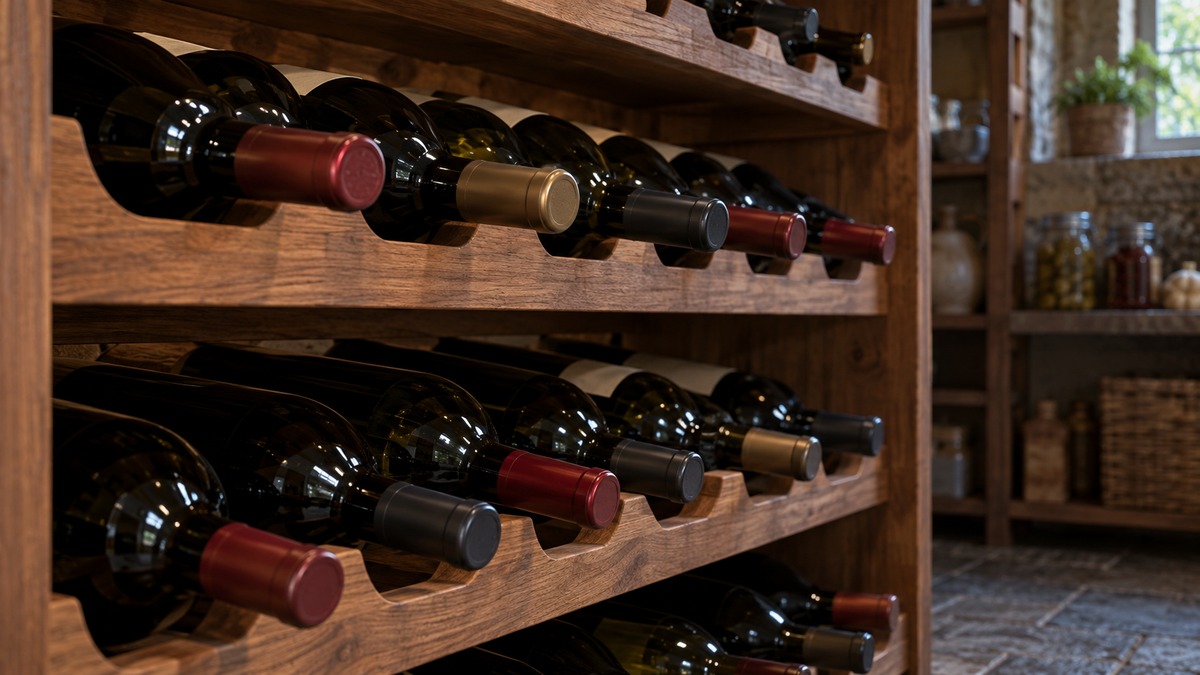
The Purdue Extension fact sheet on wine storage says bottles closed with corks, whether bark or synthetic, “should be stored upside down or sideways” to minimize gas exchange between the outside air and the wine, which avoids faster oxidation. North Dakota State University Extension, writing for home winemakers, is plainer: “Store wine bottles on their sides in a cool, dark place.” It says this keeps the cork from drying out and shrinking, and it adds that darkness prevents oxidation and color changes from prolonged light exposure.
The Missouri State University guide, Making Wine for Home Use, draws the line between closures. It says corked bottles should be stored horizontally so that the cork is kept moist, and that screw-capped bottles can be stored upright. That is the first sorting step for a shelf. Check each bottle’s closure before you decide where it goes. Screw-cap bottles can stand upright, which gives you more choices for shelf height. Corked bottles need a shelf or rack that lets them lie on their sides, and the sources do not give an angle for tilted storage.
The North Dakota State University list of home-winemaking equipment includes a wine rack “used to hold wine bottles at a slant to avoid drying out the cork.” The same publication tells new winemakers to stand freshly corked bottles upright for a few days so the cork expands, and then to store them on their sides. That instruction is for bottles you corked yourself. The other sources do not repeat it for bottles bought sealed.
Where the sources disagree about position
Position is not settled in the research. The extension guides agree on sideways storage, and a review article on bottle aging, hosted in the National Library of Medicine’s PubMed Central archive, says wine is generally better preserved horizontally, because the cork stays moist in contact with the wine. The same review reports that wine placed horizontally is more sensitive to vibration. A laboratory article on the glass and cork interface, also hosted there, found something different for one stopper type: bottle position, vertical or horizontal, “does not influence the oxygen transfer.”
| Source | Type | What it says about position |
|---|---|---|
| Purdue Extension | Extension fact sheet | Corked bottles upside down or sideways |
| North Dakota State University Extension | Extension publication for home winemakers | Bottles on their sides |
| Missouri State University | University guide for home winemakers | Corked bottles horizontal; screw caps can stand |
| Review of bottle aging (PubMed Central) | Review article | Horizontal generally better preserved; horizontal bottles more sensitive to vibration |
| Glass and cork interface study (PubMed Central) | Laboratory article, microagglomerated corks, 24 months | Position did not change oxygen transfer |
The lab study used model wine and microagglomerated stoppers at 20 degrees Celsius, so it does not overturn the extension advice for natural corks. Its useful message for a shelf is narrower. For that stopper type and that period, temperature mattered and position did not: at 35 and 50 degrees Celsius the cork and glass system stayed stable for about 9 and 3 months respectively, then started to let more oxygen through. The practical rule is the one all the extension sources share: corked bottles on their sides, in a steady, cool place.
The temperature numbers
Temperature is the factor with the most numbers behind it. Purdue Extension says the greatest storage hazards for wine come from elevated temperatures and temperature fluctuations, and it gives a table of limits by storage time. Each limit below is the extension’s own figure, and the Fahrenheit values are as printed there.
| Exposure | Limit (Celsius) | Limit (Fahrenheit) |
|---|---|---|
| Heat: never | 30 or above | 86 or above |
| Heat: spikes of 30 minutes or less | 29 or below | 85 or below |
| Heat: 1 to 4 weeks | 24 or below | 75 or below |
| Long-term storage | 10 to 16 | 50 to 60 |
The same fact sheet explains why the long-term band matters. Any temperature above 16 degrees Celsius (60 degrees Fahrenheit) accelerates maturation, may change the wine’s character and can shorten its life, especially for whites. Above 24 degrees Celsius (75 degrees Fahrenheit), most wines age greatly and atypically. At the cold end, wines kept below 10 degrees Celsius (50 degrees Fahrenheit) may not develop their full potential, and at 0 degrees Celsius (32 degrees Fahrenheit) and below, crystals can precipitate in as little as an hour.
Other sources give a single point inside that band. The Missouri State guide calls an area with a cool temperature of about 60 degrees Fahrenheit, which is 15.6 degrees Celsius by our conversion (60 minus 32, divided by 1.8), ideal. The bottle-aging review says it is generally accepted that 12 to 13 degrees Celsius is the ideal temperature for wine storage, which is 53.6 to 55.4 degrees Fahrenheit (12 times 1.8 plus 32, and 13 times 1.8 plus 32). The Verdejo white-wine study discussed below used 12 degrees Celsius as its cellar condition. All of these points fall inside the Purdue band. The sources do not name a single target for a home shelf, so choose a spot that stays in the band and changes slowly.
Keep the temperature steady
Steadiness gets as much attention as the number. Purdue Extension says that temperature fluctuations “test the integrity and position of the bottle closure,” especially corks, and can let air into the wine, with rapid spoilage following. It also warns about moving bottles. Moving them from very cold storage to a warmer environment causes condensation on the bottle, labels and cork, which can lead to mold growth and damage to the whole package. If you bring bottles in from a cold place, our reading is to let them warm up before they go on the shelf, since the sheet gives no warm-up time.
The Purdue fact sheet carries a caution that matters for sparkling wine. High temperatures raise the already high pressure in sparkling wine bottles, which the sheet puts at about 6 atmospheres, or 90 pounds per square inch. It says loss of sparkling wine by bottle bursting has been reported as a result of heat exposure. A sparkling bottle does not belong on a shelf that gets warm. The sheet is a winery-oriented document, and it does not say how likely bursting is on a home shelf, so treat the point as a reason for caution and not as a prediction.
Keep bottles dark
North Dakota State University Extension and the Missouri State guide both ask for a dark place or one out of direct sun. The bottle-aging review explains the mechanism. Light is a major inducer of wine oxidation during bottle storage, and ultraviolet light can reduce free sulfur dioxide, which slows the protection against oxidation. The review says that dark glass bottles, amber or green, are justified because they reduce light exposure, and that “minimising exposure to light is vital to improve the wine flavour.”
A study of Verdejo white wine from a Spanish university shows the size of the effect for one wine. Researchers stored bottles for one year in two conditions, one simulating retail light and temperature (diffuse white LED light at 24 plus or minus 2 degrees Celsius) and one simulating cellar conditions (darkness at 12 degrees Celsius). The first group lost more sulfur dioxide, turned browner and changed in aroma, and the authors conclude that retail-style conditions “considerably decrease the quality of bottled white wines.” The study covered one white wine variety in two combined conditions, so it cannot separate the effect of light from the effect of temperature. For a shelf, the lesson is the same as the extension advice: choose a dark, cool wall, not a lit display.
The Purdue fact sheet gives a related time frame under good conditions. If storage avoids excessive ultraviolet light and holds a constant temperature within roughly 1 to 1.5 degrees Celsius (2 to 3 degrees Fahrenheit), typical white table wines should keep their quality for about three years after bottling, and red table wines for three to 10 years depending on style. It calls these very general guidelines, and adds that some wines are made to be drunk within their first year.
Vibration and where the shelf goes
The Missouri State guide asks for a spot away from strong odors and vibrations, and it gives one location warning that applies directly to shelves: do not put a wine rack on top of a refrigerator or freezer, because the appliance may vibrate and produce heat. The bottle-aging review adds the reason in chemical terms. Strong vibrations harm wine, and high vibration levels accelerated the decline of organic acids and tannins in the studies it summarizes. The review also reports that wine placed horizontally is more sensitive to vibrations, and it links the effect to the larger contact area between wine and headspace in a horizontal bottle.
That sets up a trade-off the sources do not resolve. Horizontal storage keeps the cork moist, and it also makes a vibrating shelf matter more. The answer the sources support is to put the bottles on their sides and then choose a still location. The table turns the guidance into a quick placement check, and each verdict is our summary of the sources, not a ranking they publish.
| Shelf location | What the sources say | Our summary |
|---|---|---|
| On top of a refrigerator or freezer | Missouri State: the appliance may vibrate and produce heat | Avoid |
| In direct sun, such as a window wall | Missouri State and NDSU: out of direct sun, dark place | Avoid |
| Against a wall with a heat source | Purdue: fluctuations and heat above 16 degrees Celsius harm wine | Avoid |
| Near a washer, dryer or other machine | Missouri State: away from vibrations | Avoid, by the same rule |
| A cool, dark, still interior wall | Matches the Missouri State and NDSU descriptions | Best fit among common spots |
Humidity
The Missouri State guide asks for relatively high humidity but gives no number. The bottle-aging review explains the stakes without one either. The higher the relative humidity during bottle storage, the higher the survival rate of mold, which may cause undesired flavors, and fluctuating humidity changes the breathability of corks, which expand when wet and shrink when dry. It says storage humidity has to be strictly controlled, but it states no range.
That leaves a gap. The extension pages and the review agree on the direction, which is moist enough to keep corks from drying and dry enough to avoid mold, and none of them names a percentage that we could verify. A room hygrometer shows what your shelf location actually does. The sources we opened do not say which reading to aim for, so we do not give one.
Plan the load before you fill the shelf
None of the sources gives a bottle weight, a bottle diameter or a weight limit for a home shelf. The table shows the method with two assumptions that are ours. We assume each bottle lying on its side takes 3.0 inches of shelf width and weighs 2.75 pounds when full. Measure and weigh one of your own bottles and replace both numbers. The method: shelf width divided by bottle width gives bottles per row, rounded down, and bottles times weight gives the load for one row.
| Shelf width (inches) | Bottles per row (assumed 3.0 inches each) | Load for one row (assumed 2.75 pounds each) |
|---|---|---|
| 24 | 24 ÷ 3.0 = 8 | 8 × 2.75 = 22.0 pounds |
| 30 | 30 ÷ 3.0 = 10 | 10 × 2.75 = 27.5 pounds |
| 36 | 36 ÷ 3.0 = 12 | 12 × 2.75 = 33.0 pounds |
| 48 | 48 ÷ 3.0 = 16 | 16 × 2.75 = 44.0 pounds |
If the shelf is deep enough for a second row, double the load. The sources do not give a shelf depth for bottles, so measure the bottle’s length against the shelf. Then compare the load with the capacity the maker states for a single shelf. We cannot supply that figure: the pages we opened give no rated capacity for any wine rack or home shelf. A shelf that does not state a rating is a poor match for a full row of bottles. For shelves that state a load figure, see our roundup of floating shelves that can hold weight, and for units whose shelf height can change, see adjustable height shelves. For open shelf units in general, see display shelves.
A setup plan, step by step
- Step 1: sort by closure. Corked bottles lie down, and screw-cap bottles may stand.
- Step 2: choose the spot. Pick a cool, dark, still place that stays in the 10 to 16 degree Celsius band most of the time.
- Step 3: rule out the bad spots. Skip the top of a refrigerator, the window wall and anywhere near a heat source or machine.
- Step 4: check the load. Weigh a bottle, multiply by the row count, and compare it with the shelf’s rated capacity.
- Step 5: place sparkling wine with care. Keep it where heat cannot build up.
- Step 6: let bottles settle. Bring cold bottles to room temperature before shelving to avoid condensation on labels and corks.
- Step 7: check on it. Read the room’s temperature at intervals, because steadiness matters as much as the average.
How we chose
We read each page on 2026-10-21 and kept only the rules a page states in its own words. The core set is a Purdue Extension fact sheet on wine storage, a North Dakota State University Extension publication on home winemaking, and a Missouri State University guide to making wine for home use. Three journal articles hosted by the National Library of Medicine add the research behind light, vibration and position. We did not use retailer or manufacturer pages for any storage or load claim, and we left out pages that did not load. The tables are our own arithmetic and summaries, and each assumption is named.
Mistakes to avoid
- Standing corked bottles for years. The extension guides ask for sideways storage to keep the cork moist.
- Putting the rack on a refrigerator. The Missouri State guide warns about vibration and heat.
- Leaving bottles in direct sun. Both the Missouri State and North Dakota State guides ask for a dark place.
- Letting the room swing. Purdue Extension says fluctuations test the closure.
- Moving cold bottles straight to a warm room. Purdue Extension warns of condensation on labels and corks.
- Loading the shelf without a rating. The sources give no capacity, so the maker’s figure is the only check.
What we could not verify
The sources we opened do not give a humidity percentage that we could verify, an angle for tilted bottles, a bottle weight or diameter, or a rated capacity for any home shelf. They do not say how much vibration a household shelf typically sees, and they do not compare one shelf material with another for wine. Most of the storage figures come from winery and research settings, and the position and light studies each covered one wine type, so applying them to a home shelf is an adaptation and not a direct rule. None of the pages names a rack, shelf or product as the right one, and nothing in this guide is a product claim. The bottle width and weight in the load table are our assumptions.
Frequently asked questions
Should wine bottles lie flat on a shelf?
Corked bottles should lie on their sides, according to Purdue Extension, North Dakota State University Extension and Missouri State University. Missouri State adds that screw-capped bottles can be stored upright.
What temperature should a wine shelf be?
Purdue Extension gives 10 to 16 degrees Celsius (50 to 60 degrees Fahrenheit) for long-term storage. Missouri State gives about 60 degrees Fahrenheit, and the bottle-aging review says 12 to 13 degrees Celsius is generally accepted as ideal. Keeping the temperature steady matters as much as the number.
Can I put a wine rack on top of the refrigerator?
The Missouri State guide advises against it, because a refrigerator or freezer may vibrate and produce heat.
Does light matter for wine on a shelf?
Yes. North Dakota State University Extension asks for a dark place, and the bottle-aging review says light is a major inducer of oxidation. Darker glass reduces exposure, but a dark spot is still the safer choice.
How much weight does a wine shelf carry?
The sources give no figure, so work it out from your own bottles using the load table above and compare the result with the maker’s rated capacity for one shelf.
What humidity does wine need?
The Missouri State guide asks for relatively high humidity but names no number, and the sources we opened give no percentage we could verify. A hygrometer shows what your location does.
Bottom line
Lay corked bottles on their sides in a cool, dark, still spot, and load the shelf only to the capacity its maker states.
Sources
- https://www.extension.purdue.edu/extmedia/FS/FS-58-W.pdf (opened 2026-10-21)
- https://www.ndsu.edu/agriculture/sites/default/files/2022-07/fn1638.pdf (opened 2026-10-21)
- https://ag.missouristate.edu/StateFruit/_Files/MS28MWFHUweb.pdf (opened 2026-10-21)
- https://pmc.ncbi.nlm.nih.gov/articles/PMC10534415/ (opened 2026-10-21)
- https://pmc.ncbi.nlm.nih.gov/articles/PMC10629979/ (opened 2026-10-21)
- https://pmc.ncbi.nlm.nih.gov/articles/PMC7794777/ (opened 2026-10-21)