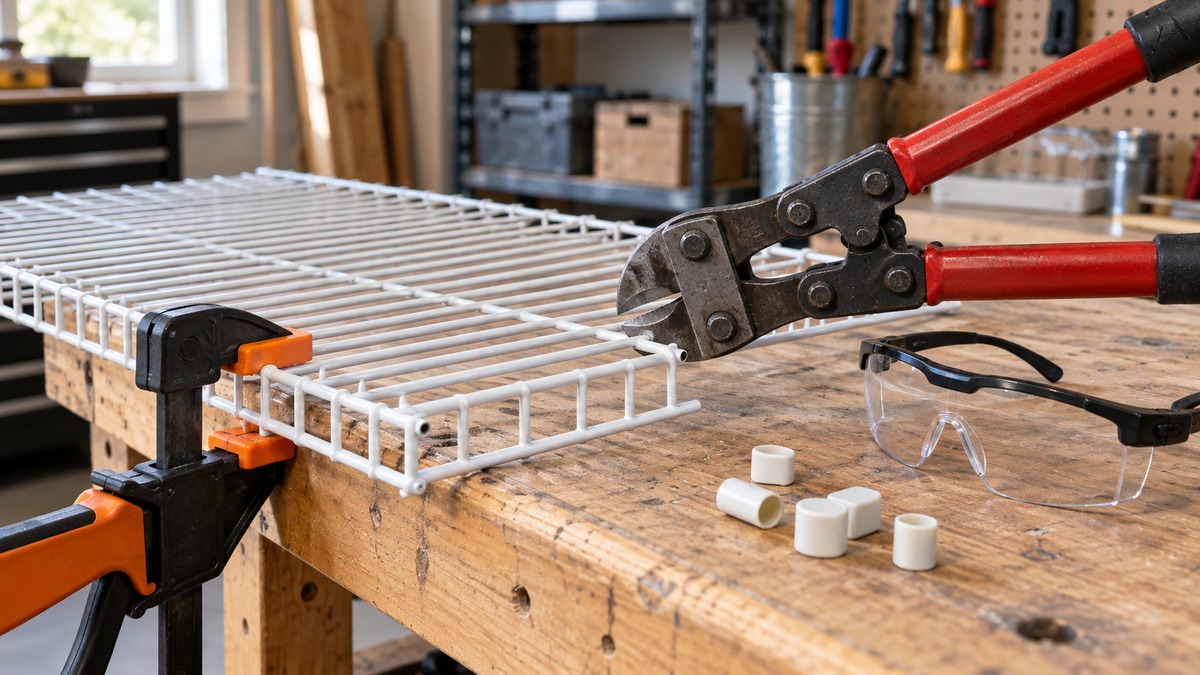
Can Wire Shelving Be Cut to Size
As an Amazon Associate we earn from qualifying purchases.
Can wire shelving be cut to size? For closet-style wire shelves, yes. ClosetMaid’s own FAQ says you may need to cut shelving at installation, and its instruction sheets name a bolt cutter or hacksaw. For freestanding commercial units, the InterMetro and MuscleRack pages we opened list fixed sizes and say nothing about cutting. This guide sorts the two cases, then covers tools, measuring, covering the cut ends and resetting the wall clips, and it marks where the sources stop.
Quick answer
- Closet-style wire shelving sold as a do-it-yourself system is meant to be trimmed. ClosetMaid says such products are not cut to size before shipping.
- Use a bolt cutter or hacksaw, cut between the wires, and cap every cut end right away, because the manufacturer’s sheet warns that cut ends are sharp.
- Measure wall to wall and subtract an inch, then recount your wall clips, which the sheet says must never sit more than 12 inches apart.
- For freestanding wire units, the pages we opened give no cutting method, so ask the maker before you cut.
Which kind of wire shelving do you have
The answer depends on the system, not on the wire. A shelf that hangs on wall clips in a closet is sold as a do-it-yourself part that may need trimming. A freestanding unit with posts and a fixed set of shelf sizes is sold as a kit. The table shows what each manufacturer page says about length.
| Line | What the page says about length or cutting | Where |
|---|---|---|
| ClosetMaid closet wire | You may need to cut shelving at installation; products are not cut to size before shipping; bolt cutter or hacksaw named for wire | ClosetMaid FAQ, installation guide and tips sheet |
| Rubbermaid closet wire | The spec sheet lists a pneumatic cutter, replacement jaws and white epoxy touch-up paint as installation aids and says the shelving can be customized; it does not describe how to cut | Rubbermaid spec sheet |
| InterMetro Super Erecta | Lists standard shelf widths of 14, 18, 21 and 24 inches and lengths of 24 to 72 inches; kits ship in standard sizes; custom configurations come through a builder; no cutting statement | InterMetro wire shelving page |
| MuscleRack chrome wire | Lists models in fixed sizes such as 18x10x18 and 24x14x59 inches; no cutting statement | Edsal support page |
Read the table as a map of what the sources say, not as a ranking. A missing statement does not mean a shelf cannot be cut. It means the page we opened does not address it.
What ClosetMaid says about cutting
ClosetMaid is the clearest source because it addresses the question directly. Its home organization FAQ asks whether you might need to cut shelves and hang rods yourself, and the answer begins with “YES.” The same answer explains that these are do-it-yourself products and that they are not cut to size for your individual design before the order ships.
The ClosetMaid installation guide lists the tools for a wire closet as a bolt cutter or hacksaw, and for a wood closet as a fine-tooth saw. A ClosetMaid blog post on installing a closet system goes further and says you might need to trim the shelves to size, so measure twice and cut once. A separate QuickTip post from ClosetMaid refers to sizing and cutting your shelving, whether wire or laminate, and points to an installation video, which we did not open.
One limit comes with that advice. ClosetMaid’s blog says that for a walk-in closet with corner units the maximum lengths of the rods and the shelves are 48 inches. That figure belongs to that layout and not to every wire shelf, so check the length your own kit allows before you plan the cut.
Choose a tool and protect yourself
The sources name two tools for closet wire. A third appears for the rods.
| Tool | Who names it | What the source adds |
|---|---|---|
| Bolt cutter | ClosetMaid guide and sheets; Family Handyman | The Family Handyman installer says to cut with a bolt cutter because it is quick and makes a clean cut |
| Hacksaw | ClosetMaid guide and sheets | Named as an alternative to the bolt cutter, without a ranking |
| Pipe cutter | ClosetMaid tips sheet | Named for hanger bars, not for shelves |
| Fine-tooth saw | ClosetMaid FAQ and guide | Named for wood or laminate shelves, with painter’s tape along the cut line to prevent chipping |
The sources we opened name hand tools for wire. Family Handyman lists safety glasses among the tools for a wire shelving job. A University of Georgia facilities safety presentation adapted from the OSHA Office of Training and Education gives general rules for hand tools: use the right tool for the job, inspect it before use, operate it according to the manufacturer’s instructions, and use PPE such as safety goggles and gloves. It also tells users to keep cutting tools sharp. Those rules are general, and none of the pages we opened gives a bolt cutter capacity for a specific wire gauge, so check that your cutter is rated for the wire you plan to cut.
The ClosetMaid sheets carry a plain warning: sharp ends on the shelf when cut. That warning is the main reason to plan your caps before you make the first cut.
Measure: wall to wall, minus an inch, in whole inches
The Family Handyman installer’s rule is to measure wall to wall and subtract an inch. The inch covers the thickness of the end brackets and a little room to move, and the article adds that cutting exact lengths only earns wall scratches and a trip back to the cutting station. The ClosetMaid instruction sheet adds a second constraint: cut the shelf between the wires, in one inch increments, to the length you want. The Rubbermaid spec sheet says its cross deck wires are spaced at 1 inch increments, which matches the one inch steps.
Putting the two rules together gives a simple method. Measure the wall to wall width, subtract 1 inch, and round down to the next whole inch. The rounding step is our own combination of the two rules, because the pages we opened do not say how the first wire of a shelf is positioned. Treat the results below as a worked example and compare them with your own shelf before you cut.
| Wall to wall (inches) | Minus 1 inch | Cut length, rounded down (inches) |
|---|---|---|
| 36 | 36 – 1 = 35 | 35 |
| 41.5 | 41.5 – 1 = 40.5 | 40 |
| 47.25 | 47.25 – 1 = 46.25 | 46 |
| 53 | 53 – 1 = 52 | 52 |
| 59.75 | 59.75 – 1 = 58.75 | 58 |
If the wall is not square, measure at the shelf height at both ends and use the shorter number. That check is our advice, not a rule from the sources.
Where to cut, and which wire carries the shelf
Cut between the wires, as the ClosetMaid sheet says. The Rubbermaid spec sheet adds that its wires are welded at the cross deck intersections and trimmed smooth. The Family Handyman installer notes that the top, thinner wire is what actually supports the shelf, and that one wire per end is enough. That is one installer’s view in a how-to article, so treat it as practical advice and not a rated figure.
The order is simple. Mark the length, support the shelf off the floor so the cutter has room (the installer holds it up with his feet), make the cut, and put caps on right away.
Cover every cut end
ClosetMaid gives two instructions that belong together. The first is “Immediately place endcaps onto cut shelf ends.” The second, from the tips sheet, is to add caps to every exposed wire on both ends of each shelf, and it says end caps protect you, your clothing and the shelving materials.
There is a second reason, and it is our reading of the sources rather than a stated rule. ClosetMaid describes its wire shelving as vinyl-coated steel. A cut exposes the steel inside the coating. A Lehigh University corrosion page explains that rusting is iron combining with water and oxygen and that it can be prevented by excluding air and water from the surface, for example by painting. InterMetro’s FAQ says standard chrome wire shelving is intended for dry storage only and corrodes quickly in damp or cold places. Taken together, a bare cut end in a damp room is the weak point. The Rubbermaid spec sheet lists white epoxy touch-up paint among its installation aids, but it does not say the paint is meant for cut ends, so we cannot say what it is for. None of the pages we opened tells you how fast a cut end rusts or whether a cap fully seals it.
Reset the wall clips after you cut
Cutting changes the clip layout. The ClosetMaid instruction sheet gives a rule for cut shelves: install a wall clip 2 inches from each end of the shelf, space the remaining clips at even intervals between the end clips, and never install wall clips more than 12 inches apart. It also says to drill 1/4 inch holes and not to punch them. Another wire shelf sheet on Lowe’s document site, whose maker is not named in the text, uses 3 inches from each end with the same 12 inch maximum. The offset depends on the kit, so read the sheet that came with yours.
The table applies the ClosetMaid 2 inch rule to the cut lengths above. The formula is our arithmetic: the span between end clips is the shelf length minus 4 inches, the number of gaps is that span divided by 12 and rounded up, and the clip count is the gaps plus one.
| Cut length (inches) | Span between end clips | Gaps (span ÷ 12, rounded up) | Clips | Even spacing (inches) |
|---|---|---|---|---|
| 35 | 35 – 4 = 31 | 31 ÷ 12 = 2.58, so 3 | 4 | 31 ÷ 3 = 10.33 |
| 40 | 40 – 4 = 36 | 36 ÷ 12 = 3.00, so 3 | 4 | 36 ÷ 3 = 12.00 |
| 46 | 46 – 4 = 42 | 42 ÷ 12 = 3.50, so 4 | 5 | 42 ÷ 4 = 10.50 |
| 52 | 52 – 4 = 48 | 48 ÷ 12 = 4.00, so 4 | 5 | 48 ÷ 4 = 12.00 |
| 58 | 58 – 4 = 54 | 54 ÷ 12 = 4.50, so 5 | 6 | 54 ÷ 5 = 10.80 |
The 40 inch and 52 inch rows land exactly on 12 inches, which is the limit, so a cut that is one inch longer needs another clip. The ClosetMaid guide also says wire system support brackets should be no more than 36 inches apart for fixed-mount systems and no more than 24 inches for ShelfTrack hardware. For the weight side of closet wire shelves, see our guide to the ClosetMaid wire shelf weight limit.
Freestanding wire units: what the pages do and do not say
A freestanding unit stands on posts and takes shelves in set sizes. InterMetro’s FAQ gives common widths of 24, 36, 48, 60 and 72 inches and depths of 12 to 36 inches, and its product page lists the 14, 18, 21 and 24 inch widths and 24 to 72 inch lengths. Shelves reposition in 1 inch steps along the posts, which changes height, not length. The page also points to custom configurations through its online builder and invites readers to contact a Metro representative.
The MuscleRack chrome page lists its models in fixed sizes, and none of the pages we opened for either brand describes cutting a shelf. If you need a length that is not on the list, the pages we opened point to ordering a configuration, or to asking the maker. For options in the fixed sizes, see our guides to free standing wire shelves for the kitchen and the Hyper Tough 5 tier wire shelving unit.
Capacity after a cut
This is the question the sources do not answer. The pages we opened give clip and bracket spacing, but none states how much a shelf holds once it is cut shorter. The Family Handyman article quotes a ClosetMaid capacity for a 16 inch deep shelf by mounting method, and it does not tie that figure to shelf length. Because no page states a capacity for a cut shelf, we cannot give one. Follow the clip and bracket spacing rules for the new length, and check the maker’s capacity statement for your kit. For clothes-rod layouts, our guide to wire closet shelving with a clothes rod covers the combination.
How we chose
This is a method guide, not a product list. We read fourteen pages on 2026-10-21: six ClosetMaid pages and sheets, one wire shelf sheet that does not name its maker, one Rubbermaid spec sheet, two InterMetro pages, one Edsal MuscleRack support page, one Family Handyman article, one University of Georgia safety presentation and one Lehigh University page. We kept a step only if a page states it plainly. ClosetMaid supplies most of the cutting detail because it is the one manufacturer in our set that publishes cutting instructions, so the guide leans on it and says so. We treated the installer’s tips as one person’s practice. The cut-length table and the clip table are our own arithmetic, and each input is named.
Mistakes to avoid
- Cutting before you cap. The ClosetMaid sheet warns that sharp ends are exposed on a cut shelf and says to place end caps right away.
- Cutting to the exact wall width. The Family Handyman installer says to subtract an inch, because exact lengths only earn wall scratches.
- Forgetting the clips. The ClosetMaid sheet sets the end clips 2 inches from each end and a 12 inch maximum between clips, and a shorter shelf needs a new count.
- Assuming every kit follows the same offset. A second wire shelf sheet uses 3 inches from each end.
- Cutting a freestanding unit without asking. The InterMetro and MuscleRack pages we opened give no cutting instructions.
- Leaving a cut end bare in a damp room. InterMetro says standard chrome corrodes quickly in damp or cold places, and Lehigh says rust needs water and oxygen.
What we could not verify
The sources we opened do not say whether InterMetro or MuscleRack freestanding shelves can be cut, and they do not state a shelf’s capacity after it is cut. They do not give a bolt cutter size for a given wire gauge or say how fast a cut end rusts. The Rubbermaid spec sheet mentions a cutter and touch-up paint without describing their use. The ClosetMaid video referred to in its QuickTip post was not opened. Two of the ClosetMaid sheets are hosted on retailer document servers, and one wire shelf sheet does not name its maker, so we used that sheet only to show that the clip offset differs by kit. If your shelf came with an instruction sheet, follow it over this guide.
Frequently asked questions
Can you cut wire closet shelving yourself?
Yes, according to ClosetMaid. Its FAQ says you may need to cut shelving at installation, and its sheets name a bolt cutter or hacksaw.
What is the best tool to cut wire shelving?
The ClosetMaid pages name a bolt cutter or hacksaw without ranking them. The Family Handyman installer prefers the bolt cutter because it is quick and leaves a clean cut.
How much shorter than the wall should a wire shelf be?
The installer quoted by Family Handyman measures wall to wall and subtracts an inch. That allows for the end brackets and a little room to move.
Do I need end caps after cutting?
ClosetMaid says to place caps on cut ends immediately and to cap every exposed wire on both ends of each shelf. Its sheet warns that cut ends are sharp.
Can I cut a freestanding wire shelf from a commercial brand?
The InterMetro and MuscleRack pages we opened say nothing about cutting. InterMetro lists standard sizes and custom configurations, so ask the maker or order the size you need.
Does cutting a shelf change how much it holds?
The pages we opened do not say. They give clip and bracket spacing, so follow those rules for the new length and do not assume the original rating still applies.
Bottom line
Cut closet wire shelving between the wires with a bolt cutter or hacksaw, cap every cut end at once, and reset the clips for the new length.
Sources
- https://www.homebyames.com/en-us/ho/ho-faqs.html (opened 2026-10-21)
- https://www.homebyames.com/en-us/b2c_hba_complex_closetinstallguide.html (opened 2026-10-21)
- https://pdf.lowes.com/productdocuments/d1af380f-0c6e-4e7d-92b6-c4cde568f53d/50039299.pdf (opened 2026-10-21)
- https://images.homedepot-static.com/catalog/pdfImages/d4/d47809c7-9248-4a92-b18d-d818a1e37e63.pdf (opened 2026-10-21)
- https://pdf.lowes.com/productdocuments/2cb8189d-c7f8-49e3-a64b-c8d07dc49c29/44005842.pdf (opened 2026-10-21)
- https://inspire.homebyames.com/home-organization/how-to-install-a-closet-system/ (opened 2026-10-21)
- https://inspire.homebyames.com/home-organization/quick-tip-how-to-cut-shelving/ (opened 2026-10-21)
- https://www.familyhandyman.com/project/how-to-install-wire-shelving/ (opened 2026-10-21)
- https://sweets.construction.com/swts_content_files/152919/2511748.pdf (opened 2026-10-21)
- https://metro.com/wire-shelving/ (opened 2026-10-21)
- https://metro.com/faq/wire-shelving/ (opened 2026-10-21)
- https://edsalmanufacturingcompany.freshdesk.com/support/solutions/articles/153000070249-musclerack-chrome-wire-shelving (opened 2026-10-21)
- https://fmd.uga.edu/wp-content/uploads/hand_and_power_tool_safety_osha_uga_fmd_2018.pdf (opened 2026-10-21)
- https://www.lehigh.edu/~amb4/wbi/kwardlow/corrosion.htm (opened 2026-10-21)
As an Amazon Associate we earn from qualifying purchases.