How to Clean Garage Shelves
As an Amazon Associate we earn from qualifying purchases.
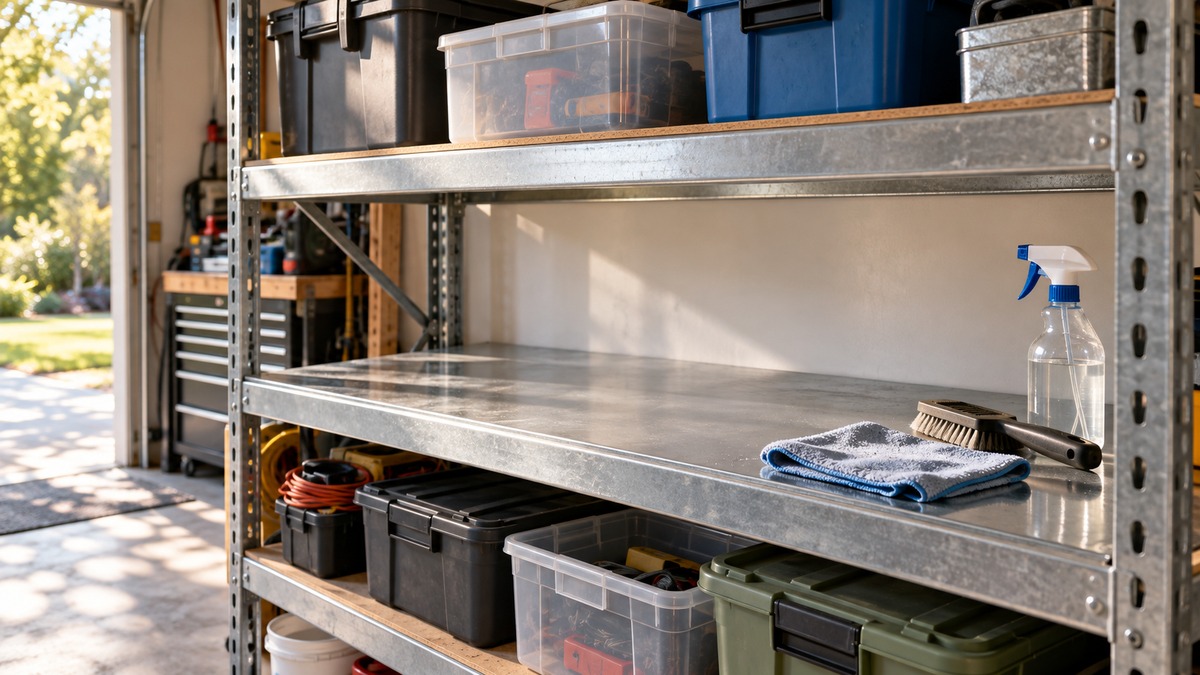
How to clean garage shelves is mostly a question of order: empty one level, dust it dry, wipe it, dry the steel, check it, and only then reload. The University of Arkansas Cooperative Extension Service advises cleaning from the top down and vacuuming dusty spots while they are dry. A corrosion page from Lehigh University explains why steel shelves should be dry before you refill them. None of the pages we opened names a cleaning product, so this guide covers the method and the checks, and leaves product choice to your shelf maker’s care instructions.
Quick answer
- Clear and clean one shelf level at a time, starting with the top level, so the set-down space stays small.
- Remove dust dry first, by vacuuming, before any wet cloth touches the shelf. The Arkansas guide gives that order.
- After wiping, dry steel shelves. Rust forms when iron meets water and oxygen, according to the Lehigh page.
- While the shelf is empty, look for rust, bare steel, droppings and loose joints, then reload the heaviest items low and keep bins off the floor.
Decide how much to empty at once
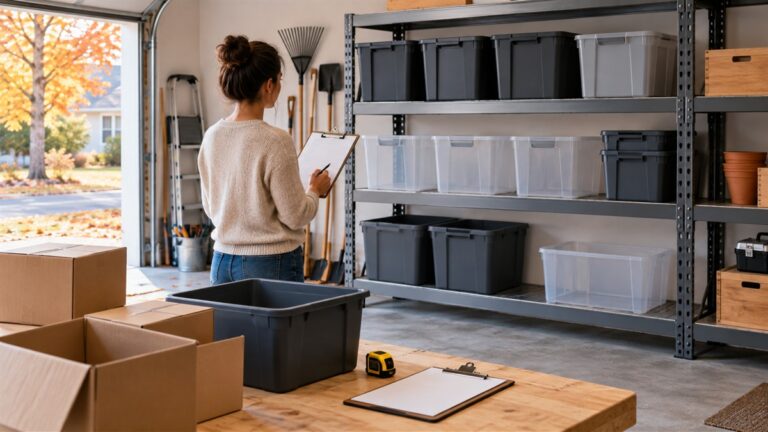
Utah State University Extension says that organizing a garage can be done in stages, which can significantly reduce the time and effort required. The same logic applies to cleaning shelves. Emptying a whole unit at once means finding floor space for everything that was on it. Emptying one level means finding space for one level.
You can estimate that space with a formula: set-down area equals the number of bins on the level times the footprint of each bin, where footprint is length times width. The example uses the shelf size printed on an Edsal spec sheet for a four-shelf welded steel rack, 71.25 inches wide by 22.125 inches deep, and Sterilite’s stated outside dimensions for three totes. Replace those numbers with your own shelf and bins.
| What is on the level | Footprint on the floor (sq in) | Footprint (sq ft, ÷ 144) |
|---|---|---|
| Bare shelf surface, for reference: 71.25 × 22.125 | 1,576.4 | 10.95 |
| Two 27 Gal. Industrial totes: 2 × (28.5 × 19.625) | 1,118.6 | 7.77 |
| One 38 Gal. and one 27 Gal. Industrial tote: (37.5 × 21.625) + (28.5 × 19.625) | 1,370.3 | 9.52 |
| Three 12 Gal. Latch totes: 3 × (19.5 × 15.375) | 899.4 | 6.25 |
| Whole four-level unit, two 27 Gal. Industrial totes per level: 4 × 1,118.6 | 4,474.5 | 31.07 |
The comparison is plain. One level of two large totes needs about 7.8 square feet of floor, while the whole unit needs about 31.1. These figures count the bins only, with none of the walking room around them, and they assume the bins are not stacked. The bare shelf surface is 10.95 square feet, which is also the area a damp cloth has to cover on each level.
Use the empty shelf as a chance to decide what comes back. The Arkansas guide says to remove the clutter from shelves, and the Utah State article says that if something has not been used in the last few years, you should consider getting rid of it. If the answer is a sorted set of bins, our guide to basement shelves for totes covers shelving built around them.
Start with a dry pass, top level first
The Arkansas deep-cleaning guide gives two rules that fit shelves. The first is “Clean top to bottom.” It says to start at the top of the room and work down to the floor, and it applies the same order to each room in a house. On a shelving unit the top level goes first and the bottom level last, so that nothing you have already cleaned collects what falls from above.
The second rule is about dry dust. The guide says that vacuuming highly dusty areas, such as base boards or cabinet tops, while they are dry keeps you from spreading dirt and dust when you later clean with wet rags or sponges. For a shelf, that means a vacuum pass over the surface, the front edge and the uprights before any cloth is dampened. The guide does not name a vacuum attachment, and the pages we opened do not say which is best for wire decking or for solid shelves.
A second reason to remove dust early comes from the National Park Service. Its museum handbook appendix on metal objects says that dirt and dust may contain chemical compounds that react with metals or trap moisture close to the metal surface. The appendix is written for collections, not for garage shelving, so take it as a reason to treat dust on steel as more than untidiness, not as a cleaning schedule.
Edsal describes the black coated wire decking on some of its racks as providing visibility, airflow and “less dust accumulation” on the surface. The company’s page does not compare that against another shelf type or give a figure, so it is a design note and not a promise that wire shelves stay clean. If your shelves have solid decking, the dry pass is the same job, with more of the surface to cover.
Wipe the shelf, then dry the steel
After the dry pass, the Arkansas guide’s order points to wet rags or sponges. Beyond that, the pages we opened do not name a cleaning product, a dilution or a tool, and the Edsal and Gladiator pages we could open do not include care instructions. Check the paperwork that came with your shelves, and keep the cloth damp rather than wet, which is our own precaution and not a source figure.
The reason to dry afterward is chemistry. The Lehigh University page explains that rusting is a process in which iron combines with water and oxygen to form rust, “the reddish-brown crust” on the surface of the iron. A University of Illinois physics Q&A makes the same point in plainer words: rust forms when the iron in steel combines with oxygen from the air, and the reaction happens much faster when water is present. Its suggestion for steel wool is to dry it after every use and store it in a cool, dry place. A steel shelf is a different object, but the mechanism is the same, so a dry cloth after the damp one is cheap protection.
The Lehigh page also says rusting can be prevented by excluding air and water from the iron surface, for example by painting, oiling or greasing it, or by plating it with a protective coating of another metal. Shelf finishes do part of that job. Edsal’s article for its boltless wire-deck shelving describes a textured powder-coated finish, and the spec sheet for its welded rack lists a textured finish. Our reading is that a chip or scratch through the finish is where water and oxygen can reach bare steel, so those spots deserve the closest look.
Check the shelf while it is empty
An empty shelf is the one time you can see the whole unit. The table lists what to look for and which page supports each check.
| Check | What to look for | Where the check comes from |
|---|---|---|
| Finish | Chips or scratches that expose bare steel | Lehigh page on excluding air and water; Edsal finish descriptions |
| Rust | A reddish-brown crust, especially where it flakes | Lehigh page: rust is brittle and flakes off, exposing a fresh surface |
| Droppings | Droppings from mice or insects on or under the shelf | National Park Service appendix; University of California post on garage pests |
| Joints | Brace and beam rivets seated in the post slots | Edsal assembly manual |
| Footing | The unit standing on a level surface | Edsal assembly manual |
| Behind and underneath | Dampness along an exterior wall or on the floor | National Park Service appendix advice on where to store metal (our reading) |
The Lehigh page adds a detail that matters for rust spots: rust is brittle and flakes off the iron, continually exposing a fresh surface. A flaking patch is therefore not a stable one. The page does not say how to remove rust, and none of the pages we opened do, so this guide gives no removal method.
Droppings are a separate problem. The National Park Service appendix says the droppings of pigeons, mice and even insects will cause pitting and corroding of a metal object’s surface, and the University of California post says garages, basements, attics and other storage spaces can attract unwanted pests. Neither page explains how to clean up droppings, so look up your local health department’s guidance before you sweep or vacuum any you find.
The Edsal assembly manual says to inspect the unit periodically to make sure the brace and beam rivets are properly seated in the post slots, and it says the unit should be placed on a level surface. The manual gives no interval for the inspection, so the word periodically is all the sources say. If you need to shift the unit to reach behind or under it, the same manual says to use two or more people to move the unit. The National Park Service appendix advises against storing metal directly on the floor or close to exterior walls, so look for dampness in those spots while the unit is moved.
Do not climb the shelves to reach the top level. The Edsal manual says not to climb, stand on or use the unit as a ladder, and the University of Oregon shelving sheet says to use a step stool or ladder instead of reaching overhead.
Put things back so the shelf stays cleaner
Reloading is part of cleaning, because it decides how much dust and moisture the shelf meets next time. The Edsal manual says to store larger, heavier items on the bottom levels and small, lighter items on the upper levels. The University of California post advises keeping bins off the floor and away from walls, which also keeps the lowest level clear for the next sweep. Penn State Extension’s decluttering guidance for child care facilities gives a number: all items, including storage containers, should be at least six inches off the floor for easier floor cleaning. The same page says “Cleaning around clutter is also very difficult.” Both points come from a child care setting, so read them as general cleaning rules.
The Arkansas guide suggests thinking of things you can use to cover shelves or other areas so messes are quickly fixable. Gladiator’s heavy-duty rack page lists shelf liners sold in a pack of two, sized for 18-inch and 24-inch deep shelves. The page does not say what the liners are made of or how to clean them, so treat the listing as proof that sized liners exist and nothing more. Match any liner to your shelf’s actual width and depth, since a rack listed as 24 inches deep may have a shelf surface that is smaller, as the Edsal 24-inch-deep rack does at 22.125 inches.
If you are replacing a worn unit, compare dimensions and decking in our guide to garage storage shelf dimensions and heights, or read the review of a five-shelf metal storage rack.
A cleaning rhythm you can keep
No page we opened gives a cleaning interval for garage shelving. The table below is our own assumption, built from the actions the sources do describe, and you should adjust it to how dusty or damp your garage is.
| Task | How often (our own assumption) | Why |
|---|---|---|
| Dry vacuum pass on the top level and the tops of bins | Once a season | Arkansas guide: remove dry dust first |
| Empty one level, wipe, dry and recheck | One level per visit, the whole unit once a year | Utah State: work in stages |
| Look for rust, bare steel and droppings | Every dry pass | Lehigh page; National Park Service appendix |
| Check rivets and footing | Every dry pass | Edsal manual says periodically, with no interval |
How we chose
This is a method guide, not a product ranking. We read the pages listed at the end of this guide on 2026-10-21 and kept only steps that a page supports. For the order of work we used the Arkansas Extension guide and the Utah State article. For rust we used the Lehigh page and the Illinois physics answer. For checks on steel and storage we used the National Park Service appendix and the Edsal manual. Shelf and bin sizes come from Edsal’s spec sheet and Sterilite’s product pages, and every area in the table is arithmetic on those sizes. We left out cleaning products because no page we opened names one.
Mistakes to avoid
- Wiping before dusting. The Arkansas guide says to vacuum dusty areas while they are dry, so dirt does not spread when you use wet rags.
- Cleaning bottom to top. The guide’s rule is top to bottom.
- Reloading a damp steel shelf. The Lehigh page and the Illinois answer both tie rust to water and oxygen.
- Climbing the shelves. The Edsal manual and the Oregon sheet both say not to.
- Ignoring droppings. The National Park Service appendix says they pit and corrode metal.
- Emptying the whole unit at once. The table shows the set-down area grows with every level you empty.
What we could not verify
The pages we opened do not name a cleaning product, a dilution or a tool, and they give no care instructions for Edsal or Gladiator shelving. They do not cover cleaning wood, laminate, particleboard or plastic shelves, mold, or the safe cleanup of droppings. They do not give a method for removing rust, a cleaning interval, or how often to inspect rivets. The National Park Service appendix is written for museum collections, and the Illinois answer is about steel wool, so both are close fits for a garage shelf rather than exact ones. Gladiator’s and Edsal’s product pages we could open describe features and sizes but not cleaning. We could not open Gladiator’s blog or product detail pages, so the liner point rests on a listing page only.
Frequently asked questions
What should I use to clean metal garage shelves?
The pages we opened do not name a product. The Arkansas guide describes wet rags or sponges after a dry vacuum pass, and the shelf maker’s own care instructions are the place to confirm anything else. Dry the steel afterward.
Do I need to dry steel shelves after wiping them?
Yes, by our reading of the sources. The Lehigh page says iron rusts when it combines with water and oxygen, and the Illinois answer says the reaction is much faster when water is present.
How often should I clean garage shelves?
No source gives an interval. Edsal’s manual says to inspect the unit periodically, and the table above suggests a dry pass each season and a full empty-and-wipe once a year as our own assumption.
What do I do about rust spots?
The pages we opened explain how rust forms but do not give a removal method. The Lehigh page notes that rust flakes off and exposes a fresh surface, so a flaking spot is worth checking each time you clean. Ask the shelf maker about repair or touch-up.
Can I move the shelving unit to clean behind it?
The Edsal manual says to use two or more people to move the unit. Emptying the level or the whole unit first is our own precaution, not a step the manual states.
Bottom line
Clear one level, vacuum dry from the top down, wipe, dry the steel, and check for rust and droppings before reloading heavy items low.
Sources
- University of Arkansas Cooperative Extension Service, Carroll County, “Torrie’s Top Tips for Deep Cleaning Your House”: https://uaex.uada.edu/counties/carroll/torries-top-tips-blog/posts/deep_cleaning.aspx (opened 2026-10-21)
- Utah State University Extension, “Got Room for the Car in Your Garage?”: https://extension.usu.edu/archive/got-room-for-the-car-in-your-garage (opened 2026-10-21)
- Lehigh University web page, “Corrosion and the Environment”: https://www.lehigh.edu/~amb4/wbi/kwardlow/corrosion.htm (opened 2026-10-21)
- University of Illinois Physics Van, “How to Prevent Rusting”: https://van.physics.illinois.edu/ask/listing/16962 (opened 2026-10-21)
- National Park Service Museum Handbook, Appendix O, Curatorial Care of Metal Objects: https://www.nps.gov/subjects/museums/upload/MHI_AppO_MetalObjects.pdf (opened 2026-10-21)
- University of California Agriculture and Natural Resources, indoor pests blog post: https://ucanr.edu/blog/pests-urban-landscape/article/unwanted-indoor-critters-theres-pest-notes (opened 2026-10-21)
- University of Oregon, Shelving Safety sheet: https://safety.uoregon.edu/sites/default/files/safety_sheet_-_shelving_safety_final.pdf (opened 2026-10-21)
- Penn State Extension, Better Kid Care, “Clean, Uncluttered Space”: https://extension.psu.edu/programs/betterkidcare/news/clean-uncluttered-space (opened 2026-10-21)
- Edsal assembly manual, model MROP3618W5B: https://pdf.lowes.com/productdocuments/fe18e1bc-f07c-4345-84ce-7fe425fa1c7a/43253606.pdf (opened 2026-10-21)
- Edsal spec sheet, model ER7824W4: https://edsalmanufacturingcompany.freshdesk.com/helpdesk/attachments/153003547654 (opened 2026-10-21)
- Edsal boltless shelving with wire decking article: https://edsalmanufacturingcompany.freshdesk.com/support/solutions/articles/153000072255-musclerack-heavy-duty-steel-boltless-shelving-with-wire-decking (opened 2026-10-21)
- Gladiator heavy duty storage racks page: https://www.gladiatorgarageworks.com/collections/heavy-duty-storage-racks (opened 2026-10-21)
- Sterilite 27 Gal. Industrial Tote: https://www.sterilite.com/product/27-gal-industrial-tote-2/ (opened 2026-10-21)
- Sterilite 38 Gal. Industrial Tote: https://www.sterilite.com/product/38-gal-industrial-tote-2/ (opened 2026-10-21)
- Sterilite 12 Gal. Latch Tote: https://www.sterilite.com/product/12-gal-latch-tote/ (opened 2026-10-21)
As an Amazon Associate we earn from qualifying purchases.