How to Organize a Laundry Room Without Cabinets
As an Amazon Associate we earn from qualifying purchases.
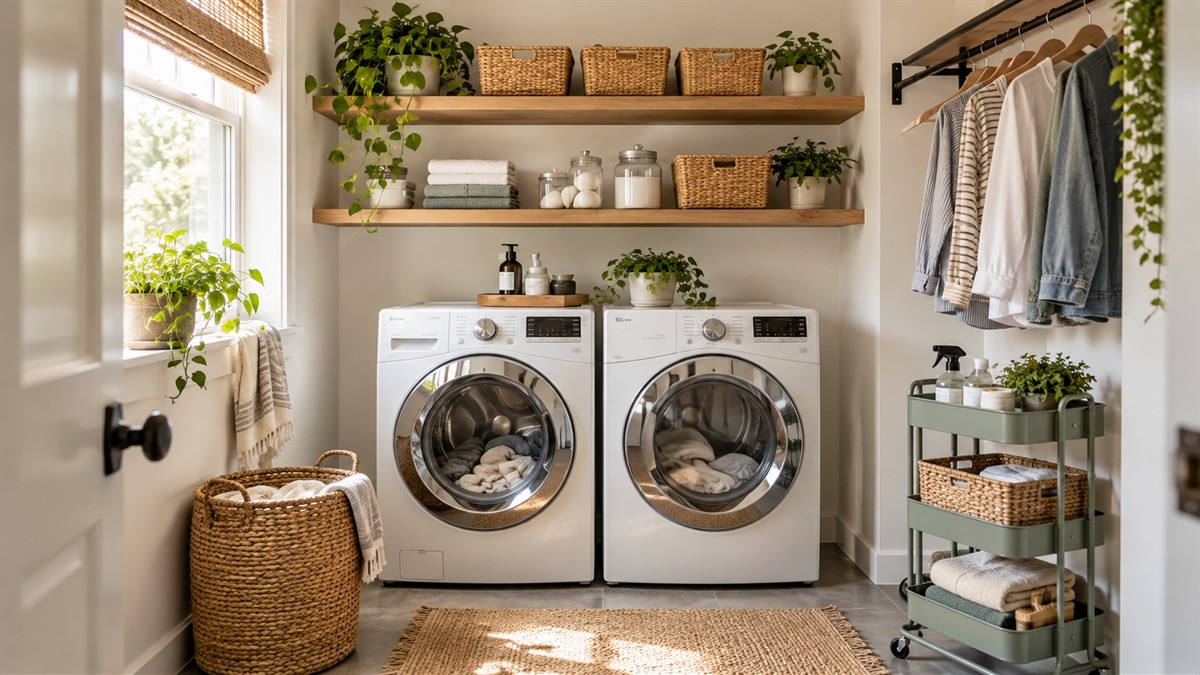
How to organize a laundry room without cabinets comes down to three choices: what goes on the wall above the machines, where the detergent lives, and what you keep clear around the dryer. The American Academy of Pediatrics, Poison Control, NFPA, the U.S. Fire Administration, Elfa and ClosetMaid each cover one piece. None gives a full open-shelf plan, so this guide joins their figures into a wall map and a safety checklist, and shows the arithmetic.
Quick answer
- Use the wall, not the machine tops. The American Academy of Pediatrics says not to store laundry products on top of the washer and dryer, and NFPA says to keep the dryer area clear of things that can burn.
- Mind the lid. LG asks for 15.7 inches above a top-loading washer to account for lid clearance, which can put the first shelf above the 48-inch forward reach limit.
- Pick wire shelves in two depths. Elfa suggests 30 and 40 cm for small laundry rooms, with the shallower depth for detergent and the deeper one for boxes and towels.
- Keep detergent in its original container, closed, out of sight and out of reach, and close the laundry room door when you leave.
Map the wall above the machines
Start with heights, because a top-loading washer’s lid sets the lowest shelf. LG’s help library page for its top-loading washers asks for 15.7 inches (40 cm) above the washer, accounting for lid clearance, with 1 inch on each side and 4 inches behind. That page is LG’s own and applies to LG top-loaders. Other brands and front-loaders may differ, so use your appliance manual.
The pages we opened give no typical washer height. The Access Board’s ADA guide sets a maximum of 36 inches for the opening of an accessible top-loading washer, so the next table uses 36 inches as one example height and shows 34 and 38 inches as our own comparisons. The lowest shelf bottom is the machine height plus the 15.7-inch lid clearance.
| Machine height (in.) | Where the number comes from | Lowest shelf bottom (in.) | Compared with the 48 in. forward reach limit |
|---|---|---|---|
| 34 | our own example | 34 + 15.7 = 49.7 | 1.7 in. above |
| 36 | ADA maximum for accessible top-loaders | 36 + 15.7 = 51.7 | 3.7 in. above |
| 38 | our own example | 38 + 15.7 = 53.7 | 5.7 in. above |
The 48-inch figure is the maximum unobstructed forward reach in the Access Board’s ADA Standards, section 308.2.1. The standard is written for covered facilities, and no page we opened says it applies to a home laundry room, so it serves here as a reference. The pattern matters more than the number: a shelf that clears a washer lid starts at or above the top of a comfortable reach range.
The ADA also has a rule for reaching over an obstruction, which a washer is. A high forward reach of 48 inches is allowed when the reach depth is 20 inches or less. If the depth is more than 20 inches, up to 25, the high reach drops to 44 inches. The pages do not give a machine depth, so we cannot say which case your room is in. Treat the shelves over the machines as storage for things you reach for rarely, and put the daily items elsewhere.
Choose the shelf: depth, height and what a ready unit looks like
Elfa’s laundry room page recommends wire shelves in different depths for a small room, “such as 30 and 40 cm,” with the shallower shelves for items such as laundry detergent and the deeper ones for larger storage boxes and towels. Those depths are about 11.8 and 15.7 inches. ClosetMaid sells wire shelving in 12 and 16 inch depths and says its Shelf and Rod style is used where storage and hanging space are both needed, “such as in the closet or laundry room.”
Elfa shows one ready solution for the wall over a washer. Its listing gives the size as 1248 mm wide, 625 mm deep and 988 mm high, and describes it as “perfect to place above the washing machine,” with a top track, hang standards, wire shelves and fold-down drying shelves. The same page says it uses shorter hang standards to leave room for a washing machine below. The table converts those sizes and runs the height against the washer example above.
| Dimension | Listing (mm) | In inches (mm ÷ 25.4) | What it means for the wall |
|---|---|---|---|
| Width | 1248 | 49.1 | About 4 ft of wall |
| Depth | 625 | 24.6 | Projects past the 20 and 25 inch reach-depth marks above |
| Height | 988 | 38.9 | 51.7 + 38.9 = 90.6 in. top if the bottom sits at 51.7 |
If the bottom sits at 51.7 inches, the top reaches 90.6 inches. An 8-foot ceiling, which is our assumption at 96 inches, leaves 5.4 inches. The listing says hardware for mounting is not included, so the wall fasteners are a separate purchase. Check the listing before you rely on a ready unit in a room with a lower ceiling.
Fasten it to the wall
Open shelving carries its load through the wall, so the fasteners matter. The pages give maker instructions for their own products only. ClosetMaid’s fixed-mount sheet says to use its drywall hardware with the attached anchor in drywall that is 5/8 inch thick or less, to drill a 1/4 inch hole, and to avoid oversized holes, which weaken the installation. For wood studs it says to cut off the attached anchor and secure the hardware with a #8 by 1 inch screw into the stud. Its how-to page says stud installation is recommended whenever possible for the strongest installation of its ShelfTrack system.
Elfa gives loads for its Sparring wall-band system by section width, measured between wall bands: 40 kg at 45 cm, 30 kg at 60 cm and 20 kg at 90 cm. For its ready laundry solution, Elfa says the maximum load per section is 200 kg for the click-in top-hung system, and it warns against overloading individual components and tells you to spread the weight evenly. The two figures describe different systems, so do not mix them. For another view on wire shelf limits, see our guide to ClosetMaid wire shelf weight limits.
Where the detergent goes when there are no cabinets
The American Academy of Pediatrics gives the clearest storage rule for laundry products. It says to keep them “in their original containers with the original label on them,” to close them tightly when not in use, and to put them away out of sight and reach of children and pets. It adds that “A high, locked cabinet is best,” and it says “Do not store products on top of the washer and dryer” or in storage drawers under laundry machines. Spray bottles go up and away, too.
A room with no cabinets cannot meet the best-case rule, so the remaining rules matter more. The AAP says young children move quickly and can often reach higher than you expect, and that you should close and lock the laundry room door when you leave. Poison Control says to store laundry products out of sight and reach of children and keep them in their original containers. For pods, it adds that you should use the locks on the container after removing a pod every time. Elfa’s ready laundry solution suggests detergent “on the top wire shelves,” which is high but open, so a tightly closed original container and a closed door are the safeguards.
The Access Board’s advisory reach ranges for children give a sense of where children can reach. The maximum high reach is 36 inches at ages 3 and 4, 40 inches at ages 5 through 8, and 44 inches at ages 9 through 12. Those are design ranges for children’s controls and hooks, not a safety threshold for poisons, and the AAP warns that children reach higher than expected. The comparison below shows only how the shelf bottoms in the first table sit against them.
| Reference | Maximum high reach (in.) | Shelf bottom at 51.7 in. is above it by (in.) |
|---|---|---|
| Ages 3 and 4 | 36 | 51.7 – 36 = 15.7 |
| Ages 5 through 8 | 40 | 51.7 – 40 = 11.7 |
| Ages 9 through 12 | 44 | 51.7 – 44 = 7.7 |
| Adult unobstructed reach | 48 | 51.7 – 48 = 3.7 |
Use the table as a starting point for the top shelf and not as a guarantee. If children age 6 or younger live in or visit the home, the AAP also suggests considering traditional detergent in place of single-load packets, because it says traditional detergent is much less toxic.
Keep the dryer area clear
Open shelves and baskets invite clutter next to the dryer. NFPA’s washer and dryer safety tips, hosted by the Department of Energy, say to “Keep the dryer area clear of things that can burn,” such as boxes or clothing. They also say the leading cause of home clothes dryer and washer fires is failure to clean them, and that you should clean the lint filter before or after each use. The U.S. Fire Administration’s flyer says not to forget to clean the back of the dryer where lint can build up, and to check that the venting behind the dryer is not damaged, crushed or restricted.
These tips set two rules for an open-shelf layout. Keep stacked laundry and empty boxes away from the dryer, and leave a way to reach behind it. LG’s 4 inches behind the washer is a spacing example for one brand, and neither fire page gives a clearance figure for dryers, so follow your dryer’s manual for the distance.
Hanging and drying space
Without cabinets, the wall can do the job of a drying closet. Elfa’s page says to place shelves or a drying rack above the washer to maximise space, and its ready laundry solution includes fold-down drying shelves that fold away when not in use. The ClosetMaid how-to page describes Shelf and Rod shelving, which combines a shelf with a hanging rod, for places that need storage and hanging space. The pages we opened do not give a hanging rod height for a laundry room. The closet figure of 60 to 68 inches in the Hunker guide is for clothing closets, so use it only as a rough guide.
For ideas on a sorter that combines a bar and a shelf, see our guide to laundry sorters with a hanging bar and shelf. For wire shelves in a small room, see closet organizer ideas for wire shelving.
Plan around the room
Elfa’s laundry room page gives three layout cases. In a clever room with obstacles, it says to place shelves or a drying rack above the washer and to use shallower wire shelves to easily get around visible pipes. If a window is in the way, it says to go for low storage solutions without blocking light. In a large room, it says cleaning equipment such as dusters, mops and vacuum cleaners should be “stored at a height where they are easy to reach.”
The Access Board’s washing machine guide adds a floor-space rule. Clear floor space must be centered on each appliance for a parallel approach, and enclosures, including doors when open, cannot overlap that space. It also says that closet or laundry room doors must fully clear the required wheelchair space when open. The guide covers accessible machines in facilities the ADA covers. A rack or cart parked in front of the machines can take the same space.
How we chose
This guide is a layout method, so it ranks no products. We read the pages on 2026-10-21 and kept only figures a page states in plain words. We used safety guidance from the American Academy of Pediatrics, Poison Control, NFPA and the U.S. Fire Administration for the detergent and dryer sections, and maker pages from Elfa, ClosetMaid and LG for dimensions and clearances.
We left out pages that returned an access error, including a South Dakota State extension page on laundry room design, a Consumer Product Safety Commission page on laundry packets and Rubbermaid product pages. We found no readable NKBA laundry guideline. The tables show their arithmetic, and each assumption, such as the 34 and 38 inch machine heights and the 96 inch ceiling, is labeled as ours.
Mistakes to avoid
- Storing detergent on top of the machines. The AAP says not to store products on top of the washer and dryer.
- Hanging a shelf where the lid cannot open. LG asks for 15.7 inches above a top-loading washer.
- Crowding the dryer. NFPA says to keep the dryer area clear of things that can burn.
- Using the wrong system’s load figure. Elfa lists 40, 30 and 20 kg for wall-band sections and 200 kg for its click-in top-hung system.
- Leaving the laundry room door open. The AAP says to close and lock it when you leave.
What we could not verify
The pages we opened do not give a typical washer or dryer height or depth, a hanging rod height for a laundry room, a safe clearance between a dryer and stored items, or a size for a folding surface. They do not say what to use in place of a locked cabinet for detergent. The 36-inch machine height is the ADA maximum for accessible top-loaders and not a measured typical value.
The LG clearance comes from an LG help page for its top-loading washers, and the page is not a rule for other brands. The Elfa ready solution is one maker’s product, and it appears here only for its sizes. The Access Board figures are written for covered facilities, and no page says they apply to a home laundry room. We found no NKBA laundry guidance we could read.
Frequently asked questions
Where do I put detergent in a laundry room with no cabinets?
The American Academy of Pediatrics says a high, locked cabinet is best, and that products should not sit on top of the washer or dryer. Without a cabinet, keep detergent in its original, tightly closed container, out of sight and reach, and close and lock the laundry room door when you leave.
How high should a shelf above a washer be?
For a top-loader, LG asks for 15.7 inches above the washer for lid clearance. If the washer is 36 inches tall, that puts the shelf bottom at 51.7 inches. Check your own appliance manual.
What shelf depth works in a small laundry room?
Elfa suggests wire shelves in 30 and 40 cm depths, about 11.8 and 15.7 inches, with the shallower ones for detergent and the deeper ones for boxes and towels. ClosetMaid sells 12 and 16 inch wire shelving.
Can I store things near the dryer?
Keep the dryer area clear of things that can burn, such as boxes or clothing, NFPA says. Keep a way to clean behind the dryer, as the U.S. Fire Administration advises.
Can wall shelves hold a lot of weight?
It depends on the system and the wall. Elfa recommends 40 kg per section at 45 cm between wall bands and 20 kg at 90 cm, and ClosetMaid says to screw into studs where possible. Follow the maker’s sheet for your own shelves.
Bottom line
Put the shelves on the wall above a lid-clearance gap, keep detergent closed and out of reach, and leave the dryer area clear.
Sources
- https://www.healthychildren.org/English/safety-prevention/at-home/Pages/Laundry-Room-and-Detergent-Safety.aspx (opened 2026-10-21)
- https://www.poison.org/articles/laundry-products (opened 2026-10-21)
- https://www.poison.org/articles/laundry-detergent-pods-and-children (opened 2026-10-21)
- https://www.energy.gov/sites/prod/files/2016/06/f32/NFPA_DryerWasherSafetyTips.pdf (opened 2026-10-21)
- https://www.usfa.fema.gov/downloads/pdf/publications/clothes_dryer_fire_safety_flyer.pdf (opened 2026-10-21)
- https://elfa.com/en/inspiration/room/laundry-and-cleaning (opened 2026-10-21)
- https://elfa.com/en-gb/products/classic-by-elfa/top-hang/ready-solutions/9800252laundrysolutionclassicwhiteopt2-rs (opened 2026-10-21)
- https://elfa.com/en-nz/products/sparring-by-elfa/framework/wallband-402410 (opened 2026-10-21)
- https://homedepot.closetmaid.com/en-US/Installation/Pages/how-to-guides.aspx (opened 2026-10-21)
- https://pdf.lowes.com/productdocuments/d1af380f-0c6e-4e7d-92b6-c4cde568f53d/50039299.pdf (opened 2026-10-21)
- https://www.access-board.gov/ada/guides/chapter-6-washers/ (opened 2026-10-21)
- https://www.access-board.gov/ada/ (opened 2026-10-21)
- https://www.lg.com/ae/support/product-help/CT20076046-20154752556982 (opened 2026-10-21)
- https://www.hunker.com/13413647/what-is-the-proper-height-for-closet-rods-shelves/ (opened 2026-10-21)
As an Amazon Associate we earn from qualifying purchases.