How to Organize a Laundry Closet
As an Amazon Associate we earn from qualifying purchases.
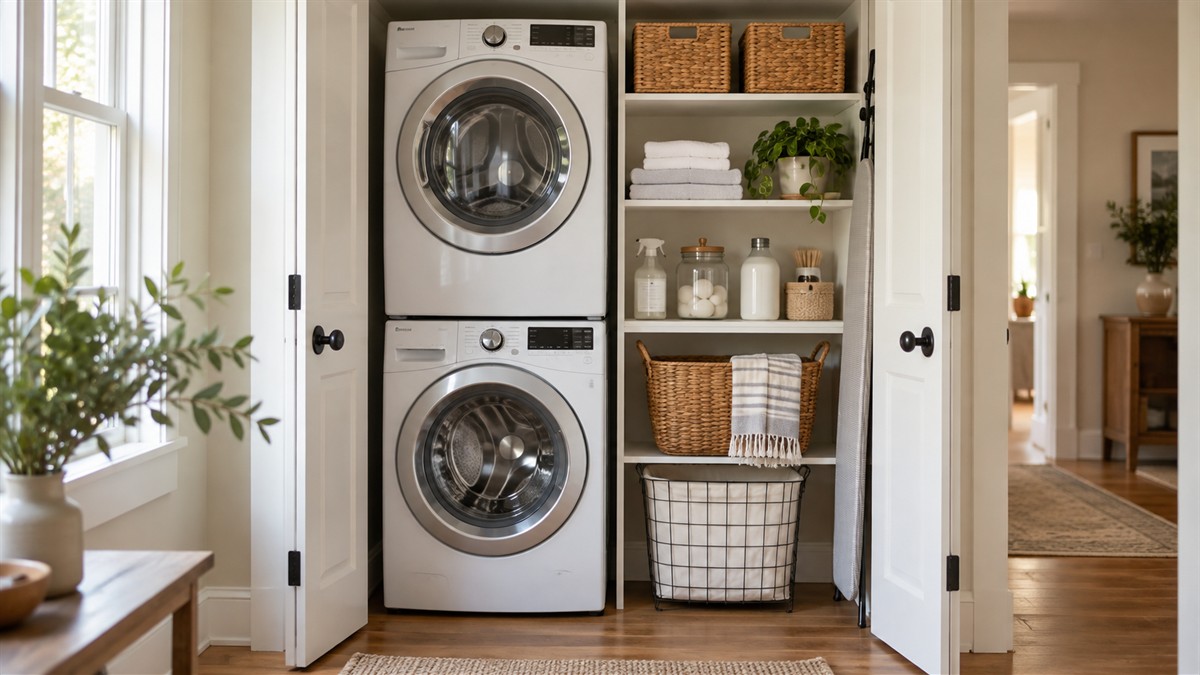
How to organize a laundry closet starts with what must stay clear, not with bins. Fire-safety guidance says to keep the dryer area free of things that can burn, and pediatric guidance says to keep laundry products out of sight and reach of children. Everything after that is layout: where the shelves go, how deep they are, and which supplies sit at reachable heights. This guide turns the pages we opened into six steps, a height map and a shelf-space calculation, and it marks what no page covers.
Quick answer
- Keep the dryer area clear of boxes, clothing and anything else that can burn, and leave a way to reach the lint filter and the vent behind the machine.
- Store detergent and other laundry products in their original containers, out of sight and reach of children and pets. The American Academy of Pediatrics says a high, locked cabinet is best and says not to store products on top of the washer or dryer.
- Shelves above the machines start at the height the appliance sheet gives. The LG sheet we opened gives 56 inches from the floor, which is above the 48 inch high reach used in accessibility standards, so keep daily items on the door or beside the machines.
- Pick shelf depth from the stock sizes the makers list: 12 and 16 inches at ClosetMaid, and 30 and 40 centimeters (11.8 and 15.7 inches) in the Elfa laundry guidance.
Step 1: Empty the closet and sort by job
Take everything out before you place a single shelf. A laundry closet collects more than detergent. An Elfa customer story about a laundry room of a couple of square meters lists seasonal items, cleaning and washing products, a medicine storage box and pet accessories sharing one space. Sorting by job, not by container, shows what actually belongs next to the machines.
The groups below are our own sorting scheme. The pages we opened do not prescribe one. The last column points to the step in this guide that decides where each group goes.
| Group | Typical contents | Used | Placement decided in |
|---|---|---|---|
| Wash products | Detergent, stain treatments, fabric softener, bleach | Every load | Step 3 |
| Dryer extras | Dryer sheets, lint brush | Every load | Step 2 and Step 4 |
| Folding and hanging | Hangers, drying rack, laundry baskets | Every load | Step 5 and Step 6 |
| Cleaning supplies | Mop, duster, spray bottles | Weekly | Step 3 and Step 4 |
| Seldom used | Seasonal items, spare supplies | A few times a year | Step 4 |
Count each group and measure the largest item in it. You will need the tallest bottle and the widest basket in Step 5, when shelf depth and spacing come up. Decide what does not belong in a closet with a dryer, a call the sources leave to you.
Step 2: Keep the machine zone clear
Start with the dryer, because the safety guidance is firmest there. A fire-safety sheet from the National Fire Protection Association, hosted by the U.S. Department of Energy, says the leading cause of home clothes dryer and washer fires is failure to clean them. It tells owners to keep the dryer area clear of “things that can burn, such as boxes or clothing.” The same sheet says to clean the lint filter before or after each use and to clean lint out of the vent pipe once a year, or more often if clothes take longer than normal to dry.
A U.S. Fire Administration flyer adds two points that matter to a closet layout. It says to “clean the back of the dryer” where lint can build up, and to check that the venting system behind the dryer is “not damaged, crushed or restricted.” The NKBA planning guidelines say the vent and lint trap should be “accessible for periodic cleaning and maintenance.” Our reading of these three pages is practical: do not wedge boxes or shelving uprights behind or beside the dryer so tightly that you cannot reach the back panel and the duct.
A closet door raises one more question. The Maytag dimension guide we opened says that if a closet door or louvered door is installed, “top and bottom air openings” in the door are required. Our reading is that anything hung on the inside of such a door should leave those openings uncovered. The guide does not say what to store on the door.
Side and rear spacing differs by maker. The LG installation sheet we opened gives minimum clearances of at least 1 inch at the sides and 4 inches behind the unit, for water lines and airflow. The Maytag guide says its washer was tested for installation with 0 inches of side clearance, and it suggests adding 1 inch on all sides to reduce noise transfer. Both sheets point the reader to the walls, doors and moldings that add to the spacing. Take the numbers from the sheet that shipped with your machines, because the two we opened disagree.
Step 3: Put laundry products out of reach
Where the wash products go is a safety decision before it is a layout decision. The American Academy of Pediatrics page on laundry room safety tells families to keep laundry products “in their original containers with the original label on them” and to close them tightly. It says to put products away “out of sight and reach of children and pets,” and that “a high, locked cabinet is best.” It also says “do not store products on top of the washer and dryer” or in storage drawers under the machines, and that spray bottles belong up and away too.
The pediatric page explains why a shelf alone is not enough: “Young children move quickly and can often reach higher than you expect.” Poison Control gives the same direction in shorter form, telling readers to store laundry products out of sight and reach of children and to keep them in their original containers. It also warns against leaving bleach in a cup on the washer, calling that “an invitation to poisoning.” For single-load packets the pediatric page goes further and says families with children age 6 or younger who live in or visit the home should consider traditional detergent instead.
The Elfa laundry guidance points the other way on one point. It suggests using the back of the closet door for wire baskets, and says that “the door is often an unused storage option in the laundry room,” perfect for detergent and clothes pegs. A door basket sits at hand height. Where children or pets are in the home, the pediatric guidance should win. The Elfa page does not mention children, and the pediatric page does not mention door baskets. If you want the door for storage, give it the clothes pegs, hangers and similar items that are not laundry chemicals.
Practical sorting from these pages gives a short rule set:
- Keep every bottle and box in its original container with the label on it.
- Keep detergent, bleach and sprays out of sight and reach, in a locked or high cabinet if possible.
- Clear the washer and dryer tops of products, and do not use the drawers under the machines for them.
- If the closet has a door that can be locked, lock it when you leave, since the pediatric page tells readers to lock the laundry room door.
Step 4: Map the heights
Once the hazards are placed, assign the rest by reach. Two sources give a reach band for laundry storage, and they disagree on how much of the storage must be in it. The UD Project, a residential universal-design specification, says at least 75 percent of laundry storage should sit between 18 and 48 inches from the floor, under the heading “Everything within reach.” The North Dakota Community Housing and Grants Management Division publishes Universal Design Standards for projects, and its laundry-area rule uses the same band with a 20 percent minimum. Both are accessibility specifications, not rules for a private closet. The Access Board’s ADA standards use a related range: a high forward reach of 48 inches and a low forward reach of 15 inches.
The band has a consequence for a closet that houses the machines. The machines fill the lower part, and the LG sheet we opened gives 56 inches as the minimum vertical space from the floor to overhead shelves, cabinets or ceilings. That puts the lowest overhead shelf 8 inches above the 48 inch reach limit, since 56 − 48 = 8. The pages do not give a model-independent number, and the Maytag guide lists a height with the lid open of about 55¾ to 56⅜ inches, which is close. So the overhead shelves of a closet with machines in it sit outside the reach band, by arithmetic.
| Height from floor | What the sources say about it | Suggested use (our own) |
|---|---|---|
| Below 15 inches | Under the ADA low forward reach of 15 inches | Items you rarely handle |
| 15 to 48 inches | ADA reach range; 18 to 48 inches is the band in the UD Project and North Dakota standards | Daily items. In a closet full of machines this band is mostly machine, so use the door, a side shelf or a nearby cart |
| 48 to 56 inches | Above the high reach; the LG sheet we opened uses this height for the open lid | Open lid space on a top-loader, by our reading of the 56 inch figure |
| 56 inches and up | Overhead shelves in the LG sheet | Seldom-used items, as the Elfa story does with its top shelf |
The Elfa customer story we opened keeps its seldom-used items on the top shelf, and says to “allocate a small shelf for extra supplies, just in case.” Our guide to top shelf closet storage covers what tends to go that high.
Step 5: Size the shelves
Shelf depth is the next choice. ClosetMaid’s installation guide says Shelf & Rod wardrobe shelving, used “in the closet or laundry room,” comes in 12 and 16 inch depths, and its Close Mesh shelving in 16 and 20 inches. The Elfa laundry page suggests wire shelves in different depths, “30 and 40 cm,” with the shallower shelves for smaller items such as laundry detergent and the deeper shelves for larger boxes and towels. Converting with 1 centimeter = 0.3937 inch gives 11.8 and 15.7 inches.
The NKBA kitchen guidelines give a way to compare shelf options: shelf and drawer frontage is cabinet width in inches times the number of shelves times cabinet depth in feet. It was written for kitchens, and we borrow only the arithmetic. For a shelf 36 inches wide, which is our own example width, the table gives the frontage of one shelf and of three.
| Shelf depth | Source | Depth in feet | One shelf: 36 × 1 × depth | Three shelves |
|---|---|---|---|---|
| 11.8 inches | Elfa, 30 cm | 0.98 | 35.4 | 106.2 |
| 12 inches | ClosetMaid | 1.00 | 36.0 | 108.0 |
| 15.7 inches | Elfa, 40 cm | 1.31 | 47.1 | 141.3 |
| 16 inches | ClosetMaid | 1.33 | 48.0 | 144.0 |
| 20 inches | ClosetMaid Close Mesh | 1.67 | 60.0 | 180.0 |
Moving from 12 to 16 inches adds 12 frontage units per shelf, or 33 percent, and the three-shelf total rises from 108 to 144. A deeper shelf also holds items farther from the front edge. The sources do not rank depths for a laundry closet, so match the depth to the largest item from Step 1.
Hardware instructions from ClosetMaid cover the rest of a wire shelf. Standards should be spaced no more than 24 inches apart and no more than 4 inches from the end of a shelf. Bracket size should match shelf depth, except Shelf & Rod shelving, which always takes 12 inch brackets. The guide adds that “stud installation is recommended whenever possible” for the strongest installation. The Elfa product page for its laundry unit states a maximum load per section of 200 kilograms for the click-in system, asks owners to spread the weight evenly, and says to check the wall material and condition before installation. Our guide to the ClosetMaid wire shelf weight limit goes further into the load question.
Step 6: Use the door, the side wall and a rail
Items that are used on every load but are not chemicals suit the door and the walls. Elfa’s page lists wire baskets on the door, a storage rail with small drawer boxes and hooks for clothes pegs and scrubbing brushes, mesh baskets for shallow spaces and doors, and fold-down drying shelves. Its ready laundry solution is listed at 1248 by 625 by 988 millimeters (49.1 by 24.6 by 38.9 inches by dividing by 25.4) and described as “perfect to place above the washing machine.” Mounting hardware is not included. IKEA’s laundry guide lists a BOAXEL drying rack at 23⅝ or 31½ inches wide and 15¾ inches deep, with matching clothes rails, and ENHET wall frames with shelves that are 6 or 12 inches deep.
For a hanging bar and shelf on legs, see our guide to a laundry sorter with a hanging bar and shelf. For rods and general closet hanging, see our guide to the rod to hang clothes in a closet.
Keep it organized
A closet drifts back to clutter unless the routine is short. Pull from the safety sheets: clean the lint filter before or after each load and the area behind the dryer on a schedule. Labels help too. The Elfa customer story chose wooden boxes with labels on the shelves for a calm look, and an open system so you can see where things are. If more than one person uses the closet, post the one rule that matters most, which is that laundry products go back to the locked or high place after each load.
How we chose
We read the pages listed below on 2026-10-21: a National Fire Protection Association sheet hosted by the Department of Energy, a U.S. Fire Administration flyer, the NKBA planning guidelines, a pediatric safety page, a Poison Control article, the ClosetMaid installation guide, two Elfa pages, an IKEA laundry guide, two appliance installation documents, the UD Project laundry chapter, a North Dakota housing standard and the ADA text. We kept the statements each page makes in plain words and quoted only those we checked against the page text. Safety statements come from the fire and pediatric pages. Shelf sizes come from the makers’ own pages. The tables use our own arithmetic, and the 36 inch width is our own example.
What we could not verify: what the sources do not say
The pages we opened give no organizing plan written for a laundry closet. A South Dakota State University Extension page on laundry room design could not be opened, and no university extension publication on laundry closets was among the pages we could read. The sources do not say how much of a closet’s storage should go to each group, how deep a shelf should be for detergent bottles or baskets, or how high a shelf must sit above a given washer, because that depends on the model. The two appliance documents disagree on side clearance. The reach-band figures come from accessibility documents for covered housing and for public buildings, and they do not apply to a private closet by law. Nothing here is a product claim.
Frequently asked questions
What should go in a laundry closet?
The pages we opened mention wash products, cleaning supplies, seasonal items and pet accessories sharing small laundry spaces. Keep boxes, clothing and other things that can burn away from the dryer, and store laundry chemicals in their original containers, out of reach.
Where should I store laundry detergent?
The American Academy of Pediatrics says to keep it out of sight and reach of children and pets, with a high, locked cabinet as the best option. It says not to keep products on top of the washer or dryer or in drawers beneath the machines.
How high should shelves be above a washer and dryer?
The appliance sheet decides. The LG installation sheet we opened gives a minimum of 56 inches from the floor to overhead shelves, cabinets or ceilings for that model. Check your own sheet, because the pages we opened do not give a model-independent figure.
How deep should laundry closet shelves be?
ClosetMaid lists wardrobe shelving for closets and laundry rooms at 12 and 16 inches deep. Elfa suggests depths such as 30 and 40 centimeters, which are 11.8 and 15.7 inches. Measure the largest basket or box first.
Can I store boxes next to the dryer?
The fire-safety sheet says to keep the dryer area clear of things that can burn, such as boxes or clothing. It also asks owners to keep the lint filter and the vent clean, which requires access to both.
Bottom line
Clear the dryer area, lock up the laundry chemicals, and put the reachable shelf space where the daily items are, using the appliance sheet to set the first overhead shelf.
Sources
- https://www.energy.gov/sites/prod/files/2016/06/f32/NFPA_DryerWasherSafetyTips.pdf (opened 2026-10-21)
- https://www.usfa.fema.gov/downloads/pdf/publications/clothes_dryer_fire_safety_flyer.pdf (opened 2026-10-21)
- https://kb.nkba.org/uploads/2023/05/2023-DC-Guidelines-1.pdf (opened 2026-10-21)
- https://www.healthychildren.org/English/safety-prevention/at-home/Pages/Laundry-Room-and-Detergent-Safety.aspx (opened 2026-10-21)
- https://www.poison.org/articles/laundry-products (opened 2026-10-21)
- https://homedepot.closetmaid.com/en-US/Installation/Pages/how-to-guides.aspx (opened 2026-10-21)
- https://elfa.com/en/inspiration/room/laundry-and-cleaning (opened 2026-10-21)
- https://elfa.com/en/elfa-stories/johanna-berglund-impossible-spaces (opened 2026-10-21)
- https://elfa.com/en-gb/products/classic-by-elfa/top-hang/ready-solutions/9800252laundrysolutionclassicwhiteopt2-rs (opened 2026-10-21)
- https://universaldesign.org/specifications/laundry (opened 2026-10-21)
- https://www.ndhousing.nd.gov/sites/default/files/documents/Plans/UniversalDesignStandards.pdf (opened 2026-10-21)
- https://media.nkba.org/uploads/2022/05/Kitchen-Planning-Guidelines.pdf (opened 2026-10-21)
- https://images.thdstatic.com/catalog/pdfImages/2a/2aa5113a-37a9-4d41-a594-ffa33bf7c1a3.pdf (opened 2026-10-21)
- https://images.thdstatic.com/catalog/pdfImages/0f/0f514b96-ddce-4687-9163-9b10685650b6.pdf (opened 2026-10-21)
- https://www.access-board.gov/ada/ (opened 2026-10-21)
Disclosure: As an Amazon Associate we earn from qualifying purchases.