Built-In Shelving Ideas for Living Rooms
As an Amazon Associate we earn from qualifying purchases. Details
Built-in shelving used to sit in dining rooms, basements, and other rooms that did not see much use. The Spruce notes that built-ins are now often found front and center in the living room. This guide covers the layouts and materials that designers show, what drives cost, how to think about capacity and mounting, and what to keep off the shelves. We have not built or tested any of these designs, and the two listings below are described from specs only. Read the cost section before you talk to a builder, since The Spruce, citing Angi, names size as the main cost driver.
Quick answer
Choose a wall that the room already centers on, such as the fireplace or the main window wall. Vary the shelf sizes instead of repeating one size, and mix materials such as wood and stone for texture. Keep a share of the built-in closed so clutter has somewhere to go. Get cost estimates that separate materials from labor, since size is the main driver of cost according to The Spruce, citing Angi. Anchor any floating or freestanding unit to the wall.
Products worth checking
These two products fit the living-room shelving ideas in this guide. Specs come from listing data we stored on 2026-10-11. We have not installed either one.
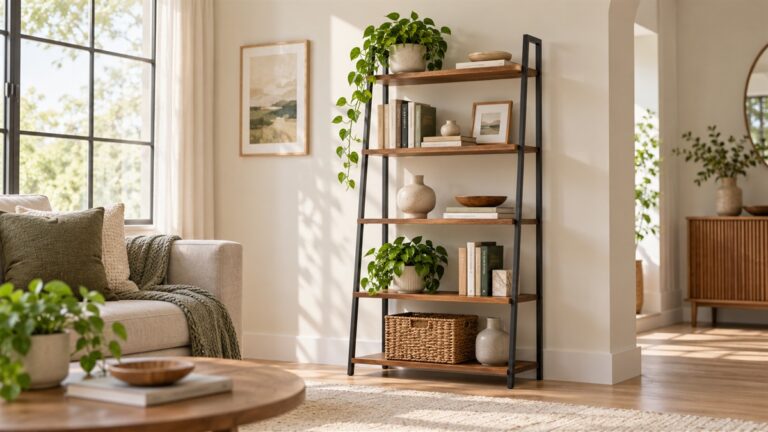
TVU 5-tier wooden bookshelf, 65 inches tall
Listing specs: 11.8 x 31.5 x 65.2 inches; 32 lb; walnut brown; freestanding; listed weight capacity 240 lb; assembly required; installation kit and hardware included.
Who it suits: a living room that needs freestanding storage now rather than a built-in. Anchor it to a stud. Not stated on the listing: whether the installation kit is an anti-tip anchor, and whether the 240 lb figure applies to the whole unit or to one shelf.
View on Amazon (affiliate link)
Harwaya 5-tier wall shelf unit (white and natural)
Listing specs: 8.6 x 11.8 x 32.7 inches; engineered wood with a metal frame; listed weight capacity 25 lb; wall mounted; screws and plastic anchors included; assembly manual included.
Who it suits: a narrow wall run beside a sofa or TV for light books and decor. Not stated on the listing: which wall types the anchors suit, or whether the unit can carry a full bookcase load.
View on Amazon (affiliate link)
Layouts that work
A full back-wall built-in in white
The Spruce describes customized built-ins that run across an entire back wall. The crisp white color keeps the room feeling refreshing rather than cramped.
Modern built-ins designed for entertaining
Marie Flanigan Interiors designed a living room with sleek, modern built-ins. The Spruce describes them as designed around entertaining.
A fireplace with wood floating shelves and deep blue cabinets
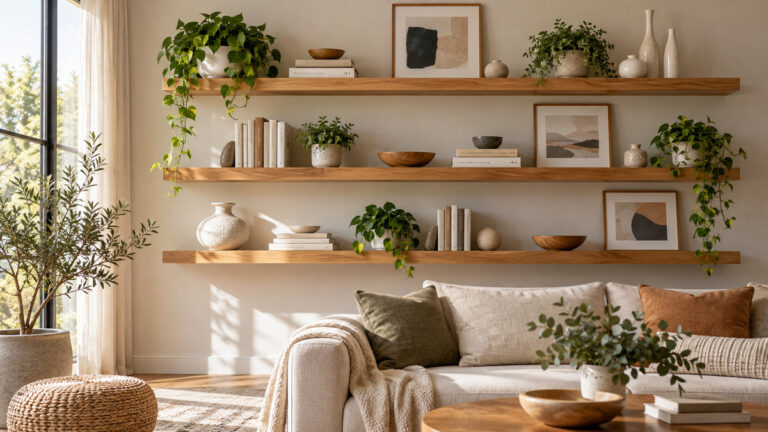
Ashley Montgomery Design paired a white-painted brick fireplace with wooden floating shelves and deep blue lower cabinets. The combination gives the room a modern look, with the closed storage placed in the lower cabinets.
Shelves in more than one size
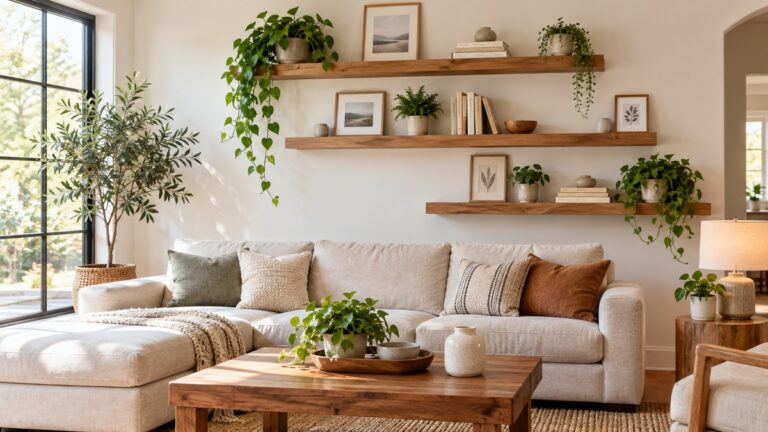
When people picture shelving, they often imagine the same size and style on every level. The Spruce notes that this does not have to be the case. A built-in with a range of sizes can suit different kinds of decor.
Mixed materials and finishes
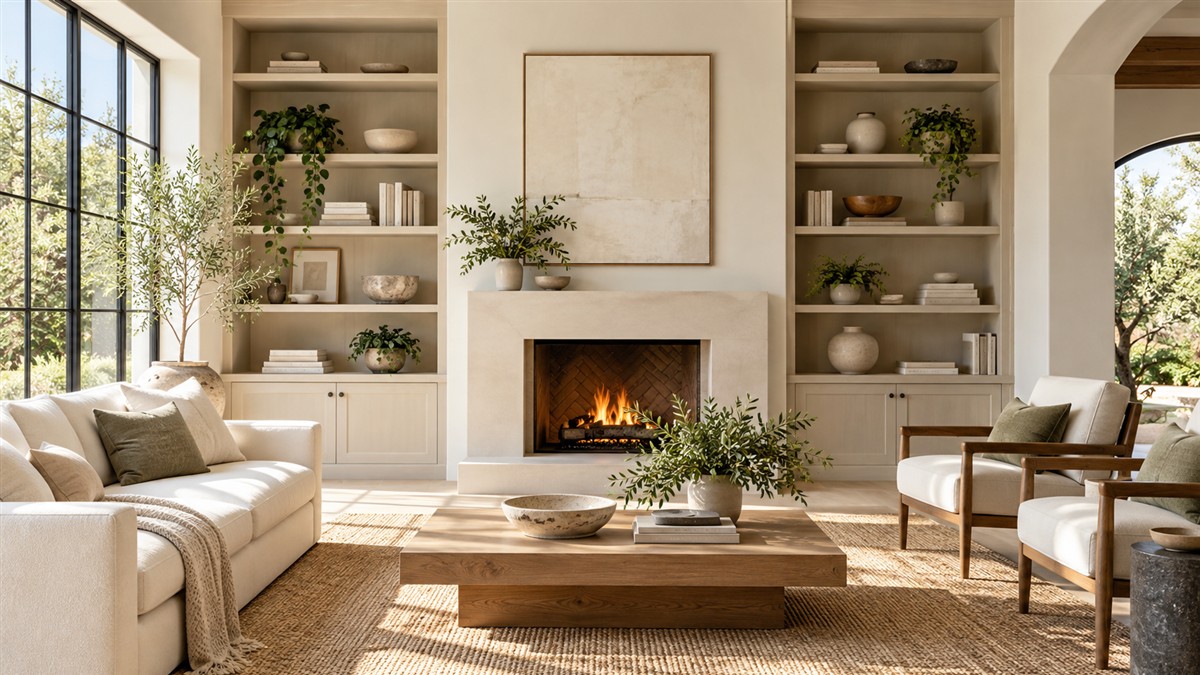
The Spruce advises mixing materials and finishes to add texture to living room built-ins. The Spruce’s list of living room built-in ideas includes mixing wood and stone.
What drives the cost
The Spruce says the final cost of built-in shelving depends on materials and on labor in your area. It cites Angi as saying the most important cost factor is the size of the built-ins, and custom built-ins cost more than standard units. Ask for quotes that show materials and labor separately.
Capacity, mounting, and anchors
The Spruce says the capacity of an individual shelf depends on its length, the type and thickness of the wood, and the kind of bracket used. This guide does not give a load figure for a built-in, because the number depends on those choices and on the wall. Read the manufacturer’s rating for any hardware you buy, and do not assume a generic bracket will carry a heavy load.
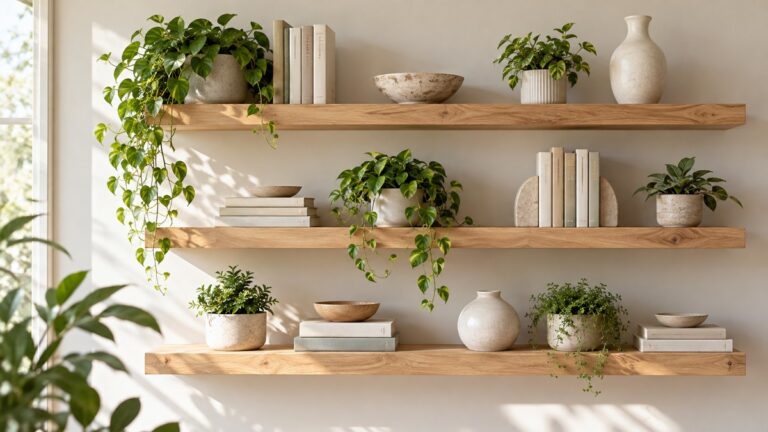
Floating shelves are mounted with anchors, and the anchor must suit the wall. The Spruce’s wall anchor guide describes plastic hollow wall plugs for light-duty jobs in drywall or plaster, which need a pilot hole. It describes hollow wall anchors, often called molly bolts, for medium-duty jobs such as light decorative shelves. Wing-style toggle bolts give heavier holding power in drywall and also need a pilot hole. Check whether the wall is drywall, plaster, or masonry before you choose anchors.
Anchor freestanding bookcases
A built-in is fixed to the wall, but a freestanding bookcase in the same room can tip. The U.S. Consumer Product Safety Commission says existing furniture can be anchored with inexpensive anti-tip brackets, and that new furniture should have its anti-tip devices installed right away. CPSC also advises removing tempting objects such as toys and remote controls from the top of furniture.
Keep the room clear
The Spruce quotes professional organizers on what they notice first in a messy living room. Their list includes a cluttered coffee table, a messy bookshelf, too many small pieces of furniture, a lack of closed storage, and items that do not belong in the room, such as tools or unpacked boxes from a move.
One organizer says a living room should contain a sofa and coffee table, a TV, and a bookshelf or basket for reading material. Plan your built-in around those basics first. Storage alone does not remove clutter, so the items themselves need to be sorted.
A layout checklist
- Wall. Measure the full width, and note where the windows, doors, and fireplace sit.
- Use. List what the shelves must hold: books, decor, the TV, or a mix.
- Open and closed. Decide how much of the unit will be closed storage, so that clutter has a place to go.
- Sizes. Plan a range of shelf heights and depths rather than one repeating size. The Spruce’s DIY shelving article gives 10 inches to 12 inches of depth and 24 inches to 36 inches of width as typical shelf sizes, a starting point before you fit the shelves to the wall.
- Cost. Ask for quotes that separate materials from labor, and ask how size changes the price.
- Mounting. Identify the wall type and choose anchors or fixings suited to it.
Sizing a 9-foot wall
This example shows only the arithmetic. For example, a wall 108 inches wide (9 ft) with three shelves 30 inches wide leaves 18 inches for the gaps and ends. Each shelf sits inside the 24 to 36 inch width range above, so the wall works on width. Check the anchors for the wall type before you mount anything.
Mistakes to avoid
- Filling every shelf with objects. Leave space, since the shelves will look cluttered if you do.
- Building the whole wall as open shelves with no closed storage, which leaves nowhere to hide the things that do not belong on display.
- Using a single shelf size on every level, when the sources show that a range of sizes suits decor better.
- Choosing a generic anchor for a heavy shelf. Use the manufacturer’s rating and the wall type.
Related guides
For floating shelves in a living room, read decorative floating wall shelves for a living room and small wall shelves for a living room. If you have a corner to fill, see floating corner shelves for a living room.
Sources
- 20 Beautiful Living Rooms With Built-In Shelving (The Spruce)
- Things pro organizers notice in messy living rooms (The Spruce)
- Wall anchor types and uses (The Spruce)
- Easy shelving hacks that will beautify your home (The Spruce)
- AnchorIt! campaign (U.S. Consumer Product Safety Commission)
Frequently asked questions
Do built-in shelves add cost to a project?
Yes. The Spruce says the cost depends on materials and labor in your area. It cites Angi as saying size is the most important cost factor, and custom built-ins cost more than standard units.
How much weight can a built-in shelf hold?
This guide does not give a load figure. The Spruce says capacity depends on the shelf’s length, the wood type and thickness, and the bracket. Check the manufacturer’s rating for the hardware you use.
What anchors work for floating living room shelves?
The Spruce’s anchor guide describes plastic hollow wall plugs for light-duty jobs in drywall or plaster, hollow wall anchors for medium-duty decorative shelves, and wing-style toggle bolts for heavier jobs in drywall. Plugs and toggles both need a pilot hole. Match the anchor to the wall type.
What belongs in a living room?
One professional organizer quoted by The Spruce says a living room should contain a sofa and coffee table, a TV, and a bookshelf or basket for reading material.
Should a freestanding bookcase be anchored?
The CPSC says existing furniture can be anchored with inexpensive anti-tip brackets, and that new furniture should have its anti-tip devices installed right away.
Conclusion
A built-in works when it fits the wall, uses a range of shelf sizes, and keeps some of its storage closed. Get cost quotes that separate materials from labor, check the wall type before you choose anchors, and anchor any freestanding piece in the room.