Bookshelf Cube Storage: Four Listings Compared
Disclosure: As an Amazon Associate we earn from qualifying purchases.
The person typing bookshelf cube storage wants a modular shelf made of open square or rectangular compartments that can hold books, bins and decor, and wants to know which listed options differ in size, material and stated capacity. Four products fit that need in the listings we read. The listings differ on cube size, frame material, stated weight limits and whether the unit is meant to be anchored, so the right choice depends on the figures each listing states. Read the sections on capacity and anchoring before you order, because a cube unit that is tall and light is the kind that can tip.
Quick answer
- For a cube unit that stays in one place, compare the stated cube size first. The listings we read range from about 11.8 inches to 15.9 inches per cube, and that sets which bins and books fit.
- Check the stated capacity. Two listings state a per-cube limit (11 pounds and 22 pounds), and one states a maximum of 60 pounds for the whole set. These figures are not directly comparable.
- Plan to anchor any unit taller than its base. The CPSC report we opened explains why a wall connection needs a stud, not a plain drywall anchor.
- Choose wire grid for an open look, plastic cubes for a closed look, and check the listing’s assembly notes before you buy.
What a bookshelf cube storage unit is for
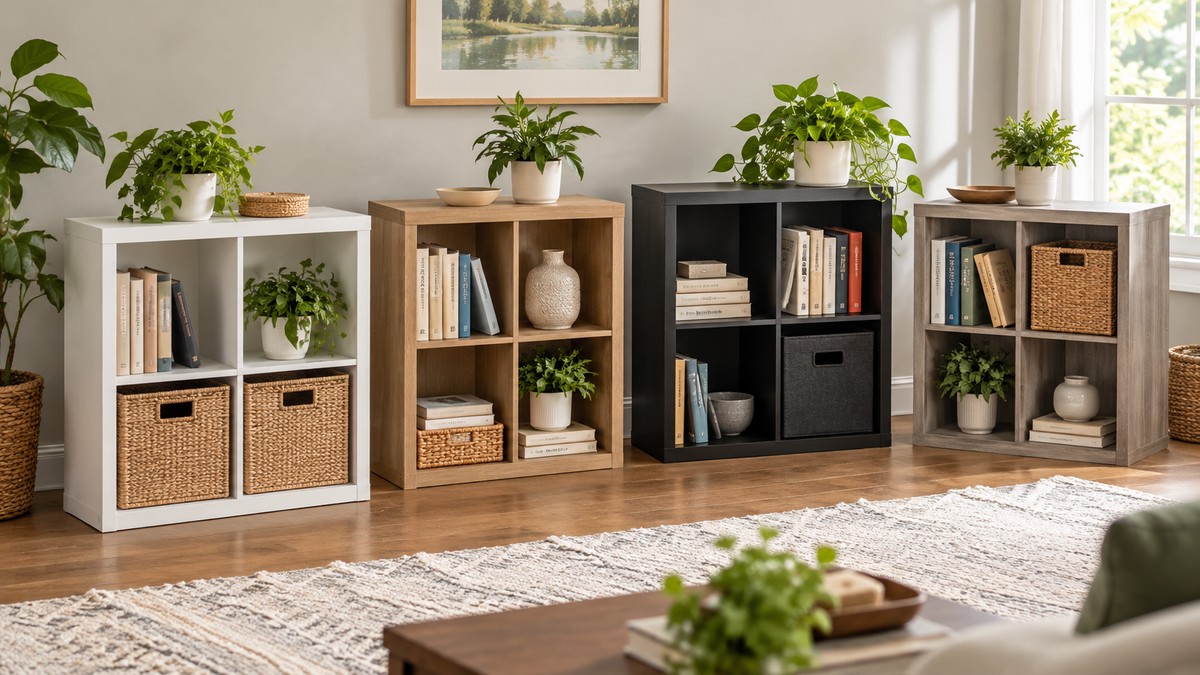
A cube unit is a grid of open compartments. Each cell takes a book, a basket, a stack of folded clothes or a few decorative pieces. Because the cells are open on the front, a cube unit suits a reader who wants to see the contents and reach them quickly. It also works in a room where a deep bookcase would take too much floor space. The grid shape means the same parts can be placed as a row, a stack or an L-shape, which is the main reason people choose this format over a fixed shelf.
The trade-off is that a cube unit has no solid back in most listings, so items at the back of a cell are visible from the front and dust can collect on them. Some cube units also have shelves that are only as deep as the cube, so a large hardcover may stand upright but not lie flat. Measure your heaviest and tallest items before you choose a cube size.
How we chose
We read the Amazon listings for four cube storage products on 2026-10-27 and opened each one’s product page. We began with a search for the keyword and took the non-sponsored results. Five candidates were opened. One of them, a freestanding tall open bookcase, was a different product type from a cube grid, so we dropped it from this comparison. The remaining four are shown below.
The criteria are simple: a cube format that is clearly a cube grid, a listing that states the cube size, a listing that states a material, and a listing that states some capacity or assembly information. We did not rank the four by quality, because the listings do not give us the data to do that. Each product is described in the words of its own listing.
What we could not verify
- We could not confirm the stated weight limits by a load test or any other independent test. The figures below are what each listing says, and we have not checked them.
- The listings do not state the same set of specifications. Where a listing is silent on a point, the table says “not stated”.
- One listing gives its weight limit per cube, another gives a maximum for the whole set, and a third gives a per-cube figure in a different unit. We have not converted these to a common number, because that would be an assumption.
- Listing data can change. Check the product page for the current figures before you buy.
Comparison table
Only the columns below are used. Where a listing does not state a figure, the cell says “not stated”.
| Product (ASIN) | Cube size (listing) | Overall size (listing) | Cube count | Frame / material (listing) | Stated weight limit (listing) | Tool-free set-up (listing) |
|---|---|---|---|---|---|---|
| Amazon Basics 6 Cube Wire Grid Storage Organizer (B0735GRJXY) | 14 x 14 x 14 in | not stated | 6 | Powder-coated steel wire, plastic connectors | Maximum 60 lb (whole set, per listing) | Yes, listing says no tools required |
| Mavivegue Bookcase, 18-Cube (B0BXXKJMZ7) | 15.87 x 12.36 x 11.97 in | 12 in D x 46.26 in W x 72.44 in H | 18 | Metal tubes, non-woven fabric panels, ABS plastic joints | not stated | not stated |
| C&AHOME 16 Cube Storage Organizer (B085ZG27N1) | 11.8 x 11.8 x 11.8 in | 12.4 in D x 48.4 in W x 48.4 in H | 16 | PP / ABS plastic, metal frame | 11 lb per cube (per listing) | not stated |
| C&AHOME 12-Cube Wire Storage (B07LDZXKQF) | 11.8 x 11.8 x 11.8 in | 36.6 in L x 12.4 in W x 48.4 in H | 12 | Metal wire panels, ABS plastic connectors | 22 lb per cube (per listing) | not stated |
Two points in this table need attention. First, the two C&AHOME listings state limits in the same unit but at different scales, so compare them only after you have read both listings in full. Second, the Mavivegue listing gives a mounting type of “Pole Mount”, which does not match its description of a freestanding cube set. Confirm this on the product page before you plan a mounting method.
Product notes: what each listing says
Amazon Basics 6 Cube Wire Grid Storage Organizer (B0735GRJXY)
The listing says: 6 cubes, each 14 x 14 x 14 inches, built from powder-coated steel wire with 26 plastic corner connectors and 23 grid panels. It says no tools are required for set-up, that the set weighs 15.9 pounds, and that it can be stacked vertically, side by side or horizontally. It states a maximum weight capacity of 60 pounds, and its category tags include “Dorm Room” and “Floor Mount”.
Skip if you need a closed back or doors. The listing describes an open wire grid.
Limitation: the listing does not say whether the 60-pound figure is for the whole set or for each cube. Read that figure as a total only if the product page confirms it.
Mavivegue Bookcase, 18-Cube (B0BXXKJMZ7)
The listing says: each cube is 15.87 x 12.36 x 11.97 inches, with an internal compartment of 15 x 11.5 x 10.4 inches. It says the set can be built as 12, 16, 18 or 20 cubes and comes in black, gray or white. The frame is described as metal tubes, the panels as non-woven fabric, and the joints as ABS plastic. The listing also says the hook on the side is for hats or umbrellas and advises against placing heavy loads on it. It gives an overall product size of 12 x 46.26 x 72.44 inches.
Skip if you need a stated weight limit, because the listing does not give one.
Limitation: the listing gives both “Pole Mount” as the mounting type and a freestanding description. We cannot tell from the listing alone how this set is meant to be fixed to a wall, so check the product page and the assembly instructions.
C&AHOME 16 Cube Storage Organizer (B085ZG27N1)
The listing says: 16 cubes, each 11.8 x 11.8 x 11.8 inches, in an overall size of 48.4 x 12.4 x 48.4 inches. It says the cubes are made of PP material with a metal frame and ABS connectors, and that each cube can carry a maximum of 11 pounds. It also says the cubes fit storage bins smaller than 11 x 11 inches and that a gift hook can hang keys, ties, hats or umbrellas. The listing says the unit is suited to bedrooms, closets, living rooms and offices.
Skip if your bins are larger than 11 inches square, because the listing says the cubes fit smaller bins.
Limitation: the 11-pound figure is per cube. The listing does not state a total limit for the unit.
C&AHOME 12-Cube Wire Storage (B07LDZXKQF)
The listing says: 12 cubes, each 11.8 x 11.8 x 11.8 inches (30 x 30 x 30 cm), in an overall size of 36.6 x 12.4 x 48.4 inches. It describes a metal wire grid with ABS plastic connectors and gives a maximum load of 22 pounds per cube. It says the panels can be arranged to build a pet fence and that the unit suits clothes, books, shoes, toys, bags and potted plants. The fits-bin figure is stated as smaller than 11.5 x 11.5 inches.
Skip if you need a closed, solid back, because the listing describes an open wire grid.
Limitation: the 22-pound figure is per cube. The listing does not give a total for the set, and does not say whether the cubes are meant to be anchored.
Anchoring and tip-over: what the CPSC report says
A cube unit that is taller than it is wide can tip, and the risk is highest when the unit is loaded at the top or when a child climbs on it. The CPSC report we opened, Preliminary Evaluation of Anchoring Furniture and Televisions Without Tools (TR-15/001, May 2015), describes these hazards in detail. It reports 363 fatalities involving televisions, furniture or appliances falling, and says 303 of those victims were children aged from 1 month to 10 years. Of the 363, 109 deaths (30 percent) were associated with furniture falling alone.
The report also explains why anchoring is harder than it looks. It says a furniture strap usually connects to the wall with a screw that has to go into a stud, because drywall cannot typically withstand the 50-pound pull force required by the voluntary standard it discusses. It adds that a wood screw is usually provided and must be installed in a stud. For that reason, a plain drywall anchor is not a substitute for finding a stud.
What this means for a cube unit in practice:
- Find a stud with a stud finder before you drill. If the wall is plaster or masonry, the stud or fixing method changes, so check the wall type first.
- Do not rely on a generic anchor for a stated load. None of the four listings gives a wall-fixing load, so no load can be promised for an anchor.
- Use the hardware the listing includes, and read the product’s own assembly notes. None of the four listings we read states an anti-tip kit, so check the product page for one before you assume it is in the box.
- Keep heavy items on the lower cubes, and avoid climbing on any cube unit.
The CPSC report does not address any of the four listed products specifically. It is the source for the general hazard and the anchoring method only. The report’s main point for a shopper is simple: a fixing that has no stated strength rating is not a fixing you can rely on, and the time spent finding a stud is small compared with the risk of a unit falling onto a child.
Buying checklist
- Measure the tallest and heaviest item you plan to store. Check it against the cube’s interior size, not the outside size.
- Write down the overall height and width of the space. The overall figures in the table are what the listings state; check them against your room.
- Decide between wire grid, which is open and see-through, and plastic cubes, which give a more closed look.
- Check the stated capacity. If it is per cube, add up the load you plan to place in each cell.
- Read the assembly notes. Only one listing states that no tools are required.
- Confirm the mounting method. If the listing says “Pole Mount” or “Freestanding”, match your plan to the product page.
- Locate a stud before you install anything tall.
Mistakes to avoid
- Assuming all cube sizes are the same. The four listings state cube sizes from 11.8 inches to 15.87 inches, so a bin that fits one may not fit another.
- Treating a per-cube limit as a total limit. Two of the four listings state per-cube figures, and the third states a total. Add up your load before you assume the unit can carry it.
- Using a plain drywall anchor. The CPSC report explains that drywall anchors are the weakest point in a typical furniture strap, so fix to a stud.
- Ignoring the mounting type. The Mavivegue listing gives a “Pole Mount” type that does not match its freestanding description. Settle this before you drill.
- Stacking items above the frame. Keep heavy items low; the listings do not describe a top-heavy load as safe.
FAQ
What is a bookshelf cube storage unit?
It is a grid of open compartments, usually built from wire or plastic, that can be used for books, bins and decor. The cells are open at the front, so the contents are visible.
How do I choose a cube size?
Measure the bins and books you plan to store, then compare them with the interior size each listing states. The listings in this comparison range from about 11.8 inches to 15.87 inches per cube, and the internal compartment sizes differ from the outside sizes.
Can a cube unit hold a heavy load?
The listings state limits in different ways. One gives 60 pounds for the set, two give per-cube limits of 11 and 22 pounds, and one does not state a figure. Use the limit for the unit you plan to buy, and do not add the per-cube figures together without checking the listing.
Do I need to anchor a cube unit?
If the unit is taller than its base, the CPSC report we opened describes the tip-over hazard and recommends a stud-fixed strap. The four listings do not describe a wall-fixing method for every product, so check the product page.
Can I use a plain drywall anchor?
The CPSC report says drywall anchors are the weakest part of a typical furniture strap, and that the usual fix is a screw into a stud. Use a stud for a tall unit. A generic anchor does not carry a stated load.
Are cube units good for children’s rooms?
The listings suggest use in dorm rooms, bedrooms and offices. Any tall unit in a child’s room should be anchored, because the CPSC report links most of its reported child victims to tip-over incidents.
Bottom line
Choose the cube size from the bins and books you plan to store, read the stated capacity as a per-cube or total figure, and anchor any tall unit to a stud. Check the mounting type on the product page, because the listings do not all describe the same fixing method.
Internal links
- Bookcase ideas for small rooms
- Choosing a bookshelf for a small room
- Floating shelves and the weight they can hold
- Wire shelf weight limits
- Free-standing wire shelves for the kitchen
- Five-tier metal shelving
- Five-shelf metal storage racks
- Small wall shelves for the living room
- Six-shelf bookcase
- Five-tier ladder bookshelf
Sources
- Amazon product listings: B0735GRJXY, B0BXXKJMZ7, B085ZG27N1, B07LDZXKQF. Read 2026-10-27 in the owner’s Chrome. Listing data only; prices, ratings and rank were not recorded.
- U.S. Consumer Product Safety Commission, Preliminary Evaluation of Anchoring Furniture and Televisions Without Tools, CPSC/EXHR/TR-15/001, May 2015. https://www.cpsc.gov/s3fs-public/pdfs/Tipover-Prevention-Project-Anchors-without-Tools.pdf (opened 2026-10-27).
As an Amazon Associate, this site earns from qualifying purchases. Product details come from the listings named above and may change.