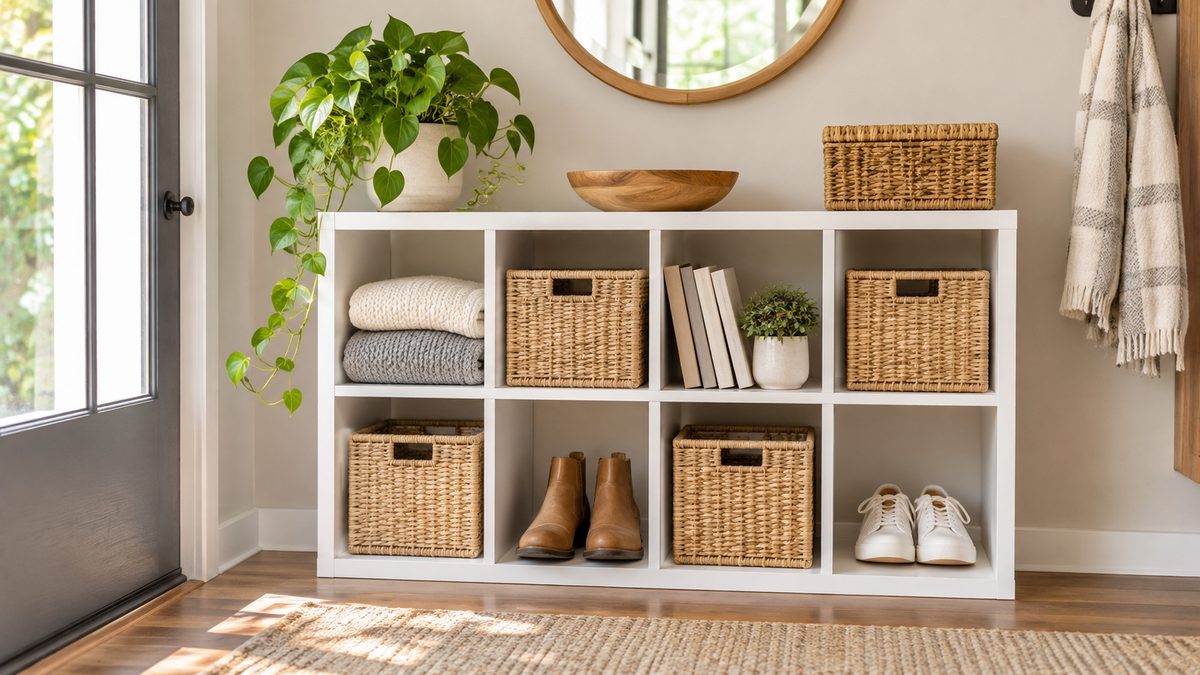
cubbie-storage
Disclosure: As an Amazon Associate we earn from qualifying purchases. This page links to Amazon product listings.
Cubbie Storage: Two Listings Compared by Size and Load
The person typing cubbie storage wants an open, compartment-style unit that holds clothes, bins, shoes or toys in separate square openings, usually standing on the floor in a closet, bedroom or dorm room. This guide compares two cubby organizers that Amazon lists for that use. The first is a 16-cube plastic unit with a stated size of 48 inches wide and 49 inches tall. The second is a 6-cube wire grid that stacks and rests on the floor, with a stated load of 10 pounds per cube. Neither listing says whether it can be anchored to a wall, so the wall-fixing advice comes from a federal safety source.
Quick answer
- For a closet or a kid’s room with clothes or bins, the 16-cube plastic unit gives more openings in one footprint. Its listing states 22 pounds per cube and 350 pounds total.
- For a stackable, lighter set you can rearrange, the 6-cube wire grid is the one to check first. Its listing states 10 pounds per cube and 60 pounds total, and it needs no tools.
- Neither listing says it includes anti-tip hardware. A tall unit in a room where a child climbs should be fixed to the wall before anyone loads or climbs it.
- Measure your bins before you buy. The 16-cube listing gives two different bin sizes in different places.
What counts as cubbie storage in this guide
In a store listing, the words cubbie, cubby and cube are used for the same thing: a shelf unit built from open square or rectangular compartments. Some sellers use “cubby” for a closet organizer and “cube” for a bookcase. This guide keeps only the products whose listing describes the unit as a cubby or cube organizer for storing clothes, bins, toys or shoes in open compartments. Units with doors, fabric drawers or a solid back were left out of the comparison, because the listing describes a different use.
The first question is the opening size. A cubby is only useful if the item you plan to store fits through the opening. Both listings give a cube size, and the two figures are close, so check your own bin against each one. The second question is how much the unit is expected to hold, and that is the one number this guide treats with the most care.
Product one: 16-cube plastic cubby organizer (ASIN B0B8DTX8T3)
The listing for the Neprock 16 Cubby Storage Organizer was opened in Chrome on 2026-10-29. The title on the page matches the ASIN in the link. The listing describes a 16-cube unit with a polypropylene body, a floor mount and a cubby shelf type. It lists the room types as bathroom, bedroom, cloakroom, closet and dorm room. The product dimensions are 12 inches deep, 48 inches wide and 49 inches tall. Each cube is stated at 11.8 inches on each side.
What the listing says about load: each cube holds up to 22 pounds, and the unit has a total of 350 pounds. The listing does not say whether the total assumes the cubes are full, or whether the 22 pounds applies to a cube that is loaded from the top or from the front. Treat the 22-pound figure as the one the seller states, not as a guarantee for every cube at once.
The listing says the unit is assembled with a plastic hammer and no screws or glue. The package list gives 56 panels, 44 feet connectors, 14 standard connectors, one hammer, one hook, 30 zip ties and one instruction manual. The count of connectors matters, because a missing connector changes whether the panels lock. The listing also says the plastic panels are waterproof and can be wiped clean, and that raised legs lift the unit off the floor. Those points are useful for a bathroom or a basement, but the listing does not say the unit is rated for a damp room.
The listing gives two different bin sizes. One line says the regular size fits storage bins smaller than 11.5 by 11.5 inches. A bullet point says the cubes are designed for standard 11-by-11-by-11-inch bins. If you own 11-inch bins, both statements point the same way, but a bin slightly larger than 11.5 inches will not fit. Measure the bin and the opening before you buy.
Product two: 6-cube wire grid organizer (ASIN B0735GRJXY)
The Amazon Basics 6 Cube Wire Grid Storage Organizer was opened in Chrome on 2026-10-29. Its page title and ASIN agree with the link. The listing describes a black, six-cube unit made of steel wire and plastic. It is a floor mount with a wire mesh shelving unit type. The stated dimensions are 14 inches deep, 14 inches wide and 14 inches tall, and each cube is listed as 14 by 14 by 14 inches. The set weighs 15.9 pounds.
What the listing says about load: 10 pounds per cube and 60 pounds total. The listing does not say how the total is measured, or whether the figure applies when the units are stacked more than one high. A unit stacked on another unit adds its own weight to the one below it, so the lower unit should be checked against the full stack, not one cube.
The listing says assembly needs no tools. The set includes 26 plastic corner connectors and 23 grid panels. It can be stacked vertically, placed side by side or set horizontally. The listing does not say whether the cubes can be used outdoors or whether a cover is included. Reviewers on the page describe using zip ties to add stability; that is reviewer opinion, so this guide does not treat it as a fact about the product. If you plan to load the unit near the top or to stack it, the zip-tie step is a practical choice the listing does not require.
The wire grid suits a storage spot where you want to see what is inside and move the unit later. It is a poor match for very small items that could fall through a 14-inch grid. The listing does not give an opening size for the grid, so check the spacing against the items you plan to store.
Comparison of the two listings
| Item | 16-cube plastic (B0B8DTX8T3) | 6-cube wire grid (B0735GRJXY) |
|---|---|---|
| Number of cubes | 16 (listing says 16 shelves) | 6 |
| Stated size | 12 in D x 48 in W x 49 in H | 14 in D x 14 in W x 14 in H per cube |
| Cube opening (stated) | 11.8 in per side | 14 in per side |
| Stated load per cube | Up to 22 lb | 10 lb |
| Stated total load | 350 lb | 60 lb |
| Material | Polypropylene | Steel wire and plastic |
| Tools needed | Included plastic hammer; no screws listed | None stated |
| Set weight | Not stated | 15.9 lb |
| Anti-tip hardware | Not stated | Not stated |
| Wall anchoring kit | Not stated | Not stated |
| Outdoor use | Not stated (listing says waterproof panels) | Not stated |
The table includes only the figures each listing states. Where a listing is silent, the cell says so. Both listings were opened on 2026-10-29, and the figures may change if the seller updates the page.
Load and wall fixing
Floor cubby units are not the same as a wall shelf, but a tall, open unit can still tip. The U.S. Consumer Product Safety Commission runs the AnchorIt.gov program on furniture tip-overs. Its page advises that top-heavy furniture should be secured, and it says that “existing furniture can be anchored with inexpensive anti-tip brackets.” The same page says to follow the manufacturer’s instructions when anchoring. Both listings in this guide are unit types that can rise above a child’s reach, so a fixing step is worth taking when the unit is taller than the child or stands in a room where children climb.
Neither listing says an anchoring kit is included. If you add an anti-tip bracket, fix it into a stud or a rated anchor, and choose the hardware for your wall type. A drywall anchor rated for light picture frames is not a tip restraint. The listings do not state a load for wall fixing, so the figures above are the only load figures this guide can cite, and they are not a rating for a wall mount.
The stated weight limit is per cube for both products. A full cube of heavy items, such as books, is more than a folded shirt. Keep the heaviest items on the lowest cubes, and check the per-cube figure against what you plan to store, not against the total.
How we chose
We searched Amazon for “cubbie storage” on 2026-10-29 and read the results page in Chrome. The results were mostly cube organizers and some cubby bookcases. From those results, we opened two listings whose titles or descriptions use the word cubby or cubbie and that describe an open-compartment unit for clothes, bins, books or toys. We confirmed that the ASIN in each link matched the title on the product page. We did not choose either product based on price, rating, number of reviews or badges. Those were left out of this guide on purpose.
We did not include products with doors, drawers or fabric bins as the main unit, because those units are described for a different use. The results list contains many more cube organizers than this guide covers. A reader who needs a specific size should read the full results page and compare the stated figures on each listing.
What we could not verify
- Dimensions and loads here are the figures each listing states on 2026-10-29. They are not independent checks.
- The 16-cube listing gives two different bin sizes, and we cannot say which one the seller intends.
- Neither listing states whether the total load assumes full cubes, stacking or wall fixing.
- We could not confirm anti-tip or wall-anchor hardware in the box for either product.
- Reviewer comments about stability and zip ties were read on the page, but they are opinions and not specifications.
Mistakes to avoid
- Buying by the cube count alone. The 16-cube unit gives more openings, but each cube is stated at a 22-pound limit and the total is 350 pounds. A unit with fewer cubes can still suit a heavier load.
- Ignoring the bin size. The 16-cube listing gives two different bin sizes. Measure your bins first.
- Assuming a floor unit cannot tip. A tall open unit with items piled high can tip. Fix the top to the wall where children can reach it.
- Stacking the wire grid without checking the lower unit. A stack adds weight to the unit below, and the listing does not state a figure for stacked units.
Buying checklist
- Measure the bins you own and the space in the closet or room. Compare the bin size with the stated cube size on the listing.
- Add up the weight of the heaviest items you plan to store, and compare it with the stated per-cube and total load.
- Count the connectors and panels in the box against the package list on the listing before you start assembly.
- Decide whether the unit needs a wall anchor. If it is taller than a child, plan the fixing before loading the unit.
- Confirm that the product page you buy from matches the ASIN and the figures in this guide. Listings change.
Products covered
The two listings below are the ones this guide compares. Each link goes to the product page on Amazon.
- Neprock 16 Cubby Storage Organizer, closet clothes storage with 16 cubes: View on Amazon
- Amazon Basics 6 Cube Wire Grid Storage Organizer, black: View on Amazon
FAQ
What is cubbie storage?
It is an open shelf unit built from square or rectangular compartments. People use it for clothes, bins, shoes, toys and books. The name is used for the same kind of unit as cube storage.
How much weight does a cubby organizer hold?
The two listings in this guide state a per-cube load and a total. The 16-cube plastic unit lists 22 pounds per cube and 350 pounds total. The 6-cube wire grid lists 10 pounds per cube and 60 pounds total. Neither listing says how the total is measured.
Do cubby organizers need to be anchored to the wall?
Neither listing says anchoring is required. The CPSC AnchorIt.gov page advises securing top-heavy furniture, and says existing furniture can be anchored with inexpensive anti-tip brackets. Where a child can climb or reach the top, plan a fixing step.
Which cubby size fits a standard storage bin?
The 16-cube listing gives 11.8-inch cubes and says the cubes are designed for 11-inch bins, while another line says the regular size fits bins under 11.5 inches. The 6-cube wire grid lists 14-inch cubes. Measure your bin before you choose.
Can a cubby organizer be used in a closet?
The 16-cube listing names closet and cloakroom as room types, and the wire grid lists dorm room. Both are floor units. Check the depth of the closet against the 12-inch depth of the plastic unit or the 14-inch depth of the wire grid.
Is a cubby unit a good choice for a bathroom?
The 16-cube listing lists bathroom as a room type and says its plastic panels are waterproof and wipe clean. The listing does not state a moisture rating for the unit. Use the plastic panels in a bathroom only if the room is not wet all the time, and follow the listing’s cleaning instructions.
Bottom line
Choose the cubby unit by the item you will store and the wall you can fix it to, not by the cube count alone. The 16-cube plastic organizer gives more openings and a higher stated total load, but its bin size needs measuring. The 6-cube wire grid is lighter and needs no tools, but its stated load is lower. Neither listing states an anchoring kit, so plan the fixing before you load a tall unit.
Related guides
- Best DIY clothes storage ideas for small spaces
- Best small shoe rack for a closet floor
- Storage ideas for a house with no closets
- Floating shelves that can hold weight
- Chest of drawers for clothes storage
Sources
- Amazon.com product listing page for ASIN B0B8DTX8T3 (Neprock 16 Cubby Storage Organizer), opened 2026-10-29 in Chrome. Figures are as stated on that page on that date.
- Amazon.com product listing page for ASIN B0735GRJXY (Amazon Basics 6 Cube Wire Grid Storage Organizer), opened 2026-10-29 in Chrome. Figures reflect the page on that day.
- U.S. Consumer Product Safety Commission, “AnchorIt.gov,” https://www.cpsc.gov/Safety-Education/Safety-Education-Centers/AnchorItgov, opened 2026-10-29.


