How to Measure an Alcove for Shelves
Disclosure: As an Amazon Associate we earn from qualifying purchases.
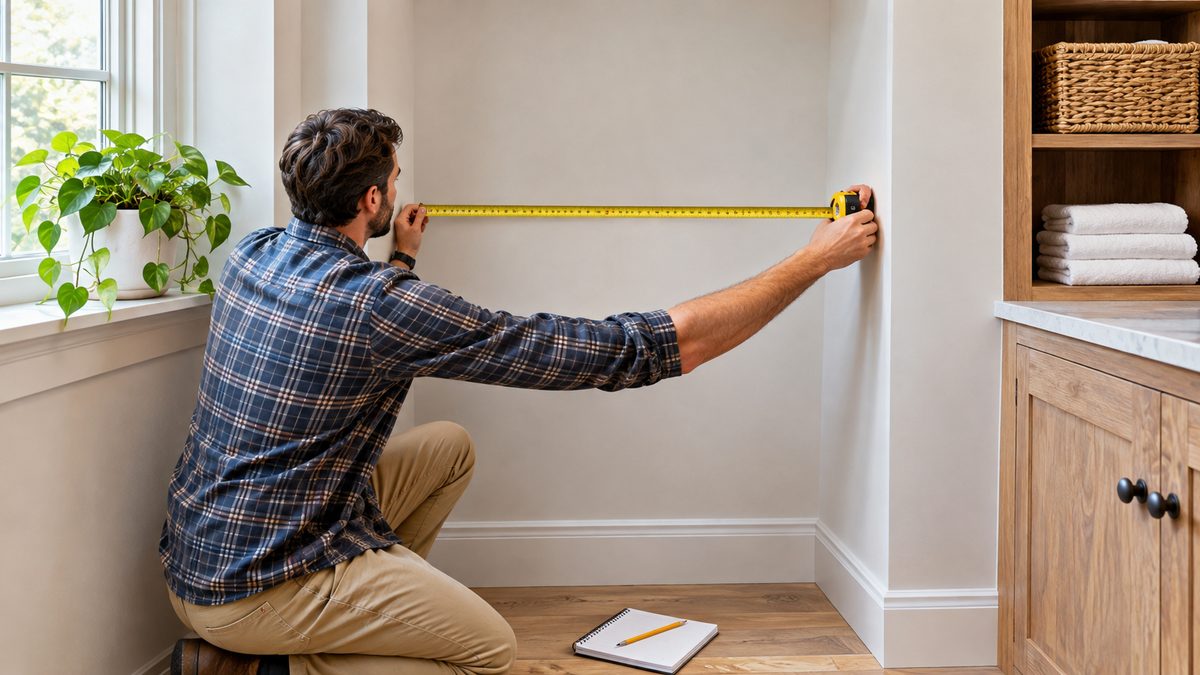
How to measure an alcove for shelves: record the width at more than one height, the depth from the back wall to the front edge, and the height to the highest point you want to use, then check how square the walls are. Alcoves are rarely perfect boxes, so the smallest reading usually sets the size limit for each shelf. This guide covers the measurements, the obstacles to subtract, and the wall checks that decide whether a shelf can be fixed safely.
Quick answer
- Measure the width at several heights and use the narrowest reading as the limit.
- Measure the depth from the back wall to the front edge, then match it to what you plan to store.
- Measure the height to the highest point you want, and subtract anything that blocks the shelf, such as a vent, a light fitting or a switch.
- Find the studs and mount into them, or use hardware rated for the load. The sources we opened do not give load figures for alcove shelves.
Plan the shelves before you measure
Start by deciding how many shelves you want and what each one has to hold. Bob Vila’s DIY guide to built-in shelving begins with the same step: assess the alcove, then decide how many shelves to add. The plan tells you which measurements matter most. A row of paperbacks needs a different depth from a row of binders, and a shelf that carries a heavy speaker needs a different mounting plan from one that holds picture frames.
Write the plan on paper as a simple list: shelf number, intended contents, and the spot on the wall where each shelf will sit. This list makes the later measurements easier to use, because each number has a job to do.
Measure the width at several heights
Alcove walls are often not parallel. A width taken near the top of the opening can differ from one taken near the bottom, and the difference matters if the shelf has to slide into the space. Take the width at the top, the middle and the bottom of the opening. Use the narrowest figure as the limit for that shelf, and leave a small gap for the shelf to slide in and out.
Keep in mind that the sources we opened do not give a number for the clearance a shelf needs on each side. If you are building in place, plan a gap that lets the piece slide in without forcing it, and check the fit with a dry run before you fix anything to the wall.
Measure the depth from the back wall
Depth is measured from the back wall of the alcove to the front edge of the opening. This is the number that decides which shelf depth will fit without the front overhanging the alcove edge. Bob Vila’s guide makes the point that each shelf can be cut to its own measurements, which is useful when the depth also varies from one side to the other.
Once you have the depth, compare it with the items you plan to store. Shallow items fit a shallow shelf, and deeper items need more depth front to back. A shelf that is too deep may stop the door or the edge of the alcove from clearing, so check both the shelf and the opening before cutting.
Measure the height and find the obstacles
Height is measured from the floor to the highest point you want the shelves to reach, or to the ceiling if the alcove runs that high. Note any feature that sits in the opening: a light fitting, an electrical outlet, a switch, a vent, a pipe or a trim strip. Each one can reduce the usable width or height, and each one should be measured on its own so you know where it starts and ends.
Use a pencil to mark the obstacles on the wall. A marked wall is easier to read than a list of numbers, and it helps you see whether a shelf will clear a switch plate or a light fitting before you drill anything.
Check whether the walls are square
Most alcoves are not perfectly square, and the Bob Vila guide says the same: walls can curve or be slightly out of square with the floor, which changes the space between two walls from the floor to the ceiling. A single measurement may therefore give a false picture of the opening. The guide suggests taking individual measurements for each shelf so each piece fits its own spot.
A level helps here. Use it to check that the floor is level across the opening and that the shelf marks run level from one wall to the other. If the top of the alcove sits lower on one side, mark the shelf positions from a reference line you have checked with the level, not from the top of the opening alone.
Find the studs before you choose hardware
The mounting method is part of the measurement job, because it decides where the shelf can sit. The Bob Vila guide shows the usual approach for alcove shelves: find the studs behind the drywall on the sides of the recess, mark them at the height of each shelf, and check the marks with a level. Then drill pilot holes through the support into the stud and fix the support with screws.
The CPSC staff report on anchoring furniture is useful background here. It describes a wood screw that must be installed in a stud, and it says drywall anchors are strongest when pulled at an angle parallel to the wall. In other words, a drywall anchor that works in one direction may fail in another, so a stud is the safer choice when the load is heavy. The report is a staff report and has not been reviewed or approved by the commission, so treat it as guidance rather than a rule.
The American Academy of Pediatrics, through HealthyChildren, makes a related point for furniture: the heavier the furniture, the more anchors you should use. Shelves in an alcove are not furniture in the same sense, but the principle carries over. A heavier load needs more fixing points, and each fixing point has to reach something solid.
Turn the measurements into a shelf size
Once you have the width at several heights, the depth, the height and the obstacles, write the smallest usable figure for each shelf. Subtract the clearance you want on each side, subtract any obstacle, and subtract a little for the gap that lets the piece slide in. The result is the largest shelf that will fit that spot. Cut or buy each shelf to its own figure rather than to one standard size, because the alcove may differ from top to bottom.
Some readers will want to buy ready-made shelves and fit them to the opening. That works only if the purchased shelf is measured against the narrowest reading, not against the wall at the front. Check the shelf’s listed dimensions against your own numbers before you order, and keep the measurements with the plan so you can compare them later.
Measurement checklist
| Measurement | Where to take it | What it decides |
|---|---|---|
| Width | Top, middle and bottom of the opening | The narrowest figure sets each shelf’s maximum width |
| Depth | Back wall to front edge | Shelf depth and whether the front clears the opening |
| Height | Floor to the highest shelf or ceiling | How many shelves fit and their spacing |
| Obstacles | Switches, outlets, lights, vents, pipes | Where a shelf can and cannot go |
| Square check | Level across the floor and the marks | Whether one shelf size fits the whole opening |
| Studs | On the side walls of the recess | Where each support can be fixed |
The table lists what to measure, not how much room to leave. The sources we opened do not give a clearance figure for alcove shelves, so set your own gaps and state them in your plan.
Mistakes to avoid
- Using one width measurement. The Bob Vila guide notes that walls can be out of square, so one reading can mislead you. Take the width at more than one height.
- Cutting shelves to a single standard size. The same guide recommends individual measurements for each shelf, because the discrepancies differ from place to place.
- Relying on drywall anchors alone. The CPSC staff report says a wood screw is usually provided and must be installed in a stud, and that anchors have limits under angled pulls.
- Skipping the obstacle check. A light fitting, switch or vent can take up space that the plain width reading does not show.
What we could not verify
The sources we opened do not give a number for alcove width tolerance, clearance on each side, the maximum load for a shelf in an alcove, or the spacing of wall studs in a particular house. The CPSC report covers anchoring of furniture and televisions, and the AAP page covers furniture tip-over prevention, so neither one gives alcove dimensions. The Bob Vila guide describes a built-in shelf project and does not give general measurement tolerances. Where a figure is needed for your wall, check the wall itself with a stud finder and the product’s own hardware notes.
How we chose
We limited the sources to pages that are not retailers or product listings. One came from a government agency (the CPSC staff report), one from a child-health organization (the AAP page), and one from an editorial DIY guide (Bob Vila), which the owner approved as the second source for this how-to. We left out product pages and shopping guides, because they do not explain how to measure a space. The criteria were plain: the page had to describe measuring, mounting or wall checks, and the quoted lines had to be present in the page text we opened.
How we checked
We opened three sources. The CPSC staff report “Preliminary Evaluation of Anchoring Furniture and Televisions Without Tools”, TR–15/001, May 2015, was opened on 2026-10-27. The AAP HealthyChildren page “Preventing Furniture and TV Tip-Overs” was opened on 2026-10-27. The Bob Vila guide “How to DIY Built-In Shelves Like a Pro” by Tony Carrick, updated July 27, 2021, was opened on 2026-10-27. We checked the quoted lines against the text of each page after removing the HTML tags. The Bob Vila page is an editorial DIY guide, so its advice is about one kind of built-in project, not a standard for every alcove.
FAQ
How many places should I measure an alcove width?
Measure the width at the top, middle and bottom of the opening, and use the narrowest reading. Walls can be out of square, so one reading can mislead you.
Should the shelf depth match the alcove depth?
Not always. Measure depth from the back wall to the front edge, then choose a shelf depth that suits what you store and still clears the opening.
Can I mount shelves into drywall without studs?
The CPSC staff report says drywall anchors are strongest when pulled parallel to the wall, and a wood screw must be installed in a stud. For heavy loads, mount into studs where you can.
Do I need a level when measuring an alcove?
Yes. Use a level to check the floor across the opening and to mark each shelf line, because a shelf that is not level will look wrong even if it fits.
What if my alcove has a switch or vent in it?
Measure the obstacle and subtract it from the usable width or height. Mark it on the wall so you can see whether a shelf will clear it before drilling.
What do the sources say about the load a shelf can carry?
The sources we opened do not give a load figure for alcove shelves. Check the hardware notes for any product you buy, and mount into studs for heavy items.
Bottom line
Use the narrowest measured width, the depth from the back wall, and the height to any obstacle, then size each shelf to its own spot. If a shelf will carry anything heavy, mount it into studs rather than relying on drywall anchors alone.
For the next step, see our guide to floating shelves that can hold weight, which covers the load questions that come after you have a size. If your alcove is a corner, our notes on floating corner shelves for a living room show how corner openings change the layout. For a narrow opening in a small room, see bookshelves for a small room, and for tight wall spaces in general, see shelves for a small room.
Sources
- CPSC, “Preliminary Evaluation of Anchoring Furniture and Televisions Without Tools”, staff report TR–15/001, May 2015. https://www.cpsc.gov/s3fs-public/pdfs/Tipover-Prevention-Project-Anchors-without-Tools.pdf (opened 2026-10-27)
- AAP HealthyChildren, “Preventing Furniture and TV Tip-Overs”. https://www.healthychildren.org/English/safety-prevention/at-home/Pages/Preventing-Furniture-and-TV-Tip-Overs.aspx (opened 2026-10-27)
- Bob Vila, “How to DIY Built-In Shelves Like a Pro”, by Tony Carrick. https://www.bobvila.com/articles/diy-built-in-shelves/ (opened 2026-10-27)