How to Store Shoes Properly
As an Amazon Associate we earn from qualifying purchases.
How to store shoes properly starts with letting them dry, then matching the storage to the shoe. Leather shoes want a dark, dry spot and a shoe tree, while sneakers and suede want a cool, dry place out of direct sun, and closets need enough airflow to keep mildew from taking hold. A Clarks care guide, extension pages on mildew and rest-day advice from Mississippi State, Penn State and Harvard Health point the same way. This guide sorts the rules by shoe type and turns the rest-day advice into a pair count.
Quick answer
- Let worn shoes dry before they go into the closet. A Florida cooperative extension page says to let sweaty shoes dry before putting them away.
- Match the storage to the shoe. Clarks describes different steps for leather, sneakers and suede.
- Rotate pairs. Harvard Health says shoes should have at least 24 hours to breathe between wears.
- Keep air moving in the closet. NDSU Extension says opening closet doors for air circulation limits mold growth.
Dry the shoes before anything else
Every storage rule depends on dry shoes. A Palm Beach County Cooperative Extension page on avoiding mildew says that perspiration, together with the composition of leather in shoes or belts, is food for mildew. Its instruction is short: “Let sweaty shoes dry before putting them away in your closet.” Texas Tech University Student Housing gives a matching rule for any wet footwear: “Do not leave wet or damp clothes, towels, or shoes in closets.” The same page says to set wet items out on drying racks until completely dry.
How you dry them matters as much as whether you do. Clarks’ care guide tells owners of leather shoes to leave them to dry naturally with newspaper inside to help soak up moisture, and says “Do not use any artificial heat source” because heat may ruin the leather. Its sneaker section gives the same warning, saying that artificial heat may ruin the upper. Alabama Extension, reproducing Mississippi State University Extension advice for flood recovery, adds that shoes should dry away from sun and heat and that stuffing them with paper helps them hold their shape.
The sources give no drying time. Harvard Health says shoes need longer than a day to breathe if they are wet, without naming a number. Clarks and Alabama Extension give no hours either. The practical test is yours to apply: shoes that feel cool and damp inside are not ready for a closed closet.
Match the storage to the shoe
The Clarks Australia care guide is the one source we opened that sorts storage by shoe type. The table sets out its three storage steps and adds what the other pages say that applies.
| Shoe type | Clarks storage step | What other pages add |
|---|---|---|
| Leather shoes | Keep in a dark, dry place in the original box, and use a shoe tree to maintain shape and size | Dry fully first; avoid artificial heat |
| Trainers and sneakers | Keep out of direct sunlight and store somewhere cool and dry | Rotate so they have time to breathe |
| Suede and nubuck | Keep out of direct sunlight to prevent color fading, and store somewhere cool and dry | Humidity matters; see the closet section |
For suede and nubuck, Clarks gives a reason as well as a rule: suede can become mouldy in humidity. For sandals and flip-flops, none of the Clarks steps apply, but a Penn State Hershey podiatric surgeon quoted in a Medical Minute article advises letting shoes air out after wear and alternating shoes every other day so they have dried. That article is about summer footwear, so it is a close fit for sandals rather than an exact one.
Original box or open shelf?
The Clarks guide recommends the original box for leather shoes, and a closed box gives the dark space that Clarks asks for. A box also limits airflow, and the mildew sources keep returning to airflow. Texas Tech’s housing guide says not to block airflow, in its case around heating and cooling units, and NDSU Extension says opening closet doors to permit air circulation limits the growth of molds.
The pages do not reconcile the two ideas, so the decision is yours. Our reading is that a box suits shoes that are clean, fully dry and stored in a dry room, and that an open shelf suits shoes you wear often or that may hold some moisture. If you use boxes, a lid that sits a little open is something we infer from the airflow advice, and no source says to do it.
Why rest days matter, and how many pairs they require
Three pages mention rotation, with different reasons. Mississippi State University Extension says to rotate walking shoes to give them “time to return to their original shape” between walks. Harvard Health Publishing says, in a question and answer about athlete’s foot fungus in shoes, to rotate footwear “so shoes have at least 24 hours to breathe” and to allow longer if they are wet. The Penn State article says to alternate shoes every other day to ensure they have dried.
These reasons are shape, breathing and drying, and they lead to the same schedule. If you wear shoes every day, the number of pairs you need equals one pair worn plus the number of days each pair must rest. The formula is our arithmetic, applied to the rest periods the sources give or imply.
| Scenario | Rest days per pair | Where the rest period comes from | Pairs needed: 1 worn + rest days |
|---|---|---|---|
| Dry shoes, minimum rest | 1 | Harvard Health: at least 24 hours | 1 + 1 = 2 |
| Alternate every other day | 1 | Penn State Hershey article | 1 + 1 = 2 |
| Shoes that got wet | 2 (our assumption) | Harvard Health says longer, no number | 1 + 2 = 3 |
The result is that two pairs suffice for dry shoes worn daily, and three give you a spare while one pair dries after rain. If you commute in the same pair and the weather is wet, the third pair earns its shelf space. A pair you wear only a few days a week rests on the other days by default.
Closet air: where mildew starts
Mold does not need much. NDSU Extension’s guide to molds in the home says molds grow on organic materials such as paper, leather, dirt and soap scum, and that they grow in moisture. It names high relative humidity, condensation and water leaks as situations that increase growth. The same publication says “Closets often have mold growth,” especially if clothing is stored damp or dirty or if the closet has a cool outside wall.
That list gives three checks for a shoe shelf. The shoes should be dry and clean before they go in. The shelf should not sit against a cool exterior wall, if you have a choice. The closet door should open often enough for air to move, because NDSU names open closet doors as a way to limit mold. None of the pages gives a humidity percentage for shoe storage, so there is no number to hit.
One more point from the Clarks guide connects here. It asks for a cool, dry place for sneakers and suede, which matches the mildew sources, and it ties suede’s risk to humidity. A closet that is cool but damp therefore fails the Clarks test, even though it passes a temperature check.
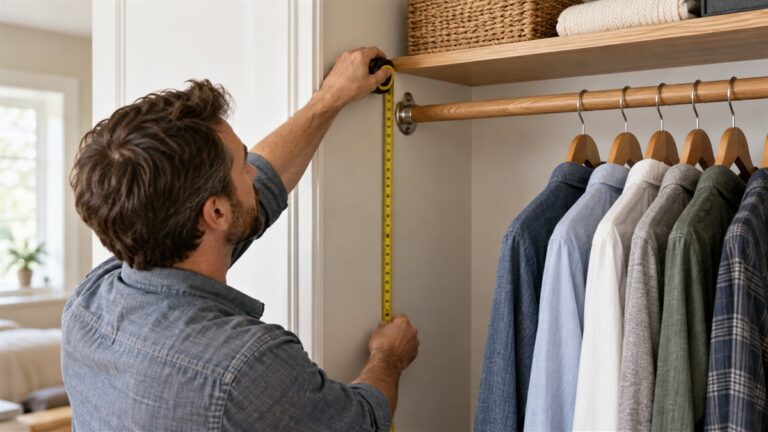
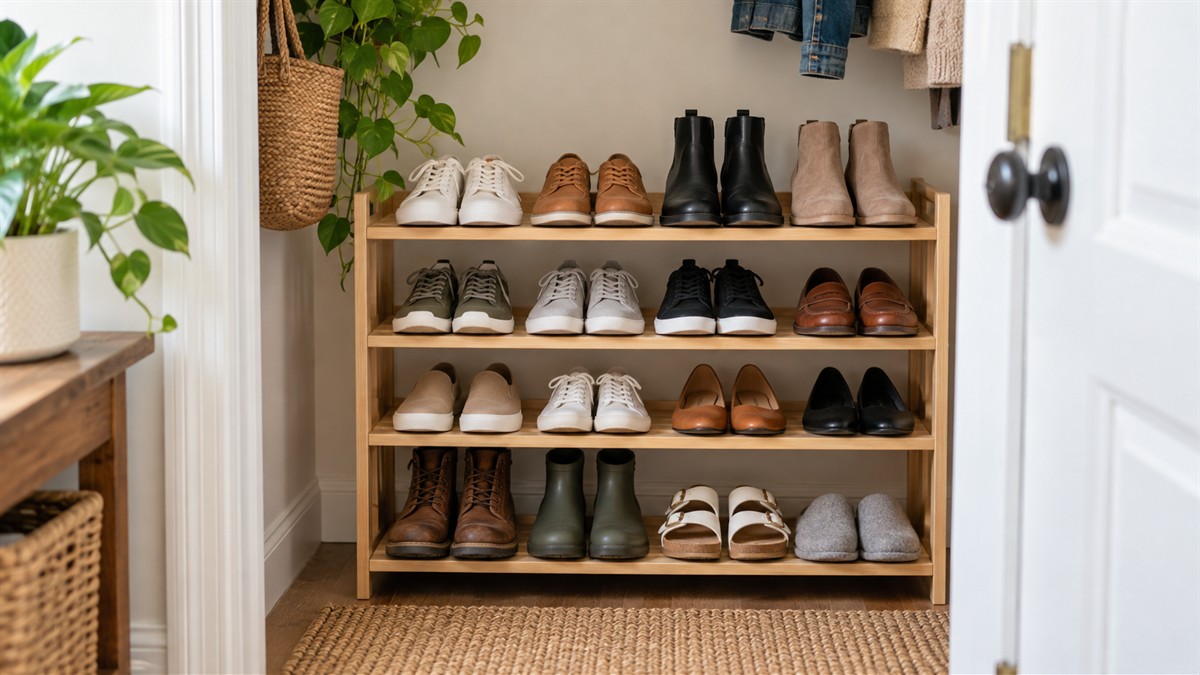
Plan the shelf with a width and height calculation
The sources give no shoe dimensions, so the numbers below are our own assumptions. Measure your own shoes before you rely on them. For each pair we add a 1-inch gap beside it and a 1-inch gap above it, in place of the airflow the sources ask for, since no source gives a distance. The shelf is assumed to be 36 inches wide.
| Pair type (our assumption) | Pair width (inches) | Pair height (inches) | Pairs on a 36-inch shelf | Clear height needed (inches) |
|---|---|---|---|---|
| Sneakers | 10 | 5 | 36 ÷ (10 + 1) = 3.27, so 3 | 5 + 1 = 6 |
| Dress shoes on trees | 9 | 5 | 36 ÷ (9 + 1) = 3.6, so 3 | 5 + 1 = 6 |
| Sandals | 8 | 3 | 36 ÷ (8 + 1) = 4.0, so 4 | 3 + 1 = 4 |
Now apply those figures to a collection of 8 pairs of sneakers, 6 pairs of dress shoes and 4 pairs of sandals, which is 18 pairs in all.
| Group | Pairs | Shelves needed | Clear height of those shelves (inches) |
|---|---|---|---|
| Sneakers | 8 | 8 ÷ 3 = 2.67, so 3 | 3 × 6 = 18 |
| Dress shoes | 6 | 6 ÷ 3 = 2 | 2 × 6 = 12 |
| Sandals | 4 | 4 ÷ 4 = 1 | 1 × 4 = 4 |
| Total | 18 | 3 + 2 + 1 = 6 | 18 + 12 + 4 = 34 |
Six shelf levels need at least 34 inches of clear height before you count shelf thickness. The sneakers need three shelves for eight pairs, because a third shelf holds only two of them, which leaves one slot spare. If two sneaker pairs are retired, the group fits two shelves and frees a whole shelf, which is a reason to cull before you buy shelving. These counts are for pairs you own, while the rotation table tells you how many pairs you need in daily use.
For shelf and closet options that fit shoes, see our guides to shoe storage for a small closet, ways to organize shoes in a small closet and ways to store shoes in small spaces. For floor and top-of-closet options, see a small shoe rack for the closet floor and a shoe organizer for the top of the closet.
A routine you can follow
- When you take the shoes off, check whether the inside is damp. If it is, stuff the shoes loosely with paper and let them dry away from sun and heat.
- Wait until they are fully dry before they go into a closet, as the Florida extension page and Texas Tech advise.
- Insert a shoe tree in leather shoes, which is the Clarks step for keeping shape and size.
- Store leather in a dark, dry place, and sneakers or suede somewhere cool, dry and out of direct sun.
- Keep a spare pair so each pair rests at least a day between wears.
- Open the closet door now and then, and keep shoes off a cool exterior wall if you can choose.
How we chose
This is a method guide, not a product list. We opened eight pages on 2026-10-21: the Clarks Australia shoe care guide, a Palm Beach County Cooperative Extension page, a Texas Tech University Student Housing page, an NDSU Extension publication on mold, a Mississippi State University Extension publication, a Harvard Health Publishing question and answer, a Penn State Hershey article and an Alabama Extension page. We kept only points that a page states in plain words, and we checked each quoted sentence against the page text. Allen Edmonds pages and a second Clarks page returned access errors when requested by script, so nothing here relies on them. The shelf and pair tables are our own arithmetic, and each input is labeled an assumption.
Mistakes to avoid
- Putting sweaty shoes straight into the closet. The Palm Beach County page and Texas Tech both say to dry them first.
- Drying shoes on a heater. Clarks says not to use any artificial heat source on leather or sneakers.
- Leaving suede in humid air. Clarks says suede can become mouldy in humidity.
- Wearing one pair every day. Harvard Health and Penn State both describe rotating pairs.
- Storing shoes in direct sun. Clarks says to keep sneakers and suede out of direct sunlight.
- Blocking the air in a closet. NDSU says closets often have mold growth, especially with damp or dirty items or a cool outside wall.
What we could not verify
The pages we opened do not give a humidity or temperature target for shoe storage, a drying time, or a distance to leave between pairs. They do not say whether a box should be closed or left ajar, whether shoes can be stacked, or how many pairs a shelf should hold. They do not name a shoe tree material. The Clarks guide is the Australian site and covers Clarks products, and the Harvard Health item is about athlete’s foot fungus, not shoe storage. The Penn State article dates from 2013, and the Alabama page is about flood recovery. Nothing here is a product claim or medical advice.
Frequently asked questions
Should I keep shoes in their original boxes?
Clarks recommends the original box for leather shoes, kept in a dark, dry place. The mildew pages stress airflow, so a box suits shoes that are clean and fully dry, and open storage suits shoes that may hold moisture.
How long should shoes rest between wears?
Harvard Health says at least 24 hours, and longer if the shoes are wet. Penn State describes alternating shoes every other day.
Are shoe trees worth using?
Clarks includes a shoe tree in its storage step for leather shoes to maintain shape and size. The pages we opened do not compare tree materials or give sizing advice.
Can I store shoes in a damp closet?
Not if you can avoid it. NDSU Extension says closets often have mold growth, and Clarks says suede can become mouldy in humidity.
How do I dry wet shoes before storing them?
Let them dry naturally with paper inside and without artificial heat, as Clarks describes. Alabama Extension adds that shoes should dry away from sun and heat.
Bottom line
Dry the shoes fully, store each type the way its care guide says, rest every pair for at least a day, and keep the closet air moving.
Sources
- https://clarks.com.au/pages/shoe-care-guide (opened 2026-10-21)
- https://discover.pbc.gov/coextension/FACS/Housing/Avoid-Mildew.aspx (opened 2026-10-21)
- https://www.depts.ttu.edu/housing/safety/moldprevention.php (opened 2026-10-21)
- https://www.ndsu.edu/agriculture/extension/publications/molds-your-home (opened 2026-10-21)
- https://extension.msstate.edu/publications/purchasing-pointers-for-walking-shoes (opened 2026-10-21)
- https://www.health.harvard.edu/immune-and-infectious-diseases/athletes-foot-fungus-in-shoes (opened 2026-10-21)
- https://www.psu.edu/news/hershey/story/medical-minute-summer-foot-fashion-doesnt-always-lead-foot-health (opened 2026-10-21)
- https://www.aces.edu/blog/topics/emergency-handbook-home-family/salvaging-clothing/ (opened 2026-10-21)
As an Amazon Associate we earn from qualifying purchases.