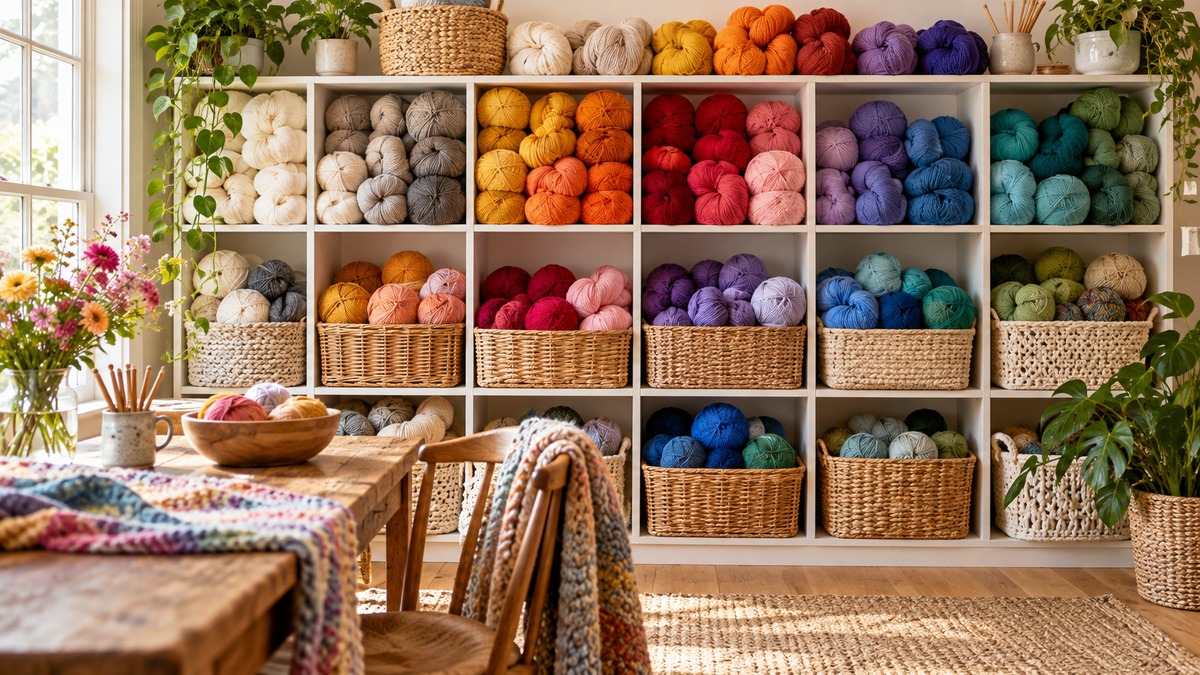
How to Store Yarn on Shelves
As an Amazon Associate we earn from qualifying purchases.
How to store yarn on shelves starts with the fiber, because the two threats to a yarn stash, moths and mildew, do not hit every fiber equally. Extension and museum guidance says wool and wool blends are the moth targets, cotton is the mildew target, and clean, dry, cool, ventilated storage protects both. This guide sorts a stash by fiber, compares the container options the sources offer, shows the shelf arithmetic with every assumption named, and says plainly where the pages we opened stop short of yarn.
Quick answer
- Sort by fiber first. Mississippi State Extension says clothes moths feed on wool, silk and other animal-based fibers, and attack blends of wool and synthetics.
- Store yarn clean and dry. The same Extension notes say soiled items are far more attractive to moths, and Kansas State says to dry damp textiles before storing them.
- Use a lidded bin or a cloth cover, not a loose bag. The sources disagree on plastic, so the container table below shows each position.
- Keep the shelf cool, dry and dark, and look inside the bins on a schedule.
Sort the stash by fiber
Fiber decides which risk is bigger. The Mississippi State Extension Bug-Wise newsletter says clothes moths and carpet beetles feed on items containing wool, mohair, fur, hair, silk, feathers and other keratin-based animal products. It says they do not feed on synthetic carpets, but “these pests will attack fabrics that are blends of wool and synthetics.” A later Mississippi State note says clothes moths rarely damage cotton or synthetics.
Mildew points the other way. The National Park Service Conserve O Gram on mold and mildew on textiles says all fibers can support microorganism growth, but natural fibers are more susceptible than synthetics. It says cellulosic fibers such as cotton and linen are the most vulnerable. Protein fibers such as wool and silk are less susceptible, though the same sheet says certain fungi feed on and damage them as well. The sheet dates from 1993, so treat it as a conservator’s baseline, not the latest research.
| Fiber group | Moth and beetle risk (Mississippi State) | Mold and mildew risk (NPS Conserve O Gram 16/1) | Storage lean |
|---|---|---|---|
| Wool, mohair, silk | Feeds on them | Less susceptible than cellulosics, but not immune | Bug-tight lidded bins |
| Wool and synthetic blends | Attacked | Natural share is susceptible | Treat as wool |
| Cotton, linen | Rarely damaged | Most vulnerable | Ventilation and humidity control first |
| Acrylic and other synthetics | Rarely damaged | Less susceptible than natural fibers | Dust control and light protection |
The last column is our reading of the two sources, not a rule either page states. It gives you a way to split a mixed stash into groups that need different bins.
Count the bins
Counting turns the sort into a shopping and shelving number. The skein counts and the 20-skeins-per-bin figure below are our own assumptions for an example stash, and the formula is bins equal skeins divided by skeins per bin, rounded up.
| Group | Skeins (assumed) | Skeins per bin (assumed) | Bins |
|---|---|---|---|
| Wool and wool blends | 40 | 20 | 40 ÷ 20 = 2.0, so 2 |
| Cotton and linen | 25 | 20 | 25 ÷ 20 = 1.25, so 2 |
| Acrylic and synthetics | 30 | 20 | 30 ÷ 20 = 1.5, so 2 |
| Partial skeins and leftovers | 60 | 40 | 60 ÷ 40 = 1.5, so 2 |
| Total | 2 + 2 + 2 + 2 = 8 |
Clean and dry before it goes on the shelf
The Bug-Wise newsletter lists cleaning first among its protective steps for clothing and other items. It says soiled items, with sweat, oil and flakes of skin as examples, are much more attractive and nutritious to pests. A 2016 Mississippi State note adds that items soiled with sweat or other stains are especially attractive to egg-laying moths. The pages were written about clothing, and yarn that has been handled for a project fits the same pattern more than a sealed new skein does.
Dryness comes next. A Kansas State extension publication on mold says to dry damp or wet textiles before storing them and to follow the care label when cleaning. An Ohio State University Extension note on sweaters says clothes should be cleaned and completely dried before storage, and that soiled sweaters in storage could attract cloth-damaging insects. The NPS sheet explains why: growth is noted when relative humidity is above 50 percent, rapid spread occurs above 80 percent, and textiles relatively free of dust and food stains are less susceptible to becoming a host.
Choose the container: the sources disagree
This is where the pages part ways, and the table lays out each position. The Bug-Wise newsletter favors tight containers: moths and adult carpet beetles “can’t lay eggs in clothing that they can’t reach,” it says, and sweaters can be stored in plastic boxes with tight-fitting lids. It warns that if moths or beetles do get into a box or bag, they thrive.
| Option | What the sources say | Trade-off |
|---|---|---|
| Plastic box with a tight lid | Mississippi State: keeps moths from reaching the items. Missouri quilt sheet: new HDPE or polypropylene containers are acceptable if lined with tissue or washed muslin. | Blocks egg-laying, but nothing is airing out |
| Plastic bag | Nebraska Extension: not for quilts, since trapped moisture can cause mildew. Kansas State: acceptable for short periods only, because condensation may occur. | Easy to seal, with the highest moisture risk |
| Cloth bag or draped sheet | Kansas State: allows ventilation, protects from light and soil, prevents condensation. | Breathable, but does not stop a moth that can reach the cloth |
| Open shelf with a dust cover | NPS dust-cover sheet: polyethylene sheeting or unbleached muslin on open steel shelving. | Stops dust, which the sheet says abrades and attracts moisture |
For a wool stash, the tightest option in the table matches the one pest the sources name for wool. For cotton, the sources worry about moisture, so breathability and a humidity check matter more. The Missouri sheet says a lined lidded container keeps the yarn off the plastic, where it says gases and condensation concentrate, so a liner is worth adding to any lidded bin.
Wood shelves
If the bins or covers sit on a wood shelf, remember the contact rules. Nebraska Extension says to protect textiles from direct contact with wood and cardboard, which give off acid byproducts as they age, and to line wooden shelves with acid-free tissue or unbleached cotton muslin. Our guide to the type of wood for closet shelves covers the material question on its own. A lidded plastic bin on a bare shelf keeps the yarn itself off the wood, and the lining matters most for loose skeins.
Set the room: cool, dry, dark
The shelf matters less than the conditions around it. The pages give numbers, and they differ in the details.
| Source | Temperature | Relative humidity | Context |
|---|---|---|---|
| NPS Conserve O Gram 16/1 | 64°F to 68°F, upper limit 75°F | Below 65 percent, 50 to 55 percent if possible | Textile collections |
| Missouri quilt sheet | 62°F to 72°F | 45 to 55 percent | Family quilts at home |
| EPA mold guide | Not stated | Below 60 percent, ideally 30 to 50 percent | Homes in general |
The Park Service sheet adds that the conditions should be kept consistent, because fluctuations may allow dormant spores to begin growth, and that poor or stagnant air makes mold problems worse. It says desiccant bags can help in storage cabinets but must be monitored, because they absorb moisture until they stop working. Kansas State adds that desiccants are more effective in small confined compartments such as drawers and boxes. A lidded bin is a small confined compartment, so that is where a desiccant pack would work best by that reading.
The National Archives article on preserving textiles says to store them in a cool, dry location, to avoid hot attics, damp basements and garages, and that an environment comfortable for people is suitable for textiles. It says textiles last longest in the dark. The Nebraska sheet adds that quilts should be kept away from outside walls. A yarn shelf on an interior wall in a room you live in satisfies all of these at once.
Kansas State also says closets should not be overfilled, because that reduces air circulation, and that louvered doors aid ventilation. If the stash lives in a closet, leave visible space around the bins. Our guide to the items to store on closet shelves covers what shares the space.
Moths: what to do and what not to rely on
The sources are clear that housekeeping comes first. The Missouri sheet says to deter pests by keeping storage areas clean with frequent vacuuming, making sure items are clean when stored, and inspecting the storage area regularly. The Bug-Wise newsletter says to check stored items periodically and gives signs to look for: small light-colored moths, small oval-shaped beetles, small hairy larvae, or shed larval skins in the bottom of the container. It adds that items stored in one place without being used for long periods are prime candidates for damage.
Cedar, moth balls and sprays
Mississippi State says cedar can help only when it is very fresh and the chest seals tightly, and that cedar-lined closets usually do not seal well enough. The Missouri sheet says cedar closets and chests may have almost no value as moth repellents. On moth balls the pages disagree. The Bug-Wise newsletter says neither naphthalene nor paradichlorobenzene repels clothes moths or carpet beetles, that both can kill young larvae at high concentrations in airtight containers, and that they can react with plastic. The Missouri sheet says the active ingredient in mothballs is harmful to humans and should be avoided. This guide does not recommend them. Mississippi State also says insecticides should never be sprayed directly on clothing, which is the closest the pages come to a yarn rule.
Freezing is treatment, not prevention
Both Mississippi State and the Park Service describe freezing, with different details. The Bug-Wise newsletter says to put items in a plastic bag, force out as much air as possible, and freeze for four to seven days. The Park Service sheet on freezing says the process should not be used on a routine or preventive basis, but only when pest activity is evident or suspected. It describes two cycles of 48 hours each at a minimum of −20 °C (−5 °F) in a chest freezer without a frost-free cycle, and says wet objects should never be exposed to below-freezing temperatures. That sheet is written for museum collections. It says an inexpensive household chest freezer can reach the required −20 °C, and that a frost-free freezer warms periodically, which defeats the process except in an emergency. For a wool stash with signs of moths, the choice between the two procedures is yours.
Pest signs aside, the Park Service mold sheet gives a rule for an actual mold outbreak: isolate the textile by sealing it in polyethylene and seek a textile conservator’s advice. It also advises a HEPA respirator and disposable gloves for badly infested pieces. That is a higher bar than most yarn stashes will meet, but it is the standard the page sets.
Light and dust on the shelf
Light fades dyed fiber. The National Archives article says all types of light can damage textiles, with sunlight and fluorescent light of major concern, and recommends storing in the dark. The Missouri sheet says all light fades and weakens textiles and that the damage is cumulative and irreversible. A shelf in a bright window loses color in the very skeins you bought for color.
Dust is the other shelf problem. The Park Service dust-cover sheet says dust acts as an abrasive and attracts moisture and gaseous pollutants that can form acidic solutions. Its fix for open shelving is a cover of clear polyethylene or unbleached cotton muslin, attached with small magnets or binder clips. Polyethylene lets you see inside and keeps out moisture, while muslin does not let you see through it. The sheet describes museum steel shelving, so a home shelf is an analogy.
Shelf arithmetic for the bins
Back to the 8 bins from the count above. The bin size is our assumption: 16 inches long, 11 inches deep and 8 inches tall. The shelf is 36 inches wide with 12 inches between shelf surfaces and a 2-inch gap above for reaching in, which leaves 10 inches of usable height. The count per shelf is the number across times the number deep times the number of layers, each rounded down. The shelf depths are the thing to compare.
| Shelf depth (inches) | Bin orientation | Across | Deep | Layers (10 ÷ 8) | Bins per shelf | Shelves for 8 bins |
|---|---|---|---|---|---|---|
| 12 | Long side across (16 × 11) | 36 ÷ 16 = 2.25, so 2 | 12 ÷ 11 = 1.1, so 1 | 1.25, so 1 | 2 × 1 × 1 = 2 | 8 ÷ 2 = 4 |
| 18 | Long side deep (11 × 16) | 36 ÷ 11 = 3.3, so 3 | 18 ÷ 16 = 1.1, so 1 | 1.25, so 1 | 3 × 1 × 1 = 3 | 8 ÷ 3 = 2.7, so 3 |
A deeper shelf saves one shelf in this example. A bin deeper than the shelf is not an option, since a University of Oregon safety sheet says items should not hang over the edge, and the same sheet says not to overload shelves. If you are still choosing a unit, our posts on cube shelves and the best storage shelf cover units that suit bins in this size range.
Finished knits and half-done projects
A stash is not the only yarn on the shelf. The Ohio State Extension note says clean sweaters should be folded and put on a drawer or shelf, rather than hung, because hanging can stretch a sweater or create bumps in the shoulder area. It says to store them in a cool, dark, dry area. A half-finished project is part-yarn, part-fabric, and the same fiber logic applies: a wool project belongs in the lidded group, and a cotton project in the breathable one. The pages give no guidance on needles left in work or on how long a project can sit.
How we chose
This is a method guide, so there are no products to rank. We opened twelve pages on 2026-10-21: two Mississippi State Extension pieces on clothes moths and carpet beetles, three National Park Service Conserve O Gram sheets (mold on textiles, freezing, and dust covers for open shelving), a National Archives article on textiles, a Kansas State extension publication on mold, an EPA guide to moisture, a University of Nebraska Extension quilt sheet, a Missouri sheet from the International Quilt Study Center, an Ohio State Extension note on sweaters, and a University of Oregon shelving safety sheet. We kept only statements a page makes in words and checked each quoted phrase against its text. The skein counts, bin sizes and shelf sizes in the tables are our own assumptions.
Mistakes to avoid
- Storing soiled or damp yarn. Mississippi State says soiled items attract pests, and Kansas State says to dry damp textiles first.
- Mixing wool into the cotton bin. The two fibers face different risks, as the fiber table shows.
- Trusting cedar to protect wool. Both Mississippi State and the Missouri sheet say its repellent value is low.
- Sealing yarn in a loose plastic bag for years. Nebraska Extension and Kansas State both warn about trapped moisture.
- Putting the shelf in a sunny window. The National Archives says light fades and weakens textiles.
- Never opening the bins. The Bug-Wise newsletter says to check stored items periodically.
- Spraying insecticide on yarn. Mississippi State says never to spray directly on clothing.
What we could not verify
None of the pages we opened is about yarn. They cover clothing, quilts and museum textiles, so every rule is carried over by analogy. They do not say how long yarn can sit before it needs a check, how many skeins fit in a bin, or whether winding tension damages fiber over time. They give no figure for how long a bin may stay shut, and they do not test any sealed storage product. The Park Service sheets date from 1993 and 1994. Mississippi State and the Park Service differ on freezing, and the pages do not settle which suits a home freezer.
Frequently asked questions
Do synthetic yarns need moth protection?
Not much, according to the Mississippi State notes, which say clothes moths rarely damage synthetics and cotton. Blends that contain wool are the exception, since the newsletter says moths attack blends of wool and synthetics.
Is a plastic bin or a cloth bag better?
It depends on the fiber. Mississippi State favors tight containers against moths, while Kansas State and Nebraska Extension warn about moisture in sealed plastic. For wool, the tight lid fits the pest. For cotton, ventilation fits the moisture risk.
Can I use cedar blocks in the bin?
The pages say cedar has little proven value against moths. Mississippi State says cedar only helps when it is fresh and the container seals tightly, so it should not be your only protection.
How often should I check the yarn?
The pages say periodically and regularly, without a number. A check each time the seasons change is our own starting point, and it is easy to remember.
What humidity should the shelf stay under?
The EPA says below 60 percent, ideally 30 to 50 percent. The NPS sheet says below 65 percent and 50 to 55 percent if possible, so keep it under 60 percent and you meet all three pages.
Bottom line
Sort by fiber, store the yarn clean and dry, put wool in tight bins and cotton where air moves, and keep the shelf cool, dark and dry.
Sources
- https://extension.msstate.edu/sites/default/files/newsletter/bw0105.pdf (opened 2026-10-21)
- https://extension.msstate.edu/newsletters/bugs-eye-view/2016/webbing-clothes-moth-vol-2-no-3 (opened 2026-10-21)
- https://www.nps.gov/subjects/museums/upload/16-01_508.pdf (opened 2026-10-21)
- https://www.nps.gov/subjects/museums/upload/03-06_508.pdf (opened 2026-10-21)
- https://www.nps.gov/subjects/museums/upload/04-02_508.pdf (opened 2026-10-21)
- https://www.archives.gov/publications/prologue/2016/summer/preserve-textiles.html (opened 2026-10-21)
- https://www.shawnee.k-state.edu/homeandfamily/pdfs/Controling%20mold.pdf (opened 2026-10-21)
- https://www.epa.gov/mold/brief-guide-mold-moisture-and-your-home (opened 2026-10-21)
- https://extensionpubs.unl.edu/publication/g1820/na/pdf/view (opened 2026-10-21)
- https://mhctc.missouri.edu/wp-content/uploads/2021/06/ToProtectandPreserve.pdf (opened 2026-10-21)
- https://u.osu.edu/livehealthyosu/2024/09/26/sweater-weather/ (opened 2026-10-21)
- https://safety.uoregon.edu/sites/default/files/safety_sheet_-_shelving_safety_final.pdf (opened 2026-10-21)
As an Amazon Associate we earn from qualifying purchases.