How to Store Fabric Bolts on Shelves
As an Amazon Associate we earn from qualifying purchases.
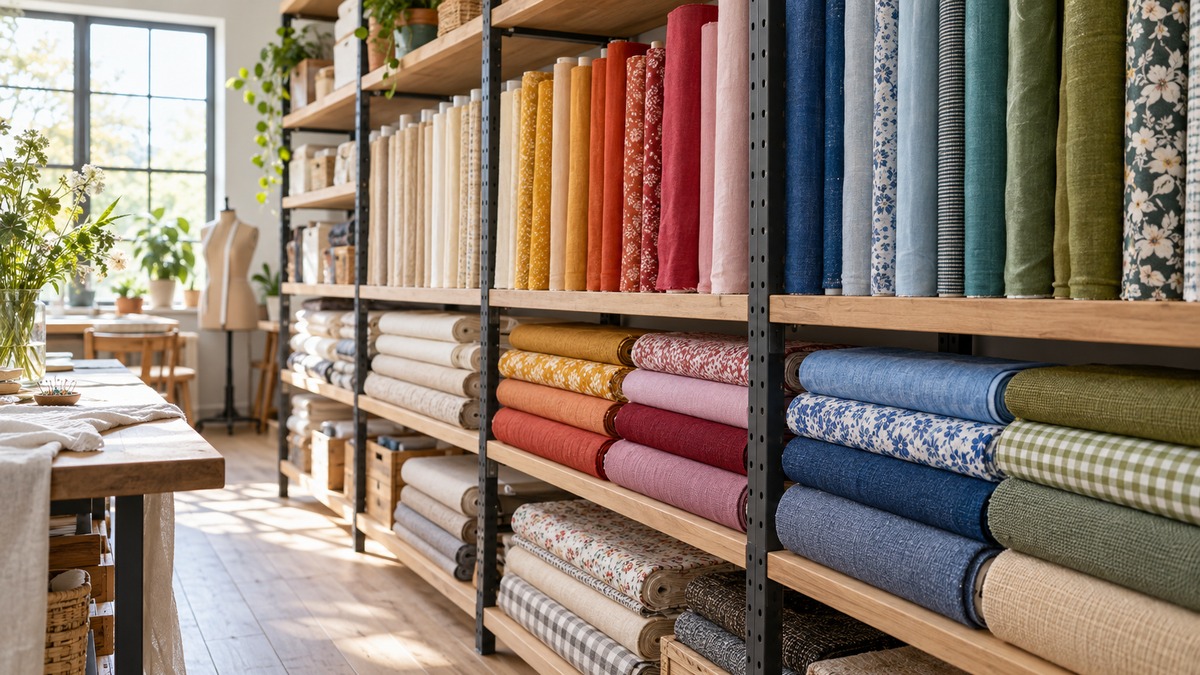
How to store fabric bolts on shelves depends on one early choice: whether the cloth lies flat, is folded, or is rolled on a tube. Museum and extension guidance ranks these by how kindly they treat fabric, and each has a shelf cost. Rolling on a padded tube avoids creases but needs a shelf at least as long as the fabric is wide. This guide compares the three, shows the shelf arithmetic with every assumption named, and covers the cardboard, dust, damp and light questions that follow.
Quick answer
- Rolled on a large padded tube is the low-crease option that can sit on a shelf. The Quilt Museum and Gallery leaflet names flat, rolled and folded methods and calls folded the space saver.
- Keep regular cardboard and wood from touching the cloth. Nebraska Extension and a Missouri quilt sheet both say to use acid-free tissue or washed muslin as a barrier.
- Cover open shelves against dust. A National Park Service sheet says dust acts as an abrasive and attracts moisture.
- Put the shelf in a cool, dry, dark room with humidity below 60 percent, and keep heavy rolls from overloading it.
Flat, folded or rolled
The Quilt Museum and Gallery in the United Kingdom publishes a storage leaflet that names three ways to store a textile and ties each to the space you have. It calls boxed and folded storage the space saver, rolled storage the choice when you have more space, and flat storage the choice when you have the most space. Flat is best because nothing is creased, folded or rolled.
The University of Nebraska Extension sheet on quilts agrees about the order. It says to store quilts flat if possible, to fold them as few times as possible if they must be folded, and to refold periodically to redistribute the strain along fold lines. It adds that a textile left folded for a long time may develop permanent creases, and that stacking heavy items on top can crush the batting. The pages are written for quilts and antique textiles, so yardage you plan to cut soon does not need the same care. They show the principle, and you decide how far to follow it.
| Method | Fold lines | Shelf cost | What the sources say |
|---|---|---|---|
| Flat, full width | 0 | Largest: the whole piece lies out | Quilt Museum: most space, no creasing. Nebraska: flat if possible. |
| Rolled on a tube | 0 | A span longer than the fabric is wide | Nebraska, National Archives and Quilt Museum all describe rolling on large tubes. |
| Folded in thirds | 2 | Smallest footprint | Quilt Museum: thirds, never half and quarters, folds supported by tissue rolls. |
| Folded in half | 1 | Medium footprint | Quilt Museum advises against half and quarters for quilts. |
The table maps the sources onto plain cloth. A sheet of cloth folded in half has one fold line, while the leaflet’s advice against half and quarters is aimed at quilts, so apply it to your yardage with judgment.
How to roll fabric on a tube
Three of the pages describe rolling, and they agree on the outline. The Nebraska sheet says quilts may be rolled onto large cardboard tubes that are longer than the quilt is wide and at least 4 inches in diameter. The tube is padded with cotton batting or resin-free polyester batting, then covered with acid-free tissue or washed cotton muslin, and the textile is rolled loosely and without wrinkles. It warns never to roll a quilt that was already folded, because that causes severe stress along the fold line.
The National Archives article says to roll large flat textiles around the outside of large-diameter acid-free cardboard tubes, and to place the rolls inside boxes or cover them with muslin. The Quilt Museum leaflet builds the tube differently: tin foil as a buffer over the cardboard, then wadding, then plain cotton or tissue, then roll the quilt top side down, not too tight. The pages agree on the aim and differ on the layers, so pick one set and keep it consistent.
Rolling for shelves: the National Park Service method
The most specific shelf instructions come from a National Park Service sheet on rolling flags. It says rolling stores a flag compactly and avoids the damaging creases often seen on folded flags. It says the tube should be six inches longer than the widest edge of the flag, with a header of acid-free tissue on the tube, and the roll tied with one-inch undyed cotton twill tape 2 to 3 inches in from each end and every 18 to 24 inches along the tube. For open shelving it says to cover the whole tube with an outer layer of soft wrap, prewashed cotton muslin or polyethylene.
It also says to raise each end of the roll slightly on a foam block or cradle, so the bottom of the roll is not crushed by its own weight and that of the tube. The sheet describes a block about 2 inches thick, 3 to 4 inches high and 5 to 6 inches long. As an alternative to shelves, it describes a wall rack where metal poles slip through the center of the tube and attach to brackets at each end. Flags are the sheet’s scope, in fair to good condition, so this is a related example and not a fabric rule.
Fit the roll to the shelf
Two numbers decide whether a roll fits: how long the tube must be, and how thick the roll gets. The tube length is the fabric width plus a margin. The Park Service flag margin of six inches is the only figure in the pages we opened, so we borrow it as an assumption. The Nebraska sheet only says the tube should be longer than the width.
| Fabric width (inches, assumed) | Tube length = width + 6 | Shelf widths that fit it (36, 48, 60, 72 inches) |
|---|---|---|
| 44 | 44 + 6 = 50 | 60 and 72 (50 ≤ 60); not 36 or 48 |
| 54 | 54 + 6 = 60 | 72 only; a 60-inch shelf has no margin at 60 |
| 60 | 60 + 6 = 66 | 72 only (66 ≤ 72) |
The result is plain. On a 36-inch or 48-inch shelf, a full-width roll lying side to side does not fit, which is why the Park Service wall rack and the Quilt Museum’s folded option exist. The tie count follows from the Park Service spacing: ties 3 inches in from each end, then evenly spaced at no more than 24 inches. For the 50-inch tube that is (50 − 6) ÷ 24 = 1.8, so 2 gaps and 3 ties. For the 66-inch tube it is (66 − 6) ÷ 24 = 2.5, so 3 gaps and 4 ties.
How thick the roll gets
The roll’s diameter depends on yardage and fabric thickness, and the pages give neither. The formula treats the roll as a spiral. Length in inches is yards times 36. The area of the wound layers is length times thickness, and the outer diameter is the square root of (4 × area ÷ π + core diameter squared). The thickness of 0.02 inches and the 4-inch core, matching the Nebraska minimum, are our assumptions, and the muslin wrap is ignored.
| Yardage | Length (inches) | Layer area (× 0.02) | Outer diameter |
|---|---|---|---|
| 5 yards | 5 × 36 = 180 | 180 × 0.02 = 3.6 sq in | √(4 × 3.6 ÷ 3.14 + 16) = 4.5 inches |
| 10 yards | 10 × 36 = 360 | 360 × 0.02 = 7.2 sq in | √(4 × 7.2 ÷ 3.14 + 16) = 5.0 inches |
| 15 yards | 15 × 36 = 540 | 540 × 0.02 = 10.8 sq in | √(4 × 10.8 ÷ 3.14 + 16) = 5.5 inches |
A 15-yard roll is only 5.5 inches across on these assumptions, because the core takes up most of the width. With a 2-inch gap above for reaching in, a shelf with 8 inches of clear height holds any of the three. On a 12-inch deep shelf with 1 inch between rolls, the number of 5-inch rolls side by side is (12 + 1) ÷ (5 + 1) = 2.2, so 2, which is the count for a 10-yard roll.
Keep cardboard and wood off the cloth
If your fabric is wound on a cardboard core or board, the sources are consistent about cardboard. The Missouri quilt sheet says ordinary cardboard and wood emit volatile acids that deteriorate and yellow textiles over time, and that folded textiles on closet shelves should be protected by lining the shelves, drawers or boxes with layers of acid-free tissue or washed unbleached cotton muslin or sheeting. Nebraska Extension says the muslin should be washed periodically, yearly ideally, and the tissue replaced about every five years, and that colored tissue should be avoided because it can stain.
Cloth stored for months against a plain cardboard core fits that warning, so the pages suggest adding a barrier layer between the cardboard and the cloth. The pages do not test craft-store bolt boards in particular, and you should check yours before assuming it is archival. For the shelf itself, our guide to the type of wood for closet shelves covers the board question. A lining makes the choice matter less.
Cover open shelves against dust
The National Park Service sheet on dust covers says dust harms objects in two ways. It acts as an abrasive that can wear away surface detail, and it attracts and catalyzes moisture and gaseous pollutants to form acidic solutions. Its fix for open shelving is a cover of clear polyethylene sheeting or unbleached cotton muslin, attached with small magnets or binder clips. Polyethylene allows inspection without opening the cover. Muslin does not.
A Kansas State extension publication on mold offers a cloth option for textiles in general: cloth bags, or fabric such as sheets, draped over stored textiles allow ventilation, provide protection from light and soil, and prevent condensation. The same publication says plastic bags may protect textiles for short periods but should not be used for long-term storage because condensation may occur. Nebraska Extension goes further and says quilts should not be stored in plastic bags at all. Those pages disagree on how long plastic is acceptable, and muslin or plain cotton cloth appears as an option on all three.
Choose the room, then the wall
The conditions around the shelf matter most. The sources give these figures.
| Source | Temperature | Relative humidity | Context |
|---|---|---|---|
| NPS Conserve O Gram 16/1 (1993) | 64°F to 68°F, upper limit 75°F | Below 65 percent, 50 to 55 percent if possible | Textile collections |
| Missouri quilt sheet | 62°F to 72°F | 45 to 55 percent | Family quilts at home |
| EPA mold guide | Not stated | Below 60 percent, ideally 30 to 50 percent | Homes in general |
The Park Service mold sheet says growth is noted on textiles when relative humidity is above 50 percent and spreads rapidly above 80 percent, that poor or stagnant air worsens it, and that cool, dry conditions, ventilation and good housekeeping are critical. It also notes that fluctuations may let dormant spores start to grow, so steady conditions matter as much as the number. The National Archives article adds that textiles last longest in the dark, and that you should avoid hot attics, damp basements and garages. Nebraska Extension says to keep quilts away from outside walls. Kansas State says closets should not be overfilled, because that reduces air circulation.
Moths
Fiber content changes the pest risk. Mississippi State Extension says clothes moths rarely damage cotton or synthetic fabrics, while wool, silk, fur and other animal-origin fabrics are susceptible, and soiled items are especially attractive to egg-laying moths. For a shelf of cotton quilting fabric, mildew is the bigger worry. For wool coating or silk, add the pest checks the Missouri sheet describes: keep the area clean, vacuum often and inspect the storage area regularly.
Weight and the shelf itself
Fabric is heavy in quantity. The sources we opened give no weight per yard, so this section stays with the shelf rules. The University of Oregon shelving safety sheet says to store heavier items in the knee-to-shoulder range and lighter items overhead, to anchor shelves to the floor or wall to prevent the unit from falling over in an earthquake, and to use a step stool or ladder rather than reaching overhead. It also says “Do not overload shelves and make sure items aren’t hanging over the edge.” Roll ends that overhang a shelf are the case that rule describes.
For the load a given shelf can carry, check its own rating, since none of the pages names a figure. Our post on the ClosetMaid wire shelf weight limit and our guide to the best storage shelf cover units that handle heavier loads. For smaller textile items, the post on storing blankets in a closet covers a neighboring question.
How we chose
This is a method guide, so there are no products to rank. We opened eleven pages on 2026-10-21: a Quilt Museum and Gallery leaflet, a University of Nebraska Extension quilt sheet, a Missouri quilt sheet from the International Quilt Study Center, a National Archives article on textiles, three National Park Service Conserve O Gram sheets (flag rolling, dust covers, mold on textiles), a Mississippi State Extension note on clothes moths, a Kansas State extension publication on mold, an EPA guide to moisture, and a University of Oregon shelving safety sheet. We kept only statements a page makes in words and checked each quoted phrase against its text. The fabric widths, thickness, core size, shelf sizes and gaps are our own assumptions.
Mistakes to avoid
- Storing cloth against bare cardboard or wood for months. The Missouri sheet says both emit acids that yellow textiles.
- Rolling a folded piece. Nebraska Extension says it causes severe stress along the fold line.
- Letting a tube hang past the shelf edge. The Oregon sheet warns about items hanging over the edge.
- Leaving rolls to rest on their own weight. The Park Service flag sheet raises the ends on a cradle for that reason.
- Using a plastic bag as the long-term cover. Nebraska Extension and Kansas State both warn about trapped moisture.
- Skipping the dust cover. The Park Service says dust abrades and attracts moisture.
- Putting the shelf on an outside wall or in sun. Nebraska Extension and the National Archives advise against it.
What we could not verify
None of the pages is about fabric yardage sold on bolts. They cover quilts, antique textiles, flags and clothing, so each rule is carried over by analogy. They give no weight per yard, no standard bolt board size, no rule for how many bolts a shelf may carry, and no guidance on vertical storage of rolled bolts. They do not say whether a cardboard core needs a barrier for yardage meant to be used within weeks. The six-inch tube margin comes from a flag sheet, and the roll-diameter formula rests on our assumed thickness.
Frequently asked questions
Is rolling better than folding?
The Park Service says rolling avoids the creases seen on folded flags, and Nebraska Extension describes rolling as one way to store quilts while warning that long folding can leave permanent creases. Rolling needs a longer span, so folded in thirds, with tissue padding, is the space-saving fallback.
Do I need acid-free tissue?
For textiles you want to keep for years, the Missouri and Nebraska sheets say to line shelves and cardboard contact points with acid-free tissue or washed unbleached muslin. For yardage you plan to cut in weeks, the pages give no guidance.
Can bolts stand on end?
The pages do not say. They describe rolls lying on shelves, in boxes or on wall racks, and the Park Service raises each end on a cradle so the bottom of the roll is not crushed. Whether a standing roll is safe is not covered.
Where should the shelf go?
Away from outside walls, direct sun, attics, basements and garages, in a room you live in. Humidity should stay under 60 percent, which meets the EPA and the Park Service limits.
How do I stop dust on open shelves?
Cover them. The Park Service dust-cover sheet suggests clear polyethylene or unbleached cotton muslin held on with magnets or binder clips, and Kansas State suggests a draped sheet.
Bottom line
Roll or fold with padding, keep cardboard and wood off the cloth, cover the shelf against dust, and place it in a dry, dark room under 60 percent humidity.
Sources
- https://www.quiltmuseum.org.uk/uploads/attachment/200/quilt-care-leaflet-2-storage-in-the-home.pdf (opened 2026-10-21)
- https://extensionpubs.unl.edu/publication/g1820/na/pdf/view (opened 2026-10-21)
- https://mhctc.missouri.edu/wp-content/uploads/2021/06/ToProtectandPreserve.pdf (opened 2026-10-21)
- https://www.archives.gov/publications/prologue/2016/summer/preserve-textiles.html (opened 2026-10-21)
- https://nps.gov/subjects/museums/upload/16-05_508.pdf (opened 2026-10-21)
- https://www.nps.gov/subjects/museums/upload/04-02_508.pdf (opened 2026-10-21)
- https://www.nps.gov/subjects/museums/upload/16-01_508.pdf (opened 2026-10-21)
- https://extension.msstate.edu/newsletters/bugs-eye-view/2016/webbing-clothes-moth-vol-2-no-3 (opened 2026-10-21)
- https://www.shawnee.k-state.edu/homeandfamily/pdfs/Controling%20mold.pdf (opened 2026-10-21)
- https://www.epa.gov/mold/brief-guide-mold-moisture-and-your-home (opened 2026-10-21)
- https://safety.uoregon.edu/sites/default/files/safety_sheet_-_shelving_safety_final.pdf (opened 2026-10-21)
As an Amazon Associate we earn from qualifying purchases.