How to Organize Kitchen Pantry Shelves
As an Amazon Associate we earn from qualifying purchases.
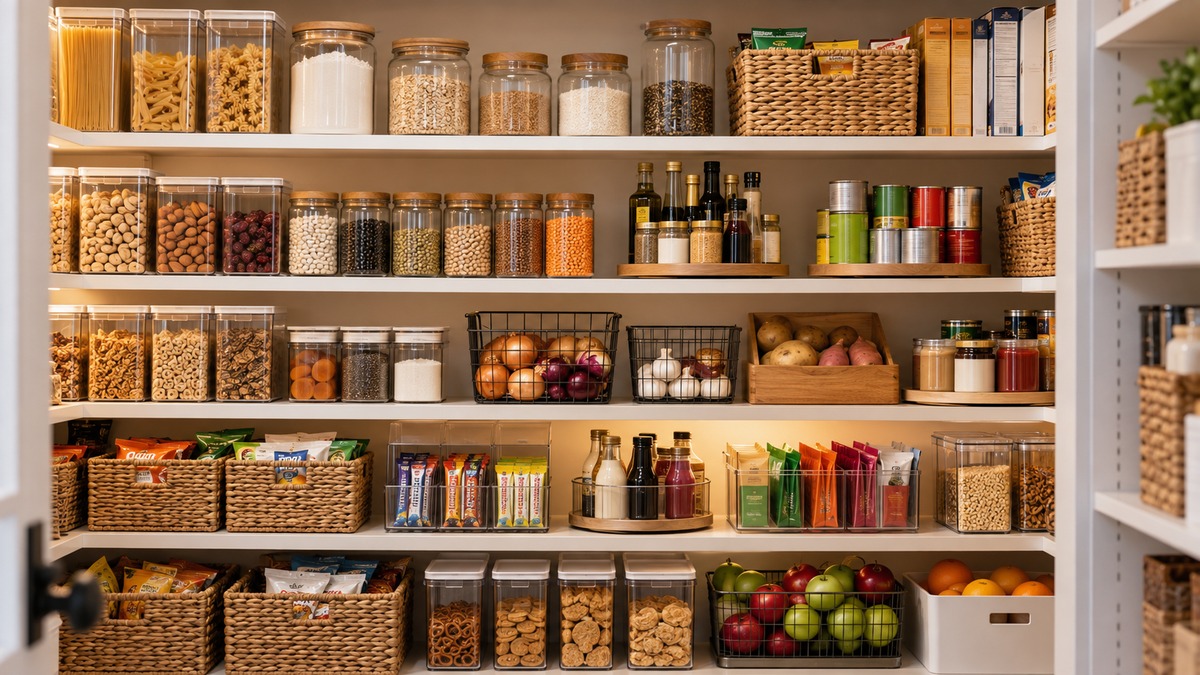
How to organize kitchen pantry shelves starts with grouping foods by type, placing the newest items behind the older ones, and choosing shelves in the cool, dry part of the kitchen. The extension guides we opened agree on those storage basics. They do not give a pantry size, a shelf count or a shelf spacing, so the arithmetic below uses a sample 84-inch pantry with five shelves, and you can replace those figures with your own.
Quick answer
- Group foods by type, and give each group its own shelf or part of a shelf.
- Label and date items, and arrange the pantry first in, first out.
- Keep the pantry cool and dry, away from appliances that produce heat.
- Put everyday items between 15 and 48 inches above the floor, and keep backup stock above or below that band.
The shelf heights in a sample pantry
The table places five shelves in an 84-inch pantry, spaced 15 inches apart. The shelf surfaces are our sample figures. The last column shows whether each surface sits inside the 15 to 48 inch unobstructed reach band from the Access Board guide.
| Shelf | Surface height (inches) | Inside the 15 to 48 inch band? | Suggested use |
|---|---|---|---|
| Bottom | 15 | Yes, at the lower edge | Bulky items you lift less often |
| Second | 30 | Yes | Everyday staples such as grains and canned goods |
| Third | 45 | Yes, near the upper edge | Everyday items, including spices |
| Fourth | 60 | No | Backup stock |
| Top | 75 | No | Seasonal or rarely used items |
Worked numbers
- Height of the reach band: 48 minus 15 equals 33 inches.
- Shelves inside the band: 15, 30 and 45 inches, so 3 of the 5 shelves.
- Spacing: 75 minus 15 equals 60 inches across four gaps, so each gap is 60 divided by 4, which is 15 inches.
- Clearance above the top shelf: 84 minus 75 equals 9 inches.
The arithmetic shows that a five-shelf pantry gives three shelves inside the band and two above it. If your pantry is taller or shorter, redo the spacing with your own height. The top shelf needs room for the items you store on it, and the pages we opened do not state a minimum clearance, so the 9 inches is a sample figure only.
Plan the spacing for a taller or shorter pantry
The same 15-inch spacing works for other pantry heights. The table keeps the bottom shelf at 15 inches, adds shelves every 15 inches, and stops at the highest shelf below the top of the pantry. It counts how many shelves land inside the band in each case. The pantry heights are sample figures, so replace them with your own.
| Pantry height (inches) | Shelves at 15-inch spacing | Shelves inside 15 to 48 | Shelves above 48 | Clearance above top shelf (inches) |
|---|---|---|---|---|
| 72 | 4 (15, 30, 45, 60) | 3 | 1 | 12 |
| 84 | 5 (15, 30, 45, 60, 75) | 3 | 2 | 9 |
| 96 | 6 (15, 30, 45, 60, 75, 90) | 3 | 3 | 6 |
The count inside the band stays at three in each case, because the band is fixed at 33 inches and the spacing is fixed at 15. Taller pantries add shelves above the band, which suit backup stock. Measure the pantry height before you plan the spacing, because the clearance above the top shelf changes with each height. For spice shelves that belong in the everyday band, see spice shelves for the kitchen.
Group foods before you place them
Start by sorting what you already have into groups such as canned goods, grains, baking supplies, spices and snacks. Keep each group together. The guides we opened do not set a grouping rule, so this method is a practical habit rather than a sourced standard. A group that stays on one shelf is easier to check when you shop.
Spices need their own plan. For a kitchen organizer for spices, see kitchen organizers for spices. For a pantry-focused spice option, see our guide to spice organizers for a pantry, and for a narrow shelf that holds a few jars, see three-tier spice shelves.
Label, date and rotate
The NDSU fact sheet gives the basic rule: ‘Be sure to label and date items and arrange your pantry in “first in, first out”‘. In practice, put new items behind older ones, so the older items come forward and get used first. A dated label tells you which item is older when two cans look the same, and it helps when a bulk purchase goes in behind older stock.
The text we read does not give a shelf life for each food. For a pantry under a staircase, see pantry storage under the stairs.
Once a week, scan the front of each group, pull older items forward, and check the dates on any item you have not used in a while. The habit takes a few minutes, and it keeps the first in, first out rule working without a special shelf.
Keep the pantry cool and dry
NDSU says: “Pantry foods last a long time on the shelf in a cool, dry place”. The advice is about the place, not the shelf. Purdue Extension makes the same point in more detail. Its guide says: “Store foods in your coolest cabinets, away from appliances, which produce heat.”
Purdue also gives a temperature cue for canned goods. It says the shelf life is “shorter when canned goods are stored above 70” degrees Fahrenheit, and it asks for a dry place that stays cool but not freezing. The same guide adds: “Warm and humid climates shorten the shelf life of foods.” If your pantry sits in a warm or humid room, move the canned goods to the coolest shelf you have.
For wire shelving in the kitchen, see our guide to free-standing wire shelves for the kitchen.
Storage rules at a glance
| Rule | Source | What to do on the shelf |
|---|---|---|
| Cool, dry place | NDSU | Use the coolest, driest shelf you have |
| Shelf life shorter above 70 degrees Fahrenheit | Purdue | Keep canned goods below that point where you can |
| Warm and humid climate | Purdue | Move staples away from a humid corner |
| Away from appliances that produce heat | Purdue | Avoid shelves over the range, near the dishwasher or by the refrigerator exhaust |
| Label and date | NDSU | Write a date on each new item |
| First in, first out | NDSU | Place new stock behind older stock |
Keep food away from the range and dishwasher
The Purdue guide names the spots that are too warm for food. It says that in cabinets over the range, near the dishwasher or by the refrigerator exhaust, “the temperature is too warm for food.” A pantry shelf in a corner next to those appliances should be checked before you use it for staples.
Under-sink space is outside the scope of the Purdue guide. For under-sink organizers, see our guide to under-sink storage in the kitchen, and check the spot against the same heat and moisture rule before you store food there.
Use the reach band for everyday items
The Access Board guide describes a 15 to 48 inch range for unobstructed reach. Its wording applies only to operable parts, so it is not a pantry rule. It does give a usable band for everyday items: the shelves inside that band hold the items you grab daily. In the sample pantry, that means the bottom, second and third shelves.
The lowest shelf sits at the lower edge of the band, so reaching items there may mean bending. Put items you lift rarely on the bottom shelf, and keep the second and third shelves for items you reach most often. For a spice shelf that stands inside the band, see spice organizers for a shelf.
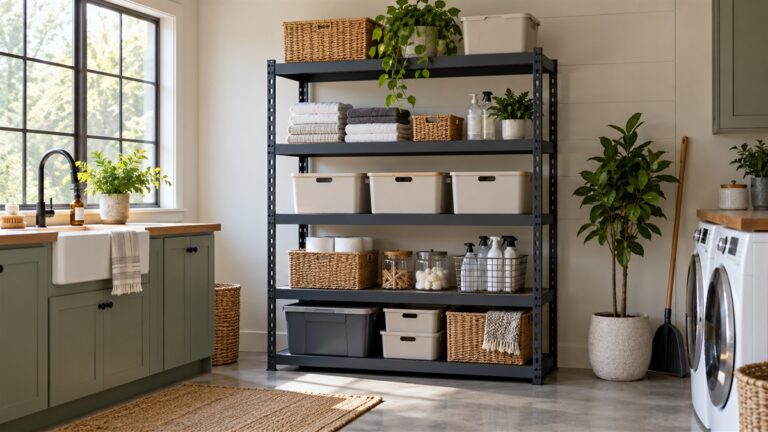
Check the wire shelves before you load them
The pages we opened do not give a load rating for pantry shelves, so a height plan cannot be checked against weight from these sources. Read the maker’s rating before you load a wire shelf with cans or jars. For a closer look at wire shelf limits, see our guide to wire shelf weight limits.
Wire shelves need the same check as any other shelf. Compare the maker’s rating with the weight of a full group of cans or jars, not with an estimate, because the pages we opened give no weight figure for a typical pantry load.
The guides we opened also do not say where heavy stock belongs. Placing heavy items low is a general habit, and it fits the bottom shelf in the sample pantry, but the choice is yours to make with the rating in hand.
How we chose
The figures in this guide come from the pages we opened with curl on 2026-10-21: an NDSU Extension fact sheet on pantry storage, a Purdue Extension sheet on cupboard storage, and an Access Board page on reach. Each one states a rule or figure that we quote, and we checked every quote against the text of the page we opened.
The shelf heights in the table come from our sample pantry, not from a measured kitchen. We did the arithmetic by hand and show each step, so you can redo it with your own figures. We chose the NDSU and Purdue sheets because both are university extension fact sheets on pantry and cupboard storage. We did not use the retail pantry-organizing pages from the search results, because none gave a source for its figures.
What we could not verify
The pages we opened do not give a pantry size, a shelf depth, a shelf spacing or a load rating, and they do not say how much food a shelf holds, so this article does not estimate capacity. They do not give a shelf life for every food. The Purdue guide includes a shelf-life table with times at 70 degrees Fahrenheit, but this article does not use it, because the entries apply to specific products and dates that we did not check. None of the pages gives a minimum clearance above the top shelf.
Mistakes to avoid
- Storing everyday items above 48 inches. Only three of the five sample shelves sit inside the band, so the everyday shelves should be those three.
- Keeping staples over the range or next to the dishwasher. The Purdue guide names those spots as too warm for food.
- Putting new stock at the front. The NDSU rule is to arrange the pantry first in, first out.
- Leaving items undated. NDSU says to label and date items.
- Storing canned goods in a warm, humid spot. Purdue says those conditions shorten the shelf life of foods.
FAQ
How should I group pantry shelves?
Group foods by type, keep each group on one shelf or part of a shelf, and put the newest items behind the older ones. The guides we opened give no grouping rule, so treat this as a method.
Which shelves should hold everyday items?
Shelves whose surfaces sit between 15 and 48 inches above the floor are inside the unobstructed reach band in the Access Board guide. In the sample 84-inch pantry with five shelves, those are the bottom, second and third shelves.
Where should I not put pantry staples?
The Purdue guide says the temperature is too warm for food in cabinets over the range, near the dishwasher or by the refrigerator exhaust.
What does first in, first out mean for a pantry?
It means the oldest stock is used first. The NDSU fact sheet says to label and date items and arrange the pantry this way.
Does a warm, humid pantry shorten food life?
Purdue Extension says warm and humid climates shorten the shelf life of foods, so a cooler and drier spot is the better choice for staples.
How much weight can a pantry shelf hold?
The pages we opened do not state a load rating for pantry shelves. Use the rating from the maker of the shelf before you load it.
Bottom line
Group foods by type, label and date each item, and keep everyday items on the shelves inside the 15 to 48 inch band.
Sources
- https://www.ndsu.edu/agriculture/sites/default/files/2024-08/fn1706.pdf (opened 2026-10-21)
- https://www.ndsu.edu/agriculture/node/2082 (opened 2026-10-21)
- https://www.extension.purdue.edu/extmedia/CFS/CFS-423-W.pdf (opened 2026-10-21)
- https://www.access-board.gov/ada/guides/chapter-3-operable-parts/ (opened 2026-10-21)
Disclosure: As an Amazon Associate we earn from qualifying purchases.