How High Should Closet Shelves Be
As an Amazon Associate we earn from qualifying purchases.
How high should closet shelves be? ClosetMaid gives typical heights of 70 inches for long hanging space and 84 and 42 inches for double hanging space, and uses slightly different numbers elsewhere on the same page. For reach, the ADA standard treats 15 to 48 inches above the floor as the range for a single reach. This guide sets those figures beside garment lengths from IKEA and an Oregon State circular, so you can pick heights from what you hang and who reaches.
Quick answer
- Put a long-hang shelf at about 70 to 71.5 inches and a double-hang pair at about 85.5 and 42 inches. These are the ClosetMaid figures, and the page gives both sets.
- Keep daily-use items between 15 and 48 inches. That is the unobstructed reach range in the ADA standard.
- Check garment length first. IKEA lists up to 190 cm, or 74.8 inches, for really long garments, which is more than a 71.5-inch shelf leaves.
- Children’s reach tops out at 36, 40 or 44 inches depending on age, so a shared closet needs a lower rod or shelf.
The heights the sources name
Several makers and standards state heights, and they do not all agree. The table puts them in one place. Every inch figure comes from the source named. The metric rows are converted by us, with centimeters divided by 2.54 and millimeters divided by 25.4.
| Source | What the height describes | Height from floor (inches) |
|---|---|---|
| ClosetMaid, measuring section | Typical shelf, long hanging space | 70 |
| ClosetMaid, “How To Create More Closet Space” | Shelf for Long Hang | 71.5 |
| ClosetMaid, measuring section | Typical shelves, double or short hanging space | 84 and 42 |
| ClosetMaid, “How To Create More Closet Space” | Double Hang shelves; shelf for Center Stack | 85.5 and 42; 85.5 |
| Elfa ready closet solutions | Overall height of the planned solution | 2140 mm = 84.3; 2172 mm = 85.5 |
| IKEA PAX frames | Two frame heights | 201 cm = 79.1; 236 cm = 92.9 |
| ADA standard 308 | Low and high unobstructed forward reach | 15 minimum, 48 maximum |
Two makers land in the same neighborhood for the top of a closet. ClosetMaid’s upper shelf sits at 84 or 85.5 inches, and Elfa lists some of its ready closet solutions at 84.3 and 85.5 inches tall. The sources do not say whether this is a design choice or a coincidence, so we only note it. IKEA’s taller PAX frame is 92.9 inches, and it needs a ceiling of 237 centimeters or more with hinged doors, which is about 93.3 inches.
Where the top shelf goes
ClosetMaid’s guide ties the top shelf to the ceiling: low ceilings affect whether a shelf can be placed at 84 inches. The arithmetic is plain. Take the ceiling height and subtract the shelf height to find the room above it. At 96 inches, which is an 8-foot ceiling and our example, a shelf at 85.5 inches leaves 10.5 inches and a shelf at 84 inches leaves 12 inches. On a 90-inch ceiling, the same shelves leave 4.5 and 6 inches. The page does not name a minimum gap between the top shelf and the ceiling, so check how your shelf and hardware are installed before you commit to the highest option.
A shelf near 85 inches is far above the reach range. The ADA advisory on storage speaks to this case. It says at least one of each type of storage must be within the reach ranges, and then adds that “it is permissible to install additional storage outside the reach ranges.” The standard is written for accessible spaces, and the pages we opened do not say it applies to a home closet, but the logic is a useful guide: keep one of each kind of storage in easy reach and use the top shelf for the rest. For ideas on what to put there, see our guide to storage ideas for the top shelf of a closet.
Long hang or double hang
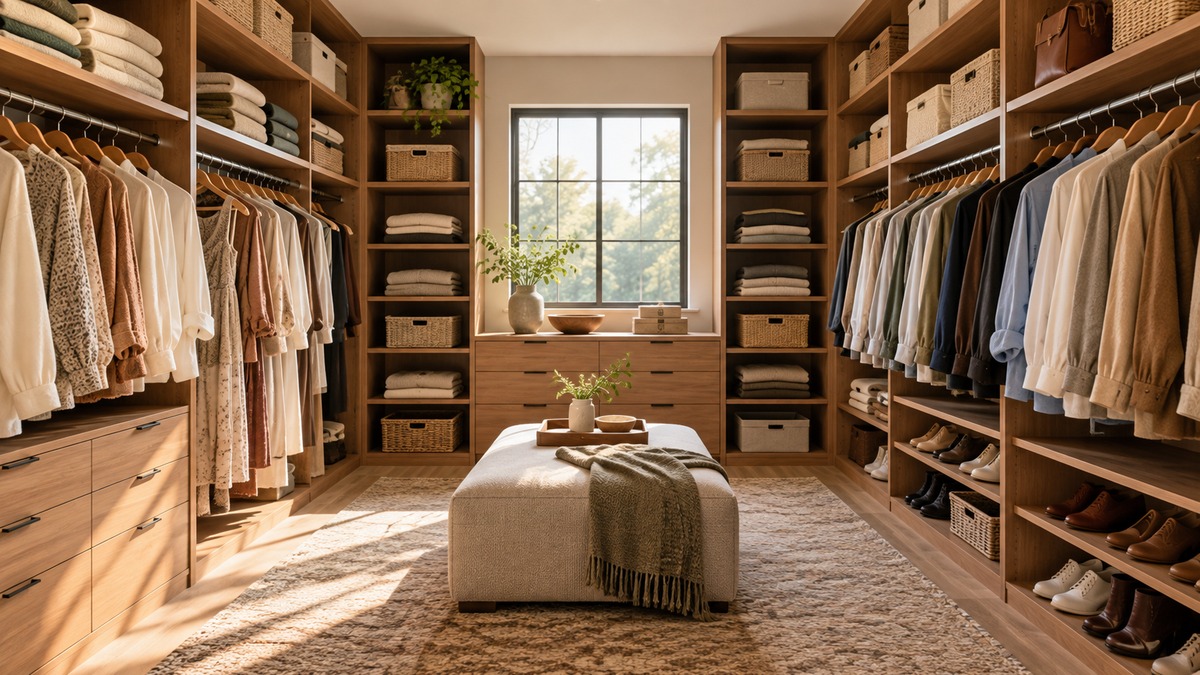
ClosetMaid frames the choice by what you own. If your wardrobe is mostly skirts, shirts, slacks and blouses, double hang is “the quickest way to get more closet space.” That is the page’s wording, and it places one shelf at 85.5 inches and another at 42 inches. Long hang puts the shelf at 71.5 inches for dresses and coats. The question is whether your garments fit the space below each shelf.
The zones come straight from the ClosetMaid numbers. Long hang leaves 71.5 inches from the floor to the shelf. Double hang leaves 42 inches below the lower shelf, and 85.5 − 42 = 43.5 inches between the two shelves. The table compares garment lengths with the tighter double-hang zone of 42 inches. The margin column is zone height minus garment length, so a negative number means the garment is longer than the space.
| Garment (source) | Length (inches) | Long hang: 71.5 − length | Double hang: 42 − length |
|---|---|---|---|
| Hanging trousers (IKEA, 60-70 cm) | 23.6 to 27.6 | 47.9 to 43.9 | 18.4 to 14.4 |
| Blouses (IKEA, 80 cm) | 31.5 | 40.0 | 10.5 |
| Trousers, suits, blouses, skirts (Oregon State, low end) | 39 | 32.5 | 3.0 |
| Coats (IKEA, 100 cm) | 39.4 | 32.1 | 2.6 |
| Trousers, suits, blouses, skirts (Oregon State, high end) | 45 | 26.5 | −3.0 |
| Short dresses (IKEA, 120 cm) | 47.2 | 24.3 | −5.2 |
| Street dresses and coats (Oregon State) | 63 | 8.5 | −21.0 |
| Really long garments (IKEA, up to 190 cm) | 74.8 | −3.3 | −32.8 |
The table is a ceiling on what is possible, not a recommendation. The ClosetMaid page does not say how far the rod hangs below the shelf, so the true margins are smaller than the numbers shown. Even so, it makes the choice clear. Double hang works for the shorter garments, but a coat at 39.4 inches leaves only 2.6 inches before any rod drop is subtracted. Long hang clears everything except the longest garments in the IKEA list.
The two sources also disagree about coats, which makes a measurement of your own more useful than either list. The Oregon State circular gives 63 inches for street dresses and coats, while the IKEA guide says about 100 centimeters, or 39.4 inches, for coats. Neither page explains what it measures. For a rod that suits either layout, see choosing a rod to hang clothes in a closet.
Reach: the 15 to 48 inch zone
The ADA standard is the only source we opened that sets reach heights in plain numbers. Section 308 says the high forward reach shall be 48 inches (1220 mm) maximum, and the low forward reach shall be 15 inches (380 mm) minimum, above the floor when the reach is unobstructed. The side reach range is the same, 15 to 48 inches, when a clear space allows a parallel approach. The range is 48 − 15 = 33 inches tall.
Set against the ClosetMaid heights, the zone sorts a closet quickly. The lower shelf of a double-hang pair at 42 inches sits inside the zone. The upper shelf at 85.5 inches is 85.5 − 48 = 37.5 inches above the top of it, and a long-hang shelf at 71.5 inches is 23.5 inches above. Garments hang below their shelf, so the lower part of a long-hang garment is within reach and the shelf itself is not. Anything on the 85.5-inch shelf is outside the 48-inch reach range.
The standard also covers reaching over something. If a high forward reach goes over an obstruction with a reach depth of 20 inches or less, the high reach stays at 48 inches. If the reach depth is more than 20 inches, up to 25, the high reach drops to 44 inches. A deep lower shelf can act as an obstruction for the shelf above it. The standard does not apply this to closet shelves, so we only offer it as a way to think about stacked shelves: the deeper the lower shelf, the lower the comfortable height of the next one up.
Elfa makes the same point in plain words, without a number. Its shelving page tells you to put shelves at a height that suits what you want to store and how you use the room, and to “Make sure you can comfortably reach the shelf” without it feeling awkwardly positioned. That is a good rule for a closet, because the right height depends on who is reaching.
Heights for children
An advisory in the ADA standard gives children’s reach ranges for elements such as coat hooks and lockers designed mainly for children. The table copies them.
| Age group | High reach, maximum (inches) | Low reach, minimum (inches) |
|---|---|---|
| Ages 3 and 4 | 36 | 20 |
| Ages 5 through 8 | 40 | 18 |
| Ages 9 through 12 | 44 | 16 |
The Oregon State circular approaches the same problem from the rod. It says a junior clothes rod hangs down 23 inches from grownup level, and that rod supports at various heights let the rod move as the child grows. If the adult level is the ClosetMaid long-hang shelf at 71.5 inches, which is our example, a rod 23 inches lower sits at 71.5 − 23 = 48.5 inches. That is above all three high-reach limits in the table, so for the youngest children the rod would need to go lower still. The circular gives no floor height, so this comparison is ours. The North Carolina circular makes the general point: “Plan a height that is convenient for the person using it.”
Set the heights step by step
- List what you hang and fold. Use the longest coat, dress and trouser lengths on their hangers.
- Choose long hang, double hang or both. Use the margin table above, then replace our numbers with your own.
- Mark the floor-to-ceiling line. Write down the ClosetMaid heights that fit your ceiling.
- Mark the reach zone. Draw lines at 15 and 48 inches, or at your own comfortable reach, and place everyday items between them.
- Fix a provisional height and adjust. ClosetMaid says its ShelfTrack hang track can be installed at any height, and its brackets are attached at the desired shelf height.
Adjustable hardware lets you correct a wrong guess. Elfa says its system lets you easily adjust heights and add or remove shelves and accessories without drilling. IKEA says its corner add-on unit always includes four adjustable shelves. The pages do not say how often owners actually adjust, so treat adjustability as a safety net, not a reason to skip the measurements.
A worked allowance for long garments
The ClosetMaid page gives shelf heights but not the distance from the shelf to the hem of a garment, so we add two allowances of our own. A is the drop from the underside of the shelf to the top of the hanger hook, and F is the clearance you want between the hem and the floor. The formula is shelf height needed = garment length + A + F. Take A = 8 inches and F = 2 inches only as stand-ins, and you should replace both with measurements from your own hardware.
| Garment (source) | Length (inches) | Shelf height needed (length + 8 + 2) | Compared with 71.5 inches |
|---|---|---|---|
| Coats (IKEA, 100 cm) | 39.4 | 49.4 | 22.1 inches to spare |
| Short dresses (IKEA, 120 cm) | 47.2 | 57.2 | 14.3 inches to spare |
| Street dresses and coats (Oregon State) | 63 | 73.0 | 1.5 inches short |
| Really long garments (IKEA, up to 190 cm) | 74.8 | 84.8 | 13.3 inches short |
With these stand-ins, the 63-inch garments in the Oregon State list need a shelf a little above ClosetMaid’s long-hang height, and the longest IKEA garments need a shelf near 85 inches. That lands close to the Center Stack shelf height of 85.5 inches. The ClosetMaid page does not say how its heights were chosen, and the garment figures may not include a hanger, so use this only to see how the numbers interact. For more shelf and rod combinations, see our guide to closet shelving systems.
Drawers and shoes in the stack
If you add drawers, they take a block of height from the same stack. ClosetMaid lists drawer frames in 30 and 42 inch heights, and drawers in 4, 7 and 11 inch sizes. A 42-inch frame is the same height as the lower double-hang shelf at 42 inches, which means a drawer stack and a lower rod would line up at the same level. The page does not say the two were designed to match.
For shoes, the North Carolina circular lists two shoe spaces with heights of 5½ and 7½ inches, and the scan does not make clear which height goes with which size. Use the larger figure for planning: a shoe shelf that clears 7½ inches handles both. The circular dates from the 1960s, so check against your own shoes. Our guide to shoe storage for a small closet covers floor and shelf options, and the list of items to store on closet shelves helps you decide what lives at each height.
How we chose
We chose the sources that state a height in inches or centimeters: the ClosetMaid how-to guide, the ADA standard on the Access Board site, the IKEA PAX buying guide, two Elfa pages, an Oregon State extension circular and a North Carolina State extension circular. Each quoted sentence was checked against the text of its page on 2026-10-21. The margin tables are our arithmetic, and the garment allowances A and F, the 96-inch ceiling and the 90-inch ceiling are our own assumptions. Where two figures disagree, such as 70 against 71.5 inches, both are shown.
Mistakes to avoid
- Using one height for every wardrobe. The ClosetMaid page gives separate long-hang and double-hang heights.
- Forgetting the ceiling. ClosetMaid notes that low ceilings affect whether a shelf can go at 84 inches.
- Putting daily items above 48 inches. The ADA reach range stops there.
- Planning double hang for coats. A 39.4-inch coat leaves 2.6 inches in a 42-inch zone before any rod drop.
- Ignoring children. The ADA advisory lists 36, 40 and 44 inch maximum reaches by age.
- Treating a stand-in number as a rule. The 8-inch and 2-inch allowances are ours, not a source’s.
What we could not verify
The pages we opened do not state a standard shelf height for a home closet, and ClosetMaid says only that there are typical heights. They do not explain why the ClosetMaid page lists 70 and 71.5 inches, or 84 and 85.5 inches. They do not give the drop from shelf to rod or the minimum gap below a ceiling. The ADA standard applies to accessible spaces, and nothing we opened says it governs a private closet. The Oregon State and North Carolina circulars are from the 1960s. No weight or load claim is made here, and the mounting steps are left to the instructions for your hardware.
Frequently asked questions
How high should a closet shelf be for hanging clothes?
ClosetMaid gives about 70 inches for long hanging space in one place and 71.5 inches in another, and it pairs 85.5 and 42 inches for double hang. Garment length decides which suits you.
What is the highest shelf most people can reach?
The ADA standard sets the high forward reach at 48 inches maximum for an unobstructed reach. Anything above that is outside the standard’s reach range, and the standard allows additional storage there.
How high should a closet shelf be for a child?
The ADA advisory lists high reaches of 36 inches for ages 3 and 4, 40 inches for ages 5 through 8 and 44 inches for ages 9 through 12. The Oregon State circular suggests a junior rod 23 inches below adult level.
Does the ceiling height change the answer?
Yes. ClosetMaid says low ceilings affect whether a shelf can be placed at 84 inches, and the room above a shelf is the ceiling height minus the shelf height.
Can I change the heights later?
With adjustable hardware, yes. ClosetMaid says its hang track can be installed at any height, and Elfa says heights can be adjusted without drilling.
Bottom line
Pick the hanging layout from your longest garments, keep everyday items between 15 and 48 inches, and use the shelf near 85 inches for things you reach for rarely.
Sources
- https://homedepot.closetmaid.com/en-US/Installation/Pages/how-to-guides.aspx (opened 2026-10-21)
- https://www.access-board.gov/ada/ (opened 2026-10-21)
- https://www.ikea.com/ie/en/files/pdf/69/0a/690a180e/pax__komplement.pdf (opened 2026-10-21)
- https://ir.library.oregonstate.edu/xmlui/bitstream/1957/24327/1/ECNO691.pdf (opened 2026-10-21)
- https://ocr.lib.ncsu.edu/ocr/ua/ua102_200-001-bx0004-004-004/ua102_200-001-bx0004-004-004.pdf (opened 2026-10-21)
- https://elfa.com/en/inspire-me/room/walk-in-closet (opened 2026-10-21)
- https://elfa.com/en/inspire-me/clothing-storage (opened 2026-10-21)
- https://elfa.com/en/inspire-me/shelves-and-shelving-systems (opened 2026-10-21)
As an Amazon Associate we earn from qualifying purchases.