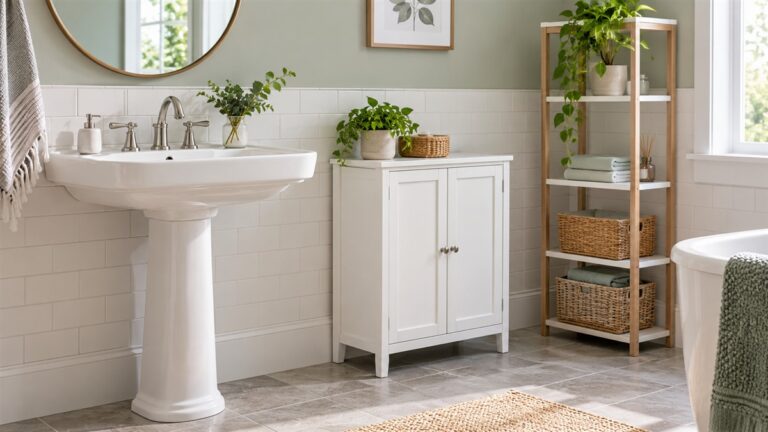
How to Organize Open Bathroom Shelves
As an Amazon Associate we earn from qualifying purchases.
Here is how to organize open bathroom shelves so they look tidy and stay dry: decide what belongs on show, keep medicines and cleaners off them, group the rest in containers, and give damp towels room to dry. Open shelves face three problems that closed cabinets hide, which are steam, small hands and dust. The pages we opened cover each of them, from the EPA on moisture to MedlinePlus and Safe Kids on medicines and cleaners, and they stop where product advice would begin.
Quick answer
- Keep medicines and cleaning products off open shelves, or put them high and out of children’s sight, as MedlinePlus, Up and Away and Safe Kids advise.
- Group daily items by use and keep them near where they are used, which is the North Carolina State Extension planning rule.
- Keep indoor humidity below 60 percent and run the exhaust fan during the shower and for about 10 to 15 minutes afterward.
- Hang damp towels where air can reach them instead of folding them onto the shelf.
What an open shelf exposes
A closed vanity hides steam, clutter and curious hands. An open shelf shows all three. The first exposure is moisture. The EPA’s guide states the principle plainly: “The key to mold control is moisture control.” It says to keep indoor humidity below 60 percent, ideally between 30 and 50 percent, and its bathroom tip is that running a fan or opening a window, together with more frequent cleaning, usually keeps mold from recurring. Kansas State’s publication on controlling mold growth says mold can often be found growing in the bathroom, and that if an exhaust fan is not used during bathing, large amounts of moisture can remain in the shower or tub area. A University of Florida guide says that even a tiny bit of soap or body oils from showering will support mildew growth, which is why it asks readers to keep bathrooms dry as well as clean.
The second exposure is access. Up and Away, an initiative that was first created in partnership with the CDC, says approximately 35,000 young children are brought to the emergency room each year because they got into medicines left within reach. Safe Kids Worldwide says household cleaning products and personal care products belong up and away, out of children’s reach and sight. An open shelf has no door, so whatever sits on it is visible and, depending on the height, reachable.
The third exposure is dust and tipping. The North Carolina State Extension circular, reprinted in 1965, says of closet accessories: “Covered boxes protect your hats from dust and soil.” The point carries over, though the circular is about hats and not bathroom items. The Mississippi State University Extension clutter guide adds a fall risk: cluttered countertops or shelves can cause injury if something falls or topples over.
| Exposure | What the pages say | What it means for an open shelf (our reading) |
|---|---|---|
| Steam and humidity | Humidity below 60 percent, ideally 30 to 50 (EPA); moisture lingers in the shower area when no exhaust fan is used (Kansas State) | Leave air around items and do not pack the shelf |
| Children’s reach | Medicines and cleaners up and away, out of reach and sight (Up and Away, Safe Kids, MedlinePlus) | Nothing hazardous at child height |
| Dust and soil | Covered boxes protect hats from dust and soil (NC State) | Use sided or lidded containers for items that should stay clean |
| Tipping items | Cluttered shelves can cause injury if something falls or topples (Mississippi State) | Fewer, steadier items per shelf |
Step 1: Clear the shelf and decide what earns a place
Take everything off the shelf. The Mississippi State guide recommends sorting items into four piles: keep, sell, donate or throw away. Then give each keeper a home. It advises finding a specific location for everything you plan to keep and grouping similar items together so they are easy to find later. When the shelf is empty, clean and wipe down the newly exposed area, which the guide says helps remove dust and allergens hiding behind the clutter. The Kansas State University fact sheet lists out-of-date prescriptions and cosmetics among the sources of clutter, so check dates now. For wall-mounted options, our guides to floating shelves in a small bathroom and the best small bathroom wall shelf cover the shelf itself.
The Kansas State fact sheet makes one point about visibility in its closet section: everything should be visible immediately, because people wear or use what they see. An open shelf has that advantage built in. The other side is that everything on it is on show, so the decision for each item is whether it earns the spot. The sheet’s context is clothing, so this is a loose fit for toiletries, and the pages do not say how many items an open shelf should carry.
Step 2: Decide what stays off an open shelf
The pages name two groups that do not belong on an open shelf in a damp room. MedlinePlus says to store medicines in a cool, dry place, such as a dresser drawer or a kitchen cabinet away from the stove, sink and hot appliances. It notes that the heat and moisture from the shower, bath and sink may damage medicines kept in a bathroom cabinet, and that they should be kept in the original container and out of reach and out of sight of children. The FDA page on expired medicines calls a damp bathroom cabinet improper storage that can decrease effectiveness before the expiration date. Up and Away says never to leave loose pills or liquid medicines out on a counter, and an open shelf works like a counter.
| Item | What the pages say | On an open bathroom shelf? |
|---|---|---|
| Medicines and vitamins | Cool, dry place; bathroom heat and moisture may damage them; out of reach and sight of children (MedlinePlus, FDA, Up and Away) | No, if you can store them elsewhere |
| Cleaning products | Up and away, out of reach and sight, in original containers (Safe Kids) | No, or only high and out of sight |
| Daily toiletries | Store frequently used items within easy reach (NC State) | Yes, in containers at reaching height |
| Spare supplies | Sort out things not often used and store elsewhere or discard (NC State) | Store them elsewhere |
| Out-of-date items | Out-of-date prescriptions and cosmetics count as clutter (Kansas State) | Discard |
| Damp towels | Damp towels can develop mildew growth (Kansas State) | Not folded onto the shelf until dry |
MedlinePlus also gives the disposal route for the medicines you clear out. It says to throw out medicines that are out of date, and suggests mixing them with something that ruins them, such as coffee grounds or kitty litter, sealing the mixture in a plastic bag for the trash, or bringing them to a pharmacist or a community drug give-back program. It lists a medicine cabinet with a child latch or lock as the way to keep medicines safe in the home.
Step 3: Choose heights with a published benchmark
The ADA standards, as published by the U.S. Access Board, give a benchmark for how high a person can comfortably reach. For an unobstructed forward reach, the high limit is 48 inches and the low limit is 15 inches above the floor. In accessible bathing facilities, shelves are to sit between 40 and 48 inches above the floor. The Access Board page says the standards apply to facilities covered by the ADA in new construction and alterations, so they are a reference and not a rule for a home. Use them as a check on your own shelves: items you reach for daily belong between 15 and 48 inches, and items above 48 inches are for things you reach for rarely.
| Shelf height above floor (inches, our illustration) | Inside the 15 to 48 inch range? | Inside the 40 to 48 inch shelf band? | Suggested contents (our reading) |
|---|---|---|---|
| 12 | No: below the 15-inch low limit | No | Rarely used backups only |
| 30 | Yes | No | Daily items that need no stooping |
| 44 | Yes | Yes | The best band for towels and everyday containers |
| 60 | No: 60 − 48 = 12 inches above | No | Seasonal stock and anything rarely needed |
Heights that are easiest for an adult can overlap with heights a child can reach. Safe Kids and Up and Away deal with that by moving hazards up and away, which is why Step 2 takes medicines and cleaners off the shelf. The sensible reading is that the middle bands hold the harmless daily items and the hazardous items leave the room or go up high. If you are choosing between wall-mounted designs, our guides to ideas for floating shelves in a bathroom and bathroom floating shelves with a towel bar show how shelves and bars share a wall.
Step 4: Pick containers, and balance air against dust
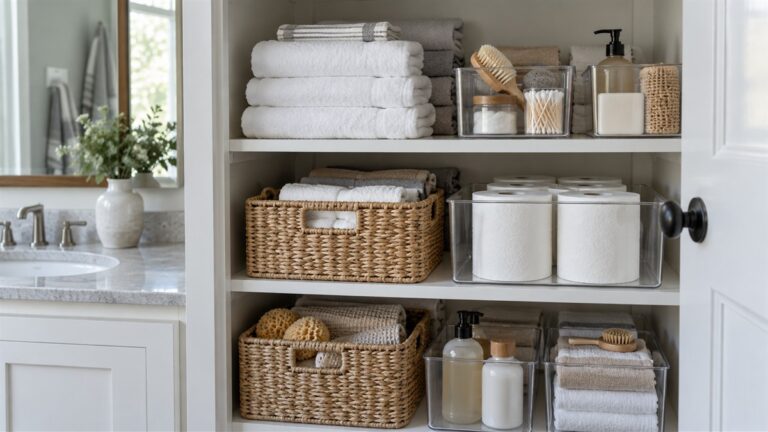
Containers turn loose items into groups. The Kansas State fact sheet describes organizing with hooks, hangers, shelves or baskets, and the Mississippi State guide includes storage bins, markers and labels in its supply list. Grouping by use follows the NC State rule to store similar items together. A basket or tray also solves the tipping problem: instead of six loose items that can topple, there is one container to lift down.
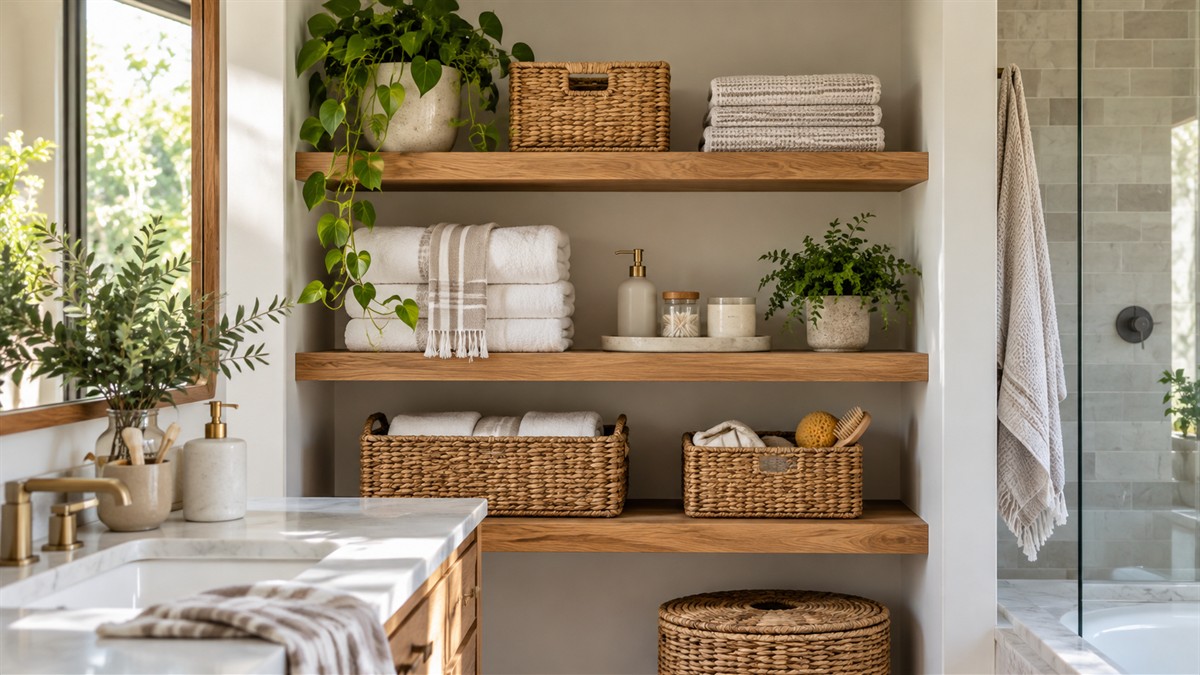
Open and covered containers pull in opposite directions. The University of Florida mildew guide notes, in its closet advice, that open shelving made of plastic-coated wire allows air circulation. The NC State circular says covered boxes protect hats from dust and soil. In a bathroom, a lid may shut out dust and splashes but may also hold in moisture, and the pages we opened do not say which effect matters more for toiletries. Our reading is to use open baskets or trays for items that are used daily and dry quickly, and to keep lidded containers for items that must stay clean and are rarely wet. Label whatever you use, since the Mississippi State guide includes labels in its supply list, and the labels let the next person put things back.
Step 5: Plan the towels
Towels are a common item on an open bathroom shelf and the most likely to be damp. The Kansas State publication says damp towels and clothes in laundry hampers, washers or dryers can develop mildew growth, and that some molds can take hold and form a new colony in one or two days on damp materials. The University of Florida guide suggests carrying wet towels to a rack in the garage or on the porch if you are battling a serious mildew problem. The EPA’s guide gives a time frame for water leaks and spills: if wet or damp materials are dried within 24 to 48 hours, mold will in most cases not grow. That figure is for leaks and spills, not towels, so applying it here is our analogy. Together the pages support a simple rule: towels that are still damp after a day or two are a mold risk, so let them dry fully before they join the folded stack. A bar or hook gives air access to both sides, which is our suggestion and not a statement from the pages we opened.
Put the folded, dry towels on the shelf and the damp ones on a bar or hook. For the shelf itself, our guides to over-the-toilet towel storage ideas and freestanding bathroom shelves over the toilet cover the furniture side.
Step 6: Run the fan long enough
NDSU Extension says to run the bathroom exhaust fan during, and for a few minutes after, showers, and that you should be able to feel air entering the bathroom under the door while the fan runs. The University of Florida mildew guide gives a longer rule: turn on the exhaust fan as soon as you start to shower and let it run for about 10 to 15 minutes after you finish. It adds that you should turn it off after that, to avoid bringing too much outside air into the rest of the house, and that cooler showers put less moisture into the air. The formula is fan time = shower length + 10 to 15 minutes. The shower lengths below are our own illustrations.
| Shower length (minutes, our illustration) | Fan time at +10 minutes | Fan time at +15 minutes |
|---|---|---|
| 5 | 5 + 10 = 15 | 5 + 15 = 20 |
| 10 | 10 + 10 = 20 | 10 + 15 = 25 |
| 15 | 15 + 10 = 25 | 15 + 15 = 30 |
Other habits from these pages help an open shelf too. The University of Florida guide notes that some people keep a window squeegee in the shower and take a minute or two to wipe water into the drain, and the Kansas State publication says: “Wipe down shower walls with a squeegee or sponge after bathing.” If the fan does not seem to clear the room, the EPA bathroom tip is to increase ventilation by running a fan or opening a window. The University of Florida guide qualifies that for humid climates: open a window to bring in air only if the outside air is dry.
Step 7: Clean the shelf and watch for mildew
Open shelves collect soap film and splashes. NDSU Extension says soap scum and skin cells that collect on shower surfaces are food for mold and mildew. That advice is about showers, not shelves, but the same soap and moisture can reach a shelf near one. Kansas State says mold growth can often be seen as a discoloration ranging from white to orange and green to brown and black, and that mold can sometimes be detected by its musty odor. If it appears on a hard shelf surface, the EPA says to scrub mold off hard surfaces with detergent and water, dry completely, and fix the moisture problem. It says a moldy area under about 10 square feet can usually be handled at home, and that porous materials may have to be thrown away.
How we chose
This is a method guide and not a product list. We opened pages on 2026-10-21 and kept only rules that a page states: an EPA mold guide, a University of Florida mildew publication, a MedlinePlus article on storing medicines, an FDA page on expired medicines, the Up and Away campaign, a Safe Kids Worldwide poison page, a Mississippi State University Extension clutter guide, two Kansas State University publications, a North Dakota State University Extension page, a North Carolina State Extension circular and the U.S. Access Board’s ADA standards page. We favored government, university and nonprofit pages. The ADA heights are used as a benchmark, and the container advice, the shelf heights and the fan table are our own applications, labeled as such.
Mistakes to avoid
- Leaving medicines in view. Up and Away says never to leave loose pills or liquid medicines out on a counter.
- Treating an open shelf as safe storage for cleaners. Safe Kids says cleaning products belong up and away in their original containers.
- Folding damp towels onto the shelf. The Kansas State publication says damp towels can develop mildew growth.
- Cutting the fan short. The University of Florida guide says to run it about 10 to 15 minutes after the shower.
- Overloading a shelf with loose items. The Mississippi State guide warns that cluttered shelves can cause injury if something topples.
- Keeping expired products on show. The Kansas State fact sheet lists out-of-date prescriptions and cosmetics as clutter.
What we could not verify
The pages we opened do not cover open bathroom shelves directly. They give no recommended number of items per shelf, no shelf spacing, no guidance on lidded versus open containers in a bathroom, and no weight limit for a shelf or its fixings. The ADA heights apply to covered facilities and accessible bathing rooms, not to private homes. The EPA’s 24 to 48 hour figure is written for leaks and spills, and the University of Florida publication is an archival copy written for Florida homes. The NC State circular is a 1965 reprint, read from a scan, and its remark about covered boxes concerns hats. Nothing here is a product claim, and no shelf is rated or recommended.
Frequently asked questions
What should not go on open bathroom shelves?
Medicines and cleaning products. MedlinePlus says bathroom heat and moisture may damage medicines and that they belong out of reach and out of sight of children. Safe Kids says cleaning and personal care products belong up and away, out of children’s reach and sight.
How do I keep open shelves from looking cluttered?
Group similar items, give each group one container, and give every keeper a specific location, as the Mississippi State guide advises. Sorting into keep, sell, donate and throw away piles first removes what should not be there.
Where should towels go on an open shelf?
Dry, folded towels can sit on the shelf at an easy reach height. The Kansas State publication says damp towels can develop mildew growth, so let them dry before they join the stack.
How high should open bathroom shelves be?
The pages give no home standard. The ADA standards use 15 to 48 inches as the reach range and 40 to 48 inches for shelves in accessible bathing facilities. Those apply to covered facilities, so treat them as a benchmark.
How do I keep open shelves from getting damp?
Keep humidity below 60 percent, as the EPA advises, and run the exhaust fan during the shower and for about 10 to 15 minutes afterward, as the University of Florida guide advises.
Are open shelves a good idea in a bathroom?
The pages we opened do not rank open against closed storage. They show the trade-offs: open shelving allows air circulation, while covered boxes protect against dust, and an open shelf has no door to keep medicines or cleaners out of sight.
Bottom line
Keep medicines and cleaners somewhere else, put harmless daily items in labeled containers at reaching height, and let towels and the room dry.
Sources
- https://www.epa.gov/mold/brief-guide-mold-moisture-and-your-home (opened 2026-10-21)
- https://journals.flvc.org/edis/article/download/108194/103485/149853 (opened 2026-10-21)
- https://www.shawnee.k-state.edu/homeandfamily/pdfs/Controling%20mold.pdf (opened 2026-10-21)
- https://www.ndsu.edu/agriculture/extension/control-mold-growth-bathroom (opened 2026-10-21)
- https://medlineplus.gov/ency/patientinstructions/000534.htm (opened 2026-10-21)
- https://www.fda.gov/drugs/safe-disposal-medicines/dont-be-tempted-use-expired-medicines (opened 2026-10-21)
- https://www.upandaway.org/ (opened 2026-10-21)
- https://www.safekids.org/poison (opened 2026-10-21)
- https://extension.msstate.edu/publications/ways-conquer-household-clutter (opened 2026-10-21)
- https://bookstore.ksre.k-state.edu/pubs/cut-the-clutter-and-get-organized-fact-sheet_MF2879.pdf (opened 2026-10-21)
- https://ocr.lib.ncsu.edu/ocr/ua/ua102_200-001-bx0004-004-005/ua102_200-001-bx0004-004-005.pdf (opened 2026-10-21)
- https://www.access-board.gov/ada/ (opened 2026-10-21)
As an Amazon Associate we earn from qualifying purchases.