How to Organize Deep Shelves in Bathroom
As an Amazon Associate we earn from qualifying purchases.
This guide shows how to organize deep shelves in bathroom cabinets, linen towers and vanities so nothing disappears at the back. The method has four parts: sort and discard, keep medicines and cleaning products away from damp and out of children’s reach, divide the depth into front and back zones with labeled bins, and keep the shelf dry enough to stay clean. It draws on extension publications, the National Library of Medicine, the FDA, the EPA and the ADA reach ranges, and it says where those pages stop.
Quick answer
- Empty the shelf and sort into keep, sell, donate and throw away, then group like items, as Mississippi State University Extension advises.
- Put the things you use daily in the front zone and the backups in the back, which applies the extension rule to store frequently used items within easy reach.
- Take medicines off the bathroom shelf if you can. MedlinePlus says heat and moisture from the shower, bath and sink may damage them, and that they belong out of reach and out of sight of children.
- Keep indoor humidity below 60 percent, as the EPA advises, so the shelf and what is on it stay dry.
Why depth is the problem
A shallow shelf shows everything at a glance. A deep one hides the back row behind the front row, so items get pushed back, forgotten and bought twice. The pages we opened say little about bathroom shelves as such. What they do offer are general storage rules, and the Mississippi State guide to household clutter puts the first one in a sentence: find a specific location for everything you plan to keep. A North Carolina State Extension circular reprinted in 1965 adds a short planning list. It says to store articles near the place they are used, to store similar items together, to store frequently used items within easy reach, and to sort out things not often used and store them elsewhere or discard them.
Those rules have a depth consequence. If the front of a shelf is the easiest place to reach, a deep shelf gives you a front zone for daily items and a back zone for everything else, and the back zone needs a plan. The ADA standards, published by the U.S. Access Board, give a way to think about how far a person can reach into a shelf. For a high forward reach over an obstruction, the high limit is 48 inches where the reach depth is 20 inches or less. Where the reach depth is more than 20 inches, the high limit drops to 44 inches, and the reach depth cannot exceed 25 inches. The standards apply to facilities covered by the ADA, not to a private home, so this is a benchmark and not a requirement. Applying it to a shelf is our own analogy: the depth of the shelf is the distance you must reach.
| Shelf depth (inches, our illustration) | ADA reach-depth band | Highest shelf height the benchmark allows (inches) |
|---|---|---|
| 12 | 20 or less | 48 |
| 16 | 20 or less | 48 |
| 20 | 20 or less | 48 |
| 24 | More than 20, up to 25 | 44 (48 − 4) |
| 28 | More than 25 | Outside the benchmark: the reach depth cannot exceed 25 |
The table shows two things. A deep shelf is easier to use when it sits lower, and a shelf deeper than 25 inches is beyond the benchmark at any height. If your shelves are deep and high, the answer is to keep only rarely used items on them. For under-vanity and sink storage, our guides to the best under-vanity organizer and under-bathroom-sink pull-out storage cover the products that bring the back row forward.
Step 1: Pull everything out and sort
Take every item off the shelf before you decide anything. The Mississippi State guide suggests starting with a small area, with an under-the-sink cabinet as its example, so the job does not overwhelm you. It lists the supplies to have ready: garbage bags, storage bins, markers and labels, multipurpose cleaners, towels and a vacuum. Sort items into four piles: keep, sell, donate or throw away. Then, as the guide puts it, “Group similar items together to easily find them in the future.”
The Kansas State University fact sheet on clutter uses a similar box method and describes the keep box as the place to sort like items together and return items to their proper places. It also lists out-of-date prescriptions and cosmetics among the sources of clutter. In a bathroom that line is a prompt to check dates. The FDA page on expired medicines says certain medicines need refrigeration and that others cannot be exposed to high temperatures, and MedlinePlus advises throwing out medicines that are out of date. MedlinePlus describes two ways to dispose of them: mix the medicine with something that ruins it, such as coffee grounds or kitty litter, and seal the mixture in a plastic bag for the trash, or bring unused medicines to a pharmacist or a community drug give-back program.
When the shelf is empty, wipe it. The Mississippi State guide says to clean and wipe down the newly exposed area, because that helps remove dust and allergens that have been hiding behind or underneath the clutter. The NC State list adds a design rule that applies once the items are back: plan the storage for easy cleaning, and see that it has good lighting and ventilation.
Step 2: Decide what should not live on a deep bathroom shelf
Some items belong somewhere else, and the pages we opened name two groups. The first is medicine. MedlinePlus says to store medicines in a cool, dry place, such as a dresser drawer or a kitchen cabinet away from the stove, sink and hot appliances, and notes that most people store them in a bathroom cabinet where the heat and moisture from the shower, bath and sink may damage them. The FDA page agrees, naming a damp bathroom cabinet as improper storage that can reduce the effectiveness of medicines before their expiration date. The second group is cleaning and personal care products. Safe Kids Worldwide says young children are often at eye level with items under kitchen and bathroom sinks, so these products belong up and away, out of children’s reach and sight, in their original containers.
Child access is the other half of the medicine rule. The Up and Away campaign, an initiative that was first created in partnership with the CDC, tells families to pick a place that is too high for children to reach or see, and says never to leave loose pills or liquid medicines out on a counter. MedlinePlus adds that medicines should stay out of reach and out of sight and suggests a cabinet with a child latch or lock. For a deep bathroom shelf, that means the top of the shelf unit or a latched cabinet is a safer home for the cleaners than the front edge of a low shelf.
| Item group | What the pages say | Where it goes on the shelf (our reading) |
|---|---|---|
| Medicines and vitamins | Cool, dry place; bathroom heat and moisture can damage them; out of reach and sight of children (MedlinePlus, FDA, Up and Away) | Off the bathroom shelf if possible; otherwise high and latched |
| Cleaning products | Original containers, up and away, out of children’s reach and sight (Safe Kids) | Top zone or a latched cabinet |
| Daily toiletries | Store frequently used items within easy reach (NC State) | Front zone at reaching height |
| Backup stock | Sort out things not often used and store elsewhere or discard (NC State) | Back zone, or another room |
| Out-of-date items | Out-of-date prescriptions and cosmetics are clutter (Kansas State) | Discard |
| Damp towels | Damp towels can develop mildew growth (Kansas State) | Not stored damp in the back of a closed shelf |
Step 3: Split the depth into zones and use bins
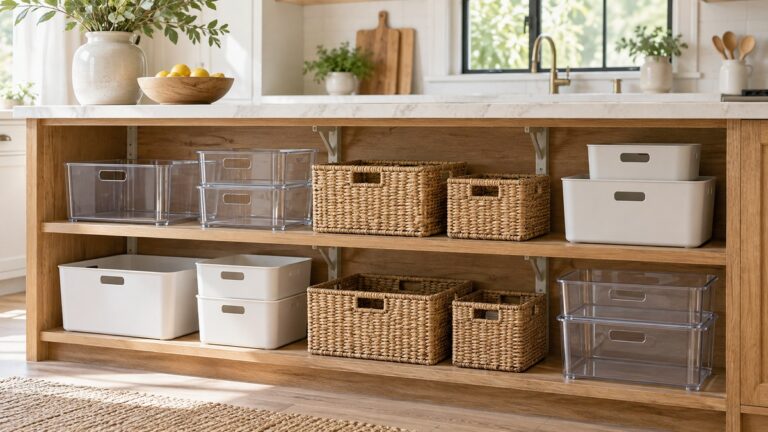
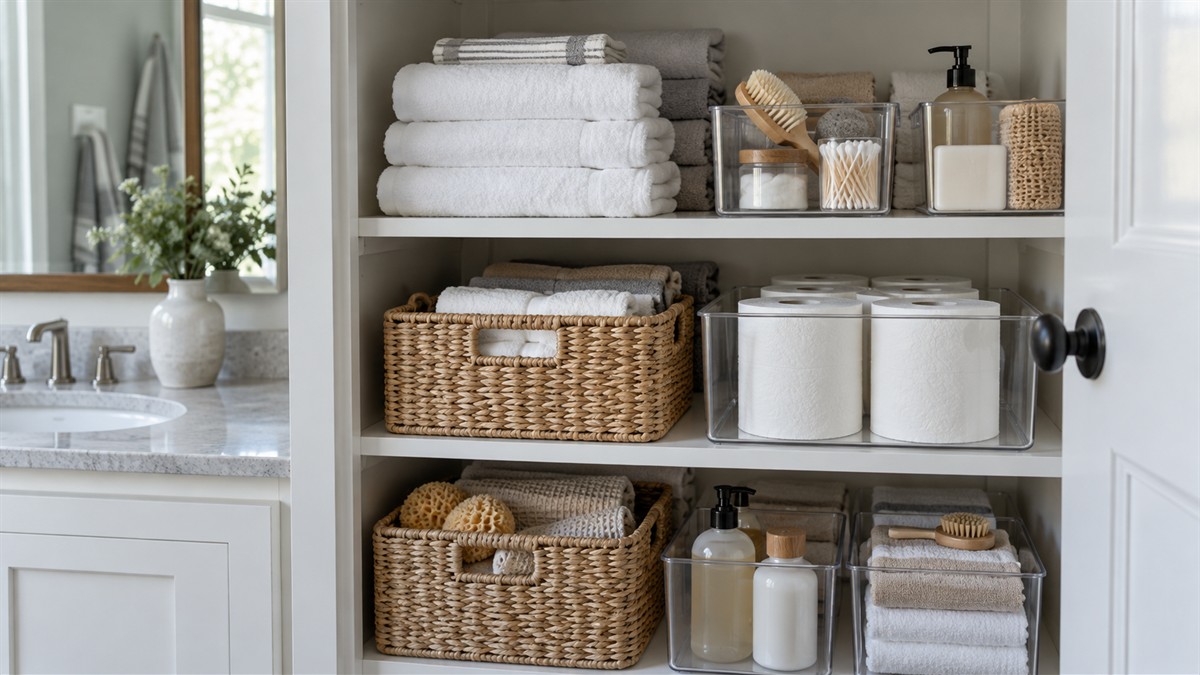
With the discards gone and the medicines relocated, split what remains by how often you use it. Our recommended structure is a front zone and a back zone, each about half the shelf depth, with a bin or tray as the unit in each zone. The half-depth split is our own assumption, not a figure from the pages we opened. The reason for bins is simple: a bin lets you pull a whole group forward at once, so the back row stops being a separate hunt. The Mississippi State guide includes storage bins and labels in its supply list, and the Kansas State fact sheet advises labeling bins and totes in its storage-box step.
The next table shows what the split means for one shelf. The formula is columns = shelf width ÷ bin width (rounded down), rows = shelf depth ÷ bin depth (rounded down), and bins per shelf = columns × rows. The front row is the set of bins you can see without moving anything. The shelf size (36 inches wide and 24 inches deep) and the bin sizes are our own illustrations, so measure your shelf and your bins before you rely on any of it.
| Bin footprint, width × depth (inches, our illustration) | Columns on a 36-inch shelf | Rows on a 24-inch shelf | Bins per shelf | Front-row bins |
|---|---|---|---|---|
| 6 × 12 | 36 ÷ 6 = 6 | 24 ÷ 12 = 2 | 6 × 2 = 12 | 6 |
| 9 × 12 | 36 ÷ 9 = 4 | 24 ÷ 12 = 2 | 4 × 2 = 8 | 4 |
| 12 × 12 | 36 ÷ 12 = 3 | 24 ÷ 12 = 2 | 3 × 2 = 6 | 3 |
| 12 × 24 (one full-depth bin) | 36 ÷ 12 = 3 | 24 ÷ 24 = 1 | 3 × 1 = 3 | 3 |
Read the table in two ways. First, narrower bins give more front-row positions, which means more categories you can see at once. Second, the bottom row has no back row at all, so everything in it is visible when you look in, but each bin is bigger and heavier to pull. The pages we opened do not say which layout is best, so the choice depends on how many categories you have and how deep your reach is. If your shelf is in a linen cabinet, our guide to storing towels in a closet covers the same zoning for bulkier items, and the guide to organizing under a bathroom sink covers the lower cabinet.
Label every bin. The Kansas State fact sheet says to label all bins and totes, and the Mississippi State supply list includes markers and labels. On a deep shelf a label on the front face of the bin is what lets you read the back row without pulling anything out. Put the label on the side that faces you, and group backups by category (spare toothbrushes together, razors together) so that a refill takes one pull and not three.
Step 4: Set the height of each zone
Height is the second dimension of reach. The ADA standards use 15 inches as the low limit and 48 inches as the high limit for an unobstructed forward reach. For accessible bathing facilities, the standards add that shelves are to be located at least 40 inches and at most 48 inches above the finish floor. These are rules for ADA-covered buildings and a published reference, not a requirement for a home, but they give a concrete band for the items you reach for every day. Anything above 48 inches is a top-zone item by this benchmark, and anything below 15 inches is a floor-level item.
| Height band above floor (inches) | Benchmark source | Suggested use (our reading) |
|---|---|---|
| Below 15 | Outside the ADA unobstructed reach range | Rarely used backups, sturdy storage |
| 15 to 40 | Inside the ADA reach range | Daily items that need no bending to the floor |
| 40 to 48 | Accessible bathing facility shelves (ADA 603.4) | The best band for the front zone |
| Above 48 | Outside the ADA reach range | Cleaners in original containers, seasonal stock, anything adults reach for rarely |
The Safe Kids point about eye level complicates the lower bands in a home with children. Safe Kids says young children are often at eye level with items under the sinks. The result is a trade-off the pages do not resolve: the easiest adult reach band and the easiest child reach band overlap in the lower part of a shelf, so the items in them should be the harmless ones. This is our reading, and the pages we opened do not name specific toiletries as safe or unsafe.
Step 5: Keep the shelf dry
A deep shelf is a closed pocket of air, and bathrooms are damp. The EPA says to keep indoor humidity below 60 percent, ideally between 30 and 50 percent, and says a humidity meter can measure it. Its bathroom tip adds that if mold keeps coming back in the shower or elsewhere in the bathroom, increasing ventilation by running a fan or opening a window, and cleaning more frequently, will usually prevent it from recurring or keep it to a minimum. The University of Florida mildew guide says to turn on the exhaust fan as soon as you start to shower and to let it run about 10 to 15 minutes afterward. It adds that even a tiny bit of soap or body oils from showering will support mildew growth, and the Kansas State mold publication says damp towels can develop mildew growth.
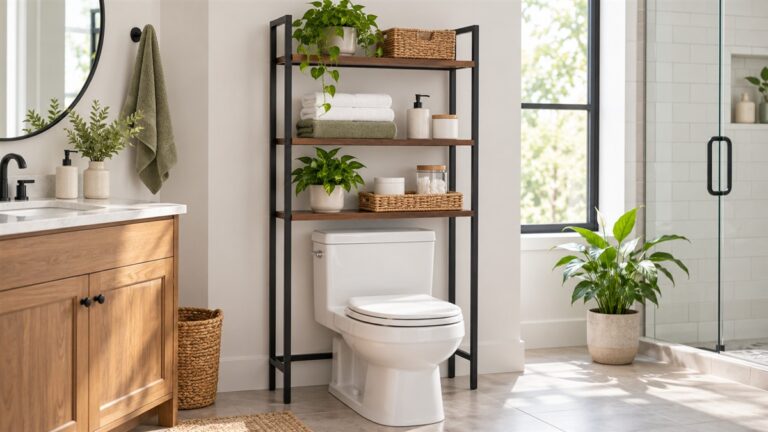
The same guide’s closet advice carries over to a deep bathroom shelf by analogy. It says open shelving made of plastic-coated wire allows air circulation, and that items should be kept off the floor because moisture can be trapped under them. That points to leaving a gap between bins and the back wall of the shelf, and to raising the lowest bin off a wet floor. Both are our applications of a closet rule, since the pages we opened do not discuss bathroom shelves. If you are replacing a shelf, our guide to the best bathroom floor cabinet for small spaces covers floor-level units.
Step 6: Keep it from creeping back
The Mississippi State guide gives habits that suit a shelf that refills itself. It says to remove an unused item before buying something new, and it describes a 60-second rule: if putting an item away takes 60 seconds or less, do it now. For a bathroom this means returning the bin to the shelf after each use instead of leaving it on the counter. Re-sort when the backup zone overflows, and check dates then.
How we chose
This is a method guide and not a product list. We opened pages on 2026-10-21 and kept only rules that a page states: a Mississippi State University Extension clutter guide, a Kansas State University clutter fact sheet, a North Carolina State Extension circular, the U.S. Access Board’s ADA standards page, a MedlinePlus article on storing medicines, an FDA page on expired medicines, the Up and Away campaign, a Safe Kids Worldwide poison page, an EPA mold guide, a University of Florida mildew publication and a Kansas State University mold publication. We favored government, university and nonprofit pages. Rule sources are named where they are used. The ADA benchmark, the half-depth zones and the bin tables are our own applications and are labeled as such.
Mistakes to avoid
- Leaving medicines on a bathroom shelf. MedlinePlus and the FDA both name the bathroom as a poor place for them.
- Keeping cleaners at child height. Safe Kids advises keeping cleaning and personal care products out of children’s reach and sight.
- Stacking the back row. The NC State list says to store frequently used items within easy reach, which a buried back row is not.
- Skipping the dry wipe. The Mississippi State guide says to clean the newly exposed area after clearing it.
- Sealing the shelf against air. The EPA bathroom tip is to increase ventilation, not to close it off.
- Keeping expired items. The Kansas State fact sheet lists out-of-date prescriptions and cosmetics as clutter.
What we could not verify
The pages we opened do not discuss bathroom shelf dimensions, bin sizes, pull-out systems or the weight a shelf can carry. They give no standard shelf depth, so every depth in the tables is an illustration. The ADA reach ranges and the 40 to 48 inch shelf band apply to ADA-covered facilities and accessible bathing rooms, not to private homes. The NC State circular is a 1965 reprint, and its text is read from a scan. The University of Florida guide is an archival copy written for Florida homes and covers closets, bathrooms and bedrooms, not shelf depth. Rev-A-Shelf pull-out specifications did not load for us, so no product dimensions are used. Nothing here is a product claim, and no organizer is rated or recommended.
Frequently asked questions
How do I stop things from getting lost at the back of a deep bathroom shelf?
Use bins that pull a whole group forward, put daily items in the front zone, and label the bins. The NC State circular says to store frequently used items within easy reach and to move rarely used items elsewhere or discard them.
Should I store medicine on a bathroom shelf?
MedlinePlus says no if you can avoid it. It names the heat and moisture from the shower, bath and sink as a risk and suggests a dresser drawer or a kitchen cabinet away from the stove and sink. The FDA names a damp bathroom cabinet as improper storage.
Where should cleaning products go in a bathroom?
Up and away, out of children’s reach and sight, and in their original containers, according to Safe Kids Worldwide. The Up and Away campaign makes the same point about medicines and adds a child-resistant container.
How deep is too deep for a bathroom shelf?
The pages we opened give no standard. As a benchmark, the ADA standards allow a high forward reach of 48 inches over a depth of up to 20 inches, and 44 inches over a depth of 20 to 25 inches, with 25 inches as the maximum. Those limits apply to ADA-covered facilities, not homes.
How do I keep a bathroom shelf from getting damp?
Run the exhaust fan during the shower and for about 10 to 15 minutes afterward, as the University of Florida guide advises, and keep indoor humidity below 60 percent, as the EPA advises. Leave space around the bins for air to move.
What should I do with expired medicine?
MedlinePlus says to throw out medicines that are out of date. It suggests mixing the medicine with coffee grounds or kitty litter and sealing it in a bag for the trash, or taking it to a pharmacist or a drug give-back program.
Bottom line
Sort the shelf, move medicines and cleaners where they belong, put the daily items in front in labeled bins, and keep the air moving so the back stays dry.
Sources
- https://extension.msstate.edu/publications/ways-conquer-household-clutter (opened 2026-10-21)
- https://bookstore.ksre.k-state.edu/pubs/cut-the-clutter-and-get-organized-fact-sheet_MF2879.pdf (opened 2026-10-21)
- https://ocr.lib.ncsu.edu/ocr/ua/ua102_200-001-bx0004-004-005/ua102_200-001-bx0004-004-005.pdf (opened 2026-10-21)
- https://www.access-board.gov/ada/ (opened 2026-10-21)
- https://medlineplus.gov/ency/patientinstructions/000534.htm (opened 2026-10-21)
- https://www.fda.gov/drugs/safe-disposal-medicines/dont-be-tempted-use-expired-medicines (opened 2026-10-21)
- https://www.upandaway.org/ (opened 2026-10-21)
- https://www.safekids.org/poison (opened 2026-10-21)
- https://www.epa.gov/mold/brief-guide-mold-moisture-and-your-home (opened 2026-10-21)
- https://journals.flvc.org/edis/article/download/108194/103485/149853 (opened 2026-10-21)
- https://www.shawnee.k-state.edu/homeandfamily/pdfs/Controling%20mold.pdf (opened 2026-10-21)
As an Amazon Associate we earn from qualifying purchases.