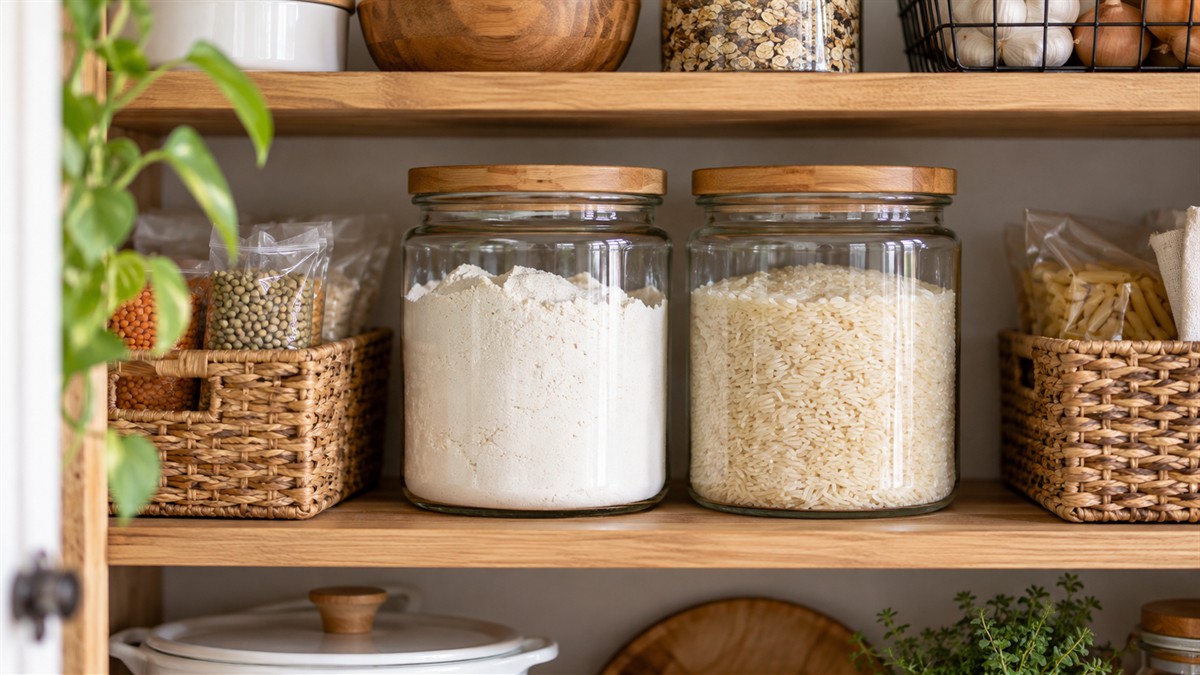
How to Store Flour and Rice in a Pantry
As an Amazon Associate we earn from qualifying purchases.
How to store flour and rice in a pantry starts with the container: move both into tightly closed containers, keep them in a cool, dry cabinet, and look at them for insects. University pest, food-safety and extension pages agree on that much. They disagree on bags, on how long each food keeps, and on how long whole-grain flour lasts in the freezer. White flour runs from 6 to 12 months across the pages, and white rice from one year to two. This guide sets the figures side by side.
Quick answer
- Use a tightly closed container. Every page asks for one, but the University of California says plastic bags are not adequate, while a Mississippi State release says zip-top bags are usually sufficient.
- Pick a cool, dry cabinet away from the stove, oven and dishwasher. Texas A&M gives 50 to 70 degrees Fahrenheit as the ideal pantry range.
- Expect 6 to 12 months for white flour and one to two years for white rice at room temperature. Whole wheat flour and brown rice are shorter because their natural oils turn rancid.
- Keep whole wheat flour, and any flour you use rarely, in the refrigerator or freezer. Look for webbing or small insects each time you open a container.
Choose the container: what the pages say
Every page that covers flour or rice names a closed container, and the wording differs in small ways. The table collects it.
| Source | What it says about containers |
|---|---|
| University of California IPM | Use containers with tight-fitting lids, not plastic bags |
| Mississippi State University Extension (2015 release) | Store opened food in airtight glass or plastic containers; zip-top bags are usually sufficient to keep pests at bay |
| Purdue Extension (CFS-423-W) | Store flour in an airtight container, because it takes up moisture and dries out easily; a large bag can stay in its bag inside a large covered container |
| Washington State University Extension (2016) | Keep flour in an airtight container or freezer bag to preserve its moisture content |
| Virginia Tech (revised October 2025) | Store raw white rice in tightly closed containers; cereals in tightly closed containers to keep out moisture and insects |
| Tufts University Health & Nutrition Letter | Store flour in an air-tight container in a cool, dry cupboard |
The one open disagreement is the plastic bag. The University of California page says: “Place it in containers with tight-fitting lids; plastic bags aren’t adequate.” The Mississippi State release says zip-top bags are usually sufficient. The release is a news item from 2015 written for a general audience, and the University of California page comes from a pest-management program. A rigid container with a tight lid satisfies every page, which is our reading of the table, not a rule from any one of them.
Container size is the other decision. Washington State gives volumes for flour: 1 pound is about 4 cups, 5 pounds about 20 cups and 10 pounds about 40 cups. Tufts notes that flour is generally sold in two- and five-pound bags. The table below applies the Washington State ratio to those bag sizes and converts cups to quarts and gallons (4 cups = 1 quart, 4 quarts = 1 gallon).
| Bag of flour | Cups (4 per pound) | Quarts (cups ÷ 4) | Gallons (quarts ÷ 4) |
|---|---|---|---|
| 2 pounds | 2 × 4 = 8 | 8 ÷ 4 = 2 | 0.5 |
| 5 pounds | 5 × 4 = 20 | 20 ÷ 4 = 5 | 1.25 |
| 10 pounds | 10 × 4 = 40 | 40 ÷ 4 = 10 | 2.5 |
The Washington State figures say “about,” and no page says how much empty space a container should have. A container sold at exactly the listed volume may be too tight, so check the maker’s stated capacity against your bag size and allow room. The pages give no cups-per-pound figure for rice, so we do not size rice containers here.
Choose the spot: cool, dry and away from strong odors
Texas A&M says pantry storage conditions should be “dry, cool, and dark,” with an ideal range of 50 to 70 degrees Fahrenheit, and that higher temperatures speed up deterioration. It says to use the coolest cabinets, away from the range, oven, water heater, dishwasher or any hot pipes. Purdue is blunter about flour: “If you store flour in a warm place, you are likely to have company” in the form of insects, it says.
Two other rules apply to dry staples. Purdue says flour absorbs odors and should not be stored near soap powders, medicines or other items with strong odors. Illinois Extension says to keep the food storage area dry, keep food off the ground and not store food and cleaning supplies in the same area. North Carolina A&T lists rice, pasta, cereal, flour and sugar among shelf-stable foods that can be stored in a cool, dry place. Purdue adds that in hot, humid weather you should buy flour in small amounts and keep it in the refrigerator or freezer.
Tufts gives a buying rule that follows from this. If you live alone or do not bake often, choose the smaller bag. For shelf options in a small kitchen, see our guide to small kitchen pantry shelving.
How long flour and rice keep at room temperature
The pages give numbers that overlap but do not match. The first table covers flour. Texas A&M and New Mexico State print the same pantry figures, so we do not count them as independent confirmation of each other.
| Source | White or all-purpose flour | Whole wheat flour |
|---|---|---|
| Purdue Extension (chart at 70 degrees F) | 6 to 8 months | 6 to 8 months, but the text says to keep it refrigerated year-round |
| Texas A&M AgriLife Extension (pantry column) | 6 to 8 months | 3 to 6 months |
| New Mexico State University (pantry column) | 6 to 8 months | 3 to 6 months |
| Washington State University Extension (dry, cool place) | 6 to 12 months | 1 to 3 months at room temperature |
| Tufts University Health & Nutrition Letter | 8 to 12 months (all-purpose) | 1 to 3 months (whole-grain flours, citing the Whole Grains Council) |
White flour spans 6 to 12 months, so the longest figure is twice the shortest (12 ÷ 6 = 2). Whole wheat spans 1 to 8 months, which is a factor of eight (8 ÷ 1 = 8), and the high end belongs to Purdue’s chart while Purdue’s own text recommends the refrigerator. Washington State explains the whole wheat figure: the oils found in the germ turn rancid at room temperature, so the flour does not last as long as white flour. Tufts gives the same reason, saying the higher oil content comes from the germ and bran.
The second table covers rice.
| Source | White rice | Brown rice | Flavored or mixed rice |
|---|---|---|---|
| Purdue Extension (chart at 70 degrees F) | 2 years | Not listed | Flavored or herb: 6 months |
| Texas A&M AgriLife Extension (pantry column) | 2 years | 1 year | Mixes: 6 months |
| New Mexico State University (pantry column) | 24 months | 12 months | Mixes: 12 to 24 months |
| Virginia Tech (revised October 2025) | Use within one year | Shorter than white; no figure given | Not listed |
Three pages put white rice at about two years (24 months), and Virginia Tech says to use it within one year, which is half the figure (12 ÷ 24 = 0.5). Virginia Tech says brown and wild rice have a shorter shelf life at room temperature because the natural oil can turn rancid, and Texas A&M and New Mexico State put brown rice at one year. For mixed and flavored rice, the pages disagree by a factor of two or more: 6 months at Purdue and Texas A&M against 12 to 24 months at New Mexico State. None of these pages explains the gaps.
When the refrigerator or freezer is the better choice
The University of California says to keep infrequently used foods such as flours, spices and grains in a freezer if possible, and that doing so prevents infestations from developing. Virginia Tech says whole wheat flour and other whole grains may be stored in the refrigerator or freezer to protect the natural oil from becoming rancid, and that refrigeration or freezing may extend the shelf life of rice. Purdue says to keep whole wheat flour in the refrigerator year-round. A Mississippi State agent says flour and cornmeal can be stored in the freezer or refrigerator until ready for use.
The cold-storage times are less consistent than the room-temperature ones, as the table shows.
| Source | White or all-purpose flour | Whole wheat flour |
|---|---|---|
| Washington State University Extension | Up to 2 years in the refrigerator; indefinitely in the freezer | 6 months in the refrigerator; up to 12 months in the freezer |
| New Mexico State University | 12 months in the refrigerator | 6 to 8 months in the refrigerator; 24 months in the freezer |
| Tufts University Health & Nutrition Letter | Not given | 2 to 6 months in the freezer (whole-grain flours) |
For whole wheat flour in the freezer, the figures run from 2 to 24 months, which is a twelve-fold spread (24 ÷ 2 = 12). The pages do not say why. Treat the lower figures as the safe planning number and the higher ones as the upper limit.
Washington State adds one practical rule for cold flour: let it return to room temperature before using it, because the coolness may affect its reaction with other ingredients and change the outcome of a recipe. It also says to keep cold flour in an airtight container or freezer bag.
Check for insects every time you open a container
The University of California page lists flour and rice among the foods that pantry moths and beetles attack. Indian meal moth larvae attack cereal products, flour, cornmeal and rice, and the page names the rice weevil and the granary weevil among the seed-feeding beetles. Its signs of trouble are plain: “Webbing in tight places of a package or tiny holes in a food container are signs of a pantry pest infestation.”
Tufts gives the reader’s version of the same check. All flours are susceptible to bugs, it says, so you should always look at your flour, and if it smells bad or contains small bugs, you should discard it. A Mississippi State release adds that infestations of red or confused flour beetles, usually called weevils, are especially common in cereal and flour products.
What to do with an infested container is where the pages split. The University of California says to throw away any food that has evidence of infestation. The Mississippi State release says that if items of high value are affected, you can place them in a deep freezer at zero degrees for at least four days, or heat items that can take it in a 130-degree oven for at least 30 minutes. A bag of flour or rice is rarely a high-value item, and the University of California is the stricter of the two, so discarding is the course the pages best support. After you remove the source, the University of California page says to wash old containers before filling them with new food, because they may be contaminated and cause a new infestation.
Shelf layout and rotation
Keep the container’s contents from mixing. The University of California says not to mix old and new lots of food, because if the old material is infested the pest will quickly invade the new. That is a reason to finish a canister and wash it before you refill it from a new bag. North Carolina A&T says to store newer food packages behind older ones and use the first-in, first-out method. Texas A&M says to keep containers clean and free of dust and to clean the pantry periodically to remove food particles.
A label makes rotation practical. Neither of those pages says what to write, so the label is our suggestion: the purchase month, and the check-by month from the table you choose. For a pantry that also holds spices, our guide to a spice organizer for a pantry covers that part of the shelf, and the University of California lists spices among the foods that pantry pests attack.
A worked example: container sizes and check-by months
Suppose you buy a 5-pound bag of all-purpose flour, a 2-pound bag of whole wheat flour and a bag of white rice in November 2026. That purchase month is our assumption. The table turns the page horizons into check-by months by adding the months from each source to the purchase month.
| Item | Storage place | Horizon used | Check-by month |
|---|---|---|---|
| 5 lb all-purpose flour | Pantry | 6 to 12 months (Washington State) | May 2027 to November 2027 |
| 5 lb all-purpose flour | Refrigerator | Up to 24 months (Washington State) | November 2028 |
| 2 lb whole wheat flour | Pantry | 1 to 3 months (Washington State and Tufts) | December 2026 to February 2027 |
| 2 lb whole wheat flour | Refrigerator | 6 months (Washington State) | May 2027 |
| White rice | Pantry | 12 months (Virginia Tech) to 24 months (three pages) | November 2027 to November 2028 |
The containers would need about 5 quarts for the all-purpose flour (20 cups ÷ 4) and about 2 quarts for the whole wheat flour (8 cups ÷ 4), on the assumption that whole wheat flour fills about the same volume per pound as the flour in the Washington State figure. The pages do not say that, so allow extra room. Together that is 7 quarts, or 1.75 gallons (7 ÷ 4).
The example shows why the horizon you pick matters. The whole wheat flour could be due for a check as early as December 2026 in the pantry or as late as May 2027 in the refrigerator, and the all-purpose flour could stay in the freezer indefinitely, by Washington State’s account. Pick one source, write the date on the container, and keep to it.
How we chose
This guide uses pages that we opened on 2026-10-21 and whose text contained what we cite. We looked first for university extension pages on flour and rice storage, then for pest guidance, then for figures we could put side by side. We kept Purdue’s undated cupboard publication because it is one of the few that covers flour handling in detail, and we flag where its chart and its text differ. We kept the Mississippi State release because it disagrees with the pest-management page on bags, and a disagreement is information, and we kept the Tufts letter for its flour figures. Pages from the USDA Food Safety and Inspection Service, FoodSafety.gov and a University of Georgia news site refused our download, and we did not use them.
The conversions, the gallons table, the ratios and the check-by months are our own arithmetic from the stated figures. We did not rank the pages.
Mistakes to avoid
- Leaving flour or rice in a plastic bag. The University of California says plastic bags are not adequate for pantry storage.
- Keeping flour near the stove. Purdue says flour stored in a warm place is likely to attract insects.
- Leaving whole wheat flour at room temperature for months. Purdue, Washington State and Virginia Tech all point to the refrigerator or freezer.
- Topping up an old canister with new flour. The University of California says not to mix old and new lots.
- Storing flour next to soap or other strong-smelling items. Purdue says flour absorbs odors.
- Using cold flour straight from the freezer. Washington State says to let it return to room temperature first.
What we could not verify (what the sources do not say)
The pages we opened do not agree on bags, on pantry life for white flour, on whole wheat flour in the freezer, or on mixed rice, and none explains the gaps. They give no volume for a pound of rice, no humidity target, no guidance on spotting rancid rice, and no times for specific rice types such as basmati or jasmine. The Washington State flour volumes are approximate. The Mississippi State release dates from 2015, the Washington State post from 2016, and the Purdue publication has no date in the text we read. The Tufts letter cites the Whole Grains Council, which we did not open.
Frequently asked questions
Where should I store flour in the pantry?
Use a cool, dry cabinet away from the stove, oven and dishwasher, in an airtight container. Texas A&M gives 50 to 70 degrees Fahrenheit as the ideal range, and Purdue says flour kept in a warm place is likely to attract insects.
How long does flour last in the pantry?
White flour runs from 6 to 12 months across Purdue, Texas A&M, New Mexico State, Washington State and Tufts. Whole wheat flour is shorter, from 1 to 3 months at Washington State and Tufts to 3 to 6 months at Texas A&M and New Mexico State.
Can I leave rice in the bag it came in?
The pages do not address the original bag. Virginia Tech says to store raw white rice in tightly closed containers and use it within one year, and the University of California says plastic bags are not adequate for pantry storage.
Does brown rice go bad faster than white rice?
Yes, according to Virginia Tech, which says the natural oil in brown and wild rice can turn rancid at room temperature. Texas A&M and New Mexico State put brown rice at one year against two for white rice.
What do I do if I find bugs in flour or rice?
Tufts says to discard flour that smells bad or contains small bugs, and the University of California says to throw away any food that shows evidence of infestation. Wash the shelf and the container before you restock, since old containers may be contaminated.
Do I need to warm flour before baking?
Washington State says to let flour from the refrigerator or freezer return to room temperature before using it, since the coolness may affect how it reacts with other ingredients.
Bottom line
Keep flour and rice in tightly closed containers in a cool, dry cabinet, refrigerate whole wheat flour, and check each container for insects before you use it.
Sources
- https://ipm.ucanr.edu/home-and-landscape/pantry-pests/ (opened 2026-10-21)
- https://www.extension.purdue.edu/extmedia/CFS/CFS-423-W.pdf (opened 2026-10-21)
- https://agrilifeextension.tamu.edu/wp-content/uploads/2025/04/safe-home-food-storages.pdf (opened 2026-10-21)
- https://pubs.nmsu.edu/_e/E118/ (opened 2026-10-21)
- https://extension.wsu.edu/foodsafety/2016/04/29/cleaning-out-the-kitchen-cupboard/ (opened 2026-10-21)
- https://ext.vt.edu/content/pubs_ext_vt_edu/en/348/348-960/348-960.html (opened 2026-10-21)
- https://www.newswise.com/articles/spring-cleaning-can-keep-stored-food-pests-at-bay (opened 2026-10-21)
- https://www.nutritionletter.tufts.edu/ask-experts/q-does-whole-wheat-flour-go-bad-more-quickly-than-all-purpose-flour/ (opened 2026-10-21)
- https://extension.illinois.edu/food-safety/room-temperature-storage (opened 2026-10-21)
- https://www.ncat.edu/caes/cooperative-extension/covid-19/stocking-up.php (opened 2026-10-21)
Disclosure: As an Amazon Associate we earn from qualifying purchases.