How Deep Are Kitchen Cabinets
As an Amazon Associate we earn from qualifying purchases.
How deep are kitchen cabinets? Base cabinets are usually 24 inches deep and wall cabinets 12 inches deep, and both figures describe the cabinet box, not the doors. KraftMaid and Luxxe Cabinetry state those depths in their size guides, and IKEA’s metric wall and base cabinets run slightly deeper and shallower. Refrigerator surrounds, shallow pantry runs and desk-height bases use other depths. This guide lines up the published figures, shows the arithmetic, and says where the sources stop.
Quick answer
- Base cabinets: 24 inches deep is the standard in the KraftMaid and Luxxe guides, and IKEA’s 60 cm METOD base is 23 5/8 inches.
- Wall cabinets: 12 inches deep in the KraftMaid and Luxxe guides, and 14 5/8 inches for IKEA’s 37 cm METOD wall cabinet.
- The depth figure leaves out the doors. KraftMaid and Luxxe both say so, so add door thickness for the full depth.
- Other depths exist: 24-inch wall cabinets around a refrigerator, 12- or 15-inch shallow bases, 27-inch bases for large cooktops and sinks, and 21-inch desk-height bases.
The published depths side by side
Three cabinet makers publish depth figures we could read: KraftMaid, Luxxe Cabinetry and IKEA. The table collects them by cabinet type. A cell reads “not stated” where the page we opened says nothing.
| Cabinet type | KraftMaid | Luxxe Cabinetry | IKEA |
|---|---|---|---|
| Wall, standard | 12 inches | 12 inches | 14 5/8 inches (METOD, 37 cm); 14 3/4 inches (SEKTION, U.S. guide) |
| Wall, around a refrigerator | 24 inches | 24 inches | 24 inches (SEKTION deep wall cabinets) |
| Base, standard | 24 inches | 24 inches | 23 5/8 inches (METOD, 60 cm); 24 inches (SEKTION) |
| Base, shallow | 12 inches | Custom depths from 9 inches | 14 5/8 inches (METOD, 37 cm); 15 inches (SEKTION) |
| Base, for large cooktops and sinks | 27 inches | Not stated | Not stated |
| Desk-height or vanity base | Not stated | 21 inches | Not stated |
| Tall or pantry | 12 or 24 inches | 24 inches standard | 24 inches or 14 3/4 inches (SEKTION high cabinets) |
KraftMaid explains the standard wall depth: 12 inches “accommodates common items like cereal boxes and dinner plates, but won’t obstruct access to the countertops below.” For base cabinets it says the industry standard is 24 inches “as anything deeper makes it difficult to reach and retrieve items stored inside.” KraftMaid is the only page we opened that gives reasons for the standard depths, and none of the pages says why IKEA’s wall cabinet is deeper than 12 inches.
What the depth number includes and leaves out
Read the definition before you compare numbers. KraftMaid says its base cabinet figure “does not include doors and drawers, only the cabinet box dimension from the face frame to the back panel.” Luxxe Cabinetry says: “Cabinet depth does not include door thickness.” For its tall cabinets, the Luxxe guide adds that you should add door thickness for the total depth.
The Luxxe spec lists one door style at 3/4 inch thick, so that style gives a full depth of 24 + 0.75 = 24.75 inches for a standard base cabinet and 12 + 0.75 = 12.75 inches for a standard wall cabinet. Those totals are our arithmetic for that one style, and a thicker or thinner door changes them. IKEA handles it differently: its METOD listings give a depth without the suspension rail and a depth with it, and the difference is 1.0 cm (37.6 − 36.6) for the wall cabinet, or about 0.4 inch. The rail is what lets the cabinet hang, so plan with the larger figure.
| IKEA METOD cabinet | Without rail | With rail | System depth |
|---|---|---|---|
| Wall cabinet, 80 cm wide | 36.6 cm (14 3/8 in.) | 37.6 cm (14 3/4 in.) | 37.0 cm (14 5/8 in.) |
| Base cabinet, 60 cm wide | 59.0 cm (23 1/4 in.) | 60.0 cm (23 5/8 in.) | 60.0 cm (23 5/8 in.) |
A quick check of the IKEA conversions: 37.0 ÷ 2.54 = 14.57 inches against the printed 14 5/8 (14.625), and 60.0 ÷ 2.54 = 23.62 inches against the printed 23 5/8 (23.625). The printed fractions match the metric figures to within 0.06 inch, so you can use either.
Cabinets that are not the standard depth
The size guides list the exceptions, and they are common enough to plan around. KraftMaid says its 24-inch wall cabinets are for a built-in effect around a refrigerator, its 12-inch shallow base cabinets are often combined with upper cabinets to make a wall of pantry storage, and its 27-inch base cabinets are designed for larger cooktops and sinks. The Luxxe guide lists desk-height bases at 21 inches deep and 28 1/2 inches high, and vanity bases at 21 inches deep and 34 1/2 inches high. IKEA’s SEKTION guide lists shallow base cabinets at 15 inches deep.
Some makers also offer custom depths. KraftMaid says it can modify width, depth and height in 1/16-inch increments through special order. The Luxxe guide gives ranges in 1-inch steps, shown below.
| Luxxe cabinet type | Custom depth range |
|---|---|
| 12-inch deep wall | 5 to 15 inches |
| 24-inch deep wall | 16 to 23 inches |
| Standard base | 9 to 23 inches |
| Base with drawers | 15 to 23 inches |
| Tall utility or linen | 9 to 23 inches |
The Luxxe guide attaches a condition to shallow bases. Base cabinets with drawers customized from 15 to 23 inches deep include working drawers, while 9- to 14-inch deep cabinets have no drawer and a false drawer front. A shallow base you order for a narrow aisle therefore cannot be assumed to keep its drawers.
Why 24 inches: what the sources say about reach
The base depth ties to countertop depth and reach. The National Kitchen & Bath Association’s Kitchen Planning Guidelines recommend a total of 158 inches of countertop frontage, 24 inches deep, with at least 15 inches of clearance above, and a continuous prep section at least 36 inches wide and 24 inches deep next to a sink. The guideline concerns the work surface, not the cabinet box, and it does not state a cabinet depth. The two figures match at 24 inches, but the guideline does not link them.
For accessible design, the same document repeats a reach rule from the ICC A117.1 standard: where a forward or side reach is unobstructed, the high reach is 48 inches at most, and where a counter 20 to 25 inches deep obstructs it, the high reach drops to 44 inches. The difference is 48 − 44 = 4 inches. A U.S. HUD rehabilitation guide adds that in base or tall cabinets with a typical depth of 24 inches or more, roll-out shelves further increase access, and that roll-outs are usually not necessary when cabinet depth is under 18 inches. That guide cites a 1999 buyers’ guide, so it is not recent.
Shelf frontage: what depth does to storage
The NKBA storage guideline uses depth in a formula: cabinet width in inches × number of shelves and drawers × cabinet depth in feet (or fraction thereof) equals shelf and drawer frontage. It recommends totals of 300 inches of wall frontage and 520 inches of base frontage for a small kitchen (under 150 square feet). The table applies the formula to a 30-inch wide cabinet. The cabinet width, the shelf counts (2 in the wall cabinet, 1 in the base cabinet) and the choice of depths are our assumptions, and the guideline does not say whether a cabinet floor counts as a shelf.
| Cabinet (30 inches wide) | Depth in feet | Frontage per cabinet | Cabinets for the small-kitchen total (rounded up) |
|---|---|---|---|
| Wall, 12 inches, 2 shelves | 12 ÷ 12 = 1.0 | 30 × 2 × 1.0 = 60 inches | 300 ÷ 60 = 5.0, so 5 |
| Wall, 14 5/8 inches, 2 shelves | 14.625 ÷ 12 = 1.22 | 30 × 2 × 1.22 = 73 inches | 300 ÷ 73 = 4.1, so 5 |
| Wall, 24 inches, 2 shelves | 24 ÷ 12 = 2.0 | 30 × 2 × 2.0 = 120 inches | 300 ÷ 120 = 2.5, so 3 |
| Base, 24 inches, 1 shelf | 24 ÷ 12 = 2.0 | 30 × 1 × 2.0 = 60 inches | 520 ÷ 60 = 8.7, so 9 |
| Base, 15 inches, 1 shelf | 15 ÷ 12 = 1.25 | 30 × 1 × 1.25 = 37.5 inches | 520 ÷ 37.5 = 13.9, so 14 |
| Base, 12 inches, 1 shelf | 12 ÷ 12 = 1.0 | 30 × 1 × 1.0 = 30 inches | 520 ÷ 30 = 17.3, so 18 |
The pattern is simple: halving the depth halves the frontage, so a run of 12-inch bases needs twice as many cabinets as a run of 24-inch bases (18 against 9) to reach the same recommended total. The wall figures work the same way. The totals are recommendations, not code, and the guideline lets you shift frontage between wall, base, drawer and pantry storage as long as the overall total stays the same.
Wall cabinet depth and the counter below it
Depth and height work together when a wall cabinet hangs over a base cabinet. KraftMaid says standard wall cabinets are typically installed 54 inches above the floor, or 18 inches above the countertop, and that a 34 1/2 inch base cabinet with a 1 1/2 inch countertop makes a 36 inch counter (34.5 + 1.5 = 36, and 36 + 18 = 54). The NKBA guidelines ask for at least 15 inches of clearance above the countertop frontage, so 18 inches meets that recommendation with 3 inches to spare (18 − 15 = 3).
Depth decides how much counter stays open in front of the cabinet. The table subtracts each wall depth from a 24-inch base box. It ignores door thickness and any countertop overhang, because the pages we opened do not give an overhang.
| Wall cabinet depth | Over a 24-inch base box | Counter depth not covered (box only) |
|---|---|---|
| 12 inches (KraftMaid, Luxxe) | 24 − 12 | 12 inches |
| 14 5/8 inches (IKEA METOD) | 24 − 14.625 | 9.375 inches |
| 24 inches (refrigerator surround) | 24 − 24 | 0 inches |
That arithmetic is consistent with KraftMaid’s statement that a 12-inch wall cabinet will not obstruct access to the countertops below. A 24-inch wall cabinet covers the whole base box, so it only suits places such as a refrigerator surround, which is where KraftMaid and Luxxe place it.
How to decide on a depth
The pages support a short decision table. Each row names the page behind it, and the last column says what the page does not cover.
| If you need | The pages point to | Source |
|---|---|---|
| Plates and cereal boxes within easy reach | 12-inch wall cabinets | KraftMaid |
| A built-in look around a refrigerator | 24-inch wall cabinets | KraftMaid; Luxxe; IKEA |
| Canned goods and pantry items | 12-inch storage, since the HUD guide says canned goods are best stored 12 inches deep | HUD rehabilitation guide; KraftMaid |
| Appliances or large items | 24-inch cabinetry | HUD rehabilitation guide |
| A large cooktop or sink | 27-inch base cabinets | KraftMaid |
| A desk or baking area | 21-inch desk-height base | Luxxe |
For shelf and storage ideas in small kitchens, see our guide to shelf ideas for a small kitchen, our guide to small kitchen pantry shelving and our guide to under-the-cabinet storage ideas.
How to measure a cabinet you already have
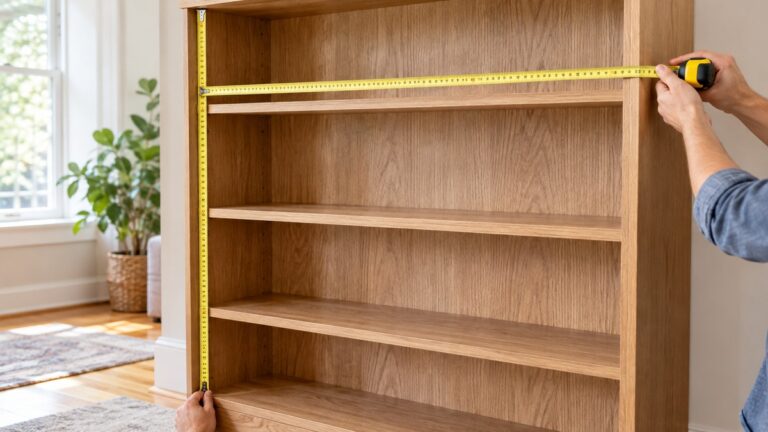
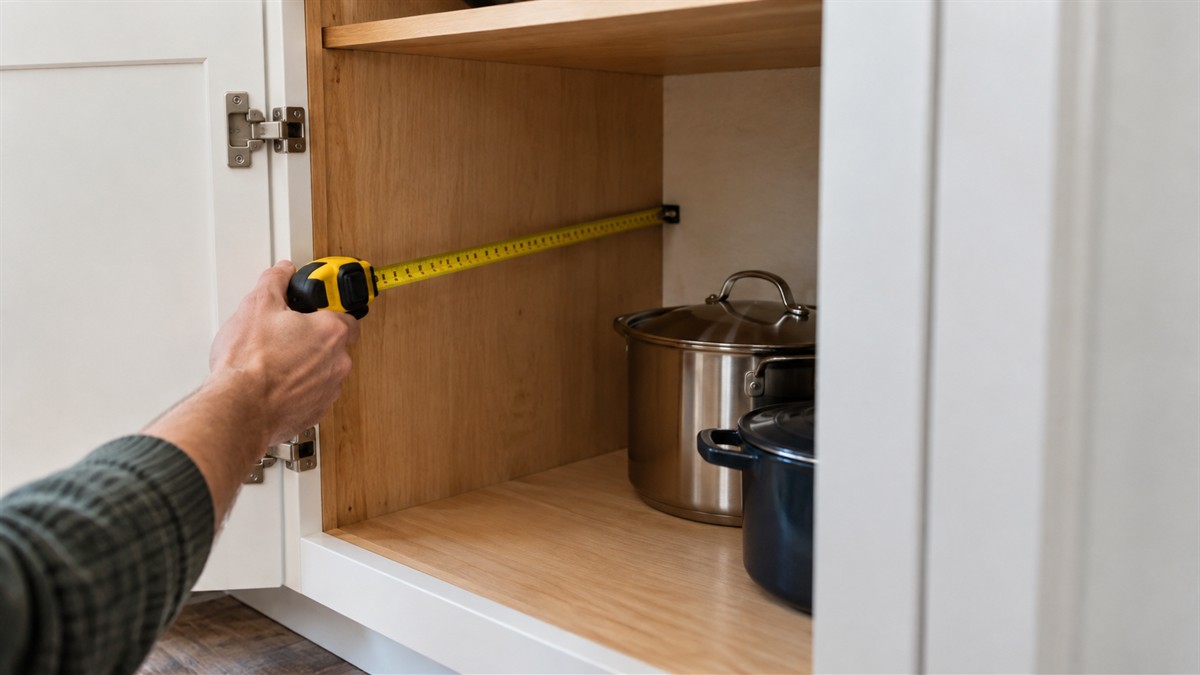
The size guides define depth as the box, from the face frame to the back panel. Measure inside the cabinet from the front of the face frame to the back wall of the box, then measure the door thickness separately and add it if you need the overall projection. Metric brands follow the same idea: IKEA gives depth with and without the suspension rail. The pages do not describe a measuring method in these words, so this is our reading of their definitions.
Interior shelves can be shallower than the box. The Luxxe construction notes say its base and wall adjustable shelves are full depth. A New York City housing specification calls for cabinet shelves 10 7/8 inches deep without stating the cabinet depth, so a shelf may sit well short of the nominal depth. Measure the shelf itself if you are buying bins or organizers.
How we chose
This guide uses pages that we opened on 2026-10-21 and whose text contained what we cite. We looked first for a planning guideline from a kitchen-design association, then for size guides from cabinet makers, then for government and university pages. We kept the three makers because they publish depth numbers in plain words and give the definition of depth. We kept the HUD guide for its statements about base-cabinet depth and canned goods, and we flag its age. The NKBA guidelines supplied the countertop depth and the storage formula, and the New York City specification supplied the shelf depth.
We did not rank the makers. The conversions, the door-thickness totals and the frontage table are our own arithmetic from the stated figures. Pages from some retailer sites refused our download, and we did not use them.
Mistakes to avoid
- Measuring from the door face. KraftMaid and Luxxe both say the depth figure leaves out the doors.
- Treating 24-inch wall cabinets as standard. KraftMaid and Luxxe describe them as the refrigerator-surround size.
- Assuming a shallow base has drawers. Luxxe says 9- to 14-inch deep cabinets have a false drawer front.
- Mixing metric and inch figures. IKEA’s 37 cm wall cabinet is 14 5/8 inches, not 12.
- Leaving out the suspension rail. IKEA’s depth with the rail is 1.0 cm more than without it.
- Using the work-counter depth as the cabinet depth. The NKBA figure of 24 inches describes the counter, not the box.
What we could not verify (what the sources do not say)
The pages we opened do not give a countertop overhang, so we cannot say how far a counter projects past the doors. The KCMA site we opened lists certifications and standards, but no depth figures, and we did not read the standard behind its certification. The NKBA guidelines state a countertop depth, not a cabinet depth, and the HUD guide is not recent. We opened size guides from only three makers, and one of them, Luxxe Cabinetry, is a semi-custom line. The IKEA figures come from retailer listing pages and a catalog PDF, and the figures here are limited to the dimensions they print.
Frequently asked questions
How deep are standard kitchen base cabinets?
The KraftMaid and Luxxe guides give 24 inches, measured on the cabinet box without doors and drawer fronts. IKEA’s METOD base cabinet is 60 cm, or 23 5/8 inches with the suspension rail.
How deep are upper kitchen cabinets?
KraftMaid and Luxxe give 12 inches for the standard wall cabinet. IKEA’s METOD wall cabinet is 37 cm, which is 14 5/8 inches.
Why are wall cabinets shallower than base cabinets?
KraftMaid says 12 inches fits common items like cereal boxes and dinner plates without obstructing access to the countertops below. The pages we opened give no other reason.
Is the cabinet depth measured with the doors on?
No. KraftMaid says its figure excludes doors and drawers, and Luxxe says cabinet depth does not include door thickness.
Do deeper or shallower kitchen cabinets exist?
Yes. The guides list 24-inch wall cabinets for refrigerators, 12- and 15-inch shallow bases, 27-inch bases for large cooktops and sinks, 21-inch desk-height bases and custom depths.
How deep should a kitchen countertop be?
The NKBA guidelines recommend countertop frontage 24 inches deep, and a continuous prep section at least 36 inches wide and 24 inches deep next to a sink. The guidelines do not state the overhang past the doors.
Bottom line
Plan on 24 inches for base cabinets and 12 inches for wall cabinets, add the doors on top, and check the maker’s size guide for any other depth.
Sources
- https://media.nkba.org/uploads/2022/05/Kitchen-Planning-Guidelines.pdf (opened 2026-10-21)
- https://www.kraftmaid.com/kraftmaid/kitchen-cabinet-sizes (opened 2026-10-21)
- https://pdf.lowes.com/productdocuments/a1eb9084-5b50-46c6-8c75-617601687698/48070959.pdf (opened 2026-10-21)
- https://www.ikea.com/ph/en/p/metod-base-cabinet-white-90270889/ (opened 2026-10-21)
- https://www.ikea.com/ph/en/p/metod-wall-cabinet-white-50271027/ (opened 2026-10-21)
- https://www.ikea.com/us/en/files/pdf/f8/64/f864251f/sektion-bw_nov_7_2022_np_no_install.pdf (opened 2026-10-21)
- https://www.huduser.gov/publications/pdf/kitchen.pdf (opened 2026-10-21)
- https://www.nyc.gov/assets/hpd/downloads/pdfs/services/11b-kitchen-cabinets-vanity-cabinets-and-countertops.pdf (opened 2026-10-21)
- https://www.kcma.org/ (opened 2026-10-21)
Disclosure: As an Amazon Associate we earn from qualifying purchases.