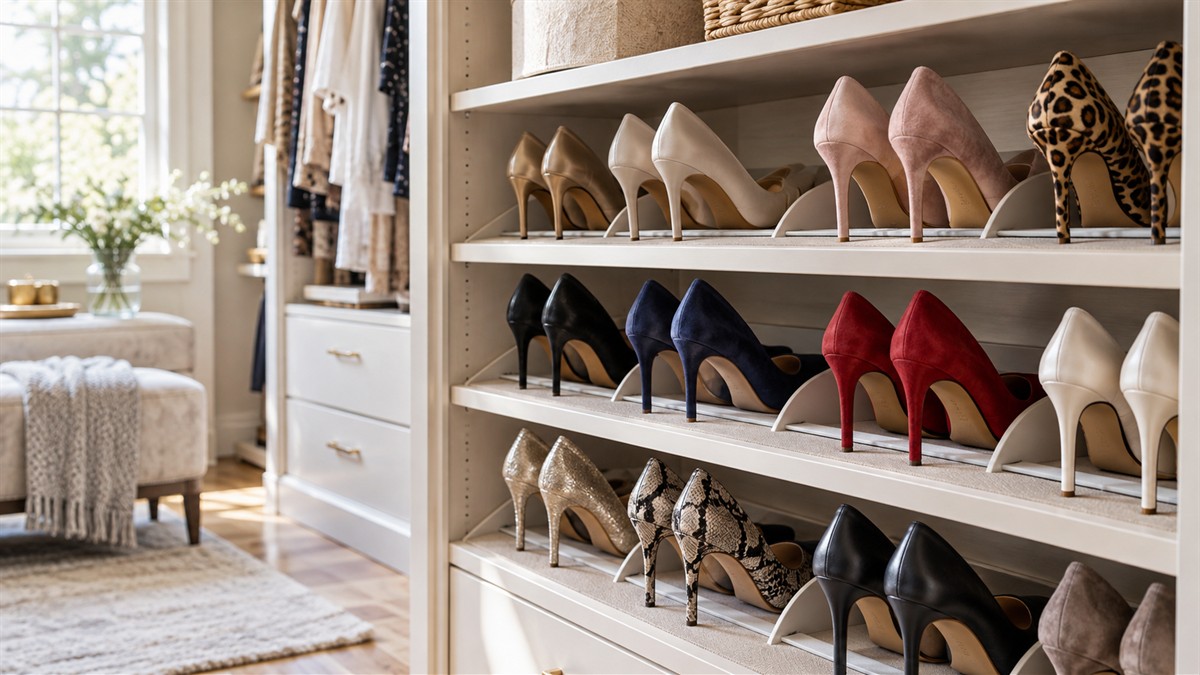
How to Store High Heels
As an Amazon Associate we earn from qualifying purchases.
How to store high heels comes down to protecting three things: the finish, the shape and the heel itself. Heels should go away dry, stay apart from other shoes, stand upright with the toe supported, and sit in a dark, ventilated spot in a box or dust bag. A Clarks care guide, a Cole Haan care page, a Zappos heel-care article, two museum conservation sources and several extension pages support those steps. This guide sorts them by problem and adds a shelf calculation for boxed and open storage.
Quick answer
- Dry heels naturally. Clarks and Cole Haan both warn that heat can damage leather, and Zappos says sun or a blow dryer can make leather harden and crack.
- Keep pairs from rubbing together. A museum project found shoes in crowded cabinets rubbing against each other, and Zappos says tossing heels in a bin invites nicks and scuffs.
- Store them in a box or a dust-resistant bag, in a dark, dry place with air moving around it.
- Support the toe so the shoe keeps its shape, and give each pair a day off between wears.
What goes wrong when heels are stored badly
Heels vary in material, height and heel shape, so each kind of storage mistake can leave a different mark. The table links each problem to a source from the pages we opened. The sources do not say which problem is most common, so the order is ours.
| Problem | What the source says | Source |
|---|---|---|
| Scuffs and nicks | Tossing heels in a cubby or bin speeds up nicks and scuffs | Zappos high heel care article |
| Rubbing and tipping | Shoes in crowded cabinets rubbed against each other and lay on their sides | Historic Deerfield museum blog |
| Cracking from heat | Artificial heat may ruin leather, and heat may dry leather and cause cracking | Clarks and Cole Haan care pages |
| Fading from light | One of a pair displayed in sunlight faded to an extreme color difference | ASU FIDM Museum article |
| Mildew | Closets often have mold growth, and sweaty shoes should dry before going in | NDSU Extension and a Palm Beach County extension page |
The rest of this guide takes those problems in turn. Where a source covers shoes in general rather than heels, we say so.
Dry the heels, and skip the heat
Start with a dry shoe. A Palm Beach County Cooperative Extension page says that perspiration plus the composition of leather in shoes feeds mildew, and tells readers to “Let sweaty shoes dry before putting them away in your closet.” The page is about mildew in general, not heels, so the heel advice is a close fit rather than an exact one.
How you dry the heels matters. Zappos says to leave heels “to dry naturally, not directly under a blow dryer or in the sun,” adding that “This can cause leather to harden and crack.” Clarks agrees for leather shoes: “Do not use any artificial heat source” because it may ruin the leather. Cole Haan says wet footwear should be allowed “to dry at room temperature,” because “Heat may dry leather and cause cracking.” Alabama Extension, quoting Mississippi State advice for flood recovery, says shoes should dry away from sun and heat and can be stuffed with paper so they hold their shape.
Three manufacturer or retailer pages therefore give the same instruction for leather. None gives a drying time, so judge by feel: a heel that is cool and damp inside is not ready for a box.
Keep pairs apart
The clearest evidence on contact comes from a museum. Historic Deerfield’s shoe project began with a plain observation: “Many shoes were rubbing up against each other and some were on their sides.” The staff built a mount for each pair so that “no shoe is in contact with another and pairs cannot be separated.” The mounts were made from archival materials, which a home closet will not have, but the principle carries over. Heels that touch each other can scuff, and heels that lie on their sides can shift.
Zappos reaches the same place from the retail side. Its article says “tossing your heels in a cubby or bin fast tracks nicks and scuffs.” It also says a conventional shoe rack designed for boots and sneakers may not fit or balance heels well. The article advises organizing shoes by type, so heels get their own section.
The practical rule is one pair per slot, with a gap. The sources do not name a gap, so our calculation later in this guide uses an assumed 1 inch.
Stand them upright and support the shape
Historic Deerfield rests shoes upright on a thin foam footprint on a board. For shoes with heels or pronounced arches, the conservator made shank support mounts, because the project aimed to “mitigate damage caused by their own weight.” The same blog describes pillow inserts for the toe box and vamp, made from stockinette filled with polyester batting, so the front of the shoe does not collapse.
Home versions are simpler. Clarks says to use a shoe tree in leather shoes to maintain shape and size. Alabama Extension says to stuff shoes with paper so they hold their shape. Cole Haan’s care page names cedar shoe trees for men’s dress shoes and for wet footwear, which is a product claim we do not repeat. None of the pages we opened gives a tree size for a pump or a stiletto, and none says whether a heel can stand on its own or needs a support under the arch.
Our reading is that a loose roll of paper in the toe box is the cheapest way to follow the Alabama and Deerfield advice for the front of the shoe. We would not push paper into the heel counter, and no page tells you to.
Box, dust bag or open shelf
The sources point three different ways, and the differences are worth laying out.
| Option | What the sources say | Limit or caution |
|---|---|---|
| Original box | Clarks keeps leather shoes in a dark, dry place within the original box | A closed box limits airflow, which the mildew sources favor |
| Box or dust-resistant bag | Zappos says to tuck dry heels away in a box or dust-resistant bag | The article does not say what the bag should be made of |
| Cloth bag | Washington State University says to store leather in a cloth bag and not a plastic bag | Written for leather garments |
| Plastic bag | Iowa State says not to store leather in a plastic bag, and a museum article says a PVC garment bag breaks down and becomes discolored and sticky | Both pages are about garments |
The common line through these is breathable, not sealed. A box, a cloth bag or an uncoated dust bag fits what the pages say, while a plastic bag does not. The pages do not say whether a box lid should stay on, so that choice is yours.
Light, dark and closet air
Clarks recommends a dark, dry place for leather shoes, and the ASU FIDM Museum article shows why light is a risk. It describes a pair of 1940s shoes in which one shoe was displayed in sunlight for a long period and the other was not, which accounts for the “extreme color discrepancy” between them. That is museum evidence, not a home test, but it points to the same rule.
For the closet itself, NDSU Extension says “Closets often have mold growth,” especially when clothing is stored damp or dirty or the closet has a cool outside wall. It also says opening closet doors to permit air circulation limits the growth of molds. A heel shelf placed away from an exterior wall, in a closet whose door opens now and then, follows both points. The page gives no humidity target for shoes.
Rotate, and give each pair a day off
Cole Haan’s care page says “Give shoes a day off between wearing.” Harvard Health Publishing, in a question and answer on athlete’s foot fungus in shoes, advises rotating footwear “so shoes have at least 24 hours to breathe,” and longer if they are wet. A pair you wear only now and then rests on the other days by default. The sources give no rest period specific to heels.
Plan the shelf: boxed versus open
The sources give no heel or shelf dimensions, so every figure here is our own assumption. Replace them with your measurements. We assume the shoe body is 3 inches tall above the heel, a 1-inch clearance above and beside each pair, a pair footprint 8 inches wide, and a 36-inch shelf. Clear height needed is heel height plus 3 plus 1.
| Heel type (our assumption) | Heel height (inches) | Clear height needed (inches) | Pairs on a 36-inch open shelf |
|---|---|---|---|
| Low heel | 2 | 2 + 3 + 1 = 6 | 36 ÷ (8 + 1) = 4.0, so 4 |
| Mid heel | 3.5 | 3.5 + 3 + 1 = 7.5 | 4 |
| Stiletto | 4.5 | 4.5 + 3 + 1 = 8.5 | 4 |
Now compare two ways to store 12 pairs, four of each type. For open storage, give each heel type its own shelf. For boxed storage, assume each box is 13 inches long, 8 inches wide and 5 inches tall, one layer of boxes, turned so the long side runs along the shelf.
| Method | Pairs per shelf | Shelves for 12 pairs | Clear height needed (inches) |
|---|---|---|---|
| Open shelf, one shelf per heel type | 4 | 12 ÷ 4 = 3 | 6 + 7.5 + 8.5 = 22 |
| Boxed, one layer | 36 ÷ (13 + 1) = 2.57, so 2 | 12 ÷ 2 = 6 | 6 × (5 + 1) = 36 |
The result is plain. Boxed storage needs twice as many shelves, and 36 inches of clear height instead of 22, because each box holds one pair and the assumed boxes are larger than the shoes. A dust bag, if we assume it adds no width, keeps the open-shelf figures and adds the dust cover Zappos mentions. None of the sources compares boxes with bags on shelf space, so this is our arithmetic on assumed sizes.
For shelving and closet options that suit heels, see our guides to shoe display cases, a shoe stacker for the closet and shoe storage for a small closet. For wider closet planning, see closet organizing ideas for small spaces.
A routine you can follow
- Wipe the heels and let them dry naturally, away from sun, a blow dryer and other heat.
- Place a loose roll of paper in the toe box, or a shoe tree in leather pairs, so the shoe keeps its shape.
- Put each pair in a box, a cloth bag or a dust-resistant bag, not a sealed plastic bag.
- Stand each pair upright on a shelf with a gap on each side, and keep it away from other heels.
- Pick a dark, dry, ventilated spot, and open the closet door now and then.
- Give each pair a day off between wears.
How we chose
This is a method guide, not a product list. We opened eleven pages on 2026-10-21: the Clarks Australia shoe care guide, a Cole Haan care page, a Zappos article on high heel care, a Historic Deerfield museum blog, an ASU FIDM Museum article, an Iowa State University Extension page, a Washington State University Extension bulletin, a Palm Beach County Cooperative Extension page, an NDSU Extension publication, an Alabama Extension page and a Harvard Health Publishing question and answer. We kept only points that a page states in plain words, and we checked each quoted sentence against the page text. Pages from Naturalizer, Stuart Weitzman, Jimmy Choo and the Canadian Conservation Institute could not be opened, so nothing here relies on them. The Zappos page is a retailer article, so it is cited only for non-safety care points. The shelf tables are our own arithmetic.
Mistakes to avoid
- Tossing heels in a bin. Zappos says it fast-tracks nicks and scuffs.
- Drying heels with a blow dryer or in the sun. Zappos, Clarks and Cole Haan all warn about heat on leather.
- Letting pairs rub together. The Historic Deerfield project began with shoes rubbing against each other.
- Using a plastic bag. Iowa State says not to store leather in one.
- Storing in a bright spot. The ASU FIDM Museum article shows a pair faded unevenly by sunlight.
- Putting sweaty heels straight into the closet. The Palm Beach County page says to let sweaty shoes dry first.
What we could not verify
The pages we opened do not give a heel-specific storage rule from a heel maker, a shoe tree size for pumps, or a distance to leave between pairs. They do not say whether stilettos should stand on their heels, lie on their sides or hang by the strap. They do not say how long a box lid should stay on, or how much humidity a closet can have. The Clarks and Cole Haan pages cover shoes in general, and the Zappos page is a retailer article. The Historic Deerfield and ASU FIDM Museum articles describe museum practice, not home practice. The extension pages on leather are written for garments, and the Alabama page is about flood recovery. Nothing here is a product claim.
Frequently asked questions
Should high heels be stored in boxes?
Clarks keeps leather shoes in the original box in a dark, dry place, and Zappos says a box or dust-resistant bag works. Boxes take more shelf space than open storage, as the calculation above shows.
Can I store heels in a plastic bag?
The pages we opened advise against it. Iowa State says not to store leather in a plastic bag, and an ASU museum article says a PVC garment bag breaks down and becomes sticky.
Should heels lie flat or stand upright?
The pages we opened do not settle this for home use. Historic Deerfield stands shoes upright on supports and found shoes on their sides in its old cabinets.
How do I keep heels from scuffing in storage?
Keep each pair apart from the others. Zappos links bins to nicks and scuffs, and Historic Deerfield’s mounts keep every shoe out of contact with another.
How do I dry heels before putting them away?
Let them air dry at room temperature, out of sun and away from a blow dryer. Zappos, Clarks and Cole Haan all give that advice for leather.
How often should I rotate heels?
Cole Haan says to give shoes a day off between wears, and Harvard Health says at least 24 hours to breathe, longer if wet.
Bottom line
Dry the heels without heat, keep each pair apart and upright with the toe supported, and store them in a box or dust bag in a dark, ventilated closet.
Sources
- https://clarks.com.au/pages/shoe-care-guide (opened 2026-10-21)
- https://www.colehaan.com/pages/how-to-clean-and-care-for-shoes (opened 2026-10-21)
- https://www.zappos.com/c/high-heel-care (opened 2026-10-21)
- https://www.historic-deerfield.org/2019-8-22-gaining-a-foothold-on-the-shoe-collection/ (opened 2026-10-21)
- https://asufidmmuseum.asu.edu/learn/articles/fidm-museum-conservation-collection (opened 2026-10-21)
- https://blogs.extension.iastate.edu/answerline/2015/03/23/leather-care-tips/ (opened 2026-10-21)
- https://content.libraries.wsu.edu/digital/api/collection/ext/id/55869/download (opened 2026-10-21)
- https://discover.pbc.gov/coextension/FACS/Housing/Avoid-Mildew.aspx (opened 2026-10-21)
- https://www.ndsu.edu/agriculture/extension/publications/molds-your-home (opened 2026-10-21)
- https://www.aces.edu/blog/topics/emergency-handbook-home-family/salvaging-clothing/ (opened 2026-10-21)
- https://www.health.harvard.edu/immune-and-infectious-diseases/athletes-foot-fungus-in-shoes (opened 2026-10-21)
As an Amazon Associate we earn from qualifying purchases.