How Deep Should Shoe Shelves Be
As an Amazon Associate we earn from qualifying purchases.
How deep should shoe shelves be? The pages we opened put the answer between 10 and 17 inches, and the spread comes from what sits on the shelf. A North Carolina extension leaflet lists a 10-inch space for women’s shoes and a 13-inch space for men’s. Hunker says most shoes need 12 to 14 inches. ClosetMaid sells 12 and 16 inch shelving, and Elfa’s gliding shoe shelf is 430 mm deep. This guide sets those figures side by side, shows how overhang works, and weighs depth against reach and closet size.
Quick answer
- Twelve to 14 inches covers most single-row shoe storage in the pages we read. The extension leaflet says a 12-inch shelf will hold most hats, folded garments, shoes and accessories, and Hunker puts most shoes at 12 to 14 inches.
- Match depth to the longest shoe you own. The leaflet lists 13 inches for a men’s shoe space and 10 inches for a women’s shoe space.
- A 10 1/4 inch shelf can let flat shoes and larger sizes hang over the edge, Hunker says in its IKEA LACK article.
- Go to 16 inches or more only with a reason. ClosetMaid calls 16-inch shelving especially good for shoes, and Elfa’s gliding shelf is about 16.9 inches deep, but deeper shelves are harder to reach into.
The depth figures, page by page
The table gathers every depth the pages gave for shoes or for shelves that hold shoes. Inches are shown as printed. Metric values are converted by dividing centimeters by 2.54 and millimeters by 25.4.
| Page | What it states | In inches | What it covers |
|---|---|---|---|
| North Carolina extension leaflet “My Clothing Storage Area” (1964, reprinted 1965) | A 12-inch shelf holds most hats, folded garments, shoes and accessories | 12 | A general closet shelf |
| Same leaflet, “Space Requirements for Shoes” table | Shoe spaces 13 in. deep and 10 in. deep | 13 and 10 | The leaflet’s men’s and women’s shoe shelves, as the scan’s text layer reads |
| Hunker, closet rod and shelf guide | “Most shoes need 12 to 14 inches of shelf depth” | 12 to 14 | Most shoes |
| Hunker, IKEA LACK shoe wall | LACK shelves are 10 1/4 in. deep; “A typical shoe shelf usually ranges between 12 to 15 inches” | 10.25; 12 to 15 | A floating shelf used for shoes; the typical range for shoe shelves |
| Dimensions.com, closet depths | Shelves 12 in. (30.5 cm) deep | 12 | Closet shelves in general |
| ClosetMaid how-to page and fixed-mount sheet | Wire shelving in 12 in. and 16 in. depths; 16 in. shelving is good “as shoe shelving” | 12 and 16 | Wire closet shelving |
| IKEA PAX and KOMPLEMENT brochure | KOMPLEMENT shoe shelf listed for 35 cm deep frames; SKUBB shoe box listed as 22, 34 and 16 cm | 13.8; 13.4 | A shelf sized to a frame; a boxed pair (dimension order not labeled) |
| Elfa gliding shoe shelf mesh and Décor+ insert | Depth 430 mm and 426 mm | 16.9 and 16.8 | Pull-out wire shoe shelves |
Read down the third column and a pattern shows. Fixed shelves cluster at 12 to 14 inches. The ClosetMaid and Elfa products sit at 16 to 17 inches. The smallest figures, 10 and 10 1/4 inches, belong to a women’s shoe space and to a floating shelf that Hunker flags for overhang. No page we opened recommends a fixed shoe shelf deeper than 17 inches.
Depth against shoe length: overhang and spare room
The simplest test is shelf depth minus shoe length. A positive result is spare room behind the heel. A negative result is overhang, which is the amount of shoe that hangs past the front edge. The pages do not give a foot-length chart, so the inputs here are the shoe spaces from the extension leaflet, 10 inches for the women’s space and 13 inches for the men’s space, and the 34 cm figure from the SKUBB shoe box, which is 13.4 inches if that number is the box length. The brochure does not label which number is which, so reading 34 cm as the length is our assumption.
| Shelf depth (in.) | Where it comes from | Women’s space, 10 in. | Men’s space, 13 in. | Boxed pair, 13.4 in. |
|---|---|---|---|---|
| 10.25 | LACK shelf | 10.25 – 10 = 0.25 spare | 10.25 – 13 = 2.75 over | 10.25 – 13.4 = 3.15 over |
| 12 | Leaflet, Dimensions.com, ClosetMaid | 12 – 10 = 2.0 spare | 12 – 13 = 1.0 over | 12 – 13.4 = 1.4 over |
| 14 | Top of the Hunker range | 14 – 10 = 4.0 spare | 14 – 13 = 1.0 spare | 14 – 13.4 = 0.6 spare |
| 16 | ClosetMaid | 16 – 10 = 6.0 spare | 16 – 13 = 3.0 spare | 16 – 13.4 = 2.6 spare |
| 16.9 | Elfa, 430 mm | 16.9 – 10 = 6.9 spare | 16.9 – 13 = 3.9 spare | 16.9 – 13.4 = 3.5 spare |
The table explains the spread in the pages. A 12-inch shelf is deep enough for the leaflet’s women’s space and short by 1 inch for the men’s space. A 14-inch shelf clears both, and the top of the Hunker range is the first depth that does. Hunker’s note that a 10 1/4 inch shelf lets flat shoes and larger sizes hang over matches the 2.75 inches of overhang shown for the men’s space.
These numbers describe one shoe standing in a row, toe forward. The pages do not say whether a heel hanging off the back counts as overhang, or how much overhang is acceptable, so the table shows the arithmetic and leaves that judgment to you. The leaflet’s two shoe spaces also come from a 1960s publication, and modern sneakers and boots can be bulkier than those spaces suggest.
Two rows deep: what 20 and 26 inches buy
Doubling the depth does not always double the storage. A shelf that holds two pairs front to back needs at least twice the shoe length, and the back pair is hard to reach.
| Shoe length input | Formula | Depth for two rows |
|---|---|---|
| Women’s space, 10 in. | 2 × 10 | 20 in. |
| Men’s space, 13 in. | 2 × 13 | 26 in. |
| Boxed pair, 13.4 in. | 2 × 13.4 | 26.8 in. |
A 20-inch figure appears in the Access Board standard, in a different job. For a high forward reach over an obstruction, it allows the full 48-inch reach height when the reach depth is 20 inches or less. Beyond 20 inches, up to a limit of 25, the allowed high reach drops to 44 inches. A shoe shelf is not an obstruction, and the standard is not written for closets. The rule still shows how depth eats into usable reach: the farther the back of the shelf, the lower the height at which it stays easy to use.
When 12 inches is enough
A 12-inch shelf is the figure the pages repeat most. The leaflet says a 12-inch shelf will hold most hats, folded garments, shoes, and clothing accessories, with the caution that the best widths for closets and shelves depend on individual needs. Dimensions.com lists shelves at 12 inches deep, and ClosetMaid lists 12 inches as one of its two wire-shelf depths.
Twelve inches fits the women’s shoe space with 2 inches to spare. It is short for the men’s space by 1 inch. If your longest shoe is shorter than 12 inches, it is enough, and if not, the next step up costs only 2 more inches. For small-closet layouts that use shallow shelves, see our guides to small shoe racks for a closet floor and narrow shoe storage.
When to go to 16 inches
The ClosetMaid fixed-mount sheet says 16 inch shelving provides additional storage capacity and is “especially good for storage of linens or boxes and as shoe shelving.” That is a product maker describing its own wire shelf, but it matches the table: 16 inches clears every shoe length used here by 2.6 to 6 inches.
The IKEA brochure points the same way for its wardrobe system. It lists the KOMPLEMENT shoe shelf for 35 cm deep frames, about 13.8 inches, and states that “actual dimensions vary” from the width and depth printed in the list. The ClosetMaid how-to page adds a practical limit: the depth of a reach-in closet affects the depth of shelving you can use. If the closet is shallow, a 16-inch shelf may not fit beside hanging clothes.
Deeper than 16 inches: gliding shelves, reach and closet depth
Elfa’s gliding shoe shelf mesh is 430 mm deep, about 16.9 inches, and its Décor+ shoe shelf insert is 426 mm, about 16.8 inches. Both pull out. Elfa says a gliding shelf of that depth needs 290 mm, about 11.4 inches, of free space in front of it to extend fully, and that the whole solution reaches 740 mm, about 29.1 inches, from the back wall when fully extended. A pull-out shelf solves the reach problem on a deep shelf, but it adds depth to the room.
Hunker gives the case against going deeper on a fixed shelf. It says top shelves work best between 11 and 16 inches, and that too deep a shelf risks small items getting pushed out of reach at the back. It also says a lower shelf can be deeper, and gives 16 inches as the maximum for a shelf installed at 68 inches. The same page sets the closet depth needed for hanging clothes at 24 inches.
That 24-inch figure appears in the extension leaflet too, which calls it the minimum depth recommended for storage areas in which clothes will be hung. The next table subtracts each shelf depth from a 24-inch closet. The result is the open depth left in front of the shelf, using the 24-inch closet as our example and not a source figure.
| Shelf depth (in.) | Open depth in a 24 in. closet | Note |
|---|---|---|
| 12 | 24 – 12 = 12 | Front edge level with the 12 in. minimum rod distance Hunker gives from the back wall |
| 14 | 24 – 14 = 10 | Top of the Hunker range |
| 16 | 24 – 16 = 8 | ClosetMaid 16 in. shelving |
| 16.9 | 24 – 16.9 = 7.1 | Elfa gliding shelf, closed; fully open it needs 11.4 in. more than the shelf itself |
Elfa’s 740 mm, about 29.1 inches, exceeds the 24-inch closet by 5.1 inches. A fully extended gliding shelf in a closet that deep would reach past the front of the closet, so it suits an open-front closet or a door that clears the shelf.
Adjustable shoe racks: sizing by the person
One ClosetMaid product shows depth as a setting and not a fixed number. Its Shoe Kit has three back holes in each bracket, which lets the rack fit different shoe sizes. The instruction sheet says to use the hole closest to the front for children’s shoes, the center hole for ladies’ shoes, and the hole closest to the back for men’s shoes. The sheet does not give inch values for the three holes. It does tie the choice to the person wearing the shoes, which matches how the extension leaflet splits its two shoe spaces.
If one household has children, women and men sharing a closet, an adjustable rack or separate shelves by owner can hold each size without wasting depth. For boots stored upright, see boot storage closets.
Choose a depth in five steps
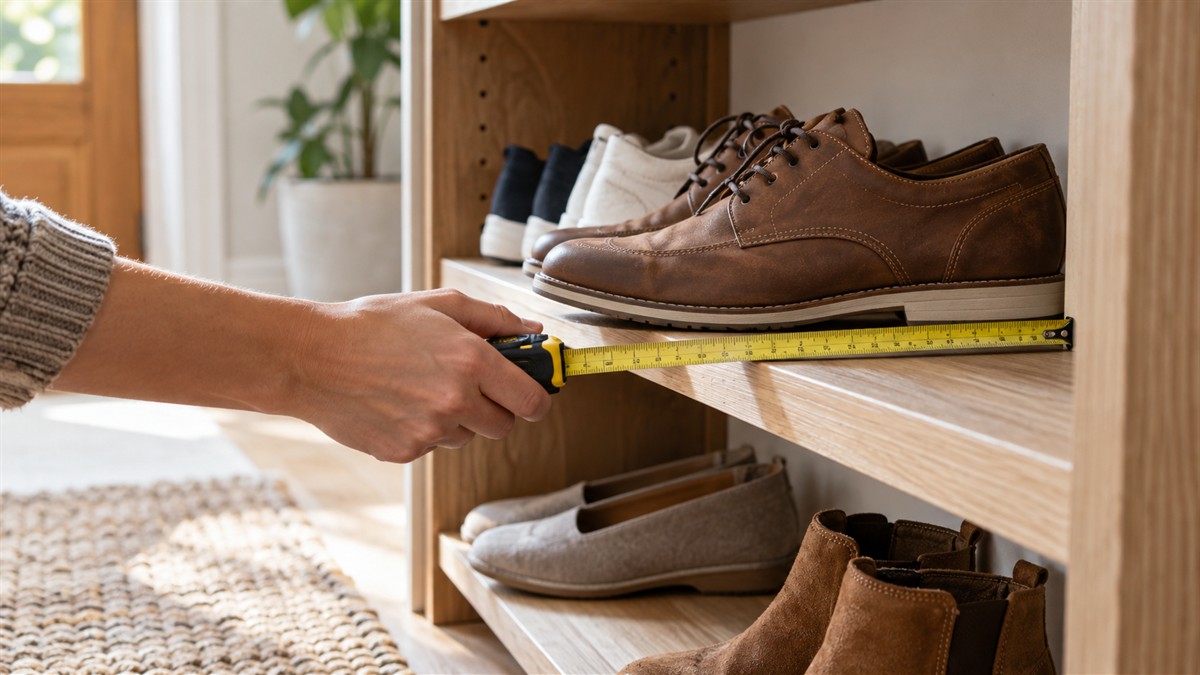
- Find your longest shoe in the group the shelf will hold and measure its length with a tape.
- Add the spare room you want behind the heel. The pages set no figure for it, so decide a number you can live with.
- Compare the sum with the shelf depths in the first table and round up to the next one that exists.
- Check the closet depth. The leaflet and Hunker both set 24 inches for hanging clothes, so subtract the shelf depth from your closet’s depth to see what is left in front.
- If the result is too deep to reach into, look at a gliding shelf or a second, shallower shelf for the same group.
How we chose
This guide is a comparison of figures and not a product list. We read the pages on 2026-10-21 and kept only depth numbers that a page states in plain words. The 1964 and 1965 prints of the North Carolina leaflet are one publication, so they count once. We kept the maker pages from ClosetMaid, Elfa and IKEA for dimensions only, and used none of them for a weight, mounting or load claim.
We left out retailer guides that returned an access error. The Dimensions.com entry counts only as a general shelf depth, because it does not name shoes. The spare and overhang arithmetic uses two inputs from the leaflet and one from the IKEA brochure, and each is named in the table. Every other number in the tables is a subtraction or a conversion shown on the page.
Mistakes to avoid
- Buying a 10 inch shelf for large shoes. Hunker notes that the 10 1/4 inch LACK shelves can let flat shoes and larger sizes hang over.
- Using the women’s figure for everyone. The leaflet lists 10 inches for women’s shoes and 13 inches for men’s.
- Forgetting the closet. Hanging clothes need 24 inches of depth, so a 16 inch shelf beside them leaves 8 inches in a 24 inch closet.
- Counting only the shelf, not the pull-out. Elfa’s gliding shelf adds 290 mm in front before it extends fully.
- Going deep at the top. Hunker says top shelves work best between 11 and 16 inches and warns that small items get pushed out of reach.
What we could not verify
The pages we opened do not give a depth rule for shoe shelves from a standards body or a current university program. The shoe spaces in the extension leaflet are from a 1960s scan, and we read the pairing of 13 and 10 inches with the men’s and women’s shelves from the text layer. The Hunker LACK article reports one creator’s closet, and it does not say which shoe sizes the creator owns.
No page we opened gives a shoe-length chart, an allowance for overhang, a depth for boots lying on their sides, or a reason to prefer 12 over 14 inches beyond fit. The IKEA brochure leaves its SKUBB dimensions unlabeled, so using 34 cm as the box length is our reading. Nothing we read ties the Access Board’s reach-depth rule to a closet shelf, so the rule appears here only to show the effect of depth on reach.
Frequently asked questions
What is the best depth for a shoe shelf?
The pages cluster at 12 to 14 inches. The extension leaflet says a 12-inch shelf will hold most hats, folded garments, shoes and accessories, and Hunker says most shoes need 12 to 14 inches. Measure your longest shoe, because the leaflet lists 13 inches for a men’s shoe space.
Is a 12-inch deep shelf enough for shoes?
For many shoes, yes. A 12-inch shelf clears the leaflet’s 10-inch women’s space by 2 inches and falls 1 inch short of its 13-inch men’s space. Measure the longest pair you plan to store.
How deep should a shelf be for men’s shoes?
The leaflet lists a 13-inch space for men’s shoes, which puts the first depth that clears it at 14 inches in the Hunker range. ClosetMaid’s 16 inch shelving clears it by 3 inches.
Can a shoe shelf be too deep?
Yes, for reach. Hunker says a shelf that is too deep risks small items getting pushed to the back where you cannot reach them, and it limits top shelves to 11 to 16 inches. A pull-out shelf solves the reach problem but needs free space in front.
How much space does a pull-out shoe shelf need in front?
Elfa says its 430 mm deep gliding shelf needs 290 mm, about 11.4 inches, of free space in front to extend fully. Its total solution depth fully extended is 740 mm, about 29.1 inches, from the back wall.
Bottom line
Measure your longest shoe, add the spare room you want, and pick the next depth up from 12, 14 or 16 inches.
Sources
- https://ocr.lib.ncsu.edu/ocr/ua/ua102_200-001-bx0004-004-005/ua102_200-001-bx0004-004-005.pdf (opened 2026-10-21)
- https://ocr.lib.ncsu.edu/ocr/ua/ua102_200-001-bx0004-004-004/ua102_200-001-bx0004-004-004.pdf (opened 2026-10-21)
- https://www.hunker.com/13413647/what-is-the-proper-height-for-closet-rods-shelves/ (opened 2026-10-21)
- https://www.hunker.com/1830480/ikea-lack-shelf-organize-shoe-storage-idea-closet-wall/ (opened 2026-10-21)
- https://www.dimensions.com/element/closet-depths (opened 2026-10-21)
- https://homedepot.closetmaid.com/en-US/Installation/Pages/how-to-guides.aspx (opened 2026-10-21)
- https://pdf.lowes.com/productdocuments/d1af380f-0c6e-4e7d-92b6-c4cde568f53d/50039299.pdf (opened 2026-10-21)
- https://images.homedepot-static.com/catalog/pdfImages/11/11b1b644-9d60-4372-a9f7-ae2ccd3fd0b5.pdf (opened 2026-10-21)
- https://www.ikea.com/ie/en/files/pdf/69/0a/690a180e/pax__komplement.pdf (opened 2026-10-21)
- https://elfa.com/en/products/classic-by-elfa/top-hang/storage-functions/glidingshoeshelfmesh (opened 2026-10-21)
- https://elfa.com/en/products/decor-plus/storage-functions/dbyeshoeshelf (opened 2026-10-21)
- https://www.access-board.gov/ada/ (opened 2026-10-21)
As an Amazon Associate we earn from qualifying purchases.