How to Store Coffee Mugs on Open Shelves
As an Amazon Associate we earn from qualifying purchases.
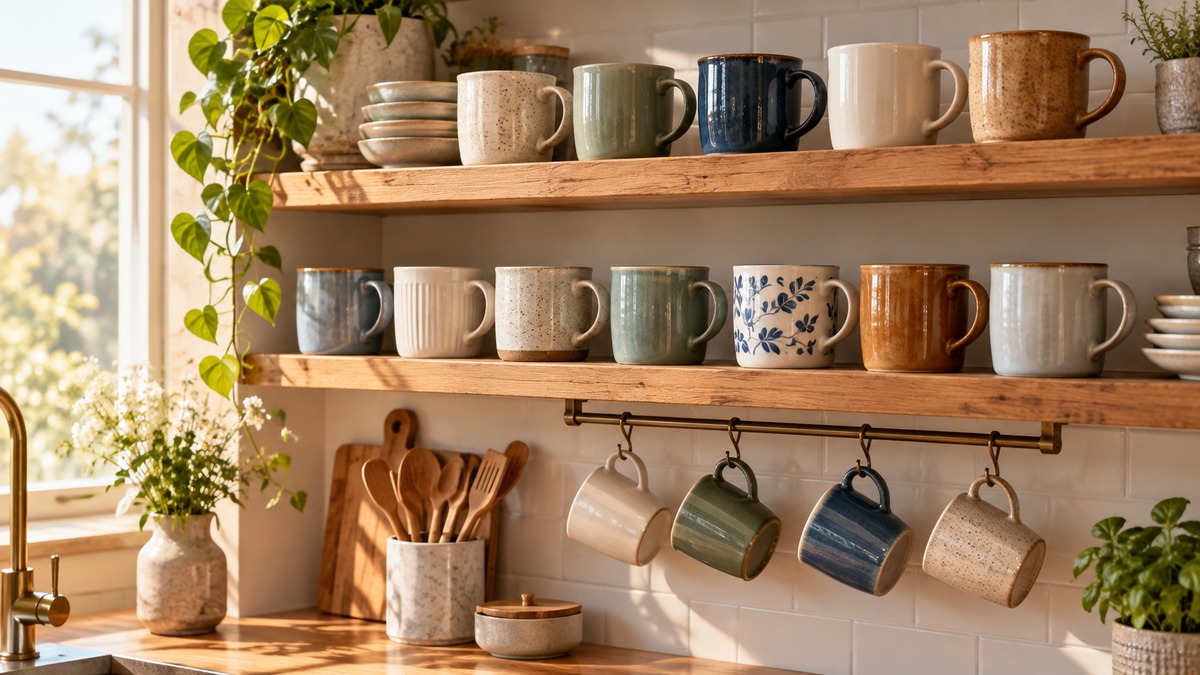
How to store coffee mugs on open shelves comes down to height, spacing and edges. Height decides how often you reach and lift. Spacing decides whether mugs rub together. Edges and the shelf anchor decide whether they stay put when something bumps the unit. Kansas State University Extension, the National Kitchen & Bath Association, the Canadian Conservation Institute, the National Park Service and the University of Hawaii at Hilo each speak to part of this. None writes about mugs specifically, so this guide applies their advice to a mug shelf.
Quick answer
- Keep everyday mugs between knee and shoulder height, near the sink or dishwasher if you can.
- Give each mug its own spot. The Canadian Conservation Institute advises against stacking ceramics and says to pad out items so they do not touch.
- Add a lip, putty or museum wax at the shelf edge, and fasten a free-standing unit to the wall.
- Keep dust and kitchen grime down, and keep glass mugs out of strong sun.
What these sources cover and what they leave out
Two Canadian Conservation Institute (CCI) pages describe how ceramics and glass are damaged and stored in museums: a note on the care of ceramics and glass, and a newer preventive conservation guide. The National Park Service (NPS) contributes a leaflet on museum storage shelves and a leaflet on removing dust from ceramic and glass objects. The University of Hawaii at Hilo and the Earthquake Country Alliance explain how to keep breakables on open shelves during earthquakes. The University of Oregon publishes a shelving safety sheet. For kitchens, we used a Kansas State University Extension story on organizing a kitchen, the National Kitchen & Bath Association (NKBA) planning guidelines, a KraftMaid cabinet-size page and a Department of Energy ventilation sheet.
None of them says how many mugs fit on a shelf, whether nested mugs are safe, or how to hang a mug. The mug sizes below are our own sample figures, and every sourced figure is named.
Where the mugs go: height and distance
Kansas State Extension gives a general rule: keep the most-used items “between shoulder and knee height” and put seldom-used items higher up. It adds that frequently used dishes should sit near the sink or dishwasher so unloading is easier. The University of Oregon sheet agrees on the vertical range, saying to store heavier and frequently used items between knee and shoulder and lighter items overhead. It adds that common items should be reachable between average waist and shoulder height, and it says never to reach overhead and to use a step stool instead.
The NKBA guidelines give numbers, though they come from an accessibility standard. The planning guideline for storage at the cleanup or prep sink says to plan storage of frequently used items 15 to 48 inches above the floor. Its reach specification gives a high reach of 48 inches when the reach is unobstructed and 44 inches when a counter 20 to 25 inches deep is in the way. The KraftMaid page says standard wall cabinets are typically installed 54 inches above the floor, 18 inches above the counter, and have a standard depth of 12 inches, which it says accommodates common items such as cereal boxes and dinner plates.
The table puts those figures together. The 4-inch mug height is our assumption, since the sources give no mug size, and the subtraction is our arithmetic: a shelf surface has to sit lower than the reach limit by the mug’s height if the top of the mug is to fall inside the limit.
| Reading | Limit (inches) | Highest shelf surface for a 4-inch mug |
|---|---|---|
| NKBA unobstructed high reach | 48 | 48 − 4 = 44 inches |
| NKBA high reach over a 20 to 25 inch deep counter | 44 | 44 − 4 = 40 inches |
| Bottom of a standard wall cabinet (KraftMaid), so a shelf surface of at least 54 | 54 | 54 − 44 = at least 10 inches above the unobstructed figure; 54 − 40 = at least 14 inches above the counter figure |
That comparison suggests a plain point: a mug shelf at the height of standard upper cabinets sits above the reach limits in the NKBA guidelines, so an everyday mug shelf belongs lower. The limits are written for accessible design, and Kansas State and Oregon give a broader shoulder-and-knee range, so the pages differ in how strict they are. We use the NKBA numbers as a yardstick, not a rule for your kitchen. For ideas on kitchen shelving, see our guides to open shelves in a small kitchen and to shelf ideas for a small kitchen.
Line the shelf and keep mugs from touching
The CCI note says to “Line shelves with soft, non-fibrous padding such as polyethylene foam sheeting.” It says fibrous padding such as polyester batting may snag on fragile or flaking surfaces. The NPS shelving leaflet lists more liner materials, including corrugated polypropylene, polyethylene foam sheeting, polyester film and acrylic sheeting, and says to cut a liner to the shelf's exact interior size so it does not overhang. Neither page gives a thickness.
The newer CCI guide gives the spacing rules. It says “Do not stack objects, as the excess weight can cause abrasions and stress.” It says to pad out items to prevent rolling or touching of other objects, which may cause abrasion. A photograph caption explains that soft coarse pottery can be abraded when pots rub against each other. These pages concern museum ceramics. They do not say whether nesting everyday mugs causes damage, and they do not mention mugs, so the stacking advice is a cautious reading rather than a mug-specific rule.
The CCI guide also says designs applied over a glaze are more susceptible to damage than designs underneath, and that gilding on dinnerware can be abraded easily by repeated use and incautious handling or cleaning. A mug with a gold rim or a printed overglaze design deserves its own space. The CCI note adds that objects with overglaze decoration are particularly susceptible during handling or cleaning.
The layout table below uses a sample mug of our own: 3.5 inches across the body and 5 inches across with the handle, standing upright with the handle sideways. The gap of one inch or two inches between mugs and at each end of the shelf is also our assumption. The number across is the shelf width minus one gap, divided by the mug width plus one gap, rounded down. The rows deep are the shelf depth minus one gap, divided by the body diameter plus one gap, rounded down, on a 12-inch deep shelf, the KraftMaid standard wall depth.
| Shelf width (inches) | Gap (inches) | Mugs across | Rows on a 12-inch shelf | Mugs on the shelf |
|---|---|---|---|---|
| 24 | 1 | (24 − 1) ÷ (5 + 1) = 3.83, so 3 | (12 − 1) ÷ (3.5 + 1) = 2.44, so 2 | 3 × 2 = 6 |
| 24 | 2 | (24 − 2) ÷ (5 + 2) = 3.14, so 3 | (12 − 2) ÷ (3.5 + 2) = 1.82, so 1 | 3 × 1 = 3 |
| 36 | 1 | (36 − 1) ÷ (5 + 1) = 5.83, so 5 | 2 | 5 × 2 = 10 |
| 36 | 2 | (36 − 2) ÷ (5 + 2) = 4.86, so 4 | 1 | 4 × 1 = 4 |
| 48 | 1 | (48 − 1) ÷ (5 + 1) = 7.83, so 7 | 2 | 7 × 2 = 14 |
| 48 | 2 | (48 − 2) ÷ (5 + 2) = 6.57, so 6 | 1 | 6 × 1 = 6 |
The gap changes the count more than the shelf width does. At a two-inch gap a 12-inch shelf holds one row, so the 36-inch shelf holds 4 mugs instead of 10. A second row also puts a mug behind another one, and handling is when the CCI guide says the risk is highest. Choose between a single roomy row and a packed double row based on how often you lift the mugs.
Keep mugs on the shelf
The University of Hawaii at Hilo page says that if kitchen shelves are open and exposed, everything on them might fall during a large earthquake, dishes and glassware included. It suggests a lip on the shelf, such as a thin strip of wood on or near the edge, and says even a lip an inch tall “can keep wineglasses from sliding off.” It also advises you to “Place silly putty, velcro, or surfboard wax under breakables.” Two residents quoted on the page report that display shelves with even a half-inch lip fared far better after the 2006 earthquake than shelves that were flat to the edge.
The Earthquake Country Alliance page on open shelves reaches a similar place. It says to move heavy items and breakables to lower shelves and to use hook and loop fasteners or “non-damaging adhesives such as earthquake putty, clear quake gel, or microcrystalline wax” to secure breakables. It names a few commercial products, which we do not repeat. The NPS shelving leaflet says unmodified shelves may let objects fall in an earthquake or be bumped by a person, and it recommends restraining bars or cords, particularly in earthquake-prone areas.
The unit matters too. The Hawaii page says free-standing bookshelves could easily fall over in a large earthquake and that metal L-shaped brackets to a wall stud are a simple fix. The University of Oregon sheet says to anchor shelves to the floor or wall, not to overload them, and to make sure nothing hangs over the edge. The sources give no weight limit for a shelf of mugs. If you hang a mug from a hook under the shelf, the CCI guide's finding on handles matters: handles are added to the body and the joints are often not strong. The pages do not discuss hooks, so we cannot say whether a hook is safe for a given mug.
Handling: lift with the body in mind
The CCI guide calls handling, moving and cleaning the times of highest risk. It says to support an object with one hand directly under its center of gravity and use the other hand to stabilize it, and it says not to pick objects up by handles or spouts, since they could break off. That rule is written for museum objects, and a mug exists to be held by its handle. The sources do not say whether a mug made for daily use has a stronger joint. For an older, repaired or sentimental mug, supporting the body from below follows the CCI advice.
The CCI note says that a repaired object is always weaker than one that has not been broken, and that a piece with yellow, brittle adhesive should be assumed fragile. It also warns that amateur repairs with five-minute epoxies can damage ceramics irreparably. These pages are about storage and condition; we make no claim about whether a chipped or repaired mug is safe to drink from.
The Oregon sheet gives a leverage rule for placing items on shelves and taking them off: keep elbows no more than six inches from the body. It also says to store heavier and frequently used items between knee and shoulder. A heavy stoneware mug belongs in that range as well.
Dust, grease and light on an open shelf
The NPS dust leaflet says “dust is abrasive and can scratch glass and glazed ceramics.” It warns that routine cleaning and dusting can damage some objects and that handling during housekeeping is itself a risk. Its answer is to keep objects in dust-proof storage or cases when possible, and it admits that dust is harder to control where objects are on open display. An open mug shelf is exactly that case. The CCI guide agrees that preventing dust is safer than dusting.
The Department of Energy ventilation sheet says most kitchen moisture and pollution come from the range, and that range hoods exhausting to the outside are preferable. It says recirculating hoods do not remove cooking-generated moisture. It does not discuss shelves, so we read it as a reason to put a mug shelf away from the cooktop and the hood outlet, not as a measured result. Kansas State Extension adds that cabinets and cupboards are trouble spots where items get pushed to the back and forgotten, and it recommends taking everything out, cleaning the shelves thoroughly and letting them dry.
The CCI note says to avoid temperature extremes and never to heat glass or put it in a sunny place or under spotlights where it might get very warm. The newer guide repeats the advice to keep objects out of direct sunlight and away from heat. A glass mug on a sunny shelf is the case that advice describes. The CCI pages treat ceramics and glass in good condition as generally robust against humidity, temperature and light, and they warn about mold on soiled ceramic surfaces above 65 percent relative humidity.
How we chose
This is a storage method rather than a product list, so there are no products to rank. We read eleven pages on 2026-10-21 and kept a rule only when a page states it in plain words and it applies to a mug on a shelf. We checked each quoted sentence against the text of its page. Where pages differ, as on reach heights and on the gloves and handles in the CCI pages, we show both sides. We left out cleaning methods for mugs, dishwasher advice and food-contact questions, which the pages do not cover. The figures in the tables are our own arithmetic with each input named, and the mug size, the 4-inch height and the gaps are assumptions.
Mistakes to avoid
- Stacking mugs without padding. The CCI guide says weight can cause abrasions and stress.
- Setting mugs flush with the shelf edge. The Hawaii page reports that shelves with a lip fared far better.
- Leaving the unit unanchored. The Oregon sheet and the NPS leaflet both call for anchoring.
- Putting daily mugs above the reach range. Kansas State Extension keeps the most-used items between shoulder and knee height.
- Using a fibrous liner that can snag. The CCI note names polyester batting as the example.
- Parking a glass mug in the sun. The CCI note warns against sunny places and spotlights.
- Ignoring the dust. The NPS leaflet says dust can scratch glazed ceramics and glass.
What we could not verify
The pages we opened do not give a mug size, a number of mugs per shelf, a weight limit for a mug shelf, or a liner thickness. They do not say whether nested mugs, hooks or putty cause damage to everyday ceramics, or how tall a shelf lip should be beyond the examples. They do not say whether a repaired mug is safe for drinking. The CCI and NPS pages are written for museums, and the Hawaii and Alliance pages are about earthquakes, so each is a close fit for a kitchen shelf rather than an exact one. The NKBA numbers come from an accessibility standard. We have no source for any product, and nothing in this guide is a product claim.
Frequently asked questions
How high should I put an open shelf for coffee mugs?
Kansas State Extension says to keep the most-used items between shoulder and knee height. The NKBA guidelines recommend 15 to 48 inches above the floor for frequently used items, and 44 inches as the high reach over a 20 to 25 inch deep counter.
Can I stack coffee mugs on an open shelf?
The Canadian Conservation Institute advises against stacking ceramics because of abrasion and stress from the weight. It does not mention everyday mugs, so the sources do not say whether nesting is harmless. If you do stack, the CCI warnings about gilding and overglaze designs argue for keeping decorated mugs out of the stack.
How do I keep mugs from sliding off the shelf?
The University of Hawaii at Hilo suggests a lip across the front and putty, velcro or surfboard wax under breakables. The Earthquake Country Alliance names earthquake putty, quake gel and microcrystalline wax. The National Park Service mentions restraining bars or cords.
Does dust on an open mug shelf matter?
The National Park Service leaflet says dust is abrasive and can scratch glazed ceramics and glass, and that dust is hard to control on open display. The Canadian Conservation Institute says preventing dust is safer than cleaning it off.
Is it okay to hang mugs under a shelf?
The sources do not cover hooks. The Canadian Conservation Institute notes that handle joints are often not strong, which argues for caution with heavy or old mugs.
Bottom line
Put daily mugs between knee and shoulder, in padded single rows with a lip or putty at the edge, on a shelf that is anchored to the wall.
Sources
- https://www.canada.ca/en/conservation-institute/services/conservation-preservation-publications/canadian-conservation-institute-notes/care-ceramics-glass.html (opened 2026-10-21)
- https://www.canada.ca/en/conservation-institute/services/preventive-conservation/guidelines-collections/ceramics-glass-preventive-conservation.html (opened 2026-10-21)
- https://www.nps.gov/subjects/museums/conserve-o-gram-4-1b-museum-storage-shelves.htm (opened 2026-10-21)
- https://www.nps.gov/subjects/museums/upload/08-01_508.pdf (opened 2026-10-21)
- https://hilo.hawaii.edu/natural-hazards/earthquakes/bookshelves.php (opened 2026-10-21)
- https://www.earthquakecountry.org/step1/openshelves/ (opened 2026-10-21)
- https://safety.uoregon.edu/sites/default/files/safety_sheet_-_shelving_safety_final.pdf (opened 2026-10-21)
- https://extension.k-state.edu/news-and-publications/news/stories/2026/01/food-safety-organizing-the-kitchen.html (opened 2026-10-21)
- https://media.nkba.org/uploads/2022/05/Kitchen-Planning-Guidelines.pdf (opened 2026-10-21)
- https://www.kraftmaid.com/kraftmaid/kitchen-cabinet-sizes (opened 2026-10-21)
- https://www1.eere.energy.gov/buildings/publications/pdfs/building_america/26466.pdf (opened 2026-10-21)
As an Amazon Associate we earn from qualifying purchases.