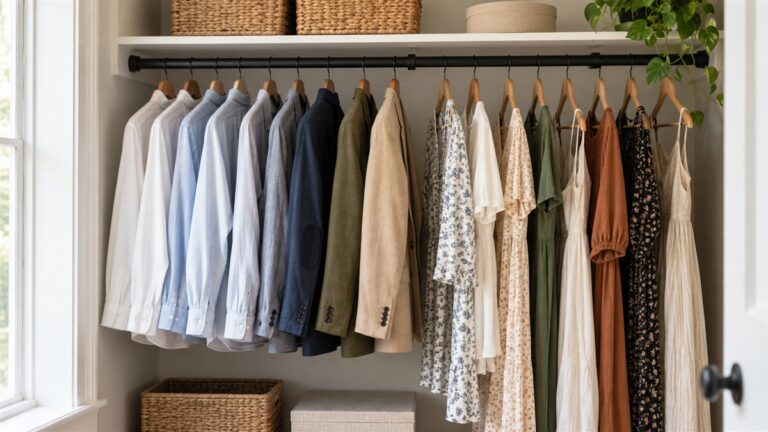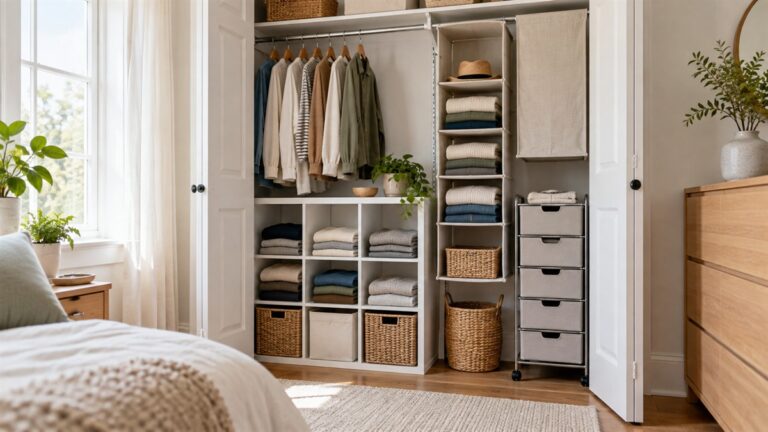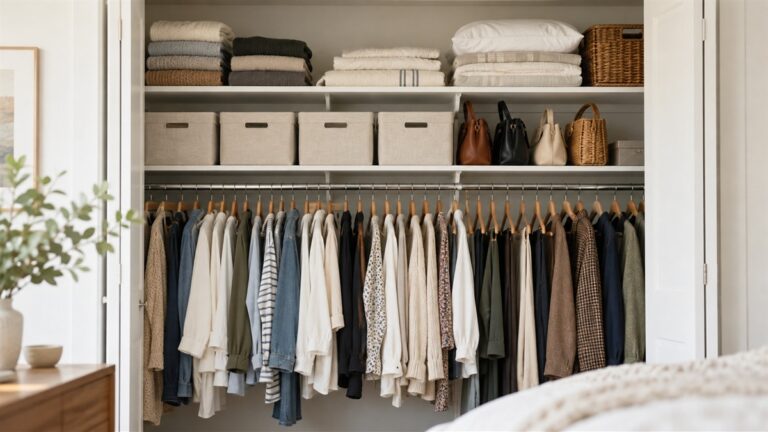
How to Organize Your Closet Step by Step
As an Amazon Associate we earn from qualifying purchases. Details
Most closet problems start with skipping the measuring step. People buy shelves, then find the rod sits too low for long coats or the shelf stack leaves no room to walk past it. This guide puts the work in order: sort what stays, measure the empty closet, set the rod and shelf heights, fix everything to the wall properly, and check any tall unit for tip-over risk. The figures come from published reference pages by Closet Design, HomeGuide and The Spruce. Where two sources give different numbers, both are shown. We have not tested any closet system or storage product, and we do not recommend products in this guide.
Quick answer
Sort first and keep only the clothes that fit your current size, the season you are in, and your work needs. Then measure the empty closet. For long garments, the sources put the rod between about 66 and 70 inches off the floor. Give folded sweaters and jeans roughly 12 to 16 inches of shelf height. Fix shelves into the wall material you actually have, and anchor any tall unit so it cannot tip.
Products worth checking
These two products fit the wire-shelf and rod steps above. Specs come from listing data we stored on 2026-10-11. We have not installed either one.
Slideep expandable closet wire shelves (3-pack)
Listing specs: 12 inches deep; extends from about 16.9 to 32 inches wide; steel with a powder-coated finish; listed weight capacity up to 40 lb; adhesive wall mount with mounting hardware included; listed for closets and cupboards.
Who it suits: a closet or pantry wall where drilling is not a choice and the load is light. Not stated on the listing: the adhesive load rating, which wall surfaces it bonds to, or whether the 16.9-inch starting length suits your space.
View on Amazon (affiliate link)
Philbinden 12-inch wire shelf brackets (2-pack)
Listing specs: alloy steel with a powder-coated white finish; each set has two brackets, two anchors and two screws; listed for 12-inch wire shelves; listing advises one bracket every 36 inches. The listing gives both 12-inch and 17-inch bracket lengths, so confirm the size before you order.
Who it suits: anyone whose 12-inch wire shelves sag or need a replacement bracket. Not stated on the listing: a weight rating per bracket, or which wall material the supplied anchors are meant for.
View on Amazon (affiliate link)
Step 1: Empty the closet and sort
Take everything out, including the top shelf and the floor. You cannot plan zones around clothes you have not looked at. Sort each item into keep, donate, or store elsewhere, and be strict about the keep pile.
The Spruce’s piece on how a cluttered closet affects the morning routine makes the point with a practical example: a person who now works from home full time may be able to cut a collection of trousers and blazers roughly in half. Use your own week as the test. If an item does not fit how you dress now, it does not need a shelf.
Step 2: Measure the empty closet
Measure the width, depth, and height of the space, and note the height of any rod already in place. Then compare your numbers with the reference figures below.
The Spruce describes a typical reach-in closet as about 6 feet long, 8 feet high, and 24 inches deep, with a width that ranges from 3 to 6 feet. Closet Design, an app vendor’s setup reference, gives a standard run height of 84 inches and a standard run depth of 24 inches for hanging, or 16 inches for shelves only. HomeGuide says reach-in closets are usually 24 to 30 inches deep when they have sliding or bifold doors. The Spruce says depth should ideally be at least 22 to 24 inches, and up to 28 inches for bulkier coats.
Closet Design gives a bay width of 18 to 36 inches, with 27 inches as the ideal. It also says that a 3/4-inch shelf wider than 36 inches visibly sags under knits. Walkway clearance should be at least 36 inches, or 42 inches if two people use the closet at the same time.
Hanger width is another figure to check against your own hangers. Closet Design lists a hanger at 22 inches wide, while The Spruce gives 17 to 19 inches for a standard adult hanger. The two numbers differ, so measure a few of your hangers before you plan the depth.
| Closet measure | Figure | Source |
|---|---|---|
| Typical reach-in size | About 6 ft long, 8 ft high, 24 in deep | The Spruce |
| Standard run height and depth | 84 in high; 24 in deep for hanging; 16 in for shelves only | Closet Design |
| Reach-in depth with doors | 24 to 30 in | HomeGuide |
| Ideal depth | 22 to 24 in, up to 28 in for coats | The Spruce |
| Bay width | 18 to 36 in; 27 in ideal | Closet Design |
| Walkway | 36 in minimum; 42 in if two people | Closet Design |
| Top shelf in an 8 ft ceiling | About 84 in, the most common height | HomeGuide |
Step 3: Set the rod heights
The right rod height depends on what hangs from it, not on a single number. The table below lists each source’s figure for each garment type, so you can see where they agree and where they do not.
| Garment or setup | Clear space or range | Rod height | Source |
|---|---|---|---|
| Long garments (dresses, long coats) | 68 in clear space | 70 in | Closet Design |
| Dresses and long coats | 60 to 70 in | Not stated | HomeGuide |
| Suits and trench coats | 50 to 60 in | Not stated | HomeGuide |
| Medium hang (pants on the bar, jackets) | 45 to 50 in clear space | 48 in | Closet Design |
| Shirts, blouses, folded pants | 36 to 40 in | Not stated | HomeGuide |
| Short hang (shirts, blouses, skirts) | 38 to 42 in clear space | Not stated | Closet Design |
| Skirts and short jackets | 36 to 42 in | Not stated | HomeGuide |
| Kids’ hanging | 24 to 30 in clear space | 30 to 46 in, by age | Closet Design |
| Double rod, upper | Not stated | 80 to 84 in | Closet Design |
| Double rod, upper | Not stated | 80 to 82 in | The Spruce |
| Double rod, upper and lower | Not stated | 80 in and 40 in | HomeGuide |
| Double rod, lower | Not stated | 30 to 40 in | The Spruce |
| Single rod with a shelf above | Not stated | 60 in | The Spruce |
| Single rod, general | Not stated | 66 in | HomeGuide |
The long-garment figures do not match. Closet Design asks for 68 inches of clear space under a rod at 70 inches, while HomeGuide gives 60 to 70 inches of hanging space for dresses and long coats. For a single rod, the sources give 70 inches for a long-hang rod (Closet Design), 66 inches (HomeGuide), and 60 inches when a shelf sits above it (The Spruce). Choice the figure that matches the longest garment you own, then check the space under the rod against the garment’s length.
When a shelf sits above a rod, leave at least 2 inches between the top of the rod and the bottom of that shelf, so hangers can slide on and off. HomeGuide also gives 84 inches as the most common height for a top shelf in a home with standard 8-foot ceilings.
Step 4: Plan the shelf spacing
Shelf spacing depends on the stack you plan to keep on each shelf. The sources agree on the broad ranges and differ on a few items.
| Item | Closet Design (in.) | HomeGuide (in.) |
|---|---|---|
| Folded shirts and tees | 12 to 13 | 10 to 12 (T-shirts) |
| Sweaters and jeans | 14 to 16 | 12 to 15 (sweaters and pants) |
| Flat shoes | 8 | 7 to 9 (standard shoes) |
| Boots | 14 to 18 | 12 to 14 |
| Handbags | 14 to 16 | 12 to 16 |
| Towels and linens | 13 to 16 | 12 to 16 |
| Hats and accessories | Not stated | 8 to 10 |
For shoes, Closet Design gives 8 inches for flat shoes and HomeGuide gives 7 to 9 inches for standard shoes. Plan for 7 to 9 inches and then measure your heaviest pair. Closet Design also gives shelf depths: 14 to 16 inches for folded shirts, 16 inches for sweaters and jeans, 12 to 14 inches for flat shoes, and 24 inches for top-shelf bins.
Step 5: Zone the closet
Use the layout you measured to give each category a home. A simple zoning plan works well in most closets:
- Hanging by length. Put short items such as shirts and skirts on the upper rod and long garments on a rod sized for them. Keep the longest items at one end so the others have room.
- Folded items on shelves. Stack sweaters and jeans on the 14- to 16-inch shelves, keeping the heaviest stacks low.
- Shoes low. Architectural Digest’s closet organization gallery describes baskets under the hanging clothes for flats, tennis shoes, and sandals.
- Small things in view. The Spruce’s small-closet article shows a small shelf above a mirror used for clutches and small bags.
- Use every inch. The same article argues for using every inch of a small closet for storage.
Step 6: Fix shelves and rods to the wall
The Spruce says custom closet shelves should be installed with drywall anchors to be sturdy enough for clothes and accessories. Its guide to wall anchors describes three types you may see in a closet:
- Plastic hollow wall plugs are for light-duty jobs in drywall or plaster. They need a pilot hole first.
- Hollow wall anchors, often called molly bolts, suit medium-duty jobs such as light decorative shelves. Their sides flare out once they are inserted into a hollow wall.
- Wing-style toggle bolts give heavy-duty holding power in drywall and need a pilot hole.
This guide does not give a shelf load limit or a stud spacing. Both depend on your wall, your hardware, and the product, so read the manufacturer’s instructions and any hardware notes. Check whether your wall is drywall, plaster, or masonry before you choose anchors. Where a stud is available, fix the shelf into it. If there is no stud where you need one, use an anchor rated for your wall type, and do not assume a generic anchor will hold a given weight.
Step 7: Anchor any tall unit
Tall, freestanding closet units can tip over. The U.S. Consumer Product Safety Commission’s AnchorIt! campaign says existing furniture can be anchored with inexpensive anti-tip brackets. It also says new furniture, such as dressers, is sold with anti-tip devices that should be installed right away. CPSC advises removing tempting objects such as toys and remote controls from the tops of furniture, because they can encourage a child to climb.
If your closet has a tall tower or a wire unit that goes near the ceiling, treat it as furniture that needs anchoring. Follow the maker’s anti-tip instructions and check them after you load the unit.
Worked example: a 48-inch closet
This example is possible and uses only the ranges above. Suppose the closet is 48 inches wide. Closet Design says a shelf wider than 36 inches sags visibly under knits, so one 48-inch shelf is a poor fit. Splitting the space into two bays of 24 inches keeps each shelf inside the 18- to 36-inch bay range and close to the 27-inch ideal. Check that the walkway still meets the 36-inch minimum after you add the stack.
Mistakes to avoid
- Setup the layout before the sort. You will end up with shelves for clothes you do not wear.
- Choosing a shelf depth that does not fit the closet. Closet Design gives 24 inches as the standard reach-in depth and 22 inches as the minimum.
- Setting the long-garment rod low to make room for a shelf. Check the 66-to-70-inch range before you fix the rod.
- Leaving a wide shelf unsupported. Closet Design notes that shelves over 36 inches wide sag under knits.
- Skipping anchors on a tall unit. Use the CPSC guidance above.
Related guides
For the depth question in more detail, read our guide to standard reach-in closet depth. If you are working in a small space, see closet organizing ideas for small spaces and ways to organize shoes in a small closet. For the top shelf, read storage ideas for the top shelf of a closet, and for shelf material choices, see type of wood for closet shelves.
Sources
- Standard Closet Dimensions: Rod Height, Shelf and Depth (Closet Design)
- Closet Shelving Height Guide (HomeGuide)
- Standard closet size guide (The Spruce)
- How your closet is hurting your morning routine (The Spruce)
- How to organize a small closet with lots of clothes (The Spruce)
- Wall anchor types and uses (The Spruce)
- How to organize your closet (Architectural Digest)
- AnchorIt! campaign (U.S. Consumer Product Safety Commission)
Worked example: sizing a closet’s zones
For example, a possible closet 96 inches wide could give 36 inches to a hanging section for long dresses, 30 inches to a shelf stack, and the remaining 30 inches to shoes and baskets. Those sizes are a setup example, not a standard. Measure your own closet and adjust the split to match your wardrobe.
Frequently asked questions
How high should a closet rod be?
It depends on what hangs there. Closet Design puts a long-hang rod at 70 inches and a medium-hang rod at 48 inches. HomeGuide uses 66 inches for a single rod, and The Spruce uses 60 inches when a shelf sits above the rod. Leave at least 2 inches between the top of the rod and the bottom of any shelf above it.
How deep should a reach-in closet be?
The sources differ. Closet Design gives 24 inches as standard and 22 inches as the minimum. The Spruce says 22 to 24 inches is ideal and up to 28 inches suits bulkier coats. HomeGuide says reach-ins with sliding or bifold doors are usually 24 to 30 inches deep.
How far apart should closet shelves be?
It depends on the items. Folded shirts and tees need about 10 to 13 inches, sweaters and jeans about 12 to 16 inches, and standard shoes about 7 to 9 inches, according to the two sources in the table above. Measure your tallest stack before you fix the shelf.
Do closet shelves need anchors?
The Spruce says custom closet shelves should be installed with drywall anchors to be sturdy enough for clothes and accessories. Choose anchors for your wall type, and fix into a stud where you can. This guide does not give a load figure for any anchor.
Can a tall closet unit tip over?
Yes. The CPSC says existing furniture can be anchored with inexpensive anti-tip brackets and that new furniture should be fitted with its anti-tip devices right away. Remove tempting objects from the top of the unit, because they can encourage a child to climb.
Conclusion
Sort first, then measure. Set the rod to match the longest garment you own, choose shelf spacing from the item sizes, and fix everything to the wall type you actually have. If two sources disagree, use the range that covers both, and measure your own clothes before you buy anything.