Creative Ways to Store Books in a Small Room, Safely
As an Amazon Associate we earn from qualifying purchases. Details
The creative ways to store books in a small room are mostly about using walls, not floor space, and the safe way to use a wall is to plan its load before the first book goes up. The U.S. Consumer Product Safety Commission’s 2015 report on anchoring furniture treats bookcases as part of the furniture it covers, and two manufacturer sheets give planning figures for the wall fixings. This guide compares the layouts a small room can take, what the sources say about each, and how to add up the load before you drill.
Updated 19 October 2026
Author: Editorial team, home-shelving-guide.com
Quick answer
- The CPSC report includes bookcases in its definition of furniture, so a tall bookcase in a small room is a tip-over question as well as a storage one.
- The clothing storage standard the report describes covers units taller than 30 inches. It does not name bookcases, so check the maker’s sheet for any bookcase’s own stability rating.
- Wall shelves depend on the wall end. The report says a drywall anchor is strongest in shear, and a stud is the usual fixing.
- Use the maker’s one-quarter figure only as a planning number. For a BA-size toggle in 1/2 inch drywall, that is 238 / 4 = 59.5 lb per anchor.
- Keep the heavy books close to the wall. The maker says that moving an object away from the wall greatly reduces the allowable load of an anchor.
The layouts a small room can take
Small rooms tend to offer three kinds of space: a long wall, a short wall or a corner, and the space under a window or a bench. Each layout has a different answer to the load question, so it helps to name them before choosing.
A long wall suits a row of wall shelves, which spread the load across more fixings. A short wall or a corner suits a single bookcase or a corner unit that stands on the floor. The space under a window or a bench suits low shelves, since the centre of the load stays near the floor. The sources do not rank these layouts, and none of them is a product recommendation. What the sources do give is the rule that applies to each: anything that can tip needs a fixing, and any wall fixing has a limit.
The layout choice also changes the anchor count. A row of wall shelves needs one set of fixings for each bracket, and the sources give no figure for a bracket. A bookcase needs its own fixing at the top, and the report describes the stud as the usual point for that screw.
What the CPSC report covers
The report sets its scope in plain words. It says that the terms “falling furniture” or “furniture” “will be used to denote any type of clothing storage unit, bookcase, electronics, and appliances.” A bookcase in a small room is therefore inside the report’s subject, even though the standard the report describes is written for clothing storage units.
The standard is ASTM F2057-14, and the report describes its coverage as chest-type furniture and clothing storage units taller than 30 inches. That leaves a gap. A tall bookcase is not named, so a reader should not assume it meets the standard’s stability and tip-restraint rules. The report’s logic still applies: a unit that can tip should be held to the wall, and the screw should go into a stud.
The report explains why the standard matters. It says children are the main concern, and it gives the test figure: “Fifty pounds represents the weight of a 95th percentile 5-year-old child.” A bookcase in a child’s room is therefore the case to plan for first, even if a small room is the only space available.
Wall shelves and the wall end
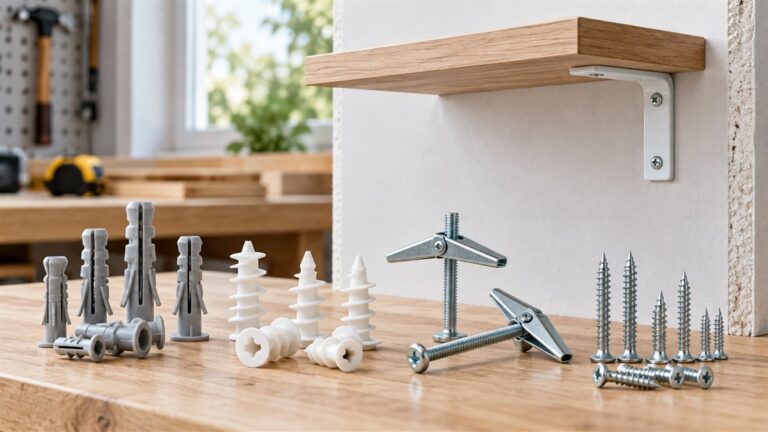
Wall shelves are the most common way to store books in a small room, and they put the entire load on the wall. The report’s clearest point on the wall end is this: “Drywall anchors are strongest when pulled at an angle parallel to the wall (a shearing force).” A shelf of books pulls the bracket outward, which is the straight-out direction the report calls the hardest for a drywall anchor.
The report’s answer is the stud: “Rather, a wood screw is usually provided and must be installed in a stud.” It also says that finding the stud takes a stud finder, a drill and time, or else poking holes in the wall. The report is about furniture, and the shelf case is a reading of its logic. It is still the most direct line the sources give.
The sources do not give stud spacing for typical houses. The report’s demonstration wall had studs 16 inches apart on centre, which is a laboratory wall and not a rule for your room.
Anchor figures for a loaded wall
Where a stud is not in the right place, the manufacturer sheets give the planning method. Both maker sheets state the same planning rule, one quarter of the ultimate value as the maximum load per anchor. The SNAPTOGGLE sheet adds that its values are guides only and cannot be guaranteed.
The SNAPTOGGLE sheet gives an ultimate tensile pull-out for the BA size in 1/2 inch drywall of 238 lb. The planning figure is one quarter of that:
| Item | Figure | Calculation |
|---|---|---|
| Ultimate tensile pull-out, BA, 1/2 inch drywall | 238 lb | Maker’s figure |
| Planning figure per anchor | 59.5 lb | 238 / 4 = 59.5 |
| Two BA anchors at the planning figure | 119 lb | 2 x 59.5 = 119 |
The maker’s FAQ adds the limit that matters most for books: “this ultimate holding value is for objects held closely to the wall.” It also says: “Moving objects away from the wall (e.g., the far end of a shelf or using a TV mount that swings away from the wall) significantly increases the effective weight of that object, greatly reducing the allowable load of that anchor.” A bookshelf with books at its far end is not the case the planning figure describes.
Adding up the books
The sources do not give the weight of a book, so this guide does not add up a shelf of books on a fixed number. A reader can do it with a kitchen scale. Weigh a shelf’s worth of books, write the total down, and add the shelf’s own weight. The example below uses invented numbers to show the arithmetic.
Suppose a shelf holds 25 paperbacks that weigh 2 lb each, and the shelf itself weighs 3 lb. The books total 25 x 2 = 50 lb, and the shelf and books together are 50 + 3 = 53 lb. Two BA anchors at the planning figure give 119 lb in total. The example load is 53 / 119 = 0.45, or about 45 percent of that planning total, before any allowance for books at the far end. The number is a planning ratio, not a rating, and the far-end rule means the real margin depends on where the books sit.
The same method works for any room. Replace the example numbers with your own weights, count the fixings in the plan, and compare the total with the planning total for your wall type. If the wall is plaster, the sources give no figure, so do not use the drywall numbers.
Options for a small room
- Wall shelves on a stud, with the brackets fixed to the stud the report describes. This suits a long wall, and the total load can be spread across several studs if the room allows.
- A tall bookcase anchored at the top, with the strap or fixing the maker names. The report’s stability logic applies, even though the standard does not name bookcases.
- A low unit under a window or a bench, which keeps the books near the floor. The sources say nothing about low units specifically, so the advice is about the wall fixings and the load, not about the unit’s height.
- Wall shelves on drywall anchors for light books, sized to the planning figure with the far-end rule in mind. Keep the heaviest titles on the lowest shelves that the fixing allows, and keep them close to the wall.
Each option is a choice of layout, and each one needs a load plan. The sources do not rank them, and none of them is a product claim.
Mistakes that overload a small bookshelf
- Treating the one-quarter figure as the ultimate value. The sheets say the ultimate figure is the maker’s, and the planning figure is one quarter of it.
- Using drywall anchors for a bookcase that a child might climb, when the report says a wood screw in a stud is the usual method.
- Stacking the heaviest books at the far edge, away from the wall, which the FAQ says reduces the allowable load.
- Leaving a tall bookcase unanchored because it looks stable. The report covers tip-over as a risk for furniture of this kind.
- Adding up a shelf without weighing it. The sources give no book weight, so measure your own.
What three book shelf listings state
The research file holds four book storage listings. Three of them give figures that help a small-room plan, and the fourth does not. The table uses only what each listing says.
| Listing | Size stated | Load stated | Fixing stated |
|---|---|---|---|
| Five-tier tall narrow bookcase | 51.9 inches high, 9.3 inches deep, 5.9 inches wide | 10 lb per shelf, 50 lb total | Wall-mount anti-tip hardware |
| Wall-mounted floating bookshelf set of three | 17 inches long, 8 inches deep (a 24-inch size is also offered) | Up to 30 lb per shelf | Hardware and manual included; can be mounted upside down |
| Floating picture ledge set of four | 24 inches wide | No depth or load stated | Pre-drilled holes spaced 16 inches apart for wall studs; hardware and a mini level included; the listing says to install on wall studs |
1. Furinno Fulda Book Shelf, 5-Tier Tall Narrow (Tall narrow bookcase with anti-tip hardware)
Pros
- The listing states 10 lb per shelf and 50 lb total for the unit.
- The listing lists wall-mount anti-tip hardware as a feature.
Cons
- The listing gives 51.9 inches of height, so it needs a fixing at the top.
- The listing gives shelf space of about 8.6 x 4.9 x 9.8 inches, which limits the book size.
Best for: a narrow bookcase in a small room, where the wall fixing can reach a stud
Skip if: your books weigh more than the listed 10 lb per shelf, or the wall cannot take the anti-tip hardware
View on Amazon (affiliate link)
2. Harwaya Wall Mounted Bookshelf, Floating Bookshelves, 17 in, Set of 3 (Wall shelf set with a stated per-shelf figure)
Pros
- The listing states up to 30 lb per shelf for a set of three.
- The listing says the hardware and manual are included.
Cons
- The listing gives no combined figure for the set.
- The listing gives an 8-inch depth, which limits the size of books each shelf takes.
Best for: a row of short wall shelves for paperbacks, mounted on studs
Skip if: you need a shelf deeper than 8 inches, or you plan to stack books at the far edge
View on Amazon (affiliate link)
3. FLYJOE Floating Picture Ledge Shelves, Set of 4, 24 in, Walnut (Ledge set with stud-spaced holes)
Pros
- The listing gives pre-drilled holes 16 inches apart for wall studs.
- The listing says hardware and a mini level are included.
Cons
- The listing gives no depth or load figure.
- The listing says to install on wall studs, so a wall without studs in the right place is not covered.
Best for: a short run of ledges on a wall where studs can be found at 16 inches apart
Skip if: the wall has no stud where the holes need to fall, or you need a load figure before you buy
View on Amazon (affiliate link)
The first listing’s figures agree with each other. Five tiers at 10 lb each give 5 x 10 = 50 lb, which matches the 50 lb total the listing states. That is a check the reader can make on any tiered bookcase: multiply the number of shelves by the per-shelf figure, and compare the result with the total the seller gives.
The second listing’s figure is per shelf. Three shelves at up to 30 lb each give 3 x 30 = 90 lb, but the listing does not state a combined figure, so 90 lb is our arithmetic. It is also the figure for shelves that are mounted by the listed hardware. The listing gives the depth as 8 inches. The maker’s FAQ point applies to any shelf: an object at the front of the shelf sits farther from the wall than one at the back, and the allowable load on the anchor drops as the distance grows.
The third listing gives a hole spacing of 16 inches for wall studs. That spacing matches the 16 inches between studs in the report’s demonstration wall. The sources do not give stud spacing for typical houses, so the hole spacing is a fact about the product, not about your wall. Find the studs before you choose the hole positions.
We left out the rotating tower in the research file. Its listing gives book counts, a rotation feature and a height range, but no load figure, no footprint and no anti-tip hardware. A small room can use it, but the sources give no basis for a load plan, so it is not a pick here.
How we chose
We used the 2015 CPSC report on anchoring furniture and televisions, the plastic toggle sheet and the SNAPTOGGLE sheet from the same maker, and the maker’s FAQ. We downloaded each source, converted it to text and checked every quoted sentence against that text. We did not use product listings, prices or ratings to choose any layout. The layouts are ways to arrange a room, not products, and we do not recommend a brand.
What we could not verify
The sources we opened do not give the weight of a book, a shelf or a bracket, so the arithmetic above uses invented numbers only to show the method.
The sources do not say whether the standard applies to a bookcase, since it names clothing storage units. The report includes bookcases in its definition of furniture but does not give a stability figure for them.
The sources do not give a stud spacing for typical houses, and they give no figure for an anchor in plaster.
FAQ
What is the best way to store books in a small room?
The sources do not name a best layout. They do say that wall fixings need a plan: find a stud where you can, use the maker’s one-quarter figure as a planning number, and keep the load close to the wall. The right layout is the one that fits your wall and your books.
Do bookcases need to be anchored?
The CPSC report includes bookcases in its scope of furniture, and it describes the tip-restraint and stud approach for clothing storage units taller than 30 inches. The report does not give a separate standard for bookcases, so anchoring a tall bookcase is the safer reading of its logic.
How much can a shelf of books hold on a toggle anchor?
The maker’s planning figure for a BA-size SNAPTOGGLE in 1/2 inch drywall is 59.5 lb per anchor, from 238 / 4. That figure is for objects held close to the wall, and it drops for items at the far end. Weigh your books and compare the total with the planning figure for the number of anchors you use.
Can I store books in a low unit under a window?
The sources do not address low units. The advice about load and the wall still applies if the unit is fixed to the wall, and a low unit keeps the books near the floor. The sources give no figure for the unit itself.
What if my wall is plaster?
The sources we opened give no figure for an anchor in plaster. Do not use the drywall numbers. Find a stud, or ask the shelf maker for a fixing rated for your wall.
Bottom line
A small room can hold a good book collection if the wall plan comes first. Find a stud where you can, anchor any bookcase that could tip, weigh the books, and compare the total with the maker’s one-quarter planning figure, with the far-end rule in mind.
For the bookcase choice itself, see the bookcases for small spaces guide and the small bookcase for a bedroom guide.
Sources
- U.S. Consumer Product Safety Commission, anchoring furniture and televisions report (2015): the furniture definition that includes bookcases, the clothing storage standard scope, the drywall shear point and the stud advice
- TOGGLER, Plastic Toggle Anchors sheet (PDF, manufacturer): the one-quarter rule and the substrate condition
- TOGGLER, SNAPTOGGLE Heavy-Duty Toggle Bolts sheet (PDF, manufacturer): the BA ultimate pull-out figure in 1/2 inch drywall and the guides-only wording
- TOGGLER, frequently asked questions (manufacturer): the close-to-the-wall limit and the far-end loading note