How to Organize Garage Storage Bins
As an Amazon Associate we earn from qualifying purchases.
How to organize garage storage bins starts before you buy or move a bin: sort the garage, decide what belongs in a container at all, then match each bin to the shelf that will hold it. Extension pages from Utah State University, Cornell and the University of California each cover part of the job: lidded stackable bins, clear labels, the heaviest items at waist height, and containers kept off the floor. This guide combines those points into a sizing table and a shelf-by-shelf plan you can apply to the bins you already own.
Quick answer
- Sort first. Utah State University Extension lists three steps in order: reduce the number of items, relocate what does not belong in the garage, then clear the floor.
- Choose bins by outside length, width and height, not by the gallon number. Two Sterilite totes labeled 27 gallons have different footprints and different heights.
- Put the heaviest bins on the lower shelves, between knee and waist height where you can, and keep only lighter bins above the shoulder.
- Label every bin, group items that are used together, and keep bins off the floor and away from walls. Penn State Extension puts the minimum at six inches off the floor.
Sort the garage before you buy or move a bin
The Utah State University Extension article on garage organizing treats the job as a staged project. Its first step is stated plainly: “The first step is to reduce the number of items stored.” It suggests donating, selling or discarding what you do not need, returning borrowed items, and getting rid of anything not used in the last few years. The article is archived and dated 2006, so read it for method, not for product choices.
The next two steps decide which things end up in bins. The article says to relocate items to other storage areas where appropriate, then to take items off the garage floor by storing them against the walls or hanging them from the ceiling. It leaves a few things on the floor: equipment with wheels or tracks and an engine, larger recycling bins and trash containers. Bins belong in the middle group, which is the set of things you keep, that are small or loose enough to need a container, and that do not hang well on a wall.
| Group | Items the Utah State article names | Where the article points |
|---|---|---|
| Long-handled tools | Rakes and shovels | Hung on walls, placed in tall cabinets or stored in vertical racks |
| Awkward shapes | Ladders, wheeled carts, odd-sized equipment | Hooks and hangers attached to the ceiling and walls |
| Light, bulky items | Bicycles, canoes and other lightweight items | Ropes and pulleys that suspend them from the ceiling |
| Seasonal items used about once a year | Seasonal decorations, inflatables, cushions for lawn furniture | Attic space or exposed ceiling joists, with cargo nets for lightweight materials |
| Small tools and similar materials | Small tools | A portable container |
| Stays on the floor | Engine equipment on wheels or tracks, larger recycling bins, trash containers | Not moved to shelves |
One more group needs a decision before bins enter the picture. The article says that for safety reasons, gasoline powered equipment, petroleum products, flammable gasses, paint, bulk fertilizer, pesticides and cleaning chemicals should not be stored in the home, and that small quantities of some chemicals can be stored indoors. The page does not say whether an attached garage counts as the home, and it does not say how to bin these items, so the pages we opened leave that choice with you and the product labels. For hanging storage, see our guide to pegboard for a garage.
Choose bins by outside dimensions, not the gallon number
Sterilite publishes outside dimensions for each tote on its product pages, in inches and fractions of an inch. The table converts them to decimals and multiplies length by width to get a footprint in square inches. The formula is simple: footprint equals length times width. The footprint tells you how much shelf a bin covers, and the height tells you how much space the bin needs above it.
| Sterilite tote | Outside length (in) | Outside width (in) | Outside height (in) | Footprint (sq in) |
|---|---|---|---|---|
| 12 Gal. Latch Tote | 19.5 | 15.375 | 13.875 | 19.5 × 15.375 = 299.8 |
| 15 Gal. Industrial Tote | 25.75 | 17.25 | 11.875 | 25.75 × 17.25 = 444.2 |
| 17 Gal. Industrial Tote | 26.875 | 18.125 | 12.5 | 26.875 × 18.125 = 487.1 |
| 27 Gal. Industrial Tote | 28.5 | 19.625 | 15.5 | 28.5 × 19.625 = 559.3 |
| 27 Gal. Stacker Tote | 25.75 | 18.375 | 19.375 | 25.75 × 18.375 = 473.2 |
| 38 Gal. Industrial Tote | 37.5 | 21.625 | 15.875 | 37.5 × 21.625 = 810.9 |
| 40 Gal. Wheeled Industrial Tote | 36.75 | 21.375 | 18 | 36.75 × 21.375 = 785.5 |
| 50 Gal. Stacker Tote | 39.75 | 21.5 | 17.875 | 39.75 × 21.5 = 854.6 |
Look at the two 27-gallon rows. The Industrial tote covers about 86 more square inches of shelf than the Stacker tote, but the Stacker is 3.875 inches taller (19.375 minus 15.5). A shelf that takes one will not necessarily take the other, and the gallon number alone hides both differences. The Stacker page adds that the same-size lids on the 10, 19 and 27 gallon bins let them stack in the same footprint, which makes that family easier to mix on one shelf.
The product pages do not say whether the listed height includes the lid, so measure one bin with its lid on before you plan shelf spacing. The Cornell post gives the same habit in general form: measure the items before you mount the shelving. If you are still choosing shelves for totes, our guide to basement shelves for totes covers that side of the decision.
Fit the bins to one shelf: a worked example
To show the method, we use the shelf size printed on an Edsal spec sheet for a four-shelf welded steel rack. The sheet lists the unit at 77 inches wide, 24 inches deep and 78 inches tall, with a shelf size of 71.25 inches wide by 22.125 inches deep. The sheet lists the shelf smaller than the unit’s overall width and depth. Your shelves will differ, so replace these two numbers with the clear width and depth of your own shelf.
The method has two checks. First, the bin’s width must be no greater than the shelf depth when the bin lies long side along the shelf. Second, divide the shelf width by the bin length and round down to get the bins per row. Leftover width is the shelf width minus the bins’ total length.
| Tote | Fits 22.125 in depth? | Bins per row (71.25 ÷ length) | Leftover width (in) |
|---|---|---|---|
| 12 Gal. Latch Tote | Yes, 6.75 in to spare | 71.25 ÷ 19.5 = 3.65, so 3 | 71.25 − 58.5 = 12.75 |
| 15 Gal. Industrial Tote | Yes, 4.875 in to spare | 71.25 ÷ 25.75 = 2.77, so 2 | 71.25 − 51.5 = 19.75 |
| 17 Gal. Industrial Tote | Yes, 4 in to spare | 71.25 ÷ 26.875 = 2.65, so 2 | 71.25 − 53.75 = 17.5 |
| 27 Gal. Industrial Tote | Yes, 2.5 in to spare | 71.25 ÷ 28.5 = 2.5, so 2 | 71.25 − 57 = 14.25 |
| 27 Gal. Stacker Tote | Yes, 3.75 in to spare | 71.25 ÷ 25.75 = 2.77, so 2 | 71.25 − 51.5 = 19.75 |
| 38 Gal. Industrial Tote | Yes, 0.5 in to spare | 71.25 ÷ 37.5 = 1.9, so 1 | 71.25 − 37.5 = 33.75 |
| 50 Gal. Stacker Tote | Yes, 0.625 in to spare | 71.25 ÷ 39.75 = 1.79, so 1 | 71.25 − 39.75 = 31.5 |
Three patterns come out of the arithmetic. A 38-gallon Industrial tote leaves only half an inch of depth, so a shelf that is a little shallower than 22.125 inches will not take it. The 27-gallon Industrial tote leaves 14.25 inches of width, which is less than the 15.375-inch width of the 12-gallon Latch tote, so nothing in the table fits in that gap. Pairing a 38-gallon and a 27-gallon Industrial tote uses 37.5 plus 28.5, or 66 inches, and leaves 5.25 inches, which wastes less width than a row of two 27-gallon totes (14.25 inches left) or a single 38-gallon tote (33.75 inches left).
Turning a bin end-out puts its short side at the front, where a label is easier to see. That needs a shelf as deep as the bin is long. On a 22.125-inch shelf only the 12-gallon Latch tote qualifies at 19.5 inches, and it would allow 4 across (71.25 ÷ 15.375 = 4.63, so 4). For dimensions and weights of whole garage shelving units, see our guide to garage storage shelf dimensions and heights.
Put each bin at the right height
Where a bin sits matters as much as how big it is. Five of the pages we opened give rules for height, and they overlap without matching. The University of British Columbia lifting guide names the strongest lifting zone as “Between mid-thigh and waist height.” It adds that you should store only lighter items above shoulder level and only lighter items below knee level. The Cornell extension post says to keep the heaviest items waist-high to protect your back. The University of Oregon shelving sheet recommends installing shelving so common items can be reached between average waist and shoulder height.
Two other pages point lower. A City of Seattle emergency-management sheet on earthquake safety in garages and storage tells readers to “Move heavy objects to lower shelves.” An Edsal assembly manual says: “Always store larger, heavier items on the bottom levels” and small lighter items on the upper levels. The Seattle sheet and the manual do not name a height in inches, and the UBC guide reserves the below-knee zone for lighter items. The sources differ on this point.
Our reading is that the sources agree on the lower-middle of the unit. A bottom shelf set near knee height keeps heavy bins low, as Edsal and Seattle say, and still keeps them out of the below-knee zone that the UBC guide reserves for lighter items. Edsal lists shelf adjustment in 1.5-inch increments on its spec sheet, so shelf heights can move in small steps, although the sheet does not state the lowest shelf position.
| Zone | What to put there | Where the rule comes from |
|---|---|---|
| Floor | No bins. Equipment on wheels and trash containers stay here. | Utah State article; University of California and Penn State Extension advice to keep bins off the floor |
| Below the knee | Lighter bins, used rarely | UBC lifting guide |
| Knee to waist | The heaviest bins | Our reading of the UBC guide (mid-thigh to waist), the Cornell post (waist-high), the Edsal manual and the Seattle sheet (lower levels) |
| Waist to shoulder | Bins you open often | University of Oregon shelving sheet |
| Above the shoulder | Light bins only, such as seasonal decorations | UBC lifting guide; Utah State article on seasonal storage |
Group bins by what gets used together
The Cornell post suggests listing the categories of tools and supplies in each storage area before you move anything, then asking which things need to be within easy reach and which will be used at the same time. That second question is a useful way to decide bin contents. A bin that holds everything for one job means one trip to the shelf, while a bin sorted by object type means several.
The same post gives a small example from the garden: put the seed starting supplies in one box or bin and keep it near the door. The garage version is a single bin for each recurring task, such as a car-care bin or a seasonal-decoration bin, placed in the waist-to-shoulder zone if you open it often and higher or lower if you do not. Use the table below as a ledger, one row per bin. The example rows are placeholders to replace with your own contents.
| Label on bin | Contents (your list) | Bin used | Shelf level | Opened how often |
|---|---|---|---|---|
| Example: Holiday, outdoor | Replace with your items | 27 Gal. Industrial Tote | Top shelf, light | Once a year |
| Example: Car care | Replace with your items | 15 Gal. Industrial Tote | Waist to shoulder | Monthly |
| Example: Camping | Replace with your items | 38 Gal. Industrial Tote | Knee to waist | Seasonally |
The “opened how often” column is our own suggestion, not a source figure. The Utah State article says setting household rules will be helpful, such as promptly returning items taken from their storage places, and a ledger gives those rules something to check against.
Label every bin and make the contents visible
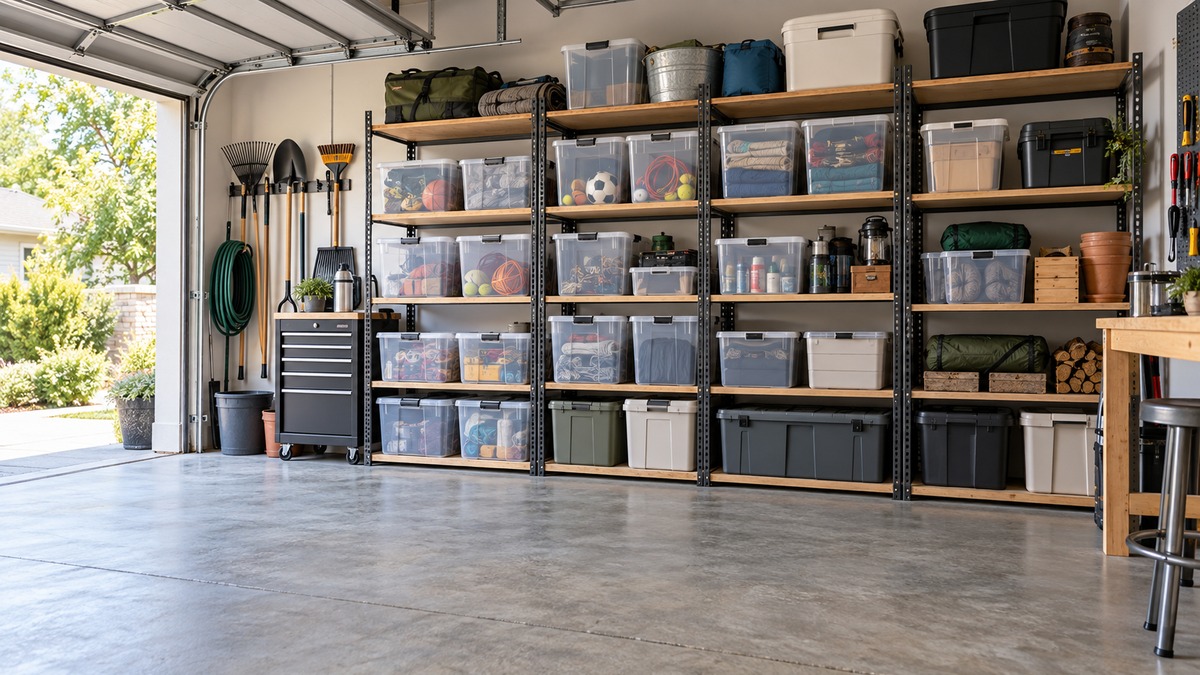
The Utah State article calls plastic storage containers with lids possibly the most versatile accessories in modern storage systems, and notes that they are stackable and come in a variety of sizes. It adds that “Clear plastic storage containers are especially helpful.” The Cornell post pairs bins with labels: it says to label boxes and bins with indelible marker, and it advises organizing so that you can see everything at a glance.
Put those two points together. Clear bins let you check contents without opening them, and a label gives the category even when the contents are hidden, as they are in the opaque Stacker totes whose product pages describe a solid opaque base for concealing contents. A workable label has three parts: the zone, the category and the season or job. Put it on the end that faces out and repeat it on the lid.
Keep bins off the floor and closed against pests
A University of California Agriculture and Natural Resources blog post on household pests says garages, basements, attics and other storage spaces can attract unwanted pests. Its advice for those spaces is to organize belongings in airtight containers such as plastic bins to keep out carpet beetles, mice and silverfish. It also says: “Store bins off the floor and away from walls.” The post gives this as a way to reduce clutter in storage areas.
The Sterilite pages we opened describe lids as snap-fit, latched, or tight-fit and drip-resistant. None of them uses the word airtight. If pest control is your reason for bins, read the product description for that wording before you rely on a lid, and keep the shelf surface and floor clear so that a bin does not become a nest site. A shelf that holds bins off the floor handles the second half of the advice without extra work.
Penn State Extension’s decluttering guidance for child care facilities gives a number for the clearance: all items, including storage containers, should be at least six inches off the floor for easier floor cleaning. The same page says not to use cardboard boxes to store items. It is written for child care settings, so read it as a general cleaning rule and not as garage-specific advice.
Wheels, carts and the lifting limit
Bins get heavy long before they look heavy. The UBC lifting guide offers a rough maximum for the general working population under ideal conditions, and it lists them: a good grip with both hands, no twisting or bending, at least 5 minutes between lifts, and lifting for no more than 1 hour of the day. It notes that NIOSH lists 50 pounds as the maximum weight, that an Oregon OSHA calculator lists 70 pounds, and that UBC’s ergonomics program recommends 50 pounds. A bin lifted off a shelf in a crowded garage usually involves some bending or twisting, so treat 50 pounds as a ceiling and not a target.
The guide’s preparation list starts with a question that suits bins: can you use a dolly or cart? The Utah State article says that some storage containers are available with wheels. Sterilite’s 40-gallon wheeled Industrial tote page describes a rotating pull handle, large wheels and a metal axle that make it easier to move bulky items. The tote measures 36.75 by 21.375 by 18 inches, so on the 22.125-inch shelf in our example it fits with 0.75 inch of depth to spare and takes about 52 percent of the row (36.75 ÷ 71.25 = 0.52). The pages we opened do not say whether a wheeled bin may sit on the garage floor, since the Utah State article names only equipment with wheels or tracks and an engine as an exception, so decide that with the University of California advice in mind.
How we chose
This is an organizing method, not a product ranking. We read the pages listed at the end of this guide on 2026-10-21 and kept only rules that a page states in its own words. Direct quotes were checked against the text of the page. For bin sizes we used Sterilite’s own product pages, because a manufacturer’s page is a reasonable place for a bin’s stated outside dimensions. We could not open the Rubbermaid and IRIS product pages for dimensions, so those brands are not in the tables. The shelf in the worked example comes from an Edsal spec sheet, and every other figure in the tables is arithmetic on the stated numbers.
Mistakes to avoid
- Buying bins by gallon number. The two 27-gallon totes in the table differ by 86 square inches of footprint and 3.875 inches of height.
- Skipping the sort. Utah State Extension puts reducing the number of items first, before relocating or shelving anything.
- Putting heavy bins on the top shelf. The UBC guide reserves the zone above the shoulder for lighter items, and the Edsal manual puts heavier items on the bottom levels.
- Leaving bins on the floor. The University of California post says to keep bins off the floor and away from walls, and Penn State Extension puts the minimum at six inches.
- Trusting a lid for pest control. The pages we opened for the totes do not call the lids airtight.
- Skipping labels. The Cornell post tells readers to label boxes and bins.
What we could not verify
The pages we opened do not give a weight limit for any Sterilite tote, so this guide gives none. The Sterilite pages do not say whether listed heights include the lid. The Cornell post is written about garden and yard storage and the University of California post about household pests, so both are close fits for a garage rather than exact ones. The Utah State article is from 2006. None of the pages says how many bins a household needs, how high to stack them, or whether clear bins hold up better than opaque ones. We could not open Rubbermaid’s or IRIS’s product pages, so nothing here compares those brands. The UBC lifting numbers assume ideal conditions that a garage shelf rarely meets.
Frequently asked questions
Should garage storage bins be clear or opaque?
Utah State University Extension calls clear plastic storage containers especially helpful. If you choose opaque bins, the Cornell post’s advice to label boxes and bins covers the gap, since a label tells you the contents without opening the lid.
How many bins fit on one garage shelf?
It depends on the shelf and the bin. On a shelf measuring 71.25 by 22.125 inches, the table shows two 27-gallon Industrial totes per row or one 38-gallon Industrial tote. Measure your own shelf, divide its width by the bin length, and round down.
Where should the heaviest bins go?
Low, but not on the floor. An Edsal manual and a City of Seattle sheet say heavier items go on lower shelves, while the UBC guide puts the strongest lifting zone between mid-thigh and waist height and says to keep only lighter items below the knee.
How do I keep mice and insects out of garage bins?
The University of California post recommends airtight containers such as plastic bins for garages and other storage spaces, and it says to keep bins off the floor and away from walls. Check a bin’s description for the word airtight, because the Sterilite pages we opened do not use it.
Should I put paint and cleaning products in a bin?
The pages we opened do not say how to bin them. Utah State Extension lists paint, pesticides and cleaning chemicals among items that, for safety reasons, should not be stored in the home, and it says small quantities of some chemicals can be stored indoors. Follow the product label and your local rules.
Bottom line
Sort first, size each bin from its outside dimensions, and put the heaviest bins low but off the floor.
Sources
- Utah State University Extension, “Got Room for the Car in Your Garage?”: https://extension.usu.edu/archive/got-room-for-the-car-in-your-garage (opened 2026-10-21)
- Cornell Cooperative Extension of St. Lawrence County, “Organizing Garden and Yard Storage Areas”: https://blogs.cornell.edu/fruition/2022/10/30/garden-storage/ (opened 2026-10-21)
- University of California Agriculture and Natural Resources, indoor pests blog post: https://ucanr.edu/blog/pests-urban-landscape/article/unwanted-indoor-critters-theres-pest-notes (opened 2026-10-21)
- University of British Columbia Human Resources, Lifting Guidelines: https://hr.ubc.ca/sites/default/files/2020-09/Lifting%20Guidelines.pdf (opened 2026-10-21)
- City of Seattle Office of Emergency Management, Garage and Storage Safety: https://www.seattlehousing.org/sites/default/files/Earthquake_Safety_Garage_%26_Storage.pdf (opened 2026-10-21)
- University of Oregon, Shelving Safety sheet: https://safety.uoregon.edu/sites/default/files/safety_sheet_-_shelving_safety_final.pdf (opened 2026-10-21)
- Penn State Extension, Better Kid Care, “Clean, Uncluttered Space”: https://extension.psu.edu/programs/betterkidcare/news/clean-uncluttered-space (opened 2026-10-21)
- Sterilite 27 Gal. Industrial Tote: https://www.sterilite.com/product/27-gal-industrial-tote-2/ (opened 2026-10-21)
- Sterilite 17 Gal. Industrial Tote: https://www.sterilite.com/product/17-gal-industrial-tote-2/ (opened 2026-10-21)
- Sterilite 38 Gal. Industrial Tote: https://www.sterilite.com/product/38-gal-industrial-tote-2/ (opened 2026-10-21)
- Sterilite 15 Gal. Industrial Tote: https://www.sterilite.com/product/15-gal-industrial-tote/ (opened 2026-10-21)
- Sterilite 12 Gal. Latch Tote: https://www.sterilite.com/product/12-gal-latch-tote/ (opened 2026-10-21)
- Sterilite 27 Gal. Stacker Tote: https://www.sterilite.com/product/27-gal-stacker-tote/ (opened 2026-10-21)
- Sterilite 50 Gal. Stacker Tote: https://www.sterilite.com/product/50-gal-stacker-tote/ (opened 2026-10-21)
- Sterilite 40 Gal. Wheeled Industrial Tote: https://www.sterilite.com/product/40-gal-wheeled-industrial-tote/ (opened 2026-10-21)
- Edsal spec sheet, model ER7824W4: https://edsalmanufacturingcompany.freshdesk.com/helpdesk/attachments/153003547654 (opened 2026-10-21)
- Edsal assembly manual, model MROP3618W5B: https://pdf.lowes.com/productdocuments/fe18e1bc-f07c-4345-84ce-7fe425fa1c7a/43253606.pdf (opened 2026-10-21)
As an Amazon Associate we earn from qualifying purchases.