How Deep Should Garage Shelves Be
As an Amazon Associate we earn from qualifying purchases.
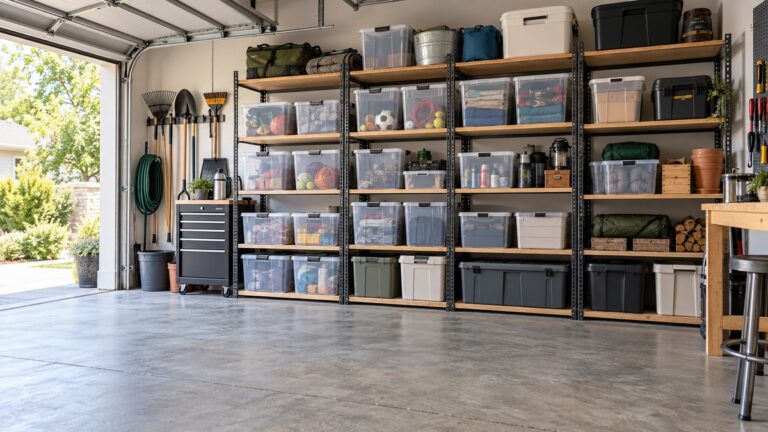
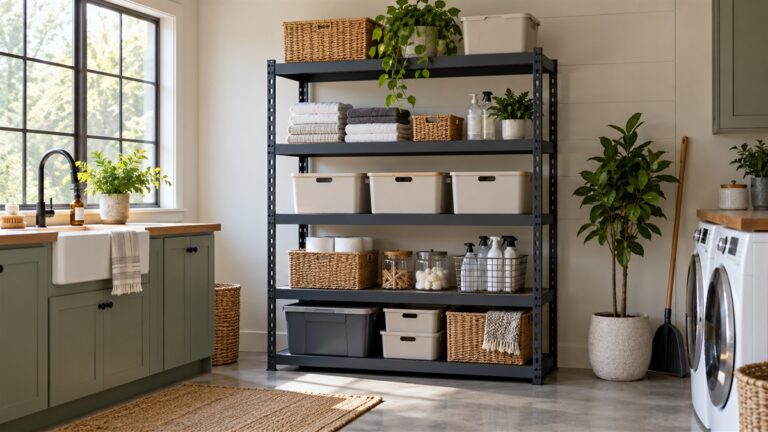
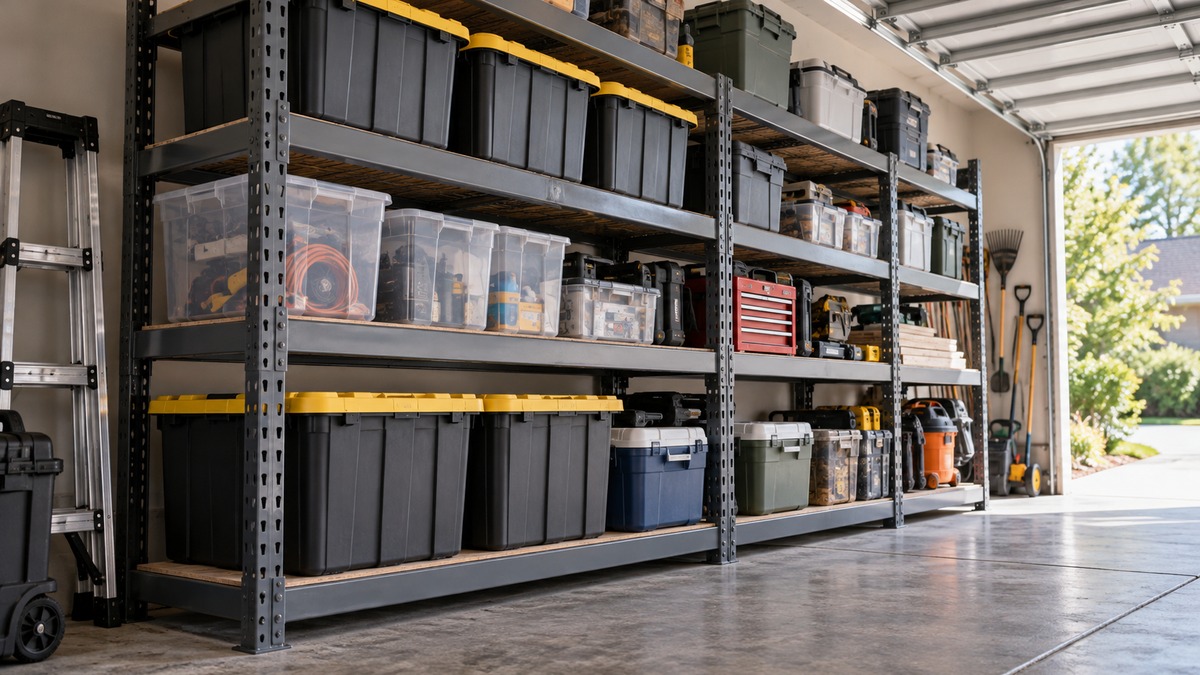
How deep should garage shelves be? Pick the depth from your widest bin first, then check that you can comfortably reach the back. The Edsal and Gladiator pages we opened list stated depths from 12 to 24 inches, with 18 and 24 the most common. A stated depth is not the usable shelf: Edsal’s 24-inch-deep welded rack has shelves 22.125 inches deep. This guide shows how to read a shelf listing, which Sterilite totes fit which depths, and where reach limits from a university safety sheet and the ADA Standards come in.
Quick answer
- Choose a shelf at least as deep as the widest bin when the bin lies long side along the shelf. Among the Sterilite totes in the table below, widths run from 15.375 to 21.625 inches.
- Read the shelf size on the spec sheet, not the name. Edsal’s 24-inch units list shelf depths from 22.125 to 23.906 inches.
- An 18-inch shelf fits only the smallest totes in the table. The 24-inch units fit all of them.
- Deeper shelves make the back harder to reach, and none of the pages we opened gives a maximum comfortable depth for a garage.
The stated depth is not the shelf depth
Shelving names round the depth. Edsal publishes a spec sheet for each model with two separate lines: the overall depth of the unit and the shelf size. Subtracting one from the other shows how much depth the frame uses. The table uses six Edsal models from the sheets we opened. Percent usable is shelf depth divided by overall depth.
| Edsal model | Overall depth (in) | Shelf size, width × depth (in) | Depth lost to the frame (in) | Percent usable |
|---|---|---|---|---|
| UR301260PB4B (particleboard decking) | 12 | 29.906 × 11.906 | 12 − 11.906 = 0.094 | 99.2 |
| MROP3618W5B-P (wire decking) | 18 | 35.5 × 17.5 | 18 − 17.5 = 0.5 | 97.2 |
| UR1848P-BLK (particleboard decking) | 18 | 47.906 × 17.906 | 18 − 17.906 = 0.094 | 99.5 |
| MROP4824W5B-P (wire decking) | 24 | 47.5 × 23.5 | 24 − 23.5 = 0.5 | 97.9 |
| UR-245BLK (particleboard decking) | 24 | 47.906 × 23.906 | 24 − 23.906 = 0.094 | 99.6 |
| ER7824W4 (welded rack, wire decking) | 24 | 71.25 × 22.125 | 24 − 22.125 = 1.875 | 92.2 |
The difference matters most at the margin. A 24-inch welded rack gives you 22.125 inches, while a 24-inch boltless rack with particleboard decks gives 23.906. Gladiator’s pages name racks by their stated depth too: the heavy-duty line lists racks with 18-inch and 24-inch deep shelves, and the EZ Connect line lists 15-inch, 18-inch and 24-inch deep shelves. The Gladiator pages we could open do not print a shelf size, so we cannot tell you how much of each stated depth is usable.
| Line | Stated depths in the pages we opened |
|---|---|
| Gladiator heavy duty racks | 18 and 24 inches (a 90 by 90 inch mega rack does not state a depth in its name) |
| Gladiator EZ Connect racks | 15, 18 and 24 inches |
| Edsal boltless and Z-beam shelving | 12, 18 and 24 inches |
| Edsal welded storage racks | 24 inches |
Start from the widest bin
The next table checks Sterilite’s outside bin widths against four real shelf depths from the Edsal sheets: 17.5 and 17.906 for 18-inch units, and 22.125 and 23.5 for 24-inch units. A bin passes when its width is no greater than the shelf depth. The number is the spare depth, or the shortfall, in inches. Widths come from Sterilite’s product pages, converted from fractions to decimals.
| Sterilite tote | Outside width (in) | 17.5 in shelf | 17.906 in shelf | 22.125 in shelf | 23.5 in shelf |
|---|---|---|---|---|---|
| 12 Gal. Latch Tote | 15.375 | Fits, 2.125 spare | Fits, 2.531 spare | Fits, 6.75 spare | Fits, 8.125 spare |
| 15 Gal. Industrial Tote | 17.25 | Fits, 0.25 spare | Fits, 0.656 spare | Fits, 4.875 spare | Fits, 6.25 spare |
| 17 Gal. Industrial Tote | 18.125 | Short 0.625 | Short 0.219 | Fits, 4 spare | Fits, 5.375 spare |
| 27 Gal. Stacker Tote | 18.375 | Short 0.875 | Short 0.469 | Fits, 3.75 spare | Fits, 5.125 spare |
| 27 Gal. Industrial Tote | 19.625 | Short 2.125 | Short 1.719 | Fits, 2.5 spare | Fits, 3.875 spare |
| 40 Gal. Wheeled Industrial Tote | 21.375 | Short 3.875 | Short 3.469 | Fits, 0.75 spare | Fits, 2.125 spare |
| 50 Gal. Stacker Tote | 21.5 | Short 4 | Short 3.594 | Fits, 0.625 spare | Fits, 2 spare |
| 38 Gal. Industrial Tote | 21.625 | Short 4.125 | Short 3.719 | Fits, 0.5 spare | Fits, 1.875 spare |
The pattern is clear. An 18-inch shelf takes the 12-gallon and 15-gallon totes and nothing larger in this set, and the 15-gallon tote leaves only a quarter inch on the wire-deck shelf. The 17-gallon Industrial tote misses the particleboard 18-inch shelf by 0.219 inch, which is easy to overlook if you buy by the gallon label or the nominal depth. On a 22.125-inch shelf every tote in the table fits, but the 38-gallon tote has half an inch to spare. Our guide to basement shelves for totes covers the same bins from the buying side.
Turning a bin end-out puts its length across the depth of the shelf. On a 22.125-inch shelf, only the 12-gallon Latch tote, at 19.5 inches long, fits that way. The 15-gallon Industrial tote at 25.75 inches would overhang by 3.625 inches (25.75 − 22.125), and the 27-gallon Industrial tote at 28.5 inches by 6.375. The University of Oregon shelving sheet says to make sure items are not hanging over the edge, so long-side-along is the safer layout for all but the smallest tote.
How far can you comfortably reach?
A deeper shelf holds more bins per level, and it puts the back bin farther from your hands. The University of Oregon sheet explains why that matters with three leverage zones. In the Green Zone your elbows are at your sides, and the sheet says leverage is better and the muscles do less work when the load is closer to the body. In the Yellow Zone your elbows move up to 6 inches away from your body and more force falls on the shoulders and upper back. In the Red Zone your elbows move farther out or above the shoulders, and the sheet says to avoid it.
The sheet does not convert zones into shelf depth, because arm length varies. The University of British Columbia lifting guide points the same way with a technique step, “Get in close.” On a deep shelf you cannot get in close to the back bin without leaning over the front one, which is our reading of the two documents and not a statement either makes. OSHA’s grocery warehousing eTool describes a similar problem with pallets: product at the back of a slot must be reached, which stresses the shoulders and back. The eTool is about warehouse pallets, so treat it as a parallel, not a garage rule.
The ADA Standards give the only numbers on reach depth that we found. Section 308 sets the high forward reach over an obstruction at 48 inches maximum where the reach depth is 20 inches maximum, and at 44 inches maximum where the reach depth exceeds 20 inches, with 25 inches as the maximum reach depth. The page we opened does not say the Standards apply to a home garage, and a garage shelf is not an operable part, so this is a benchmark for how reach depth trades against reach height, not a requirement.
| Reach depth over an obstruction | High forward reach allowed | Where an Edsal shelf falls |
|---|---|---|
| 20 in or less | 48 in maximum | A 12-inch or 18-inch shelf |
| More than 20 in, up to 25 in | 44 in maximum | A 22.125-inch to 23.906-inch shelf |
| More than 25 in | Not provided | No shelf in the table |
The last column is our own mapping of shelf depth onto those reach depths. Read it as a rough guide that a 24-inch unit sits in the band where the standard lowers the allowed high reach by 4 inches, not as a rule that applies to your shelf.
What depth does to the garage floor
Utah State University Extension says the primary function of a garage should be to provide protection for automobiles, and it suggests organizing items on shelves and suspended from walls or ceiling to leave sufficient floor space for vehicles. Each inch of shelf depth is an inch of floor. The sources we opened give no vehicle clearance figures, so measure your parked vehicle and its doors before you choose a depth.
For scale, a 77-inch-wide, 24-inch-deep Edsal rack covers 77 × 24 = 1,848 square inches (12.8 square feet) of floor, and a 48-inch-wide, 18-inch-deep rack covers 48 × 18 = 864 square inches (6 square feet). The 77 by 24 unit takes a little over twice the floor area of the 48 by 18 unit, partly because it is wider. Whether that trade is worth it depends on how many bins you need on each level, which the bin table above lets you count. For other unit dimensions, see our guide to garage storage shelf dimensions and heights.
A decision guide by widest bin
- Measure the widest bin you plan to shelve, with its lid on, and note its length.
- If the bin is 17.25 inches wide or less, such as the 15-gallon Industrial tote, an 18-inch unit can work, but check the listed shelf size and keep the margin in mind.
- If the bin is wider than 17.25 inches and no wider than 21.625 inches, a 24-inch unit is the one that fits every tote in the table. Check the shelf size, which runs from 22.125 to 23.906 inches in the Edsal sheets.
- If the bin is wider than 23.906 inches, the deepest shelf size in the Edsal sheets we opened, it will not fit long-side-along on any of them, so look for a deeper shelf or a different bin.
- Mix depths when your bins mix: a deep unit for large totes and a shallow one for small boxes, rather than one depth for everything.
The same arithmetic works for any bin or box. Measure its width, subtract it from the stated shelf depth, and a negative result means the item overhangs. The 12-inch and 15-inch units in the pages we opened suit only items narrower than those depths, and none of the pages gives a depth rule for non-bin items such as paint cans, long-handled tools or lumber.
How we chose
This guide compares stated figures; it does not rank shelves. We read the pages listed at the end of this guide on 2026-10-21. Shelf depths come from Edsal’s own spec sheets because they print the shelf size. Gladiator’s pages give nominal depths only. Bin widths come from Sterilite’s product pages. The reach material comes from a University of Oregon sheet, a University of British Columbia guide, an OSHA eTool and the ADA Standards, and we label each as a parallel or a benchmark where it does not address garages. Every computed figure shows its inputs.
Mistakes to avoid
- Treating the name as the shelf size. A 24-inch welded rack has 22.125-inch shelves on the Edsal sheet.
- Buying 18-inch shelves for 17-gallon and larger totes. The 17-gallon Industrial tote is 18.125 inches wide.
- Letting bins overhang. The University of Oregon sheet says to make sure items are not hanging over the edge.
- Going deeper than you can reach. The Oregon leverage zones put the load far from the body in the Red Zone.
- Ignoring the floor. A 24-inch-deep unit uses a third more floor than an 18-inch unit of the same width (24 ÷ 18 = 1.33).
- Forgetting the lid. Sterilite’s pages do not say whether the listed height includes it, so measure your bin with the lid on.
What we could not verify
The pages we opened give no maximum comfortable shelf depth for a garage, and the ADA page does not say whether its Standards apply to a home garage. They do not state arm length or reach for an average adult. Gladiator’s pages that we could open do not print a shelf size, so its usable depths are unknown. We could not open Rubbermaid’s or IRIS’s product pages, and we could not open BIFMA’s site, so none of those is used. The OSHA eTool is about warehouse pallets and the Oregon sheet is written for a campus, so both are close fits rather than exact ones. The Sterilite pages do not say whether the listed length includes the lid or handles.
Frequently asked questions
Is 24 inches too deep for garage shelves?
The pages we opened do not set a maximum. A 24-inch unit is the depth that fits every tote in the table, and the cost is a longer reach to the back and more floor used, as the Oregon leverage zones and the floor arithmetic show.
Is 18 inches deep enough for storage totes?
Only for the smallest ones in the table. The 12-gallon and 15-gallon totes fit an 18-inch shelf, while the 17-gallon Industrial tote and larger ones are wider than the 17.5 and 17.906 inch shelves on the Edsal sheets.
Why is my 24-inch shelf only about 22 inches deep?
Edsal’s spec sheet for its 77-inch welded rack lists an overall depth of 24 inches and a shelf size of 71.25 by 22.125 inches. Other Edsal lines lose less, down to 0.094 inch, so the spec sheet for your model is the one to read.
What depth fits a 27-gallon tote?
The 27-gallon Industrial tote is 19.625 inches wide and 28.5 inches long, so lying long side along the shelf it needs at least 19.625 inches of shelf depth. The 27-gallon Stacker tote is 18.375 inches wide.
Can I put totes end-out on a deep shelf?
Only the 12-gallon Latch tote fits end-out on a 22.125-inch shelf in our table, at 19.5 inches long. Larger totes overhang, and the Oregon sheet says items should not hang over the edge.
Bottom line
Match the shelf depth to your widest bin, read the shelf size on the spec sheet, and add depth only as far as you can comfortably reach.
Sources
- Edsal spec sheet, model ER7824W4: https://edsalmanufacturingcompany.freshdesk.com/helpdesk/attachments/153003547654 (opened 2026-10-21)
- Edsal spec sheet, model MROP3618W5B-P: https://edsalmanufacturingcompany.freshdesk.com/helpdesk/attachments/153001126053 (opened 2026-10-21)
- Edsal spec sheet, model MROP4824W5B-P: https://edsalmanufacturingcompany.freshdesk.com/helpdesk/attachments/153001126054 (opened 2026-10-21)
- Edsal spec sheet, model UR301260PB4B: https://edsalmanufacturingcompany.freshdesk.com/helpdesk/attachments/153001476335 (opened 2026-10-21)
- Edsal spec sheet, model UR1848P-BLK: https://edsalmanufacturingcompany.freshdesk.com/helpdesk/attachments/153001476411 (opened 2026-10-21)
- Edsal spec sheet, model UR-245BLK: https://edsalmanufacturingcompany.freshdesk.com/helpdesk/attachments/153001476414 (opened 2026-10-21)
- Gladiator heavy duty storage racks page: https://www.gladiatorgarageworks.com/collections/heavy-duty-storage-racks (opened 2026-10-21)
- Gladiator EZ Connect storage racks page: https://www.gladiatorgarageworks.com/collections/ez-connect-storage-racks (opened 2026-10-21)
- Sterilite 12 Gal. Latch Tote: https://www.sterilite.com/product/12-gal-latch-tote/ (opened 2026-10-21)
- Sterilite 15 Gal. Industrial Tote: https://www.sterilite.com/product/15-gal-industrial-tote/ (opened 2026-10-21)
- Sterilite 17 Gal. Industrial Tote: https://www.sterilite.com/product/17-gal-industrial-tote-2/ (opened 2026-10-21)
- Sterilite 27 Gal. Industrial Tote: https://www.sterilite.com/product/27-gal-industrial-tote-2/ (opened 2026-10-21)
- Sterilite 27 Gal. Stacker Tote: https://www.sterilite.com/product/27-gal-stacker-tote/ (opened 2026-10-21)
- Sterilite 38 Gal. Industrial Tote: https://www.sterilite.com/product/38-gal-industrial-tote-2/ (opened 2026-10-21)
- Sterilite 40 Gal. Wheeled Industrial Tote: https://www.sterilite.com/product/40-gal-wheeled-industrial-tote/ (opened 2026-10-21)
- Sterilite 50 Gal. Stacker Tote: https://www.sterilite.com/product/50-gal-stacker-tote/ (opened 2026-10-21)
- University of Oregon, Shelving Safety sheet: https://safety.uoregon.edu/sites/default/files/safety_sheet_-_shelving_safety_final.pdf (opened 2026-10-21)
- University of British Columbia Human Resources, Lifting Guidelines: https://hr.ubc.ca/sites/default/files/2020-09/Lifting%20Guidelines.pdf (opened 2026-10-21)
- U.S. Access Board, ADA Standards, section 308 Reach Ranges: https://www.access-board.gov/ada/ (opened 2026-10-21)
- OSHA eTool, Grocery Warehousing, Storage: https://www.osha.gov/etools/grocery-warehousing/storage (opened 2026-10-21)
- Utah State University Extension, “Got Room for the Car in Your Garage?”: https://extension.usu.edu/archive/got-room-for-the-car-in-your-garage (opened 2026-10-21)
As an Amazon Associate we earn from qualifying purchases.