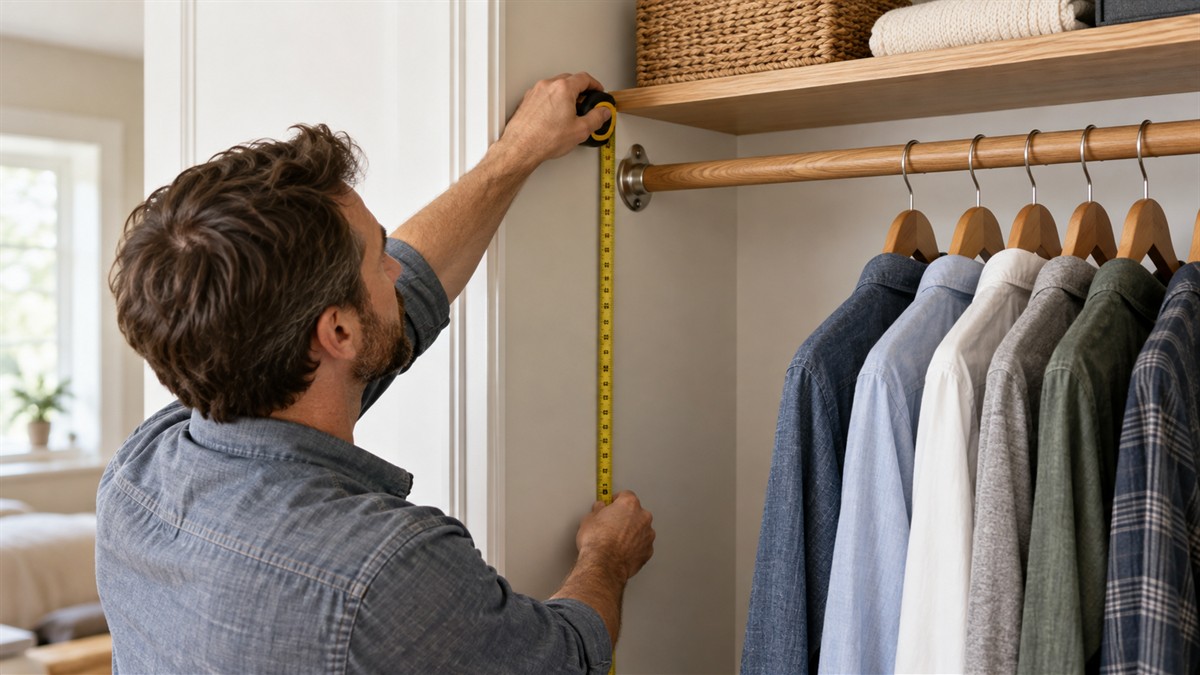
How High Should a Closet Rod Be
As an Amazon Associate we earn from qualifying purchases.
How high should a closet rod be? For a single rod that holds long garments, the two guides that give numbers put it at 68 and 66 inches from the floor. For a double hang they give 84 and 42 inches, or 81¾ and 40½. The pages do not explain the small difference. This article lays out both sets of figures, checks them against published garment lengths, and adds a reach limit from the ADA standards so you can adjust the rod to the person who uses it.
Quick answer
- Single rod for long garments: 68 inches from the floor in the Organized Living guide, 66 inches in the Bob Vila article.
- Double hang: about 84 inches for the upper rod and 42 inches for the lower rod (Organized Living), or 81¾ and 40½ (Bob Vila).
- The better rule is garment length plus clearance: the rod must sit higher than the longest garment you hang, including its hanger.
- For reach, the ADA standards use 48 inches as the highest reach in accessible design, so an upper rod at 84 inches sits 36 inches above that limit.
The heights the sources give
Two sources put numbers on rod heights. The Organized Living closet guide (a 2019 document for its freedomRail systems) lists approximate clothes rod heights for 96-inch ceilings. The Bob Vila article, updated in October 2024, gives heights for single and double rods and says to measure to the bottom of the rod. The Organized Living guide does not say which part of the rod its figures measure, so the two sets are close but not exactly comparable. The difference column is our own subtraction.
| Setup | Organized Living (96-inch ceilings), inches from floor | Bob Vila, inches from floor | Difference (inches) |
|---|---|---|---|
| Long hang or single rod | 68 | 66 | 68 − 66 = 2 |
| Medium hang | 56 | Not stated | Not applicable |
| Short hang | 42 | Not stated | Not applicable |
| Double hang, upper rod | 84 | 81¾ | 84 − 81.75 = 2.25 |
| Double hang, lower rod | 42 | 40½ | 42 − 40.5 = 1.5 |
| Triple hang | 84, 56 and 28 | Not stated | Not applicable |
| Lower rod for a small child | 28 (lowest triple-hang rod, for infants’ and toddlers’ clothes) | 30 | Not comparable: different setups |
Organized Living ties each height to examples. Long hang suits long coats, long dresses and suits. Medium hang suits long skirts, shorter dresses, shorter coats, cuff-hung pants and suits. Short hang and the lower rod of a double hang suit shirts and folded pants. The Bob Vila article says a single rod at 66 inches lets long coats, skirts, pants, dresses and suits hang without folding or brushing the closet floor, and that the lower rod of a double hang holds everyday shirts, blouses, blazers, shorts and folded pants while the top rod keeps the less frequently worn long coats and skirts.
One inconsistency sits inside the Organized Living guide. Its glossary says triple-hang rods are stacked about 20 inches apart, while its diagram lists 84, 56 and 28 inches from the floor, which are 28 inches apart. The guide does not reconcile the two, so treat the triple-hang numbers as a rough layout and not a rule. If you are choosing the rod itself, see our guide to the best rod to hang clothes in a closet.
Start from the garment, not the table
A fixed height only works if your clothes are the lengths the guide assumes. The Organized Living guide gives lengths for common garments and notes that they include the hanger. It also says the width and length figures are approximate and should be adjusted to fit you. We turned those lengths into a clearance check. The formula is clearance = rod height − garment length including hanger. A negative number means the garment would reach the floor or the rod below by that many inches. This simplifies, because the guide does not say how far a hanger hook rises above the rod, so treat the results as a first screen and not a measurement.
| Garment (length including hanger, inches) | On a 68-inch rod | On a 56-inch rod | On a 42-inch rod |
|---|---|---|---|
| Dresses, 46 to 66 | 68 − 66 = 2 to 68 − 46 = 22 | −10 to 10 | −24 to −4 |
| Long formal dress, 72 to 78 | −10 to −4 | −22 to −16 | −36 to −30 |
| Robes and coats, 46 to 66 | 2 to 22 | −10 to 10 | −24 to −4 |
| Outerwear jackets, 40 to 44 | 24 to 28 | 12 to 16 | −2 to 2 |
| Women’s suits and jackets, 32 to 42 | 26 to 36 | 14 to 24 | 0 to 10 |
| Slacks hung from cuff or waist, 46 to 52 | 16 to 22 | 4 to 10 | −10 to −4 |
| Skirts, 34 to 44 | 24 to 34 | 12 to 22 | −2 to 8 |
| Slacks and shorts folded over a hanger, 28 to 32 | 36 to 40 | 24 to 28 | 10 to 14 |
| Women’s shirts and blouses, 30 to 36 | 32 to 38 | 20 to 26 | 6 to 12 |
| Men’s shirts, 38 to 40 | 28 to 30 | 16 to 18 | 2 to 4 |
The table reproduces the logic in the guide’s own examples. Long coats and dresses reach 66 inches, and the long-hang rod sits at 68. Cuff-hung pants reach 52, and the medium-hang rod sits at 56. Shirts reach 40, and the short-hang rod sits at 42. Each example clears by 2 to 4 inches. The table also shows where a fixed height fails: a long formal dress of 72 to 78 inches does not fit a 68-inch rod by this arithmetic, so a closet that holds one needs a higher rod or a dedicated spot. The same arithmetic shows why the lower rod of a double hang suits shirts and folded pants and not dresses, since dresses would reach the floor.
The gap between the two rods in a double hang follows from the same figures. Organized Living puts them 84 − 42 = 42 inches apart, and Bob Vila puts them 81.75 − 40.5 = 41.25 inches apart. Anything on the upper rod therefore has about 41 to 42 inches before it meets the clothes below, less whatever space the hangers take up. Women’s shirts at 30 to 36 inches fit that gap, suits at 32 to 42 inches fit only at the shorter end, and coats at 46 to 66 inches do not.
A second manufacturer’s garment sizes
The IKEA PAX and KOMPLEMENT planning guide (a PDF on IKEA’s Irish site) includes a short list of measurements under the heading of generic clothes sizes. It gives centimeters, so we converted each to inches by dividing by 2.54. The two manufacturers line up on blouses, short dresses and very long garments. They split on coats, where IKEA’s figure is close to the Organized Living jacket length and well below its robe-and-coat length.
| Garment | Organized Living (inches, including hanger) | IKEA (centimeters as stated) | IKEA in inches |
|---|---|---|---|
| Coats | Outerwear jackets 40 to 44; robes and coats 46 to 66 | Plan approximately 100 | 100 ÷ 2.54 = 39.4 |
| Blouses | Women’s shirts and blouses 30 to 36 | Plan approximately 80 | 80 ÷ 2.54 = 31.5 |
| Short dresses | Dresses 46 to 66 | Approximately 120 | 120 ÷ 2.54 = 47.2 |
| Really long garments | Long formal dress 72 to 78 | Up to 190 | 190 ÷ 2.54 = 74.8 |
| Hanging trousers | Slacks hung from cuff or waist 46 to 52; folded 28 to 32 | Plan approximately 60 to 70 | 60 ÷ 2.54 = 23.6 to 70 ÷ 2.54 = 27.6 |
The coat row is the one that matters. IKEA plans about 39 inches for coats, which is close to the Organized Living figure for outerwear jackets and well below its figure for robes and long coats. Where two manufacturers disagree, plan for the longer garment you actually own. IKEA’s page does not say how its trousers hang, so the trouser row does not settle whether to plan for a cuff-hung or a folded pair. For a closet that holds several of these categories, our guides to wire closet shelving with a clothes rod and closet solutions for a small bedroom show how rods and shelves share a wall.
Reach: the ADA benchmark
The ADA standards, as published by the U.S. Access Board, set reach ranges for accessible design. For an unobstructed forward reach, the high limit is 48 inches and the low limit is 15 inches above the floor. The same limits apply to an unobstructed side reach. The Access Board page says the standards apply to facilities covered by the ADA in new construction and alterations, so they are not a rule for a private home. They are still a published benchmark for how high a person can reach, and they mention clothes rods by name. In the advisory to section 225.2, types of storage include closets, cabinets, shelves, clothes rods, hooks and drawers, and at least one of each type must fall within the reach ranges. It adds that “it is permissible to install additional storage outside the reach ranges.”
An archived ADA figure on closets, Figure 38(b) of the ADA Accessibility Guidelines, adds two numbers. If the clear floor space allows a parallel approach by a person in a wheelchair and the distance between the wheelchair and the clothes rod exceeds 10 inches, the maximum high side reach is 48 inches. The figure also says: “The maximum distance from the user to the clothes rod shall be 21 inches.” The Access Board page says the current standards are closely based on those guidelines, so use the 48-inch limit from the 2010 standards as the benchmark and the 21-inch distance as a secondary cue.
| Rod (source) | Height from floor (inches) | Inside the 15 to 48 inch reach range? |
|---|---|---|
| Single or long hang (Organized Living) | 68 | No: 68 − 48 = 20 inches above the limit |
| Medium hang (Organized Living) | 56 | No: 56 − 48 = 8 inches above |
| Short hang or double hang lower rod (Organized Living) | 42 | Yes |
| Double hang upper rod (Organized Living) | 84 | No: 84 − 48 = 36 inches above |
| Single rod (Bob Vila) | 66 | No: 66 − 48 = 18 inches above |
| Double hang, lower rod (Bob Vila) | 40½ | Yes |
| Lowest triple-hang rod (Organized Living) and child’s lower rod (Bob Vila) | 28 and 30 | Yes: both are above the 15-inch low limit |
For a user who cannot reach 48 inches, the heights that work are the lower rods. A single rod at 66 or 68 inches fails the test, so the choice is a double hang with the main clothes on the 42-inch rod, or an adjustable rod set at a height convenient for that person. The North Carolina State Extension circular reprinted in 1965 says the same in plainer terms: plan a height that is convenient for the person using the rod. It also shows an adjustable rod that can be moved as a child grows.
The 21-inch distance gives a second check on how far back the rod sits. Bob Vila advises mounting the rod at least 12 inches from the rear wall and notes that the average closet is 24 inches deep, and the NC State circular lists 24 inches as the minimum depth recommended where clothes hang. The formula is distance from the front plane = closet depth − setback from the rear wall. This is a simplification, because the ADA figure measures from the user and not from the front of the closet.
| Closet depth (inches) | Rod setback from rear wall (inches) | Rod to front plane (inches) | Within 21 inches? |
|---|---|---|---|
| 24 | 12 | 24 − 12 = 12 | Yes |
| 30 | 12 | 30 − 12 = 18 | Yes |
| 36 | 12 | 36 − 12 = 24 | No, by 3 inches |
Depth also decides how much reaching you do on a deep reach-in closet, which our guide to standard reach-in closet depth covers in more detail.
How much rod length you need at that height
Height is only half of the plan. A rod at the right height still fails if there is not enough length for the clothes. The Kansas State University fact sheet says most clothing needs 2 to 3 inches of space for hanging, which varies with the length and width of the garment. The Organized Living guide adds a growth rule: plan ahead for future additions by adding 10 to 15 percent to the storage space required, which we apply here to rod length. The NC State circular recommends at least 48 inches of rod space for bedroom closets. The formula is rod length needed = garments × inches per garment × (1 + growth margin). The low end uses 2 inches and 10 percent, and the high end uses 3 inches and 15 percent.
| Garments to hang | Base length, 2 to 3 inches each | With growth margin, 10 to 15 percent | Fits a 48-inch rod? |
|---|---|---|---|
| 12 | 12 × 2 = 24 to 12 × 3 = 36 | 24 × 1.10 = 26.4 to 36 × 1.15 = 41.4 | Yes |
| 20 | 20 × 2 = 40 to 20 × 3 = 60 | 40 × 1.10 = 44.0 to 60 × 1.15 = 69.0 | Only at the low end |
| 30 | 30 × 2 = 60 to 30 × 3 = 90 | 60 × 1.10 = 66.0 to 90 × 1.15 = 103.5 | No |
The number of garments and the choice of rod are two separate decisions. Thirty garments can fit on a 72-inch rod only if they average the thin end of the range, and a double hang spreads the same clothes across two rods. For a walk-in layout where length is easier to find, see our guides to small walk-in closet ideas and narrow walk-in closet organization.
Clearance above the rod
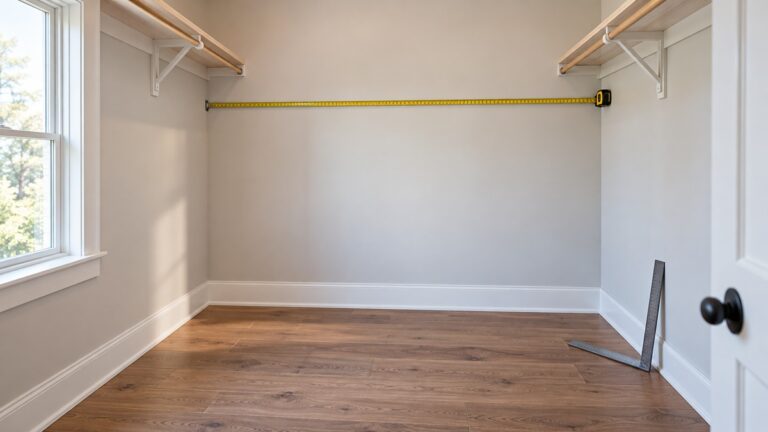
When a shelf sits above the rod, the Bob Vila article says to mount the rod so there is at least 2 inches from the bottom of the shelf to the top of the rod. Without that clearance, it says, the space is too tight to maneuver hangers. The article also says to align the bottom of the rod with the height mark, which is why the measurement point matters when you compare it with another guide. In height terms, the shelf bottom must sit at least 2 inches above the top of the rod. The pages we opened do not give the diameter of a rod to add to the rod height, so measure your rod.
How we chose
This is a planning guide and not a product list. We opened pages on 2026-10-21 and kept only figures that a page states: an Organized Living closet design guide, an IKEA planning guide, the U.S. Access Board’s ADA standards page, an archived ADA figure on closets, a Bob Vila article, a North Carolina State Extension circular and a Kansas State University fact sheet. We preferred manufacturer guides and government pages for numbers, and used the Bob Vila article as a second, independent set of heights. Where the Organized Living and Bob Vila figures differ by an inch or two, both are shown. Subtractions, conversions and the clearance table are our own arithmetic and are labeled as such.
Mistakes to avoid
- Using one height for every garment. The Organized Living guide gives different rod heights for long, medium and short hang.
- Forgetting the hanger. The garment lengths in the guide include the hanger, so a 66-inch coat needs a rod above 66 inches.
- Placing the upper rod out of reach. The ADA standards use 48 inches as the high reach limit, and an 84-inch rod is 36 inches above it.
- Squeezing a shelf onto the rod. Bob Vila says to leave at least 2 inches between the shelf bottom and the top of the rod.
- Setting the rod too far back. The archived ADA figure caps the distance from the user to the clothes rod at 21 inches.
- Ignoring length. The Kansas State fact sheet says most clothing needs 2 to 3 inches of hanging space.
What we could not verify
The pages we opened do not state which part of the rod the Organized Living heights measure, how far a hanger hook rises above the rod, or the diameter of a standard rod. They give no heights for ceilings other than 96 inches, and no extension or government page gives an adult rod height. A Knape and Vogt closet planning guide listed in search results could not be opened as a PDF, so its figures are not used. The ADA standards apply to covered facilities and not to private homes, and the closet figure we cite is from archived guidelines. The NC State circular is a 1965 reprint, and its wording on a junior rod is unclear in the scan. The Bob Vila article is a media piece and not a manufacturer guide. Nothing here is a mounting or weight claim.
Frequently asked questions
What is the standard height for a single closet rod?
The two guides we opened give 68 inches (Organized Living, for 96-inch ceilings) and 66 inches (Bob Vila, measured to the bottom of the rod). The right height is the longest garment length plus clearance.
How high is the top rod in a double-hang closet?
Organized Living lists 84 inches for the upper rod and 42 for the lower. Bob Vila lists 81¾ and 40½. The two sets differ by about 2 inches at the top.
How far apart should the two rods be?
The sources do not state a spacing. The difference between their rod heights is 42 inches for Organized Living and 41.25 inches for Bob Vila. Its triple-hang text says about 20 inches, which conflicts with its own diagram.
How low should a child’s rod be?
Bob Vila suggests mounting the lower rod of a double hang at 30 inches for a small child. The Organized Living triple-hang diagram puts the lowest rod at 28 inches for infants’ and toddlers’ clothes.
Can a person reach a rod at 66 or 68 inches?
The ADA standards set 48 inches as the high reach limit in accessible design, so a rod at 66 or 68 inches is beyond it. The standards cover facilities under the ADA, and they permit extra storage outside the reach ranges.
How much space should be left between a shelf and the rod?
Bob Vila says at least 2 inches from the bottom of the shelf to the top of the rod. The pages we opened give no other figure.
Bottom line
Pick the rod height from the longest garment you hang plus clearance, start near 66 to 68 inches for one rod or 84 and 42 for two, and lower the main rod if the person using it cannot reach 48 inches.
Sources
- https://organizedliving.com/docs/default-source/design-guide-documents/closetcreationguide_storage-101.pdf (opened 2026-10-21)
- https://www.ikea.com/ie/en/files/pdf/69/0a/690a180e/pax__komplement.pdf (opened 2026-10-21)
- https://www.access-board.gov/ada/ (opened 2026-10-21)
- https://archive.ada.gov/descript/reg3a/fig38bds.htm (opened 2026-10-21)
- https://www.bobvila.com/articles/closet-rod-height/ (opened 2026-10-21)
- https://ocr.lib.ncsu.edu/ocr/ua/ua102_200-001-bx0004-004-005/ua102_200-001-bx0004-004-005.pdf (opened 2026-10-21)
- https://bookstore.ksre.k-state.edu/pubs/cut-the-clutter-and-get-organized-fact-sheet_MF2879.pdf (opened 2026-10-21)
As an Amazon Associate we earn from qualifying purchases.