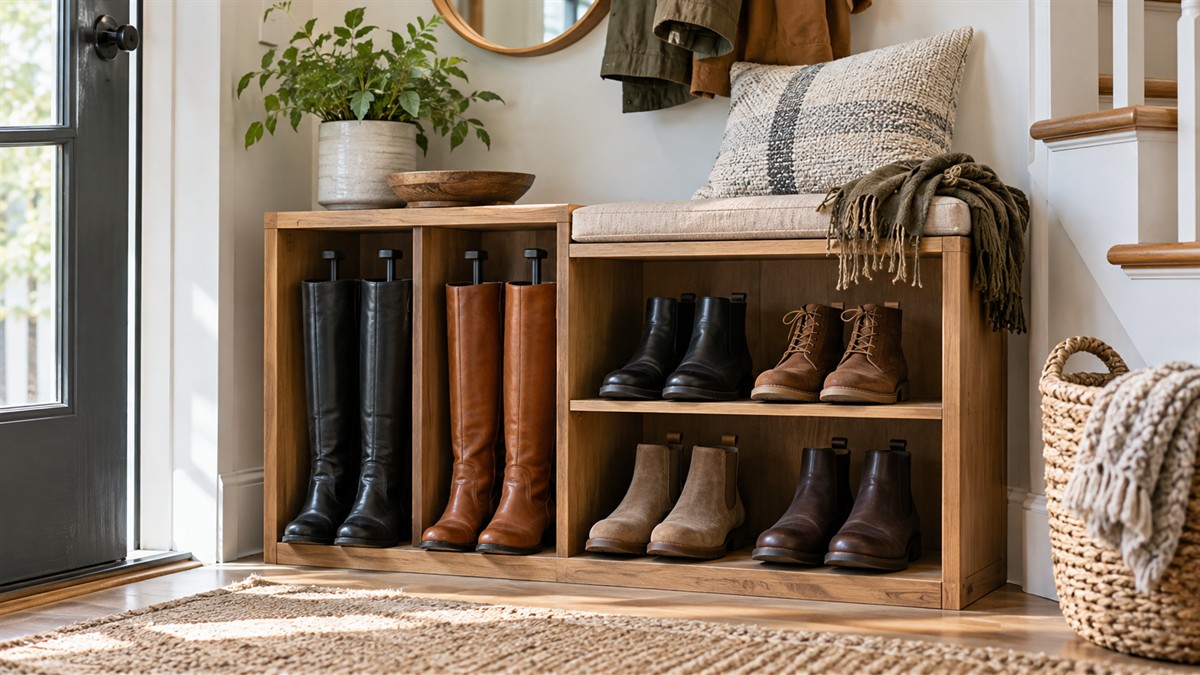
How to Store Boots
As an Amazon Associate we earn from qualifying purchases.
How to store boots comes down to five steps: clean them, dry them away from heat, keep their shape with boot trees or loose paper, put them somewhere cool, dark and ventilated, and skip plastic bags. Red Wing, Danner, two extension publications on leather care and a museum conservator agree on most of this. They split on whether to condition leather as part of storage. This guide sets out what each source says, how to plan shelf space for a mixed set of boots, and what none of them covers.
Quick answer
- Let boots air dry at room temperature. Red Wing and Danner both warn against direct heat such as radiators, hair dryers, sunlight or open flame.
- Keep the shape with boot trees, which Red Wing recommends, or with loosely crumpled paper, which Danner and Alabama Extension describe.
- Store them in a cool, dry, well-ventilated place away from direct sunlight, in a cloth bag or open space, not a plastic bag.
- Keep dirty work boots out of the house if they may carry pesticide residue, as a University of Washington center advises.
Clean and dry the boots first
Storage starts before the boots reach the shelf. Red Wing’s care guide says regular cleaning prevents dirt and debris from breaking down the leather over time, and its first step is to remove loose dirt with a soft brush or damp cloth. An extension page from Washington State University makes the same point for leather garments: “Store clean garments only.” It explains that soil can become ingrained and that age sets spots and stains.
Drying comes next. Red Wing says to always let boots air dry at room temperature and to avoid direct heat such as radiators or hair dryers, which can dry out the leather. Danner’s care pages agree. They say high heat sources, “such as direct sunlight or open flame,” are not recommended for drying boots, and that such heat may cause damage including “delaminating the outsole or cracking the leather.”
If the inside of a boot is wet, Danner describes a newspaper method. You crumple a sheet of dry newspaper loosely, and “Stuff the loose newspaper ball into the toe box of your footwear.” Repeat with more sheets until the boot is filled, then wait, because “the dry paper will absorb the moisture.” After an hour or two the page says to pull out the saturated sheets, and if the boots are still wet, to repeat with fresh sheets. The same page says not to put boots in a clothes dryer, even on low. Alabama Extension, quoting Mississippi State University Extension in a flood-recovery context, gives a matching tip for leather shoes: let them dry away from direct heat and from sun, and stuff them with paper so they hold their shape.
The common thread is patience. Every source that mentions drying says to avoid shortcuts that use heat, and none gives a drying time. The Danner page suggests a rough hour or two between paper changes, but that is a handling interval, not a time to full dryness.
Keep the shape: boot trees or paper
A boot left empty can slump and crease. Red Wing’s guide says inserting boot trees “helps maintain the shape of the leather and prevents creasing.” The Alabama page offers a lower-cost route for shoes in general: stuff them with paper so they hold their shape. Danner’s newspaper method is written for drying, so it is a close fit for shaping, not an exact one.
A museum conservator adds a warning that applies to any form you push into leather. In a Buffalo Bill Center of the West article on caring for leather, the conservator says it is better to underpad an object than to overstuff the form. For a boot, our reading is that a tree or paper should fill the boot without stretching it. None of the pages we opened gives a tree size or a stuffing amount.
Pick the place: cool, dry, dark and ventilated
Red Wing’s storage section names two location rules. Boots belong in a cool, dry place, and the page specifies “a well-ventilated area away from direct sunlight.” Two extension pages on leather garments support the same picture. Iowa State University Extension says to store leather in a cool, ventilated area, and warns that leather is “subject to drying out if exposed to dry heat” and can develop “mildew if stored in a hot, humid environment.” The Washington State bulletin says to avoid areas of extreme temperature, wetness or dryness and to use a dark area, because sun and light may cause fading and stiffening.
Those two extension pages are written for leather garments, not footwear, so boots are a close fit rather than an exact one. The Buffalo Bill Center conservator describes the same ideal from the museum side: a stable environment with minimal swings in temperature and humidity, low light levels, and clean leather. The article notes that museum practice differs from how people handle leather at home, but it names goals a home shelf can aim for.
Putting that together gives a short list of places to avoid for a boot shelf. A spot beside a radiator or heating vent fails the heat rule, and Danner’s odor page says not to place boots over a heater or air vent in the home, which it calls a fire hazard. A bright window sill fails the sun rule. A damp basement or an unheated space with condensation fails the humidity rule. The sources do not name specific rooms, so those examples are our reading of their rules.
Cloth or open air, not plastic
Three of the pages use almost the same words on this point. Red Wing says that leather needs to breathe, and that boots should be kept in a cloth bag or open space rather than in plastic containers. Iowa State says “Do not store leather in a plastic bag.” Washington State says leather needs to “breathe,” because without air circulation it will discolor and dry out, and recommends a cloth bag.
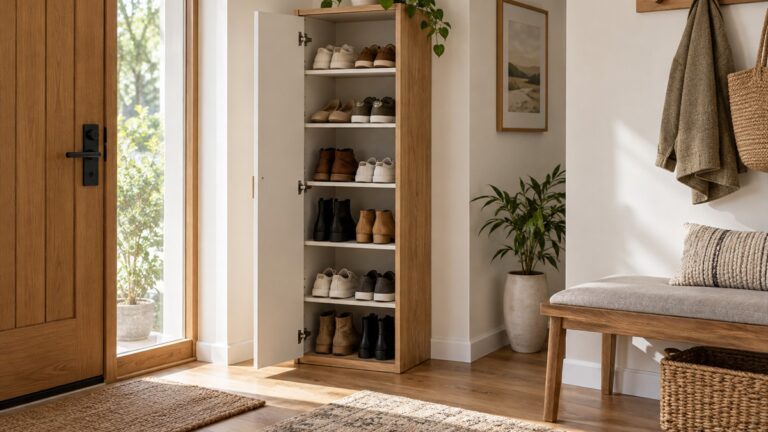
That rule has a practical effect on shelf choice. An open shelf or a cabinet with ventilation satisfies it, while a sealed plastic bin does not. If you want a bin for dust protection, a cloth bag inside open shelving is the option the pages support. The pages we opened do not mention cardboard boxes, so we have no sourced position on them.
Should you condition before storing?
The sources do not agree on conditioning, and the difference is worth seeing. Red Wing says leather needs moisture to stay flexible and resistant to cracking, and tells owners to apply conditioner sparingly with a soft cloth and let it soak in overnight. Danner says “It’s normal for leather to dry out over time” and recommends conditioning boots “every couple of months” for regular wear.
The museum view is different. The Buffalo Bill Center conservator says “Museums don’t use leather dressings, oils, waxes, or silicone oils on leather,” because a stable environment makes them unnecessary, and the dressings eventually break down and become dirty. That advice is for a collection that is displayed or stored but not worn. Boots you wear are in a different position from museum leather.
No page we opened says to condition immediately before a season of storage. What we can say is limited to the sourced points: the makers recommend periodic conditioning for worn boots, and the conservator recommends a stable environment over dressings for stored leather.
Work boots that carry residue
One source treats boot storage as a health question. A University of Washington agricultural safety center describes a plastic boot bin for farmworkers who handle pesticides. It says research found higher pesticide levels in farmworkers’ homes and vehicles than in non-farmworkers’ homes, and advises “Store your boots outside the house and away from children and pets.” Its supplies list is a plastic container with a secure lid, and a tip says “Prop the lid open to dry out work boots.”
This conflicts with the leather-care advice on its face, since Red Wing says to avoid plastic containers. The two sets of advice have different goals. The boot bin protects people from residue, and the Red Wing rule protects the leather. Our reading is that a propped-open lid on a bin kept outside the living space is the arrangement the University of Washington page describes. If your boots carry no residue, the leather rules apply as written.
Plan the shelf with a width and height calculation
The sources give no boot dimensions, so the table uses our own assumptions. Replace them with measurements of your boots, with trees in, before you decide on a shelf. For each group, add a 1-inch gap between pairs and a 1-inch gap above the tallest boot. Those gaps are assumptions that stand in for the ventilated space the sources ask for, and no source gives a distance.
| Group (our assumption) | Pair width (inches) | Boot height (inches) | Pairs on a 36-inch shelf | Clear height needed (inches) |
|---|---|---|---|---|
| Ankle boots | 9 | 7 | 36 ÷ (9 + 1) = 3.6, so 3 | 7 + 1 = 8 |
| Six-inch work boots | 10 | 8 | 36 ÷ (10 + 1) = 3.27, so 3 | 8 + 1 = 9 |
| Tall boots standing | 11 | 15 | 36 ÷ (11 + 1) = 3.0, so 3 | 15 + 1 = 16 |
Now apply the table to a collection. Suppose you own six pairs of ankle boots, four pairs of work boots and two pairs of tall boots, which is 12 pairs. Give each group its own shelf level, because the clear height differs.
| Group | Pairs owned | Shelves needed | Clear height of those shelves (inches) |
|---|---|---|---|
| Ankle boots | 6 | 6 ÷ 3 = 2 | 2 × 8 = 16 |
| Six-inch work boots | 4 | 4 ÷ 3 = 1.33, so 2 | 2 × 9 = 18 |
| Tall boots standing | 2 | 2 ÷ 3 = 0.67, so 1 | 1 × 16 = 16 |
| Total | 12 | 2 + 2 + 1 = 5 | 16 + 18 + 16 = 50 |
The table shows two things. Five shelf levels need at least 50 inches of clear height before you count the thickness of the shelves, and the work boots waste space, because four pairs need two shelves while holding only a little more than one shelf’s worth. If you own five pairs of work boots instead of four, they fill two shelves with 6 pairs of capacity and leave one slot spare. A mixed shelf is a way to recover that space, but it makes the clear height equal to the tallest boot on that shelf. Tall boots lying on their side are another option, although the pages we opened do not discuss it.
The Buffalo Bill Center conservator warns against hanging leather from metal hangers or nails, which also matters if you were thinking of a wall hook for tall boots. For shelf and cabinet options that fit a home, see our guides to a boot storage closet, a boot storage cabinet, and shoe storage for a small closet. For a garage or entry setup, see a shoe closet for the garage and small mudroom shoe storage.
A seasonal routine you can follow
- Brush off loose dirt and wipe the boots with a damp cloth, as Red Wing describes.
- Let them air dry at room temperature, with loosely crumpled paper inside if they are damp, and keep them away from radiators, hair dryers, sun and flame.
- Insert boot trees, or use loose paper if you have no trees.
- Choose a cool, dry, ventilated, dark spot, and put the boots on an open shelf or in a cloth bag.
- Check them every few months. The Buffalo Bill Center conservator advises monitoring stored leather for insect activity every few months.
- For dirty work boots, store them outside the living space and away from children and pets.
How we chose
This is a method guide, not a product list. We opened nine pages on 2026-10-21: a Red Wing care guide, three Danner care pages, an Iowa State University Extension page, a Washington State University Extension bulletin, an Alabama Extension page, a Buffalo Bill Center of the West article and a University of Washington agricultural safety center page. We kept only points that a page states in plain words, and we checked each quoted sentence against the page text. Timberland’s care pages returned access errors when requested by script, so nothing here relies on them. The shelf tables are our own arithmetic, and every input is marked as an assumption.
Mistakes to avoid
- Drying boots on a radiator or with a hair dryer. Red Wing and Danner both say direct heat can damage leather.
- Storing boots in a plastic bag. Red Wing and Iowa State both say not to.
- Leaving boots in direct sun. Red Wing says to keep them away from direct sunlight, and Washington State says light may cause fading and stiffening.
- Storing dirty boots. The Washington State bulletin says soil can become ingrained and set spots and stains.
- Hanging leather from a nail. The Buffalo Bill Center conservator says not to hang leather from metal hangers or nails.
- Bringing pesticide-exposed work boots into the house. The University of Washington page says to store them outside, away from children and pets.
What we could not verify
The pages we opened do not give a temperature range or a humidity target for boot storage, and none names a boot tree size or a stuffing amount. They do not say whether cardboard boxes are acceptable, whether boots should stand or lie on their side, or how far apart pairs should sit. Iowa State and Washington State write about leather garments, not boots, and the Alabama page is about flood recovery. The Buffalo Bill Center article is written for museum collections and notes that museum practice differs from home practice. The Danner pages cover Danner footwear, and the Red Wing guide covers Red Wing boots. Nothing here is a product claim.
Frequently asked questions
Should I store boots in a box or a bag?
The pages we opened support a cloth bag or open space. Red Wing says leather needs to breathe and should not be kept in plastic containers, and Iowa State says not to store leather in a plastic bag. The pages do not mention cardboard boxes.
Do boots need boot trees?
Red Wing recommends them for keeping the shape of the leather and preventing creasing. If you have none, Alabama Extension describes stuffing shoes with paper so they hold their shape.
How do I dry wet boots before storing them?
Let them air dry at room temperature. Danner suggests loose, dry newspaper in the toe box and warns that high heat can delaminate the outsole or crack the leather.
Where is the best spot to keep boots?
Red Wing says a cool, dry, well-ventilated place away from direct sunlight. Washington State adds that a dark area helps avoid fading and stiffening, and that extreme temperature, wetness or dryness should be avoided.
Can I keep work boots indoors?
If they may carry pesticide residue, the University of Washington center advises storing them outside the house and away from children and pets. For clean boots, the leather-care rules above apply.
Should I condition boots before putting them away?
The sources do not give a rule for the moment before storage. Red Wing and Danner recommend conditioning worn boots from time to time, while a museum conservator advises a stable environment instead of dressings for stored leather.
Bottom line
Clean the boots, dry them away from heat, keep their shape with trees or loose paper, and store them somewhere cool, dark and ventilated, in cloth or open air and never in plastic.
Sources
- https://www.redwingshoes.com/articles/proper-care.html (opened 2026-10-21)
- https://global.danner.com/danner-care/footwear-care (opened 2026-10-21)
- https://global.danner.com/danner-care/odor-management (opened 2026-10-21)
- https://global.danner.com/danner-care/full-grain-leather (opened 2026-10-21)
- https://blogs.extension.iastate.edu/answerline/2015/03/23/leather-care-tips/ (opened 2026-10-21)
- https://content.libraries.wsu.edu/digital/api/collection/ext/id/55869/download (opened 2026-10-21)
- https://www.aces.edu/blog/topics/emergency-handbook-home-family/salvaging-clothing/ (opened 2026-10-21)
- https://centerofthewest.org/2018/07/13/points-west-tips-conservator/ (opened 2026-10-21)
- https://pnash.deohs.washington.edu/psps/store-work-boots-bin (opened 2026-10-21)
As an Amazon Associate we earn from qualifying purchases.