How Much Height Do You Need for Shoe Storage
As an Amazon Associate we earn from qualifying purchases.
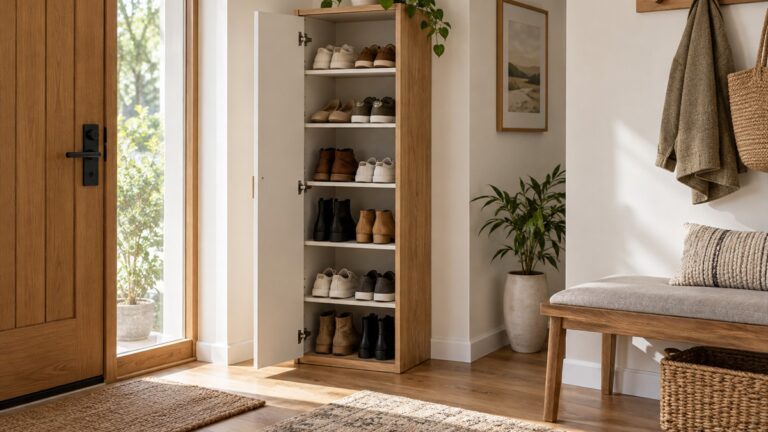
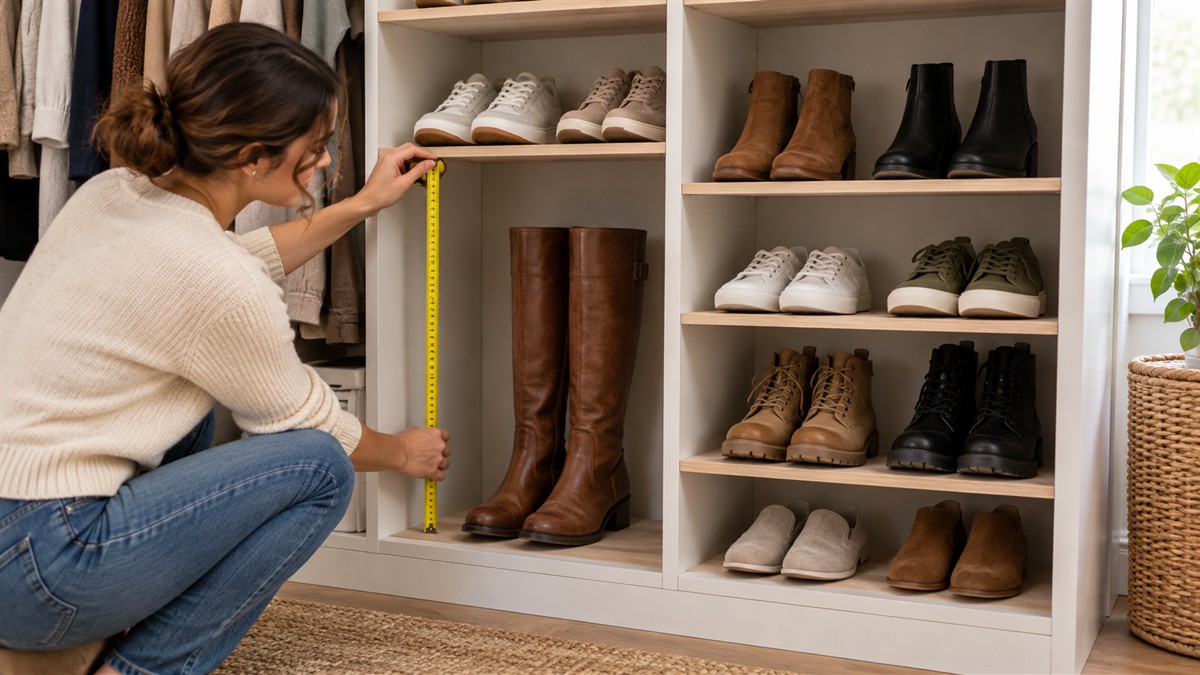
How much height do you need for shoe storage? The pages we opened give the pieces and leave the sum to you. Each tier of ordinary shoes takes about 5 to 9 inches of open space plus the shelf. Tall boots need a bay such as the 16 inches Hunker leaves under its lowest shelf, and IKEA tells planners to allow 21 cm for each SKUBB box. This guide adds those pieces up for 6, 12, 18 and 24 pairs, then checks the totals against reach and against the space under hanging clothes.
Quick answer
- Height is tiers times pitch. The pitch is the open gap for the shoe plus the shelf thickness, and the pages give gaps of 5 to 9 inches for flats, sneakers, ankle boots and heels.
- Count the tiers from your pairs and your shelf width. On a 30-inch shelf, the extension leaflet’s shoe widths give 4 pairs per tier for women’s shoes and 3 for men’s, so 12 pairs need 3 or 4 tiers.
- Tall boots need a bay of their own. Hunker puts the lowest shelf 16 inches above the floor so tall boots fit under it.
- Under hanging clothes, subtract the garment length from the rod height. A lower double-hang rod at 40 inches over blouses leaves about 8.5 inches.
The height inputs from the pages
The table collects every vertical figure the pages gave that bears on shoe storage. Inches are as printed, and metric values are converted by dividing centimeters by 2.54.
| Page | What it states | In inches |
|---|---|---|
| North Carolina extension leaflet (1964, reprinted 1965) | Shoe spaces 5½ in. and 7½ in. high | 5.5 and 7.5 |
| Hunker, closet rod and shelf guide | Shoe shelves “6 or 7 inches tall”; lowest shelf 16 in. above the floor | 6 to 7; 16 |
| Hunker, closet rod and shelf guide | Single rod 60 in. minimum; double-rod system with the lower rod at 40 in. and the top rod at 80 in. | 60; 40 and 80 |
| Hunker, IKEA LACK shoe wall | 5, 7 and 9 inches by shoe class | 5, 7, 9 |
| IKEA PAX and KOMPLEMENT brochure | Allow 21 cm for SKUBB boxes; SKUBB shoe box 22, 34 and 16 cm | 8.3; 6.3 if 16 cm is the height |
| IKEA PAX and KOMPLEMENT brochure | Planning lengths: coats about 100 cm, blouses 80 cm, short dresses 120 cm, hanging trousers 60 to 70 cm | 39.4; 31.5; 47.2; 23.6 to 27.6 |
| Elfa gliding shoe shelf page | 605 mm wide shelf holds up to 6 pairs; keep at least 4 pairs of slots free between stacked shelves | 23.8 wide; slot height not stated |
| ClosetMaid how-to page | Double Hang shelves at 85.5 in. and 42 in. | 85.5 and 42 |
| Access Board standard, section 308.2.1 | Forward reach 15 in. minimum to 48 in. maximum | 15 to 48 |
The pages do not give a single total. They give one tier at a time and one limit at a time, so the work is to combine them. The rest of the guide does that in four steps: price one tier, convert pairs to tiers, check the space under garments, and check the result against reach.
Height of one tier, by shoe class
One tier is the open gap plus one shelf. The gaps below come straight from the LACK plan and the Hunker guide. The shelf thickness is 1 inch, which is our own assumption, because the pages give no thickness for a plain wire or board shelf. For a thicker shelf, add the extra inches to every tier.
| Shoe class | Gap from the pages (in.) | Pitch with a 1 in. shelf (in.) |
|---|---|---|
| Flats, sandals, loafers | 5 (LACK plan) | 5 + 1 = 6 |
| Sneakers and ankle boots | 7 (LACK plan); 6 to 7 (Hunker) | 7 + 1 = 8 at the top of the range |
| Taller boots and high heels | 9 (LACK plan) | 9 + 1 = 10 |
| Shoes, class not stated | 5.5 and 7.5 (extension leaflet) | 6.5 and 8.5 |
The pitches run from 6 to 10 inches. A rack built entirely for flats stacks 4 tiers in 24 inches. The same four tiers built for taller boots and heels take 40 inches. That 16-inch swing is why the shoe class comes first in any height estimate.
From pairs to tiers to height
To turn a collection into a height, you need pairs per tier. The pages give two different answers. The extension leaflet lists shoe spaces 7 inches wide for the women’s shelf and 9 inches wide for the men’s shelf, as the scan’s text layer reads. Elfa says its 605 mm wide gliding shoe shelf, about 23.8 inches, holds up to 6 pairs, which works out to 605 ÷ 6 = 100.8 mm, or about 4 inches, for each pair.
The two figures disagree by almost a factor of two. The pages do not say why. The leaflet may describe a pair set flat and side by side, and Elfa’s number is a maximum that may assume shoes angled on a mesh shelf, but neither page says so. The table shows all three cases for a 30-inch wide shelf, which is our own example width, and a working pitch of 8 inches, which is a 7-inch gap with the 1-inch shelf.
| Pairs to store | 7 in. per pair (4 per tier): tiers, height | 9 in. per pair (3 per tier): tiers, height | 3.97 in. per pair (7 per tier): tiers, height |
|---|---|---|---|
| 6 | 6 ÷ 4 = 1.5, so 2; 2 × 8 = 16 in. | 6 ÷ 3 = 2.0, so 2; 2 × 8 = 16 in. | 6 ÷ 7 = 0.9, so 1; 1 × 8 = 8 in. |
| 12 | 12 ÷ 4 = 3.0, so 3; 3 × 8 = 24 in. | 12 ÷ 3 = 4.0, so 4; 4 × 8 = 32 in. | 12 ÷ 7 = 1.7, so 2; 2 × 8 = 16 in. |
| 18 | 18 ÷ 4 = 4.5, so 5; 5 × 8 = 40 in. | 18 ÷ 3 = 6.0, so 6; 6 × 8 = 48 in. | 18 ÷ 7 = 2.6, so 3; 3 × 8 = 24 in. |
| 24 | 24 ÷ 4 = 6.0, so 6; 6 × 8 = 48 in. | 24 ÷ 3 = 8.0, so 8; 8 × 8 = 64 in. | 24 ÷ 7 = 3.4, so 4; 4 × 8 = 32 in. |
Two things follow. First, the tier count depends more on the pair width you believe than on the gap. At 24 pairs the height runs from 32 to 64 inches depending on the column you trust. Second, the 33-inch reach band described below holds 12 pairs in all three columns and 24 pairs only in the Elfa column. For larger collections, widen the shelf, add a second column, or accept tiers outside the band.
The Elfa shelf also fixes the stacking rule for its own system. It tells planners to leave at least 4 pairs of free slots between stacked gliding shelves, and its Décor+ shoe insert page recommends around 4 pairs of slots free from features above, depending on the height of the shoes. Neither page states the height of one slot on the shoe-shelf pages, so the pitch for that system should come from Elfa’s planner.
Height under hanging clothes
When wall space is short, shoes can go under the clothes. The Oregon State extension circular from 1967 says “Shoe racks can be placed below hanging clothes if space permits.” The free height is the rod height minus the garment length. Hunker gives the rod heights: a single rod at 60 inches minimum, and a double-rod system with the lower rod at 40 inches and the upper at 80. IKEA gives the garment planning lengths in its brochure: “Plan appr. 100 cm for coats,” 80 cm for blouses, 120 cm for short dresses, and 60 to 70 cm for hanging trousers.
| Garment (IKEA planning length) | Rod at 60 in.: free height | Rod at 40 in. (lower double rod): free height |
|---|---|---|
| Blouses, 80 cm = 31.5 in. | 60 – 31.5 = 28.5 in. | 40 – 31.5 = 8.5 in. |
| Coats, 100 cm = 39.4 in. | 60 – 39.4 = 20.6 in. | 40 – 39.4 = 0.6 in. |
| Short dresses, 120 cm = 47.2 in. | 60 – 47.2 = 12.8 in. | no room |
| Hanging trousers, 60 to 70 cm = 23.6 to 27.6 in. | 60 – 27.6 = 32.4 to 60 – 23.6 = 36.4 in. | 40 – 27.6 = 12.4 to 40 – 23.6 = 16.4 in. |
The table treats IKEA’s planning length as the space below the rod. The brochure does not say where it measures from, so read the results as estimates. They still show the pattern. Over a 60-inch rod, blouses leave room for three 8-inch tiers (28.5 ÷ 8 = 3.6), coats for two (20.6 ÷ 8 = 2.6), and short dresses for one (12.8 ÷ 8 = 1.6). Under a lower double rod, blouses leave 8.5 inches, which fits one low tier at a 6 to 8 inch pitch and cannot hold boots. Hunker warns that a 60-inch rod “might not leave much room for tall shoes or boots below.”
ClosetMaid’s Double Hang layout puts its lower shelf at 42 inches, close to the 40-inch lower rod, so the 40-inch figures are a close guide there. Check your own rod height and the longest garment on it before you buy a rack.
Height for boots
Boots break the tier pattern, and the pages give no table of boot heights. Clarks describes a mid-calf boot only as “Longer than an ankle boot but not knee-high.” Zappos explains that a boot’s listed shaft is “measured from the middle of the arch” up to the top of the shaft, so the number on a listing is not the height the boot stands on a shelf. The LACK article says “anything higher than mid-calf boots will need more clearance” than its 9-inch tier.
The best-supported number is Hunker’s 16 inches, which it gives as the height of the lowest shelf so that tall boots and shoes fit underneath. Stand your tallest boot on a flat floor, measure to the highest point with a tape, add the margin you want, and compare the result with 16 inches. The Kansas State extension sheet gives the habit that makes this reliable: measure your space and the items you want to store before buying. For a boot-first layout, see our guide to boot storage closets.
Height for boxed shoes
Boxes change the arithmetic because the box sets the pitch. IKEA’s brochure says to plan 21 cm to fit SKUBB storage boxes. Its SKUBB shoe box is listed at 22, 34 and 16 cm, so if 16 cm is the height, the planning figure is 5 cm taller than the box. The brochure does not label the three dimensions, so that reading is our assumption.
| Boxes stacked | Height at 21 cm each | In inches |
|---|---|---|
| 1 | 21 cm | 8.3 |
| 2 | 42 cm | 16.5 |
| 3 | 63 cm | 24.8 |
| 4 | 84 cm | 33.1 |
| 5 | 105 cm | 41.3 |
| 6 | 126 cm | 49.6 |
Four stacked boxes take about 33 inches, which is nearly the whole reach band. A fifth box puts the top of the stack past the 48-inch maximum if the stack starts at the 15-inch minimum. For more ideas on stacking shoes in a small closet, see ways to organize shoes in a small closet and shoe stackers for a closet.
Does the total fit within reach?
The Access Board standard sets an unobstructed forward reach of 15 to 48 inches above the floor. It is written for covered facilities, and no page we opened says it applies to a home closet, so it works here as a reference band of 33 inches. Divide 33 by your pitch to see how many tiers sit inside it. At an 8-inch pitch that is 4 tiers (33 ÷ 8 = 4.1), at a 6-inch pitch it is 5 (33 ÷ 6 = 5.5), and at a 10-inch pitch it is 3 (33 ÷ 10 = 3.3).
Anything above 48 inches needs a step or a reach, and anything below 15 inches is outside the band. Use those zones for shoes you reach for least. A tall stack for a large collection will always push some tiers outside the band, and the table in the pairs section shows how quickly that happens: 18 pairs on a 30-inch shelf at 7 inches per pair is 40 inches tall, which is 7 inches above the band’s height before any floor bay is added.
Build the height estimate in five steps
- List the pairs by class and pick the gap for each class from the pitch table, then replace it with your own measurement if your shoes are taller.
- Choose a shelf width and a pair width, and divide to get pairs per tier. Use 7 and 9 inches from the leaflet if you want to stay inside what the pages state.
- Divide the pairs in each class by the pairs per tier, round up, and multiply by the class pitch.
- Add a floor bay if you own tall boots. The pages support 16 inches as a starting number.
- Compare the total with the reach band and with the free height under your clothes. If it does not fit, widen the shelf or move a class to another wall.
How we chose
This guide is a calculation method, so there are no products to rank. We read the pages on 2026-10-21 and kept only vertical figures that a page states in plain words. The 1964 and 1965 prints of the North Carolina leaflet count as one publication. Maker pages from Elfa, IKEA and ClosetMaid supply dimensions only, and none of them supports a weight, anchoring or load statement here.
We dropped sources that returned an access error and pages that gave no height for shoes. Each table shows its arithmetic. Inputs that come from a page are named, and inputs that do not, such as the 30-inch shelf width, the 1-inch shelf thickness and the 8-inch working pitch, are labeled as our own assumptions.
Mistakes to avoid
- Sizing the height for one class of shoe. Pitches in the pages run from 6 to 10 inches, and a boot bay is 16.
- Using listed shaft heights. Zappos measures from the middle of the arch, which leaves out the heel.
- Trusting one pair width. The leaflet’s 7 and 9 inches and Elfa’s 4 inches give totals that differ by a factor of two.
- Forgetting the shelf. Eight shelves at 1 inch each add 8 inches before any shoe is counted.
- Putting boots under short hanging space. A lower double rod over blouses leaves 8.5 inches in the table above.
What we could not verify
The pages we opened give no total-height rule for a shoe closet from a standards body or a current university program. The pair widths of 7 and 9 inches come from a 1960s leaflet scan, where we read the men’s and women’s pairing from the text layer. The 5, 7 and 9 inch tiers come from a Hunker article about one social media creator’s shoe wall, which does not say whether they are clear gaps or shelf-to-shelf distances. Elfa’s pairs-per-shelf figure is a maximum, and the page does not say how the shoes are arranged.
No page gives a slot height for the Elfa shoe shelves, a margin to leave around a shoe, a thickness for plain wire or board shelves, or a numeric height for boot styles. The IKEA brochure does not define where its garment planning lengths are measured from or label the SKUBB dimensions. The 15 to 48 inch band is a reference range, and no page we opened applies it to a home closet.
Frequently asked questions
How tall does a shoe rack need to be?
Multiply the number of tiers by the pitch. For flats at a 6-inch pitch, four tiers need 24 inches. For taller boots and heels at a 10-inch pitch, four tiers need 40 inches. Add a floor bay if you store tall boots.
How much space do I need under hanging clothes for shoes?
Subtract the garment length from the rod height. Using IKEA’s planning lengths, a 60-inch rod over blouses leaves 28.5 inches and over coats leaves 20.6 inches. The Oregon State circular says racks can go below hanging clothes if space permits.
How many pairs of shoes fit in a given height?
Divide the height by the pitch for the tiers, then multiply by pairs per tier. In a 32-inch stack at an 8-inch pitch you get 4 tiers. At 4 pairs per tier that is 16 pairs. At 3 pairs per tier it is 12, and Elfa’s figure of about 4 inches per pair would give 28 on a 30-inch shelf.
How high can I put the top shoe shelf?
The Access Board standard sets the top of the forward reach range at 48 inches, and for ages 9 through 12 its advisory sets 44 inches. Shoes stored above that need a step.
How tall should a shoe cabinet be?
The pages do not give a cabinet height. Use the tier method: pitch times tiers, plus any base or top panel the cabinet has. Our guide to tall shoe closets lists options that stack more tiers in one footprint.
Bottom line
Height is tiers times pitch, so choose the pitch from your tallest shoe, count tiers from your pairs, and check the total against the free height where it will stand.
Sources
- https://ocr.lib.ncsu.edu/ocr/ua/ua102_200-001-bx0004-004-005/ua102_200-001-bx0004-004-005.pdf (opened 2026-10-21)
- https://ocr.lib.ncsu.edu/ocr/ua/ua102_200-001-bx0004-004-004/ua102_200-001-bx0004-004-004.pdf (opened 2026-10-21)
- https://www.hunker.com/13413647/what-is-the-proper-height-for-closet-rods-shelves/ (opened 2026-10-21)
- https://www.hunker.com/1830480/ikea-lack-shelf-organize-shoe-storage-idea-closet-wall/ (opened 2026-10-21)
- https://www.ikea.com/ie/en/files/pdf/69/0a/690a180e/pax__komplement.pdf (opened 2026-10-21)
- https://elfa.com/en/products/classic-by-elfa/top-hang/storage-functions/glidingshoeshelfmesh (opened 2026-10-21)
- https://elfa.com/en/products/decor-plus/storage-functions/dbyeshoeshelf (opened 2026-10-21)
- https://www.access-board.gov/ada/ (opened 2026-10-21)
- https://homedepot.closetmaid.com/en-US/Installation/Pages/how-to-guides.aspx (opened 2026-10-21)
- https://ir.library.oregonstate.edu/xmlui/bitstream/1957/24327/1/ECNO691.pdf (opened 2026-10-21)
- https://www.clarks.com/en-us/editorial/guide-to-buying-boots (opened 2026-10-21)
- https://www.zappos.com/kratos/c/measurement-guide (opened 2026-10-21)
- https://bookstore.ksre.k-state.edu/pubs/cut-the-clutter-and-get-organized-fact-sheet_MF2879.pdf (opened 2026-10-21)
As an Amazon Associate we earn from qualifying purchases.