How to Clean a Shoe Rack
As an Amazon Associate we earn from qualifying purchases.
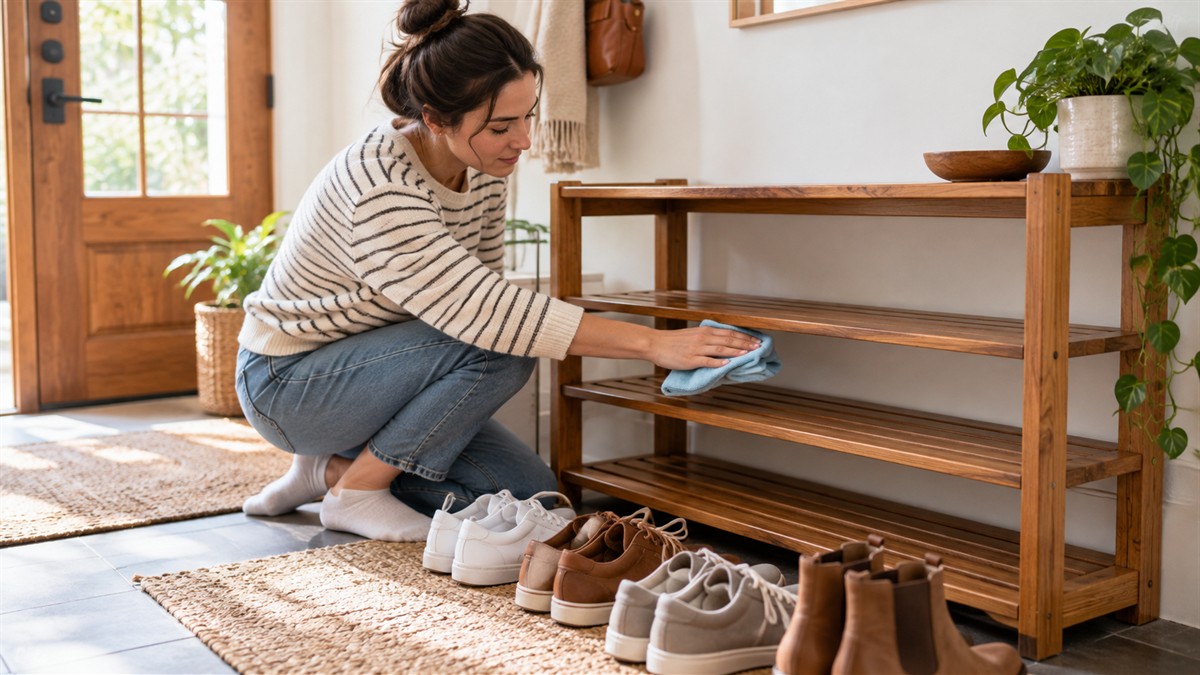
How to clean a shoe rack depends on what the rack is made of, and the pages we opened agree on the order of work more than on the cleaner. Empty it, dust it dry, wipe it with a damp cloth and mild soap, dry it right away, and keep wet shoes off it. IKEA, a laminate maker, a melamine maker, the EPA and three university extension publications each cover part of the job. This guide puts their steps in order, shows where they disagree, and adds a plan for what to do if you find mildew.
Quick answer
- Dust first. IKEA says most wooden furniture can be cleaned with a dry cloth or duster, and a melamine care manual starts with dusting.
- Then wipe by material. Wood, laminate and melamine take a damp cloth with mild soap or detergent. Metal and plastic take a mild soapy solution, and strong cleaners or abrasives can damage them.
- Dry it completely. The EPA says the key to mold control is moisture control, and IKEA says to dry oak and beech immediately after a damp cloth.
- Keep shoes dry and clean before they go on the rack, as a University of Florida extension sheet advises for mildew control.
Step 1: Empty the rack and sort the shoes
Take every pair off the rack before you clean. A Mississippi State University Extension publication on clutter says that after decluttering you should “clean and wipe down the newly exposed area,” because dust has been hiding behind and underneath the stored items. The same publication lists the supplies to have ready: garbage bags, bins, markers and labels, multipurpose cleaners, towels and a vacuum.
Sorting matters for the rack as well as the shoes. The University of Florida extension sheet on controlling mildew says to keep shoes dry and clean. Wipe or brush off mud and let wet pairs dry before they go back, and the rack stays cleaner for longer. The sheet is written for Florida homes, and it does not name shoe racks, so read it as a general rule for damp closets.
Step 2: Dry-clean the rack
Remove loose dust and grit before any water touches the rack. IKEA’s guide to natural wood furniture says most pieces need only a dry cloth or duster, advises cleaning off the dust every day if you can and at least once a week, and says to clean in the direction of the grain with a soft cloth. A care manual for melamine-faced board lists dusting as the first operation and says to “Work from clean to dirty, and from top to bottom.”
A wire rack collects dust in the grid. A Hunker article on cleaning plastic-coated closet wire shelving recommends brushing the shelving with the hose attachment of a vacuum cleaner before using any cleaner. Hunker is a consumer site, not a shelf maker, so treat the article as a household tip and not as an instruction for a particular rack.
Step 3: Wash by material
The table sets out what each source says for each common rack material. The sources are written for furniture, laminate sheets and boards, not specifically for shoe racks, so they describe the material and not the rack.
| Rack material | What to use | What to avoid | Source |
|---|---|---|---|
| Natural pine | A dry cloth, because “any moisture may mark or damage the wood” | Moisture on untreated wood; ammonia | IKEA wood guide |
| Natural oak or beech | “use a damp cloth and dry immediately with a dry cloth” | Ammonia, which damages the wood and removes its shine | IKEA wood guide |
| Bamboo | A damp cloth with hot water and very little bleach, or a lemon juice and water spray, then dry well | Leaving areas damp | IKEA wood guide |
| Finished wood (older circular) | A soft cloth wrung dry from warm, mild soap suds, rubbed with the grain, then dried | Washing shellac or cheap varnish finishes; slow work that raises the grain | Oregon State extension circular |
| Laminate | A damp cloth or sponge with mild soap or detergent; a soft brush for stains | Prolonged bleach exposure; baking soda scrubbed hard on a gloss finish | Wilsonart care sheet |
| Melamine-faced board | Detergent applied to a soft damp cloth, then a rinse | Abrasive products, bleach, highly chlorinated products, acids | Cleaf and Polyrey sheets |
| Painted steel or plastic | A mild soapy solution | Strong cleaners and abrasive materials | IKEA outdoor furniture sheet |
| Plastic-coated wire | Vacuum first, then rubbing alcohol mixed one part to two parts water, with a few drops of dish soap | Not stated | Hunker (consumer article) |
The IKEA outdoor furniture sheet covers a specific outdoor product, so it is the closest maker statement we found for plastic and metal and not a shoe rack instruction. It says to wipe clean with a mild soapy solution and adds that it is “not recommended to clean plastic or metal furniture with a strong cleaner” because the surface may discolor or be damaged. It also notes that the steel on that product is protected from rust by a powder coating, and that rust may occur if the coating comes off. If your metal rack is chipped, wipe it clean and dry it fully.
The wood rows come from different eras. The Oregon State circular is an older extension publication, and the scan date stamp is only partly legible. It tells readers to wash wood furniture with a soft cloth wrung dry from warm, mild soap suds, and to work rapidly to prevent moisture from raising the grain or softening the glue. IKEA’s current guide treats pine more cautiously and prefers a dry cloth. If you do not know the finish, start dry and move to a barely damp cloth only if dust will not come off.
Step 4: Dry it and rinse off residue
Drying is the step the sources repeat most. IKEA says to dry oak and beech immediately with a dry cloth. The Oregon State circular says to dry wood with a clean soft cloth. The Wilsonart sheet says to rinse a stubborn-stain spot thoroughly with warm water and wipe it dry. The EPA’s mold tips say to dry all items completely. Cleaf says to apply detergent to the cloth and not spray it on the surface, because spraying may leave stains and marks.
A rack that is damp when shoes go back on is the case the sources warn about. The EPA states that if wet or damp areas are dried within 24 to 48 hours after a leak or spill, mold will not grow in most cases. That statement is about leaks and spills, and the EPA page does not mention shoes, so treat it as a guide to how fast to dry a soaked rack and not a promise.
Step 5: If you see mildew or mold
The University of Florida sheet describes mildew as having a musty odor and black fuzzy discoloration, sometimes brownish or reddish. Its tips include opening closet doors so air can circulate. If a rack in a closet shows spots like that, the EPA’s cleanup page gives the method for hard surfaces: “Scrub mold off hard surfaces with detergent and water, and dry completely.” It adds that you can handle most jobs yourself when the moldy area is under about 10 square feet, roughly a 3-foot by 3-foot patch.
To judge the scale, compute the shelf area. The formula is width times depth, divided by 144 to convert square inches to square feet. The widths in the table are our own examples, and the 12-inch depth is the shelf depth in a North Carolina extension leaflet on closets.
| Shelf width (in.) | Shelf depth (in.) | Area per shelf (sq ft) | Shelves to reach 10 sq ft |
|---|---|---|---|
| 24 | 12 | 24 × 12 ÷ 144 = 2.0 | 10 ÷ 2.0 = 5.0 |
| 30 | 12 | 30 × 12 ÷ 144 = 2.5 | 10 ÷ 2.5 = 4.0 |
| 36 | 12 | 36 × 12 ÷ 144 = 3.0 | 10 ÷ 3.0 = 3.3 |
A 4-tier rack of 30-inch shelves has 10 square feet of top surface. That compares the rack to the EPA’s 10-square-foot guide, but the guide measures the moldy area, not the whole rack. The EPA also lists protective gear for mold cleanup: gloves, goggles and an N-95 respirator, with ordinary household rubber gloves acceptable when working with water and a mild detergent.
Fix the cause or the mold will return. The EPA says the key to mold control is moisture control, and it says that when mold is a problem you should clean up the mold promptly and fix the water problem. It advises keeping indoor humidity below 60 percent, ideally between 30 and 50 percent. The EPA also says porous materials such as ceiling tiles and carpet may have to be thrown away if they become moldy. The page does not name shoe racks, so for a rack that is stained all the way through, a replacement may be the practical choice. The EPA says that for items you are unsure how to clean, or that are valuable, you may wish to consult a specialist.
Bleach: where the sources disagree
Bleach shows up in several pages, and the pages do not agree. IKEA’s bamboo tip uses a very small amount in hot water, three or four drops. The Wilsonart sheet allows undiluted household bleach for stubborn stains on laminate, for no longer than two minutes, then a thorough rinse. It also warns that prolonged exposure of the laminate surface to bleach will cause discoloration. Cleaf says to avoid bleach and highly chlorinated products on melamine.
The EPA adds two cautions. A biocide such as chlorine bleach “is not recommended as a routine practice during mold cleanup”, and you should never mix chlorine bleach solution with other cleaning solutions or detergents that contain ammonia, because toxic fumes could be produced. Because the maker pages split on bleach and the EPA advises against routine use, detergent and water is the safer starting point. It is the method the EPA gives for hard surfaces, and the laminate, melamine, metal and plastic pages all allow mild soap or detergent.
Step 6: Keep the rack clean
A schedule keeps the work small. The first row follows IKEA’s own wording. The other rows are our suggestions, built from the pages’ moisture rules, and they are not figures from a source.
| Task | How often | Basis |
|---|---|---|
| Dust with a dry cloth, duster or vacuum | Daily if you can, at least weekly | IKEA wood guide |
| Dry or brush off wet or muddy shoes before they go on | Every time | University of Florida extension sheet |
| Wipe the shelves with a damp cloth and mild soap, then dry | When dirt shows, or about once a season (our suggestion) | Material table above |
| Check for musty smell, dark spots or a damp feel | Each time you wipe (our suggestion) | University of Florida sheet |
| Check closet humidity if you own a meter | Keep below 60 percent, ideally 30 to 50 percent | EPA brief guide |
IKEA also says to avoid exposing wooden furniture to direct sunlight if you do not want it to lose its color or shine. A rack beside a sunny door may fade even when it is clean. For rack options that suit damp entryways, see our guides to two-tier wooden shoe racks and narrow shoe racks for small spaces, and for other uses of a rack once it is clean, see other ways to use a shoe rack.
How we chose
This guide is a method and not a product list. We read the pages on 2026-10-21 and kept only steps that a page states in plain words. We favored the EPA, university extension publications and the makers of the materials. The Hunker article is a consumer source, and we label it as one. Where a page was written for a different product, such as an outdoor furniture sheet or a laminate sheet, the draft says so.
We dropped pages that returned an access error, including the Sauder and MRP Home care pages we had hoped to read. The table shows each source’s own words or a close paraphrase, and the area table shows its arithmetic. The cleaning schedule marks which rows are ours.
Mistakes to avoid
- Soaking untreated wood. IKEA says any moisture may mark or damage untreated pine.
- Using ammonia on wood. IKEA says it damages the wood and removes its shine.
- Scrubbing laminate or melamine with abrasives. Cleaf and Wilsonart both warn against abrasive products and excessive force.
- Mixing bleach with ammonia cleaners. The EPA says toxic fumes could be produced.
- Painting over mold. The EPA says paint applied over moldy surfaces is likely to peel, so clean and dry first.
What we could not verify
The pages we opened do not give a cleaning method written for shoe racks. They cover wood furniture, laminate, melamine, outdoor plastic and steel furniture, and wire shelving, and we apply them to racks by material. None of them says how often a shoe rack should be washed, which cleaner removes shoe polish or road salt, or how to clean a fabric or cork rack.
The Oregon State circular is old, the University of Florida mildew sheet is from 2002 and revised in 2005, and the Hunker article is a consumer piece from 2018. The IKEA outdoor sheet is for another product. The EPA page does not mention shoe racks. The area table assumes example shelf widths, and the EPA’s 10-square-foot figure measures a moldy patch and not a rack.
Frequently asked questions
What is the easiest way to clean a wooden shoe rack?
Start with a dry cloth or duster, which IKEA says is enough for most wooden furniture. For oak or beech, IKEA says to use a damp cloth and dry immediately. Do not use ammonia, and clean in the direction of the grain.
Can I use soap and water on a shoe rack?
On laminate, melamine, painted steel and plastic, yes, in small amounts. Wilsonart and Cleaf both describe a damp cloth with mild soap or detergent, and IKEA describes a mild soapy solution for metal and plastic. For untreated wood, IKEA recommends a dry cloth and warns that moisture may mark it.
How do I clean a metal or wire shoe rack?
Vacuum the dust off first, as Hunker suggests for wire shelving, then wipe with a mild soapy solution and dry it. IKEA warns that strong cleaners and abrasives can discolor or damage plastic and metal furniture.
How do I get mildew off a shoe rack?
For hard surfaces the EPA says to scrub the mold off with detergent and water and dry completely. Wear gloves and goggles, and fix the moisture source, because the EPA says the key to mold control is moisture control.
Should I use bleach on a shoe rack?
The pages split on it. Wilsonart permits brief use on laminate stains, Cleaf says to avoid it on melamine, and the EPA says a biocide such as bleach is not recommended as a routine practice during mold cleanup. Never mix bleach with ammonia cleaners.
Bottom line
Empty the rack, dust it dry, wipe it by material with mild soap, and dry it completely before the shoes go back.
Sources
- https://www.ikea.com/es/en/ideas/how-to-clean-wood-furniture-properly-pub4b2186b0/ (opened 2026-10-21)
- https://www.ikea.com/pdoc/00019_2118864_5_2.pdf (opened 2026-10-21)
- https://ir.library.oregonstate.edu/downloads/mg74qm295 (opened 2026-10-21)
- https://pdf.lowes.com/useandcareguides/688598215633_use.pdf (opened 2026-10-21)
- https://cleaf.it/docs/299/6896/Cleaf-ENG—Melamine-cleaning-instructions.pdf (opened 2026-10-21)
- https://es.polyrey.com/sites/polyrey/files/docs/resources/CARE%20MANUAL%20%E2%80%93%20Melamine%20Faced%20Board.pdf (opened 2026-10-21)
- https://www.epa.gov/mold/mold-cleanup-your-home (opened 2026-10-21)
- https://www.epa.gov/mold/brief-guide-mold-moisture-and-your-home (opened 2026-10-21)
- https://journals.flvc.org/edis/article/download/115375/113667/164270 (opened 2026-10-21)
- https://extension.msstate.edu/publications/ways-conquer-household-clutter (opened 2026-10-21)
- https://www.hunker.com/13420550/how-to-clean-sticky-closetmaid-wire-shelving/ (opened 2026-10-21)
- https://ocr.lib.ncsu.edu/ocr/ua/ua102_200-001-bx0004-004-005/ua102_200-001-bx0004-004-005.pdf (opened 2026-10-21)
As an Amazon Associate we earn from qualifying purchases.